Categories
Uncategorized

International Handbook of Sensory Criminology Series: 2

Introducing… Sensory Politics of Violence

This post marks the second in a series dedicated to discussing each of the organising themes of the Routledge International Handbook of Sensory Criminology, in preparation for its launch. Each piece will leave comments open as an experiment in discussion. Please feel free to leave talking points or ask questions – we particularly welcome questions from students.

Each section of the book opens with a similar discussion to which each of the contributing authors for that segment were invited. Some joined in real time, others submitted written – or even recorded – contributions and others declined.This first section opens with a conversational piece from Liam Gillespie, Kanupriya Sharma and Hannah Wilkinson: Sensory violence: traces, echoes, afterlives. They observe that “across these chapters, the authors take up a shared commitment: to track violence not only in what is said, but in what is heard. Not only in what is seen, but in what is sensed, remembered, absorbed, and carried. Their work attunes us to forms of harm that exceed language, that are inscribed in the body, ambient in the atmosphere, or embedded in institutional practices. Together, they “challenge the abstraction and sanitisation that often defines academic knowledge, insisting instead on research that is sensorially attuned, ethically grounded, and politically alive”.

These works disrupt conventional treatments of violence, reflecting approaches which recognise both its material and symbolic aspects as well as those of its effects. Violence, here, can be thought of as something that lingers, is carried in sensorial experience, relived and revisited through sensory reminiscences that inflict additional harms. The sensory is fashioned here as a provocation to rethink our understanding of what constitutes violence in substance and meaning. I briefly introduce each of the chapters before commenting on how they might collectively inform future approaches to theory and practice, finishing with a few questions that might stimulate discussion.

The first piece is from Liam Gillespie who demonstrates that “sound is not just a medium of communication but a weapon of mobilisation in “Listening to Donald Trump’s Voice: ‘Fight like Hell!’, the Capitol Hill Riots and the Spectre of Teleprompter Trump. Chapter two, by Amanda Holt and Sian Lewis “explores the role of sound and silence in the perpetration, experience and articulation of gender-based violence”. Colm Walsh follows “foregrounding the auditory architecture of conflict” in chapter three “The sound of Violence: Paramilitary experience in Ireland”. Colm focuses on communities affected by the Northern Irish conflict, exploring how sonic cues such as gunshots, sirens and silences are woven into tapestries of everyday memory and collective identity. He explores how these experiences became central to how these communities sensed, interpreted and navigated violence. Hannah Wilkinson closes this section with chapter four: “War, Colonialism and the Senses: “You can’t unsee or unhear that shit”. Through Hannah’s interviews and use of object and photo elicitation with British veterans of the War on Terror, she explores how violence becomes internalised through the rituals of the military body, leaving embodied stains that resist attempts to erase them.

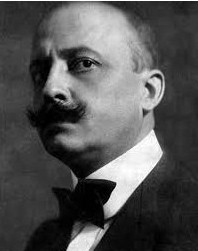
Sound has a long and dark history in the theatre of war and the production of what Goodman terms an “ecology of fear” (2012). Sound has long been interwoven with activities of hostility and bloodshed. When Marinetti sought to capture his experience of the siege of Adrianopoli of 1914, in his sound poem “Zang Tumb Tumb”, it was the auditory imagination he attempted to evoke. The “belliphonic” – Martin Daughtry’s term for the cacophony of armed combat and the wounding practice it represents – provides an instructive and compelling lens through which to understand trauma and survival in this context (Martin Daughtry 2017). This takes numerous forms; drums, sonic and ultrasonic weapons such as long-range acoustic devices LRADs, the increasing, deployment of drones emitting the sound of children crying to lure targets from cover, the “dead air” that hangs heavy in creative recreations of the Great War soundscape (Gough and Davies 2017). “Moaning Minnie and the Doodlebugs” dominate collective imaginings of the second world war (Moshenka 2017), rather than the colour of mustard gas. While there are numerous works considering the wider sensescape of warfare and transition (e.g. Neidhart 2002, Birdsall 2012, Saunders and Cornish 2017, Mrozek 2024) it is perhaps no coincidence that sound dominates considerations of violence and its sensory politics in much of this section.

Filipo Tommaso Marinetti 1876 – 1944. Unfortunate politics and inspiration behind the “ZTT” record label.

Liam disrupts assumptions of the passivity of listening, implicit in sonic treatments of violence, when he evokes Jacques Lacan informing his students that the “ears have no lids” (I had always thought it was Carpenter and McLuhan). His analysis of Trump’s mobilisation of support implicates the listener-as-actor, their participation every bit as central to decoding Trump’s subverbal inarticulacy in the creation of what Hegarty terms a “spectacle of listening” (2021). Given the current state of world politics and the rise of the right, it has rarely been more important to attempt to account for the popularity of leaders like Trump and the violence they espouse. Gillespie’s work invites us to forensically dissect Trumps seeming inarticulacy and the rousing appeal that lies beyond, and beneath, mere words, to account for how sound works to mobilise the power of the collective. Amanda and Sian underscore the potency of silence as a tool for victimisation in their account of the role of silencing in gender-based violence. Here, power is mediated through the repression of voice, rather than being mobilised in resistance to it. Amanda and Sian demonstrate how sound is both a site of, and tool for, gender-based violence while sometimes providing the keenest indication of its existence, despite often being overlooked. Not only does verbal aggression often provide an indication of the existence of other types of abuse, but “the voice itself is a tool of violence, causing immediate and long-term harm”. Together these contributions enhance our understanding of the flows of power, and how voice can be harnessed as a tool for violence.

Colm powerfully argues that sound is a crucial element of the experience of violence in conflict-affected areas of Ireland. Like Amanda and Sian, he maintains the need for an increased auditory focus as a means of better understanding the impact of violence. While Colm’s account of paramilitary experience in Ireland makes various references to inter-personal exchanges, his focus more broadly is on the multiplicity of ways in which violence and its sensescape was interwoven into the fabric of everyday life – particularly in 80’s Belfast, a fraught time in which sectarian violence featured heavily. He speaks evocatively of the soundscapes of the time; car sirens, crackling fire, gunshot, but also of the eerie silence that followed. For Colm, the sensory imposition of paramilitary activity informed his sense of West Belfast as a place, the effects and affects of violence reverberating long after the ceasefire, informing his sense of space, place and identity. His work emphasises the instructive potential of sound as a means of understanding how power operates, but also how sound is implicated in various strategies to provoke, disempower, repel and entice those subject to violence.

Sound, and the sensory more broadly, attune us to the lasting impacts of violence. Colm’s analysis of interview data demonstrates how sound “catalyses memory and can create the conditions for trauma” reminding us too, that trauma has sensory components. Hannah’s work most specifically and extensively deals with this aspect of violence. Her focus on the experience of soldiering in Afghanistan and Iraq considers how photo and object elicitation facilitated the transition from speaking about familiar things to their “visceral recollections of seeing, hearing, smelling, tasting and touching death in war”. She argues better accounting for the sensory deepens our understanding of the enduring effects of colonial state violence but also offers the capacity for repair and resistance. Hannah draws on Hockey’s (2020) work to argue that smell is a “core site of survival and suffering”. These assessments echo the testimony and vivid recollections of those she interviewed, who recalled the sensory afterlives of their memories of war and loss with a potency reflecting their endurance. As Liam, Hannah and Kanupriya reflect “the violence they perpetrated and witnessed was not abstract. It lived in their muscles, their hunger, their sleep and their everyday living.

Together, these pieces demonstrate the importance of more closely attending to the sensory politics of violence whether inter-personally, nationally or internationally – specifically with reference to colonial legacies of violence and trauma. In “Listening to war” Martin Daughtry (2017) speaks of the importance of developing a phenomenology of violence. These contributions demonstrate the necessity of not only deepening our understanding of subjective experience but also of extending this to account for intersections between subjective experience, mediations of power and its cultural significations and the sensory afterlives of violence. Whether it is the physical qualities of sound, its inescapability when under siege or its pre-eminence – relative to other senses, excluding sight – in the Western aesthetic that account for its dominance in much of this section, each demonstrate the centrality of the sensory to experiences of violence. From the suffocation of gender-based violence to considerations of the sense-legacies of colonialism, each chapter hums with the vivid, theoretical potentials of incorporating a sensory approach. One that is resolutely multidisciplinary, creative, culturally attuned and intrinsically human.

Some questions:

Is there something about the sensory that encourages a corresponding concern with ethics?

If so how, and what might the implications of this be?

How does the sensory lend itself to innovative methods?

What are the limitations of this?

Why does sound lend itself particularly well to discussions of violence?

What are the creative possibilities of foregrounding the sensory in research on violence?

What solutions might be offered for undergraduates looking to adopt sensory approaches, but struggling to think of ways to navigate increasingly restrictive ethics policies?

What might Alison Young have meant by her call to “listening criminologically” (2023)

References

To cite this blog: Herrity, K. (2025) December 1st, 2025 “Introducing… Sensory Politics of Violence” www.sensorycriminology.com

To cite the book: Herrity, K., Sharma, K., Umamaheswar, J., Warr, J. (2026) The Routledge International Handbook of Sensory Criminology. London: Routledge

Birdsall, C. (2012) Nazi Soundscapes: Sound, technology and urban space in Germany, 1933 – 1945. Amsterdam University Press – published through OPEN ACCESS PUBLISHING IN EUROPEAN NETWORKS: https://library.oapen.org/handle/20.500.12657/34484

Goodman, S. (2012) Sonic warfare: Sound, affect and the ecology of fear. MIT Press

Gough, P., Davies, K. (2017) ‘Dead Air’: the acoustic of war and peace – creative interpretations of the sounds of conflict and remembrance in Saunders, N., Cornish, P. (2017) (eds) Modern Conflict and the senses. London: Routledge

Hegarty, P. (2021). Annihilating Noise. Bloomsbury Academic Press, New York, NY.

Hockey, J. (2020) ‘Sensing regimes of war: Smell, tracing and violence’, Security Dialogue, 51 (2–3): 155–173.

Martin Daughtry, J. (2017) Listening to war: sound, music, trauma and survival in wartime Iraq. OUP USA

Moshenka, G. (2017) Moaning Minnie and the Doodlebugs: Soundscapes of air warfare in Second World War Britain in Saunders, N., Cornish, P. (2017) (eds) Modern Conflict and the senses. London: Routledge

Mrozek, B. (2024) (ed) Sensory Warfare in the Global Cold War: partition, propaganda, covert operations. Pennsylvania: Penn State University Press.

Neidhart, C. (2002) Russia’s Carnival: the smells, sights and sounds of transition. London: Bloomsbury

Saunders, N., Cornish, P. (2017) (eds) Modern Conflict and the senses. London: Routledge

Categories
Environment police power prison probation research Research methods sensory Uncategorized

International Handbook of Sensory Criminology Series: 1

Introducing… Sensory Criminology: Expanding the Criminological Imagination

This short post marks the opening of a series dedicated to discussing each of the organising themes of the Routledge International Handbook of Sensory Criminology, in preparation for its launch. Each piece will leave comments open as an experiment in discussion. Please feel free to leave talking points or ask questions – we particularly welcome questions from students.

The book asks what the sensory can contribute to our understanding and pursuit of criminological inquiry? What might the value be, of attending to the sensory in social scientific and criminological investigation? What do we even mean by “the senses”? Conventionally thought of as being restricted to sight, sound, smell, touch, taste – and often laid out in that hierarchy – what happens if this is extended to include a broader range of perceptual stimuli? What happens to how we can utilise a sensory approach to criminology if we add clarity, distinguishing it from adjacent, but distinct, theoretical frameworks adopted by phenomenological and affective perspectives? How can we think about violence and its politics, how coloniality and imperialism frame our understandings of justice and punishment, narrative and the arts in the context of criminal justice – and its absence, Environmental harm and how criminal justice practices impose particular understandings of place, space, time and justice, and how the sensory can inform methodological approaches to the rapidly changing contours of criminology and society.

The handbook is dedicated to expanding these ideas and considering how developing a set of principles to guide our approach to sensory criminology works to allow for a deeper consideration of implications for decolonial thinking. This enhances capacity, we argue, for disrupting western empirical hierarchies and the social systems they both shore up and are reinforced by. The book aims to amplify voices and experiences from beyond the Global North and to expand the possibilities of our criminological imagination.

CONTENTS

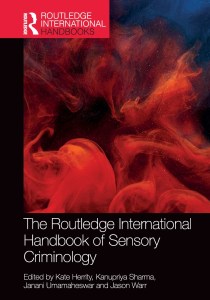
Sensory Criminology: Expanding our Imagination   Kate Herrity, Kanupriya Sharma, Janani Umamaheswar, Jason Warr

Section 1: Sensory Politics of Violence

Sensing Violence: Traces, Echoes, and Afterlives Liam Gillespie, Kanupriya Sharma and Hannah Wilkinson

  1. Listening to Donald Trump’s Voice: ‘Fight like hell!’, the Capitol Hill Riots, and the Spectre of Teleprompter Trump Liam Gillespie             
  2. ‘SHUT YOUR FUCKING MOUTH’: Sound, Silence and Gender-Based Violence Amanda Holt and Sian Lewis
  3. The Sound of Violence: Paramilitary experience in Ireland Colm Walsh
  4. War, Colonialism and the Senses: “You can’t unsee or unhear that shit” Hannah Wilkinson

Section 2: Coloniality, Imperialism, and the Senses    
Recognising Abhorrent Legacies: Lessons for Sensory Criminology Onwubiko Agozino, Rose Boswell, Nontyatyambo Pearl Dastile, Sharon Gabie, Andrew Kettler, Macpherson Uchenna Nnam, Jessica Leigh Thornton, and Jason Warr

  1. Doing Justice Differently: A Pan-Africanist Perspective Nontyatyambo Pearl Dastile, Abiodun Omotayo Oladejo, and Macpherson Uchenna Nnam                 
  2. “I’ll Make You Shit!”: Olfactory Othering and the Necropolitics of Colonial Prisons Andrew Kettler 
  3. The Sensory Aspects of Abhorrent Heritage in South Africa Rosabelle Boswell, Jessica Leigh Thornton,  Sharon Gabie , Zanele Hartmann,  and Ismail Lagardien
  4. Decolonizing Sensory Rhetorics and Activism in Africana Prison Memoirs Onwubiko Agozino

Section 3: Sensory, Narrative, and the Arts         

Reimagining Justice through Creative Encounters and Sensory Knowing Glenda Acito, Lucy Cathcart Frödén, Fangyi Li, Lorenzo Natali, Nabil Ouassini, Kanupriya Sharma, Ozlem Turhal, and Raghavi Viswanath   

  1. Black light. Drawing, Music and Theatre as Sensory Practices in the Encounter Between Inmates and University Students Lorenzo Natali , Glenda Acito, and Ozlem Turhal 
  2. Crackle and Flicker: Music and Multisensory Experiences in Prison Lucy Cathcart Frödén and Áine Mangaoang       
  3. Seeing Museums as Criminological Spaces: An Affective Tale of Two Museum Visits Raghavi Viswanath and Fangyi Li
  4. ‘Sensory Criminology, Islamic Auditory Traditions, and Rehabilitation Nabil Ouassini and Anwar Ouassini                          

Section 4: Sensing (In)Justice        

From the Courtroom to the Street: The Sensory Dimensions of Racialised (In)justice Barbara Becnel, Dale Spencer, and Jason Warr

  1. Conflicting Senses, Victims, and the Courtroom: the case of Cindy Gladue Marcus Sibley and Dale Spencer    
  2. The Sensory Effects of Racial Profiling in Berlin’s KBO’s.  Melody Howse                          
  3. Racialized Punishment and the Sensorial Symbolism of Death Row for America’s Black Gangster Class Barbara Becnel             

Section 5: Environmental Harm and the Senses            

“The Way the Soil Crumbled in Their Hands”: Sensing Environmental Harms Amy Gibbons, Ascensión García Ruiz, Janani Umamaheswar, and Aysegul Yildirim

  1. Seeing and Sensing Environmental Harm: The Death of the British Countryside Amy Gibbons                 
  2. The Sensory Ocean: Exploring Noise and Light Pollution as Blue Crime Ascension Garcia-Ruiz
  3. Sensitising Criminology to Experiences of Environmental Noise Aysegul Yildirim

Section 6: Space, Place, and the Sensory           

Vivid and Vibrant Criminological Landscapes: Sense and Space Kevin Barnes-Ceeney, Priti Mohandas, and Janani Umamaheswar

  1. Dispossessed Realities: Houselessness, and Spatial Violence Luisa T. Schneider
  2. Release from Prison Day Kevin Barnes-Ceeney and Victoria Espinoza                        
  3. “I can’t breathe” Housing, Masculinities and Violence in Cape Town, South Africa Priti Mohandas
  4. Scrutinising Social Control in the City through the Senses Anna Di Ronco and Nina Peršak      

Section 7: Time, Justice, and the Sensory

Beholding Justice and Punishment Sneha Bhambri, Eamonn Carrabine, Kate Herrity, Arta Jalili-Idrissi and Jason Warr

  1. Sitting, Seeing and Getting Lost: The Sensory Aesthetics of Latvia’s Women’s Prison Arta Jalili-Idris
  2. Time, Temporality, and Chronoception Jason Warr
  3. It’s a Circus: The Production of Domestic Violence Proceedings in Lower Courts of Mumbai, India Sneha Bhambri
  4. Beholding Justice: Images of Punishment in Medieval and Early Modern Europe Eamonn Carrabine

Section 8: Sensory Methods

“They Are Not Like You and I”: Sensory Methods  Briony Anderson, Kate Herrity, Sarah Kingston and Mark Wood

  1. Sense and Insensibility: How Technologies Invite and Invisibilise Harm Briony Anderson, Mark A Wood, Jackson Wood, Will Arpke-Wales, and Flynn Pervan             
  2. Audio Criminology: Broadening the Criminological Imagination Through the Use of Audio Methods Sarah Kingston
  3. ‘Still feels like jail’: Sensing Danger, Bleakness and Friendship in a State-Run Home For Boys Mahuya Bandyopadhyay, Aishwarya Chandran and Sanjukta Manna

This project began life as a conversation between Tom Sutton and I (Kate Herrity) at the 2022 BSC conference. Shortly after, Kanupriya Sharma, Janani Umamaheswar and Jason Warr joined. The four of us divided up the eight sections which organise the book. Each of the authors of the three or four chapters within them were invited to take part in a discussion with one another about their work. These discussions formed the basis for each introduction section of the book. Since these sections are an accessible way of introducing the contents of the book in a way which lends a substantial project a coherent narrative, they seem like a sensible focus for discussion.

As with all projects, people decline and others drop out, representation is partial, interests and approaches of the editors are reflected in those invited to participate… We discuss all this at greater length and depth in the introduction, along with our hopes for the future and the guiding ethos of the book. We hope to invite more people to the table and enrich a conversation we do not aim to be the last word in.

Categories
Drug Use Music sensory Uncategorized

Getting into the purple drank: An aesthetic and sensory perspective on lean culture

Cosimo Sidoti

Music and psychoactive substances have always gone hand in hand. Their relationship has been embedded in cultural practices since the earliest expressions of human creativity. This music and drug nexus extends beyond the representational domain where drug references appear explicitly in lyrics or visual portrayals. More critically, it operates within a non-representational register, wherein the sonic, visual, and lyrical dimensions of music converge to evoke a multisensorial experience that approximates, simulates, or enhances the embodied sensation of drug consumption and intoxication. It is this immersive capacity to affectively and sensorially reproduce drug experiences that underpins the deeply symbiotic relationship between music and drug cultures. Reggae and cannabis, psychedelic rock and LSD, acid house and ecstasy are some of the most well-known cultural entanglements – both within and beyond academia. Yet, one of the most enduring and tightly interwoven nexuses, though rarely foregrounded in scholarly literature, is the relationship between hip-hop music and lean.

Lean, also known as purple drank, sizzurp, mud, dirty sprite, or even liquid heroin, as commonly referred to in many songs, is a mixture of codeine-based cough syrups and fizzy soft drinks. It resembles the visual appearance of a cocktail where the active ingredient is codeine, a weak opioid that, when used non-medically or recreationally, falls under the broader category of ‘downers’ – psychoactive substances known for their sedative effects. It typically induces a sense of euphoria and inner warmth, making users feel relaxed, chilled, and sleepy. Its spectacularisation through hip-hop music has contributed to the development of lean culture that sinks its roots among African American communities in the Southern United States in the early 1990s. This culture has since been transmitted, imitated, and adapted globally, transcending its meaningful socio-economic and political context of structural inequalities, and illustrating its global allure and affective resonance far beyond its origins.

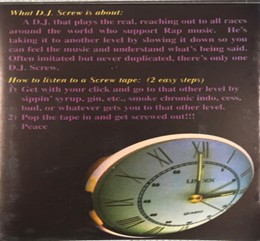
The birthplace of lean can be traced back to Houston, Texas, where it became closely associated with the local hip-hop scene in the 1990s. At the heart of this cultural emergence was the iconic Houston-based hip-hop artist DJ Screw who pioneered a specific hip-hop music genre known as Chopped and Screwed (or Screwed and Chopped) that consisted of remixing hip-hop records by slowing down their tempo (Walker, 2022). Although DJ Screw’s legacy expands far beyond lean as he revolutionised the future of hip-hop music as we know it today, his unique music has often been described as sounding tailor-made for the experience of being high on lean as suggested by DJ Screw himself in one of his tape albums released in 1995 (see Image 1). Just as the music seems designed to be experienced while high on lean, the drug itself feels as though it was made to inspire and create this sound.

The defining characteristic of the Chopped and Screwed sonic aesthetic – blending with the experience of lean – lies in its ability to distort the listener’s perception of time. This temporal disorientation is evoked through slowed-down tempos, stretched-out vocals, and repetitive looping, all of which encapsulate the dissociative, slowed-down, and relaxing sensations associated with being high on lean. Over time, this distinctive sound alongside the use of lean and its (more-than) representations was taken up, reworked, and evolved by a range of music artists into other hip-hop music genres such as trap, drill, and SoundCloud rap (as well as some of their subgenres, such as Rage, Plugg, and so on). This also extended into entirely new music genres beyond hip-hop music such as Vaporwave, emerging in the early 2010s. These sonic elements were further transformed through digital reproduction, incorporating lo-fi techniques, synthesisers, and autotuned vocals that made an even more distorted and imperfect sound. Moreover, as the time of DJ Screw’s cassettes soon passed, these sonic elements were fused with visual aesthetics through music videos consisting of wavy, slow-moving effects and purple[1] hues that not only enhanced this temporal disassociation but also introduced an ambiguous spatiality, inducing a dream-like feeling and atmosphere in which everything seems to float – detached from any concrete sense of place associated with lean.

The symbolic markers of lean as represented in many music videos – including both its main ingredients as the cough syrups and soda bottles, and its paraphernalia as double stacked cups[2] and baby bottles[3] – are often more than represented through these visual effects that appear as surreal and hallucinatory. Therefore, the auratic properties of lean as evoked by the audiovision of such types of music draw viewers into immersive and sensory atmospheres. Many of my interviewees within lean culture recalled their first social encounters with lean through hip-hop music videos not merely as moments of recognition but as affectively charged experiences where the “coolness” attributed to lean exceeds its material properties and resides in its capacity to be represented and more-than represented in multiple aesthetics and meanings that makes it feel endlessly adaptable and culturally resonant. Their initial reaction was often one of surprise and curiosity – “What the fuck is this?” – followed by a sense of encountering something distinctive and unique. They described lean as “a thing no one had ever seen before” and “exclusive, like it was rare”. Here, viewers record of their first attraction to the aesthetic of lean resonate with each other: “wow that looks cool” or “I just thought it looked cool”. These resonances fold back into beliefs and desires to be cool themselves: “when I was little, I thought it was cool to sip lean, it makes you the cool guy”.

The aesthetic of preparing and consuming lean is conveyed through music via sounds, visuals, and lyrics, where the tastes, smells, textures, and colours of lean function as affective channels of transmission. Auditory cues – such as the clinking of ice cubes, the pouring of syrup into a cup, the snap of a soda can opening, or the hiss of escaping gas from a soda bottle – are frequently included within the sonic production and representation of sensory signatures that evoke the ritual of preparing lean. Visually, the brightly coloured mixture of cough syrup and soda creates vivid displays of purples and pinks, used in music videos that draw on the drink’s aesthetic visual appeal. Lyrically, artists explicitly describe lean in terms of excessive sweetness by portraying it as intensely sugary, flavourful, and candy-like in its tasting appeal, while also emphasising the syrup’s thick, viscous, mud-like consistency.

From spectators to spect-actors, listeners and viewers are far from passive consumers; instead, they actively and creatively imitate and readapt artistic performances in which the act of viewing itself is one of action and embodiment (Rancière, 2009). Across all my interviews, the aesthetic of lean was a prominent draw for those belonging to this culture. Respondents reflected on an experience which fully engaged their senses and made the use of lean a multisensorial experience. Among the most prominent sensory features is its intense sweetness, often compared to the taste of candy. While the exact flavour can vary depending on the brand and type of cough syrup – ranging from cherry and strawberry to mint, blackcurrant, or apple – as well as the choice of soda used as a mixer (commonly referred to as “cut”), the overpowering sweet and sugary taste remains a constant. This sweetness is so pronounced that lean is sipped rather than gulped, that is why members of this culture are indeed called sippers. Closely tied to taste is the distinctive smell of lean, which emerges from its sweetness and is highly appreciated by users. Many sippers like the sweet and sugary taste of lean and its smell:

I don’t drink alcohol, I drink lean instead… and my brothers also because it tastes cherry. You mix it with tropical sprite or fanta or whatever you want and man it’s so…if you would like a candy when you were a kid, lean is gonna be a great enemy to you, because it has such a good taste…” (EM from Switzerland, personal communication, 14th January 2025)

That’s the thing too which is crazy that a lot of people don’t know is that like it blows me away that they created lean, like real lean… it tastes good! That’s what blows me away. Like it doesn’t taste like cough syrup… the stuff that you are not supposed to sip like lean that’s the shit that tastes gross, that tastes like medicine, that tastes nasty” (VD from Canada, personal communication, 21st January 2025)

The smell, the colour, and the taste.[…] Oh I love lean. I like the smell… you know wine connoisseurs? When they smell, they drink, they swish it around their mouth, they taste… “yeah that smells good, I like this one”. I’m like that with lean, I consider myself a lean connoisseur.”  (OP from the UK, personal communication, 10th February 2025)

Depending on the type of flavour, the colour of the cough syrup changes accordingly. Cherry-flavoured syrup tends to be red or purple, strawberry is typically pink, mint and apple are green, and blackcurrant is usually purple, among others. Besides the taste, the choice of the type of fizzy soft drink to use is mostly guided by visual aesthetics based on colour compatibility. Only clear or lightly coloured sodas are accepted; for instance, Coca-Cola is never used to make lean, and instead, Sprite – being transparent and relatively neutral in flavour – has become the soda most closely associated with lean. Nonetheless, sippers enjoy experimenting with colour combinations, for instance, pairing purple or red cough syrups with yellow pineapple sodas is a popular choice, as they like the visual contrast of the two colours mixing.

“[I like] the colour that it’s green and or purple and it’s really beautiful to my eyes.” (OS from Mali, personal communication, 07th February 2025)

[About lean, I like] the aesthetic, the bottle, the colours, the drug, the flow, the taste, […], I like to play with the colours, taste some new flavours, all that type of stuff…” (VR from Portugal, personal communication, 13th January 2025) Texture has also frequently been highlighted by respondents as a crucial element in the visual and sensory appeal of preparing lean. In particular, the thickness of the cough syrup plays a fundamental role during the mixture related to the ritualised process of making lean. When syrups with a dense and viscous consistency, like mud, are poured into sodas, the visual effect of the two liquids interacting – especially the slow descent of the syrup dropping into the soda – is considered visually satisfying. Conversely, syrups that are too diluted or watery are strongly disliked by users, as they lack the desired texture and fail to produce the same visually compelling effect.

Benelin [South African codeine-based cough syrup] texture is so thick, it tastes like medicine, it doesn’t taste like sweet even… that, I could drink it straight out the bottle, but with StillPane or others is thinner and is so sweet, so I cannot… I have to mix it…the texture, yeah I love it! It looks good, it looks pleasing!” (TG from South Africa, personal communication, 14th November 2024)

The liquid one is not really good because it’s too liquid… I don’t like it because of the aesthetic but if I need to drink it just to get high I’ll drink it, no problem… but the one that I prefer and looks good it’s the thick syrup.” (MD from Brazil, personal communication, 06th January 2025)

The texture of the cough syrup draws attention to the centrality of tactility in its everyday consumption in relation to the ritualised process of making lean through a series of sensory and textural stages. The first phase, known as pouring up, involves pouring the cough syrup into a bottle of fizzy soft drink (see Image 2). The two bottles are not held at a strict right 90 degrees angle, but rather at a subtle incline so that the syrup gently drops into the soda and goes down the side of the bottle to sediment at the bottom by creating a stratified texture because of the two different liquid densities (see Image 3).

Image 2 Sippers’ preparation ritual: Pouring Up

Source: Screenshots retrieved from Instagram stories

Image 3 Sippers’ preparation ritual: Syrup sedimented at the bottom

The next phase is called flipping, in which, once the pouring up is done, the bottle is closed and inverted by grasping the lid (see Image 4). This upside-down rotation facilitates the slow merging of the two liquids without flattening the drink. Finally, the mixture is transferred into a cup by culminating the ritual (see Image 5) where the process – with its gestures and tactile feel – is just as essential, if not more so, than the consumption itself as highlighted by most of my respondents.

Image 4 Sippers’ preparation ritual: Flipping
                        Image 5 Sippers’ preparation ritual: Pouring the mixture into the cup

Yeah bro, I can’t lie, I love it bro. Me personally, I love the way it drops into the soda and flips. Honestly, me personally, I’m more addicted to the actual pour up, the actual like pouring up the soda, flipping it, watching the lean twirl inside the soda and drop to the bottom, and the colour changing and mix into a nice beautiful pink colour. Like bro I’m in love with that, that is what gets me excited when I pour up.” (VD from Canada, personal communication, 21st January 2025)

I think the addiction is more than just the opioid addiction, the addiction for me is the taste, the smell, the pouring up, the whole activity of drinking lean is what I’m addicted to more so than the actual medicine itself. It’s deep, the status it gives you, the feeling it gives you, the way it makes you feel when you pouring up…” (OC from the UK, personal communication, 10th February 2025)

It’s the ritual, pouring up, flipping a bottle, that ritual… the baby bottle, stuff like that. Mostly because I think my brain associates it with feeling good you know. That’s what I enjoy about it, but also like I hang out with my friends, we just pour up “okay, let’s pour up” you know together… sometimes I do it alone also…” (MD from Brazil, personal communication, 23rd January 2025)

The ritualism surrounding the preparation of lean emerged as one of the most frequently observed daily practices within lean culture during my fieldwork on social media platforms, especially Instagram, where it was predominantly shared through short videos in Instagram stories. These stories not only revealed the tactile and visual aspects of the preparation process during the pouring up and flipping but were also consistently accompanied by hip-hop tracks about lean highlighting, once again, the importance of sound while sipping lean and its multisensorial experience.

The presence of mobile phones to either record or take pictures of the ritual for preparing lean is also an integral part of this process. As much as the cough syrups, fizzy soft drinks, the cups, and baby bottles, therefore, mobile phones are part of the embodied and multisensorial experience that are needed as both a tool for documentation[1] and a medium through which this ritual is performed, shared, and spread worldwide within digital spaces. As such, social media platforms represent newly produced social spaces for drug cultures, to consume, perform, and share drug experiences at the blurred intersections of the online and offline (Manning, 2014). They also exemplify how imitative propagation and affective contagiousness unfold through the aesthetics of lean, rapidly transcending geographical and socio-cultural barriers and evolving into globalising cultural trends.

As criminologists increasingly advocate for an aesthetic and sensory turn in Criminology (McClanahan and South, 2020), significant progress has been made in exploring various criminological issues through these emerging theoretical and methodological lenses (see Herrity et al., 2021; Young, 2023; Holt and Lewis, 2024; etc…). The perspective I have offered on lean culture invites drug scholars to further explore the relevance of aesthetics and sensory experiences in contemporary recreational drug trends among young people worldwide. By doing so, it encourages discussions that could provide fresh insights into evolving patterns of drug consumption and contribute to a broader (sub)cultural analytical perspective that extends beyond the meanings of drugs and their motivations for use.

References

Herrity, K., Schmidt, B., and Warr, J. (2021). Sensory Penalities: Exploring the Senses in Spaces of Punishment and Social Control. London: Emerald.

Holt, A., and Lewis, S. (2024). A Sense of Danger: Gender-Based Violence and the Quest for a Sensory Criminology. Feminist Criminology, 19 (1), 3–24.

Manning, P. (2014). Drugs and popular culture in the age of new media. London: Routledge.

McClanahan, B. and South, N. (2020). All Knowledge Begins with the Senses: Towards a Sensory Criminology. The British Journal of Criminology, 60(1), 3–23.

Rancière, J. (2011). The emancipated spectator. (G. Elliott, Trans.). London, UK: Verso.

Sherratt, Y. (2007). Adorno’s aesthetic concept of aura. Philosophy & Social Criticism. 33(2), 155-177.

Walker, L. S. (2022). DJ Screw: A Life in Slow Revolution. Austin: University of Texas Press.

Young, A. (2023). Listening Criminologically: On the Materiality and Relationality of Sound. Criminological Encounters, 6, 146–56.


[1] Although lean can appear in different colours, it is most commonly associated with the colour purple.

[2] A double stacked cup, or simply double cup, is where one is supposed to sip lean. The reason for the use of double cups is to insulate the drink that needs to be sipped cold and to announce the consumption of lean as part of its visual aesthetic.

[3] Baby bottles are used to dose the cough syrup. One line of syrup, as marked on the baby bottle, would be an ounce and so on.

[4] Documenting the use of lean is important for “real” sippers as proof of their long-lasting relationship with lean that differentiates them from the so-called trend sippers, as those considered within the culture who sip momentarily just because it’s trending.

Categories
Children Corrections custody Emotions food prison Uncategorized

Peanut Butter Jelly Time: Memories of a Former Juvenile Correctional Officer  

Nabil Ouassini

For most people, biting into a peanut butter and jelly sandwich can transport a grown person back into childhood. The creamy texture of peanut butter mixed with the sweet and tangy strawberry or grape jelly on doughy bread is a bite into one of the world’s popular comfort foods. The sandwich reminded me of my Batman lunchbox packed with my mother’s love during my carefree elementary school days. Unfortunately, during my years as a juvenile correctional officer at the Clark County Juvenile Detention Center in Las Vegas, Nevada, this familiar sandwich became a powerful sensory reminder of the complexities and ironies inherent within the American juvenile justice system.  

I worked as a juvenile correctional officer soon after I completed my bachelor’s degree from the University of Nevada, Las Vegas. I was not much older than many young teenagers in the facility. Along with the peanut butter sandwiches, I distinctly remember the process of entering our work shifts and the various smells throughout the units. When entering the facility, a monitored clinical environment, the sounds, and sights become etched into memory. The heavy doors, the echoes, and the constant sense of surveillance set a heavy tone for the atmosphere. I remember walking through these long, narrow hallways in the oldest unit in the detention center. The unit always had problems with flickering lights that made the darkness thick. As our eyes adjust to the dark, the musty walls and rusted iron bars remind us of the countless children and officers who spent time in these halls. The smells in the hallway contrasted between bleach and other industrial cleaners and the faint odor of sweat.

Peanut butter and jelly sandwiches are a staple for children worldwide and a quintessential symbol of childhood in the United States. The simple recipe makes these sandwiches the favorite lunch item for children in school playgrounds and the go-to meal between breaks at work for adults. In many families, affordability is a key factor in the sandwiches’ popularity, a practicality that, in my experience as a juvenile corrections officer, aligns with the cost-cutting measures found in carceral settings. Even in our detention facility, adult inmates from the nearest county jail were transported to prepare the meals for the juveniles. During my years, we would pass out the crustless version of the peanut butter and jelly sandwich made by Smucker’s as an evening snack for juveniles under our care. These sandwiches came in plastic wrappers that released a mixed aroma of artificial fruitiness and nutty peanut butter when ripped open. Biting into it, the white bread and peanut butter clung to the roof of the mouth while the jelly seeped disproportionately. The cafeteria staff would always leave a few extra sandwiches for the staff that we would eat with the youth. The taste of a peanut butter and jelly sandwich in the juvenile detention setting was peculiar, and the symbolism, even then, was never lost on me.  

Peanut butter and jelly sandwiches are emblematic of the care and nurture associated with family. In the juvenile detention setting, a space that represents lost freedoms, systemic failures, over-criminalization, and punitive punishment, the taste of a peanut butter jelly sandwich takes on a profoundly ironic tone. Stripped of its sentimentality, peanut butter and jelly become more than a sandwich when served to children in this environment. Unlike the prevailing narrative, the sandwich now represents the harsh reality of institutionalization and dehumanization of juveniles in the system. The sandwich in juvenile detention highlights the conflicts between the idealized perceptions of youth and the retributory nature of the juvenile justice system. Compared with the affectionate context and familial recipes traditionally reserved to make a tasty sandwich, the peanut butter and jelly sandwiches in detention were mass-produced and served in a cold, regimented, and adverse environment. The contrast represents a paradox of a sandwich symbolizing love and care reduced to a cheap snack to meet the juveniles’ basic nutritional needs.

In the years since, peanut butter and jelly sandwiches continue to remind me of my time working in detention. I remember how some juveniles devoured the sandwiches quickly while others slowly peeled the sandwich apart and took their time to enjoy the jelly first and then the peanut butter and bread. However, for the youth, consuming these sandwiches may inadvertently evoke negative feelings of lost innocence and a reminder of the distressing period of their lives. The symbolism of a food item meant to nourish and be a comfort food snack for children now arouses emotions of regret, anxiety, depression, and bitterness over their time spent in detention.    

Even in the years since, I have become preconditioned to think of the sights, smells, and noises, the memories and conversations I have had in the juvenile detention center when I bite and taste a peanut butter and jelly sandwich. My experiences with the sandwich, a symbol of childhood, oddly reveal the underlying contradictions of American juvenile justice, symbolized by the loss of innocence and systematic failures that contribute to recidivism. In this context, the sandwich goes from America’s beloved snack to a metaphor for the dissonance between childhood ideals and the realities of how society deals with its most vulnerable and detained population.  

* Jelly is the American equivalent of jam in other parts of the world.

Categories
Environment police power sensory space Uncategorized visual

Policing Dark Islands

Anna Souhami

One dark morning, I was standing on a hill in a howling gale in the Outer Hebrides, when I was surprised to see a police car in the distance. What did a police officer do in small, remote islands? What does policing look like when communities are small, scattered and separated by sea? Would police work be affected by the wind and rain that were then battering me? And why, after many years thinking about police work, didn’t I know?

This moment set in train an extended ethnography of policing in Shetland, the most peripheral archipelago in the UK. I wanted to explore how the historical preoccupation of criminology with the city had limited our imagination.  If our foundational research on policing had been conducted in remote islands rather than cities, what would we think was important in thinking about crime and its control? What would we notice that we currently do not see?

I soon discovered that one of the phenomena remote islands make inescapable is the dark: the visceral, overwhelming, sensory experience of immersion in darkness, and its effects on the exercise of state power.

Shetland is located over 200 miles north of the Scottish mainland in the centre of a ‘crossroads’ between Iceland, the Faroes, Scotland and Norway.   Its main connection with the UK mainland is by a 12 hour ferry from the Northeast of Scotland, though notoriously rough seas mean the journey can often take twice that. It can also be reached by propeller planes from Scottish airports, though the storms, 70mph winds and thick fog that batter the islands make this an unpredictable form of transport:  Flybe, the airline which served Shetland during my research, was known locally as ‘Fly Maybe’. 

So, in mid-December, armed with a suitcase full of seasickness tablets and some sturdy boots, I joined the young oil workers eating enormous plates of chips on the boat heading for Lerwick. Twelve hours later, I stepped out onto the deck in roaring winds, beside myself with excitement at my first glimpse of Shetland. 

I saw nothing.

Instead, I found myself enveloped in darkness, the quality of which I had never experienced before. It was impossible to tell where the land, sea and sky began or ended: the occasional tiny pinpricks of light which fleetingly appeared could have been from boats, houses or stars. This was my first experience of what islanders called ‘black dark’: an absence of light so profound that, as a police officer said, ‘you can’t let your dog off the lead as you’ll never find her again’.  Or as a former mainland officer put it, ‘you don’t know darkness until you’ve lived here. Here, there is nothing’. 

Yet while darkness may have been described in its absence – as ‘nothing’ – this was not how it was experienced. Instead, as I discovered, darkness is an acutely sensory experience. It is active, physical and alarming.

Light and darkness are central to the experience of life in remote Northern islands. Shetland experiences dramatic changes of light with continual light in midsummer (the Shetland phrase ‘simmer dim’ describes the brief dip in the light at the summer solstice) and in mid-winter, the time of my first arrival, only a few hours of watery grey daylight. Nights were not always dark: without clouds, auroras, stars and full moons lit up the sky making it possible to drive without headlights. The extraordinary experience of night illumination was so disorienting that one island police station had a list of full moon dates pinned to their front office to predict when people would ‘go crazy’.

However, more frequently, winter storms blacked out the moon and stars bringing immersion in darkness.  Staying in a little house at the end of a dark track next to a bay, I found myself overwhelmed by darkness. My fieldnotes describe tiredness, disorientation, and insomnia; feeling unable to leave my house, ‘hemmed in’ by a darkness that was ‘oppressive and total’.  To my astonishment, being submerged in darkness also brought with it a sense of creeping fear that was both existential and visceral. For the first time since a small child, I was afraid of the dark.

I soon realised these experiences were shared by the police officers navigating dark islands. All officers talked about darkness. They described how it interfered with their work: feeling exhausted and disoriented, getting lost, and not knowing in which direction they were driving. One officer came back from an unsuccessful house inquiry explaining: ‘There are no streetlights. It’s pitch black. It’s the darkest place I’ve ever been. I couldn’t find the bastard house.’ 

Yet darkness also affected officers more profoundly. It shaped the way they perceived the islands, and how they felt and moved within them.  

In the light islands were playgrounds for exploration. The starkness of the Shetland landscape became exciting:  we drove to remote cliffs to spot seals, orcas and otters on clear days, or to see shooting stars, red moons and auroras on clear nights. Officers described the colours of the land and sea, the sunsets they had seen, the wildlife and boats that passed. 

In the dark, however, islands became places of vulnerability. Officers described them as empty, lonely, barren places: ‘bleak’, ‘desolate’, depressing’, ‘shit’, ‘grey’.  Yet darkness wasn’t simply experienced as absence – of light, colour or pleasure. Instead, it was active, oppressive and visceral. Dark islands were hostile places.  Just as I felt ‘hemmed in’ in my house, officers described being crushed or consumed by darkness. It was penetrating, ‘claustrophobic’, ‘oppressive’; they described ‘sinking’ into the landscape.

Phenomenological research helps illuminate why darkness seems to generate this bodily sense of vulnerability.  Shaw (2015, p586) argues that in light, vision holds objects at a distance, becoming a ‘protective field’ which delineates the self from the world. In darkness, the boundaries between the body and environment are eroded (also Edensor 2013, Merleau-Ponty 1962, Morris 2011). Bodies become porous, leaving us open and vulnerable to the world outside. Or, as one officer described it, in darkness ‘I felt I was being swallowed by the island’.

For island officers, immersion in darkness was profoundly unsettling. As a result, officers drove quickly through dark places or avoided them entirely. Instead they headed to the comfort of the police station, or circulated around populated places with the safety of illuminated light. As one officer put it, when cloud cover at night meant there was no light at all, ‘that’s when you return to the station’. Islands became mapped through the light and the dark, structuring where officers went and what they did.

Where the police go, where they focus their attention, directly affects the use of state power. Research in dark islands suggest that their sensory experience of the environment, and the darkness and light in which they are submerged, is crucial to how police officers think, feel and move through the areas they police, and consequently what they do and who they encounter. So why have these phenomena been overlooked in police scholarship? As I have argued elsewhere (Souhami 2023), the consistency of the urban context of police research seems to have led us to overlook the physical environment of police work altogether. Remote Northern islands reveal that there is more to criminology than our preoccupations suggest. We should not be afraid of the dark.

For more on this research, see:

Souhami, A (2023): “Weather, Light and Darkness in Remote Island Policing: Expanding the Horizons of the Criminological Imagination”. The British Journal of Criminology. 63 (3) pp 634–650, https://doi.org/10.1093/bjc/azac052

You may also be interested in the ‘Just Humans’ podcast ‘Darkness: Dr Anna Souhami’ produced by the Scottish Centre for Crime and Justice Research:  https://www.sccjr.ac.uk/podcast/darkness-dr-anna-souhami/

References:

Edensor, T (2013): ‘Reconnecting with Darkness: Gloomy landscapes, lightless places’. Social and cultural geography 14, 446-65

Merleau-Ponty (1962): Phenomenology of Perception. Translated by C Smith. London: Routledge and Kegan Paul.

Morris, NJ (2011): ‘Night walking: darkness and sensory perception in a night-time landscape installation’. Cultural Geographies 18 (3), 315-342

Shaw, R (2015): ‘Controlling darkness: self, dark and the domestic night’. Cultural Geographies 22 (4), 585-600

Categories
custody Emotions Psychology sensory

Interrogating the senses: Cognitive interviewing

Kate Herrity

Sensory criminology stresses the utility of broader, sensory experience for understanding processes of criminal justice. In doing so, it is all too easy to fall into the trap of over-emphasising the novelty of such approaches, but this would be to overlook the ways in which the sensory is deeply embedded in criminal justice practices. There are a host of exciting and innovative projects and people in a number of fields, doing vital work such as Forensic architecture, a research agency investigating an array of human and nature rights abuses, based at Goldsmiths using all manner of innovative approaches both applied and theoretical. Their Saydnaya project with Amnesty international is a persuasive demonstration of how the sensory can be combined with other techniques to powerful effect. They met with survivors and used their testimony to create an account of what went on behind the prison walls, using architectural and acoustic modelling. Kate McClean’s work in Sensory maps is another example of the ways foregrounding the sensory provide a means of deepening and broadening our understanding. The Odeuropa network, and their site host a number of innovative cross-disciplinary initiatives. It is not new developments I wish to focus on here, but the contention that the value of attending to the sensory is evident in established criminal justice practices – specifically in the form of cognitive interviewing – and that acknowledging this raises interesting and important questions for criminology.

Cognitive interviewing (CI) demarcates emotions and the senses, usefully distinguishing between these separate realms of experience. CI and the ideas that underpin it, provide an example of how sensory sources of knowledge are embedded in forms of criminal justice. Exploring these methods further reveals how an absence of dialogue between practice and theory has – in the case of the sensory – left theory lagging behind. Attending to the broader uses of sensory experience provides powerful instruction for research practice, and a means of deepening our understanding of violence and its impact.

Background

Cognitive interviewing is a technique used for accurate information retrieval and/or “research synthesis” in social science, forensic and health settings (e.g. Miller et al. 2014; Beatty and Willis 2007). CI is a means of improving the quality of questionnaire data as well as a host of other applications for gathering information, but has gained greatest traction as a technique for interviewing victims and witnesses following a crime – most usually of a more serious, violent nature. In England and Wales CI was nationally wheeled out in 1993 (Shepherd et al. 1999). Its implementation across Australian, American and Canadian police services has been somewhat piecemeal though encouraging witnesses to “rely on their senses” in the process of interview retrieval has a long history, if often focused on speedily concluding investigation and suspects’ testimony (Alpert et al 2012). It has been demonstrated to be more effective than either standard interviewing or hypnosis (Geiselmen et al 1985). Its precision has been built upon in subsequent refinements in both practice and theory, while retaining its two core objectives: retrieving as much accurate information as possible, while safeguarding the wellbeing of the interviewee.

How does it work?

CI works to increase the amount and accuracy of memory retrieval, by circumventing the trauma, arousal and/or anxiety induced by witnessing or being involved in a violent event and minimising the conflabulations (the filling of gaps in memory with believed but false recollection) and inaccuracies that can result. CI places the health and wellbeing of the interviewee at the centre of the process by increasing their agency and control over the course of the interview. This is underscored by the crossover in use of these techniques in therapeutic and forensic settings. While cognitive interviewing has been enhanced and further developed, the basic cognitive theory and principles of memory its retrieval remain; i)in times of stress and trauma memory is better elicited when the broad conditions of the event are recreated, ii)when the subject is encouraged to think about all manner of detail, and iii)when they are encouraged to revisit the event from different points and iv)different perspectives.

These four points of memory retrieval strongly insinuate the sensory. They encourage the foregrounding of detail and perspective which might otherwise be regarded as peripheral, thereby utilising the weaknesses and quirks of memory while under duress; e.g. the trauma and/or distress of being caught up in a violent event. Lieutenant Jason Potts illustrates this point when he quotes Lisak (2002): “Victims are often able to recall the texture of a rapist’s shirt before being able to remember if the suspect was wearing a hat”. Reliving rich and vivid sensory experience, or “flashbacks”, characterise intrusive recollections; a “hallmark” of post-traumatic stress disorder (Clancy et al. 2020). Lee Broadbent’s tweet powerfully illustrates the debilitating effects of these intrusive, traumatic revisitations for witnesses, victims and those caught up in the aftermath of violent events. Effects cognitive interviewing can work to manage.

It is increasingly acknowledged that these techniques are useful when interviewing suspects too. This more accurately reflects the significant number of perpetrators of violent offences who are identified as suffering from post-traumatic stress disorder and associated symptomscknowled. Acknowledging the complicated relationships between victim, perpetrator, violence and trauma also works to disrupt the simplistic binaries we tend to ascribe these categories (e.g. Ternes et al. 2019).

Why this matters

Cognitive interviewing has the subject/participants wellbeing at its core, providing a means of extending greater agency and control over the narrative course. This allows those being interviewed to reflect on their responses in was which extricate their emotional response from their recollections. In this way, sensory memories form part of a broader repertoire of coping strategies, lending greater power to the interviewee in ways which safeguard their wellbeing and protect them against additional trauma. This distinction between feeling and feelings, provides a useful means of distinguishing the sensory from the realm of emotions for which it often provides a powerful conduit. While memory of our senses can offer a compelling means of evoking emotion, they are entirely separate facets of human experience. The senses are not emotions and collapsing them risks obfuscating both our recognition of the epistemological and methodological potential of the sensory and our understanding of how we make sense of our world.

Potts persuasively argues that cognitive interviewing can enhance police legitimacy when dealing sensitively with victims and witnesses of crime. He demonstrates the value of considering how these long-established knowledges can be better and more consistently incorporated into practice. In the social sciences, these approaches to working with people who may be vulnerable and/or have suffered traumatic experiences, offers instruction for how we may proceed more ethically in the field. Attending to the sensory highlighted this in my own practice, providing me with a means of working carefully when researching sound in the prison environment. Considering the utlity of cognitive interviewing also serves to validate the role of the sensory in understanding matters criminological. In this aspect of criminology, theory is substantially behind practice. We speak about the iterative process between research and theory but attending more closely (and carefully) to the sensory reveals a chasm in communication between those of us who talk and teach and those of us who do and practice. The deeply embedded practices and wisdom of CI illustrate how impoverished our thinking can be in the absence of these conversations.

Being more sensitised to the sensory onslaught which characterises the aftermath of trauma allows us to better comprehend the profound toll of those working with violence and its aftermath. Accounting for how the sensory can be a source of intrusive recollection and distress allows for a more sensitive response to victims of violent crime, as Potts persuasively argued. More controversially, perhaps, this also carves out space for considering the impact of violence – as well as the often complicated and pre-existing relationship with it – for those who engagined in it. It is not so much the extension of these techniques in the field of interrogating suspects I argue for here, but rather what this affords us in greater and deeper understanding of a complex criminological phenomenon. Often, representations of violence become couched in those tensions between moral and legal discourse, to the detriment of disinterested inquiry. We cannot see, hear, smell, feel for the emotions that so frequently characterise responses to criminal justice (Karstedt et al 2011).

CI is an example of the ways in which the sensory informs practice and understanding in the realm of crime investigation. It also demonstrates the value of honouring the iterative process between practice and theory as it extends beyond our academic realm[1]. Here is a means of clearly distinguishing between our sensory and emotional worlds, and an opportunity to reassess our understanding of violence and trauma. Far from being a frivolous novelty, or an academic indulgence, exploring the ideas underpinning the development and deep-rootedness of CI illustrates the profound source of understanding offered by our senses.

For more on this, and the potentials of sensory methods for understanding criminological practices and processes, please see our forthcoming chapter: Herrity, K., Schmidt, B., Warr, J.J. “Sensory “Heteroglossia” and Social Control: Sensory Methodology and Method in Dodge, M., Faria, R. (eds) Qualitative Research in Criminology: Cutting Edge Methods. Springer

References

Alpert, G.P., Rojek, J. and Noble, J. (2012) ‘The cognitive interview in policing: negotiating control’, Australian Research Council, Centre for Excellence in Policing briefing paper, issue 13. Available online: https://core.ac.uk/download/pdf/30678703.pdf

Beatty, J.C., Willis, G.B. (2007) “Research synthesis: the practice of cognitive interviewing”, Public Opinion Quarterly 71(2): 287-311.

Broadbrent, L. (2021) [Twitter]12th August, Available at https://twitter.com/leembroad/status/1425948433731440644 Accessed 12th August 2021

Clancy, K.J., Albizu, A., Schmidt, N.B., Li, W. (2020) “Intrinsic sensory disinhibition contributes to intrusive re-experiencing in combat veterans” Nature: Scientific reports, no. 10, article no. 936 [online]: https://www-nature-com.ezp.lib.cam.ac.uk/articles/s41598-020-57963-2

Geiselman, R.E., Fisher, R.P, Mackinnon, D.P. and Holland, H.L. (1985) “Eyewitness memory enhancement in the police interview: cognitive retrieval mnemonics versus hypnosis”, Journal of Applied Psychology 70(2): 401-412.

Karstedt, S., Loader, I., Strang, H. (2011) (eds) Emotions, Crime and Justice. London: Hart Publishing

Potts, J. (2020) blog post “Enhanced interviewing techniques to improve memory recall” National Police Foundation 28th September Available at: https://www.policefoundation.org/improved-police-legitimacy-through-cognitive-interviewing-methods-the-challenges-of-memory-recall-post-traumatic-event/ Last accessed: 03/11/21

Shepherd, E., Mortimer, A., Turner, V. and Watson, J. (1999) ‘Spaced cognitive interviewing: facilitating therapeutic and forensic narration of traumatic memories’, Psychology, Crime and Law 5(1-2): 117-143.

Ternes, M., Cooper, B.S., Griesel, D. (2019) “The perpetration of violence and the experience of trauma: exploring predictors of PTSD symptoms in male violent offenders” International Journal of Forensic Health Vol.19, No.1


[1] I argue this, as well as demonstrate the instructive value of lived experience in my sensory penalities chapter: https://books.emeraldinsight.com/resources/pdfs/chapters/9781839097270-TYPE23-NR2.pdf

Categories
Environment Green Criminology

Commissions of Injustice in Rio de Janeiro: Indigenous preservation and resistance

Janine Ewen


“Everyone assumes that the favelas are all unliveable, but they are bound together by close community ties. [Favela residents] had no choice but to make life as liveable as possible since the State turned a blind eye… Some of these evictions are corrupt, [looking] to gain the best areas in Rio de Janeiro.” (James Freeman, Professor of the University of Concordia on the strategic mega-event thinning of Rio de Janeiro’s favelas)

In February 2014, I was carrying out fieldwork in Rio de Janeiro less than two months before the FIFA World Cup commenced. I had been invited to an International Mega Events and Cities Conference to join discussions on human rights, urbanisation, public policy, law, violence and security, accompanied by a tour of the primary site of discussion, the Maracanã Stadium, which was due to host the World Cup in 2014 and the Olympics in 2016. I still remember the words from the keynote speaker, Carlos Vainer, Professor at the Urban and Regional Planning and Research Institute at the Federal University of Rio de Janeiro (IPPUR/UFR): “There are winners and there are losers in life; this is also in the same context as any soccer match. We are yet to determine who will win or lose between the government and the Brazilian people.”

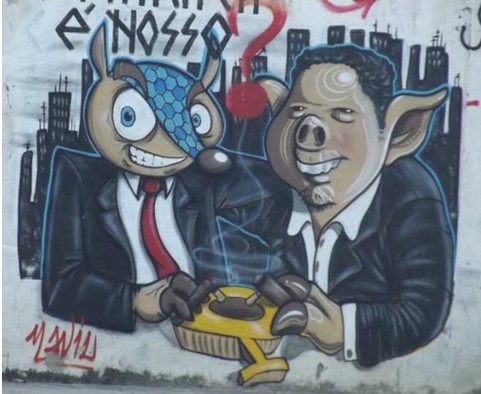
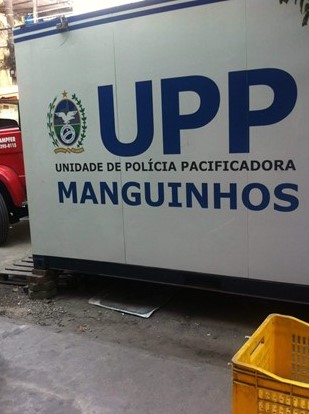
The Brazilian government was involved in greed, corruption and, as you might expect, a lack of consideration for the people of Rio through rapid urban transformations (which the image below vividly depicts). From exploring Rio, I could feel the intensity of the mega-event developments from the explosion of street protests, FIFA-themed resistant art and the noise resulting from helicopters hovering over Rio’s favelas and the stadium construction. The increased occupancy of the UPP stations (“Unidades de Policia Pacificadora”) maximised and militarised security by restoring state control in the favelas and integrating the favelas to address urban violence and disarm drug traffickers. In other words, the government wanted to set the stage for a global audience: a problem-free and glamorous Rio de Janeiro, but with a high price to pay for those not invited to the match.


One of many street visuals that popped up across Rio de Janeiro during the World Cup 2014 developments, representing overbearing greed, corruption and a gold stadium in darkness.

Manguinhos, a favela In Rio de Janeiro’s North Zone.

The Aldeia Maracanã is a sacred, multi-ethnic village and resistance space in Rio de Janeiro that sits next to the Maracanã Stadium. The area has been occupied by indigenous urban people since 2006 and is the site of Brazil’s first indigenous museum, a building abandoned since the 1970s. Between 2006 and 2013, the Maracanã village bloomed into a community that became home to over thirty indigenous people from 17 different ethnic backgrounds. The indigenous people now had a vibrant space for rituals, fairs, cultural classes and bioconstruction to disseminate ancestral knowledge and demystify prejudices that indigenous people “do not belong” in the city. There have been numerous eviction attempts, with many of the community living in constant – and ongoing – threat of violent removals. The village faced brutality in the preparations for the World Cup and Olympics. In 2013, a military operation stormed the indigenous village using tear gas, pepper spray, stun grenades and physical violence. Brazil’s colonial past has created a socio-political disintegrated landscape in which both race and ethnicity remain problematic. Brazil’s 1988 Constitution, and the ILO Convention 169, ratified by the government in 2002, offers protection to indigenous and quilombola groups. However, the reality suggests otherwise. An example of this is the non-existent land rights and a lack of building ownership for the indigenous Indians in Rio de Janeiro. The defence of tribal land rights are under enormous pressure from the current right-wing President Jair Bolsonara as Indigenous leaders have been fighting against Bolsonara’s man-led genocidal policies of environmental destruction of rainforests, including the Amazon.

https://www.youtube.com/v/H1mHrXZQs2s?app=desktop


An exhibition of violence at the Aldeia Maracanã in 2013

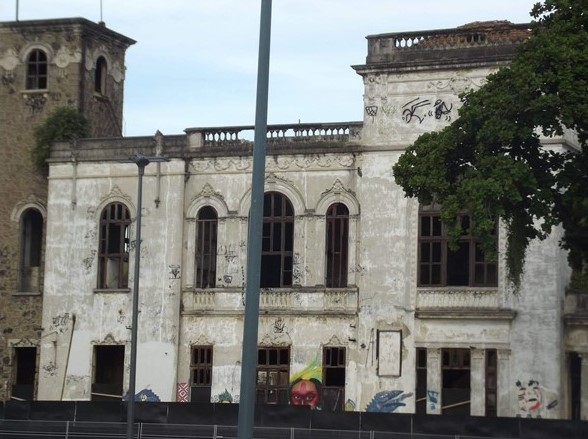
The building stands vacant in the aftermath of the Aldeia Maracanã

Participants in the International Mega Events and Cities Conference, including myself, visited the Maracanã site with a local guide who lived close to the stadium. We were also taken to the Aldeia Maracanã.

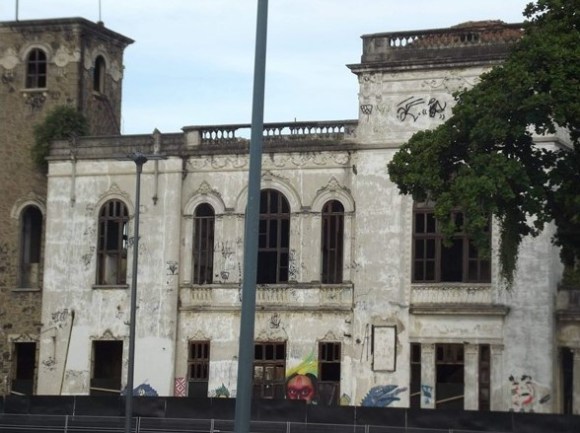
The above picture shows the front of the indigenous home. On approaching the sacred building, I was met with an eerie sense permeating the space, and of what had been left of the Aldeia Maracanã from state-sanctioned violence, even though this visit occurred a year after the attack. The eeriness increased as I stood in the largely empty space in the aftermath of the tragedy. I began to picture a lively image and spirit of the indigenous community nurturing a home and school of sanctuary; creating art through painting, music and laughter. I also saw a garden in bloom with colourful vegetables and fruit, having the power of spoken words to educate the people of Rio on their traditions, and perhaps, creating common ground in a shared world where violations of residents’ rights led to thousands of Rio’s poorest being evicted for the games.

This was a life lived on guard against the threat of outsider raids – the violence nearing, not waiting or knocking, but forcing through their home. The air was stale and silent, despite being beside the stadium construction, and the windows represented dark, empty eyes on the inside, as if presenting a witness to the disappearance of indigenous life. Once we drew closer to the building, the display of the murals covering the Aldeia created a sense that theindigenous movement would return and that we are to view the murals as a visual message of presence, pain and resistance – “Commissions of Injustice”.


The local guide explained that the police were suspicious of visitors around the Aldeia Maracanã

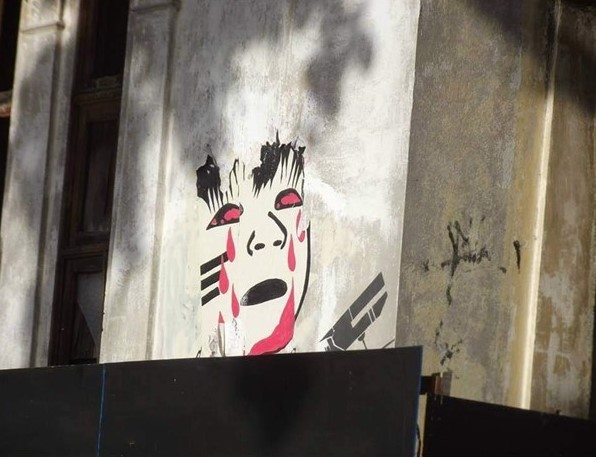
The building, standing like a skeleton, provides the framework for an indigenous man’s head; a gaunt portrait of what has been left in the ruins. The man’s eyes hold no fear as he looks directly at the viewers, who have no choice but to stare back into the windows of a now shattered shell. The portrait, painted on a crumbling plaster façade, is like a Giotto fresco. The image was not, however, paid for by a rich family like the Medicis. Instead, it came at a higher price, the cost of displaced indigenous families. Ruby war paint, a red cross in battle, covers the indigenous man’s nose, mouth and forehead like markings of blood and violence enveloping his sense of smell, vision and future insight. The arch of his eyebrows and nose opens into wings like the tail of a bird. Unlike a dove of peace, it leads to a pathway cut out by the disfigurement of his ebony raven locks—a shaved centre parting carved across his skull with a phoenix descending into a yellow flame.

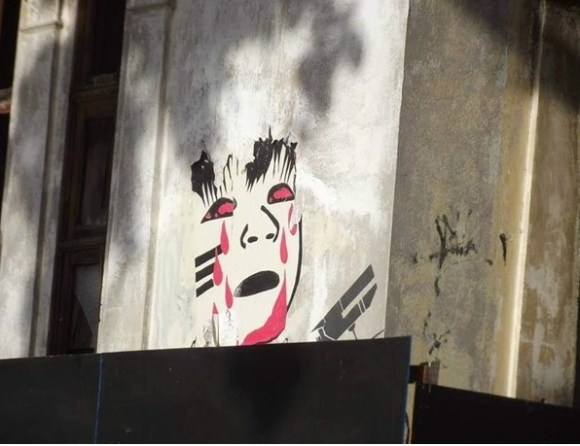
On the corner of the Aldeia, the face of an indigenous child is crying heavy tears of blood as if they will drown in them, creating a pool of redness around the edge of the chin that does not leave the child’s face. The red eyes represent what the child may be seeing and experiencing; the battle against their family and community members, suffering, perhaps anger, but most certainly danger, as shown by their small mouth gaping in horror at the display of violence. The child’s hair is missing from the middle, deep enough to have been pulled out by the roots. With more harm inflicted from the missing part of their head, they will not forget this, even if it represents the onset of becoming invisible after the battle. The vulnerability remains beside the boarded fence which prevents the viewer from seeing beneath; a stick of sorts is either diagonally going into the child or being held up in defence. It is difficult to look away from the indigenous child’s trauma.

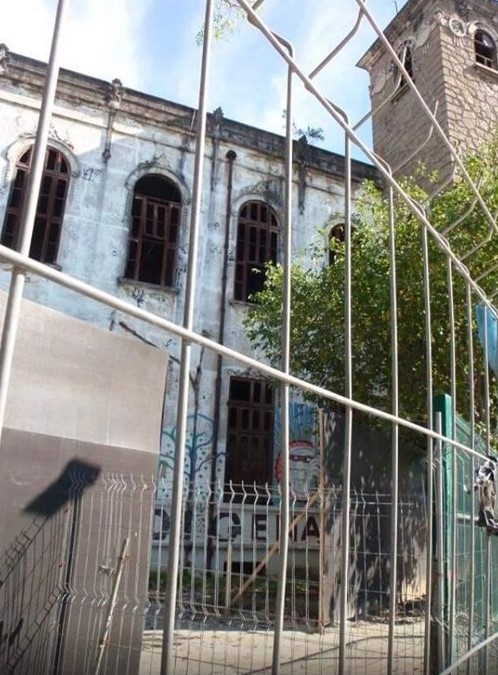
The perimeter of the Aldeia has the appearance of a prison with high steel fencing, wire and the reflection of the security camera indicating state control and monitoring of the sacred building. The chain padlock on the fencing adds another element to the atmospheric mix of distrust and control. The government is determined to prevent indigenous freedom and does so by keeping away and shutting out culture, diversity and Mother Earth. This is a village and university in survival mode floundering in a sea of tension due to war and encroachment on sacred space by the government. Indigenous people are not “urban rubbish” that can be discarded, and they are not losers in the games played by FIFA. A reinstatement of ancestral territory ownership will be reborn. The collective fight will return.

Alongside studying criminology and finishing my copy of Sensory Penalties, I have attempted to breathe life into my field notes that sat untouched in a drawer; scribbles on how I felt, what I saw and what I imagined by sharing the whole experience when I visited the Aldeia Maracanã. I believe I received a learning gift from indigenous communities in standing up to and epitomising injustice as fully as possible. I have opened the sensory aspects to a space and building where indigenous life had forcefully disappeared – and I was moved by the absence of the community and the after-effects of the military police ‘storm’ tactics of grenade bangs, weapon whacks and shots of pepper spray that left stale air and stone-cold silence. The initial unease of ghostly eeriness on approaching and standing in front of the Aldeia Maracanã acted as a trace to the brutality of 2013 and the outside remains, the murals, allowed me to resist a simplistic interpretation of the Aldeia as a vacant ‘haunted like’ building, but one in which Indigenous preservation and resistance are still present.

Comissões de Injustiça no Rio de Janeiro: indígena preservação e da resistência

Janine Ewen

“Todos assumem que as favelas são todas inviáveis, mas estão unidas por laços estreitos com a comunidade. [Moradores de favelas] não tiveram outra escolha a não ser tornar a vida o mais viável possível, já que o Estado faz vista grossa… Alguns desses despejos são corruptos, [procurando] ganhar as melhores áreas do Rio de Janeiro.” (James Freeman, professor da Universidade de Concórdia no mega evento estratégico das favelas do Rio de Janeiro.

Em Fevereiro de 2014, eu estava realizando trabalhos de campo no Rio de Janeiro a dois meses antes do início da Copa do Mundo da FIFA, onde fui convidada a participar em uma Conferência Internacional de Mega Eventos e Cidades sobre os direitos humanos, urbanização, políticas públicas, direitos, violência e segurança. Esta Conferência Internacional seria por sua vez, acompanhada de um passeio pelo local principal de discussão, o Estádio do Maracanã, que viria a sediar a Copa do Mundo em 2014 e as Olimpíadas em 2016. Ainda me lembro das palavras do palestrante Carlos Vainer, professor do Instituto de Planejamento e Pesquisa Urbana e Regional da Universidade Federal do Rio de Janeiro (IPPUR/UFR): “Na vida existe vencedores e  perdedores ; este contexto também existe em qualquer partida de futebol. Ainda estamos para determinar quem vai ganhar ou perder na partida entre o governo e o povo brasileiro”. 

O Governo Brasileiro estava envolvido na ganância, corrupção e, como era de se esperar, existe uma falta de consideração para o povo do Rio através de expontâneas transformações urbanas (que a imagem abaixo retrata vividamente). Ao explorar o Rio de Janeiro, eu pude sentir a intensidade dos desenvolvimentos de protestos de rua, da arte resistente à temática da FIFA e do barulho resultante dos helicópteros sobrevoando a construção do Estádio e as favelas do Rio. O aumento da ocupação de esquadras polícias pela UPP (Unidades de Policia Pacificadora) maximizou e militarizou a segurança, o que possibilitou o restauro do controlo estatal nas favelas, ajudando a  integrar as favelas no combate há violência urbana e a desarmar os traficantes de drogas. Em outras palavras, o Governo queria preparar o palco para uma audiência global: um Rio de Janeiro sem problemas e glamouroso, mas com um preço alto a pagar para quem não fosse convidado para a partida.

esenvolvimentos da Copa do Mundo de 2014, representa a ganância arrogante, a corrupção e um estádio de feito de ouro na escuridão.
Manguinhos, uma favela na Zona Norte do Rio de Janeiro

A Vila Maracanã é uma vila sagrada, multiétnica e centro da resistência no Rio de Janeiro situada ao lado do Estádio do Maracanã. A área é ocupada por povos indígenas desde 2006, e é o local do primeiro museu indígena do Brasil, um prédio que ficou ao abandono desde a década de 1970. Entre 2006 e 2013, a aldeia do Maracanã floresceu em uma comunidade que se tornou o lar de mais de trinta indígenas de 17 diferentes origens étnicas. Os indígenas agora tinham um espaço vibrante para os seus rituais, feiras, aulas culturais e bioconstrução como meio de disseminar o conhecimento ancestral e desmistificar preconceitos que os indígenas “não pertencem” na cidade. A vila enfrentou a brutalidade nos preparativos para a Copa do Mundo e Olimpíadas. Houve inúmeras tentativas de despejo violentas, o que causou uma vida de constante – e contínua ameaça aos moradores da comunidade. Em 2013, uma operação militar invadiu a aldeia indígena usando gás lacrimogêneo, spray pimenta, granadas de choque e violência física. O passado colonial brasileiro criou uma paisagem sociopolítica desintegrada na qual os factores raciais e étnicos permanecem controversos. Em 2002, o Governo Brasileiro retificou a Constituição Brasileira de 1988 e a Convenção 169 da OIT, onde ofereceu proteção a grupos indígenas e quilombolas. No entanto, a realidade sugere o contrário. Um dos exemplos disso são os direitos de terra inexistentes e a falta de propriedades dos índios indígenas no Rio de Janeiro. A defesa dos direitos das terras tribais está sob enorme pressão do atual presidente de direita Jair Bolsonaro, já que líderes indígenas têm vindo a lutar contra as políticas genocidas lideradas pelo homem de Bolsonaro na destruição ambiental das florestas tropicais, tais como a Amazônia. 

https://www.youtube.com/v/H1mHrXZQs2s?app=desktop

Uma exibição de violência na Vila Maracanã em 2013 

O prédio permanece abandonado no rescaldo da Vila Maracanã. 

No decorrer da Conferência Internacional de Mega Eventos e Cidades, fomos convidados a visitar o Estádio e a Vila Maracanã, na companhia de um guia local e residente da mesma. 

A foto acima mostra a frente de uma casa indígena um ano após o ataque. Ao me aproximar do prédio sagrado,  contemplei o espaço, e reflecti sobre o que havia sido deixado para atrás, um sentimento de violência sancionada pelo Estado.

Este sentimento de estranheza aumentou enquanto eu contemplava este espaço praticamente vazio repleto de tragédia. Esta estranheza me levou a imaginar de como seria o espírito da comunidade indígena, alimentando uma casa, o ensino dos seus costumes sagrados; na criação de arte através da pintura, música e riso. Também imaginei um jardim em flor com vegetais coloridos e frutas, tendo o poder da voz para educar o povo do Rio sobre as suas tradições, e talvez, criando um terreno e mundo compartilhado, onde as violações dos direitos dos moradores seriam respeitados. Direitos, esses, que foram ignorados, levando ao despejo de milhares de moradores mais podres. 

Esta era uma vida vivida de protestos contra a ameaça de ataques de forasteiros – a violência se aproximando, não esperando ou batendo, mas forçando através de sua própria casa. O ar estava obsoleto e silencioso, apesar de estar ao lado da construção do estádio.  As janelas no interior representavam os olhos escuros e vazios como se fosse uma das testemunhas do desaparecimento da vida indígena. 

Uma vez que nos aproximamos do prédio, a exposição dos murais que cobrem a Aldeia criou uma sensação de que o movimento indígena retornaria, e que, deveriamos ver os murais como uma mensagem visual de presença, dor e resistência – “Comissões de Injustiça”. 

O guia local explicou que a polícia suspeitava de visitantes no em redor da Aldeia Maracanã 

O edifício, acima representa um esqueleto, com a estrutura facial de um homem indígena; um retrato magro do que foi deixado nas ruínas. O olhar do homem não demonstra medo, enquanto ele que olha diretamente para os espectadores, que não têm outra escolha a não ser olhar de volta para as janelas de uma concha agora quebrada. O retrato, pintado em uma fachada de gesso em ruínas, como se fosse uma pintura renascentista de Giotto. No realidade, a imagem não foi paga por uma família rica, como os Medicis. Em vez disso, veio oriundo do custo das famílias indígenas relocalizadas. A pintura da guerra do rubi, uma cruz vermelha em batalha, cobre o nariz, a boca e a testa do homem indígena como marcas de sangue e violência envolvendo seu olfato, visão e visão futura. O arco de suas sobrancelhas e nariz se abre como forma de asas e a cauda de pássaro. Ao contrário de uma pomba de paz, esta imagem leva a um caminho cortado pela desfiguração do seu corvo ébano; esculpida no seu crânio acompanhado com uma fênix descendo em uma chama amarela. 

Na esquina da Aldeia se encontra uma pintura, representando um rosto de uma criança indígena chorando lágrimas de sangue, como se ela se afogasse nelas, criando uma poça de vermelhidão ao redor da borda do queixo da criança. Os olhos vermelhos representam o que a criança pode estar vendo e experienciando; a batalha contra a sua família e membros da comunidade, o sofrimento, perigos e sentimentos de raiva, o que é demostrado pela pequena boca, surpresa pelo horror e violência. A falta de cabelo no meio da cabeça da criança é profundo o suficiente, como se tivesse sido puxado pelas raízes. A vulnerabilidade permanece ao lado da cerca. Cerca esta que impede o espectador de olhar para baixo; uma imagem de um tipo de varas que estão entrelaçadas ao redor da criança, talvez como meio de defesa, sendo difícil desviar o olhar da criança indígena. 

O perímetro da Aldeia é parecido com o de uma prisão, cercas de aço alto, arame e câmeras de segurança indicando o controle estatal e o monitoramento do edifício sagrado. O cadeado de corrente adiciona outro elemento à mistura atmosférica de desconfiança e controle. O governo está determinado a impedir a liberdade indígena e o faz mantendo-se afastado na exclusão da cultura, diversidade e da Terra Mãe. 

Esta é uma aldeia vive em um modo de sobrevivência, pois existe um constante mar de tensão devido à guerra e à invasão do governo na profanação do espaço sagrado. Os indígenas não são o nosso “lixo urbano”, nem os perdedores dos jogos disputados pela FIFA, onde podem ser descartados em qualquer oportunidade. Uma reintegração da propriedade do território ancestral renascerá, e a luta coletiva voltará. 

Além de estudar criminologia e terminar a minha cópia de Penalidades Sensoriais, tentei dar vida às minhas notas de campo que estavam intocadas em uma gaveta; rabiscos sobre como me senti, o que vi e o que imaginei compartilhando toda a minha experiência quando visitei a Vila Maracanã. Acredito que fui presenteada de uma forma única e preciosa, ao aprender os factos vivenciados pelas comunidades indígenas, no confronto e no sistema simbólico da injustiça.

Esta experiência me fez compreender que o tudo aquilo que havia permanecido da comunidade indígena teria sido forçado a desaparecer. Acabando por ficar comovida pela ausência da comunidade e pelos efeitos posteriores das táticas de “tempestade” da polícia militar, sendo estes, golpes de granada, golpes de armas e tiros de spray de pimenta que deixaram no ar um sentimento envelhecido e silêncioso. O mal-estar inicial da estranheza fantasmagórica ao nos aproximar da Aldeia Maracanã nos serviu como um conta histórias , onde era visível o teor de brutalidade em 2013 e os restos externos, através dos murais, onde havia a representação simplista da Aldeia seria como um prédio vazio”assombrado pelo passado” e um espírito presente da preservação e da resistência indígena. 

Categories
Comparative Penology power Sensory Penalities

A Taste of… Ethiopian Notes

Ian O’Donnell

Ian O’Donnell’s chapter in “Sensory Penalities” describes the assault on his senses that characterised a series of visits to a prison in southern Ethiopia. Foregrounding facets of the research experience that are seldom given the benefit of sustained academic attention it addresses themes of going, seeing, hearing, smelling, tasting, touching, being, reflecting and comparing. What follows is a collection of excerpts from the chapter, with the addition of photographs which are not included in the book (full citation at the end of the piece).

Going

In 2016, Paddy Moran, a missionary priest, invited me to accompany him to a prison in the Southern Nations, Nationalities and Peoples’ Regional State of Ethiopia, where he had been working for many years. The brief was fairly loose. I was to make a visit, see what struck me and prepare a short report in conclusion. These were unusually unspecific instructions (but none the less welcome for that) for one who is used to being trammelled by the bureaucratic demands of grant-making bodies. I updated my travel insurance, arranged for the necessary vaccinations and set off.

I had visited prisons in Europe, the United States and Australia but never in Africa, and it was difficult to prepare in advance by reading – a particular disadvantage for a bibliophile – as the pertinent literature was virtually non-existent. In short, I had no sense of potential pitfalls or pratfalls. For someone who had been studying prisons for almost 30 years, this was a reminder of early days in the field when uncertainty reigned.

Seeing

The prison that I visited (for a week in 2016 and for a few days in each of the two following years) resembled a small and bustling village with a population of around 2,000 men and 100 women. It was located in a large town, a short drive from the main thoroughfare with its traffic honking and braking, drivers shouting and waving, livestock wandering, in a weirdly crash-free synchrony. There was a steep and potholed hill up to the prison where progress was slow and pedestrians waved and greeted Fr Moran and myself as we progressed – swervingly – towards the prison gate in a battered jeep.

The immediate vicinity was busy with traders touting for business, the ubiquitous three-wheeled, blue-liveried, bajaj taxis whizzing around collecting and delivering passengers, sometimes perilously overloaded, children walking to school and playing. A metal sign had been erected just inside the gate upon which one of the prisoners had painted an almost life-size representation of a member of staff in camouflage-style uniform. The sign requested visitors to stop and cooperate with any security checks. The figure in the painting offered a respectful salute, suggesting an ethos of cooperation rather than coercion. Not being able to read the official language, Amharic, was a challenge that I had neither the time nor the talent to overcome. It was impossible for me to make sense of the written word, its mystery adding to its elegance in this stranger’s eyes.

Touching and being

The heat and humidity were bearable but whenever I sat down with my interpreter to speak to prisoners in a dormitory a crowd soon gathered, sitting, standing and crouching around us. They were curious, never menacing; always keen to listen to the discussion and to offer their own observations. There was little in the way of natural light and when the group in attendance grew large the atmosphere could be somewhat stifling. I was an object of some curiosity in a place where Irish professors were seldom, if ever, encountered. There were some challenges for my kinaesthetic sense. Sitting on impossibly small stools conducting interviews was not conducive to comfort for a gangly researcher with a notebook on his knee. I needed to watch my step walking on the compound’s uneven mud paths; they were dry during my visits which made them less hazardous than they would otherwise have been. A sense of always being in a racial minority was a novelty for me – I was told that I was the first white man to visit the prison farm – but this difference was not denigrated. I had a sense of being out of place linguistically, culturally, geographically and also temporally

Not long before going to Ethiopia I visited a supermax prison in the United States. It is difficult to imagine a wider sensory gulf than that existing between the sterility and stimulus-poor environment of the supermax and the vibrancy and all-out assault on the senses that was the Ethiopian prison compound.

O’Donnell, I. (2021) “Ethiopian Notes” in Herrity, K., Schmidt, B.E., Warr, J. (eds) Sensory Penalities: Exploring the Senses in Spaces of Punishment and Social Control, pp. 203–216. Sensory Penalities is now available here: https://books.emeraldinsight.com/page/detail/Sensory-Penalities/?K=9781839097270

Categories
Emotions power prison research sound

‘Feeling’ feelings

Kate Herrity

Privileging the sensory has implications for how we understand how we know as well as what we know. The process of working with our patient, pioneering contributors has been a lesson (as we hope to discuss elsewhere) in the kind of editors we want to be as well as how significant a departure this presents from academic convention. As the most junior and least experienced of the three of us this was particularly valuable for me. I have contributed to edited and reviewed works but never before assumed this role. For me it has been formative; an intimate process of collaborative and supportive exploration rather than distanced and dictatorial. I hope this is reflected in people’s engagement with the book. I am not about to reflect in depth on the editorial process here but rather a particular, recurring, issue that prompted further interrogation.  I have spoken about the distinction between feeling and feelings before[1]. I may well do so again as I try to better understand the role of the sensory in prison social spaces, though there are broader implications here for epistemology and emotion in criminal justice and criminology.

Foregrounding the sensory brought the distinction between senses and emotion, as well as between privileging the sensory and reflexivity in to stark relief. Prompting academics to reflect on this more sharply demarcated the distinctions between these facets of knowledge and experience, and in so doing added clarity to both. There are linguistic obstacles as well as cultural ones that must be vaulted or circumvented when asking of someone “what did that ‘feel’ like?” but reaching further than whether they were happy or sad, safe or unsettled to what was mediating those emotions in the social world they sought to understand, and what reflecting on ‘feeling’ those ‘feelings’ taught them about those spaces. Rather than drawing on research on the complex relationship between emotion and sensory perception[2], I want to reflect on rather more direct demonstrations of this relationship by using a couple of examples of the surprising ways this has manifested.

I was in the second year of my PhD when I presented at the carceral geography conference in snowy Birmingham:[3] https://carceralgeography.com/conferences/2nd-international-conference-for-carceral-geography-11-12-dec-2017-university-of-birmingham/conference-programme-2017/1b-health-and-wellbeing/. I was nervous at finding myself in such illustrious company. This was one of few presentations I had given at that point, and, I think, the first time I attempted to illustrate the significance of a focus on sound by banging on furniture. I had pillaged our kitchen for suitable tools – a pestle and a souvenir bottle opener – for makeshift percussion. I reached the appropriate point in my talk and dutifully banged out the different rhythms of cell-door banging as a means of exploring the meanings they signified. Sound, I argued was a site both of symbolic violence and power contestations, a means of expressing dissent or warning from those captive and invisible (though not inaudible) behind the door. I had failed to appreciate quite what potency this might have for someone in the audience suddenly transported back to prison by my amateur banging on the table. He taught me a valuable lesson that day about how sound can traverse time[4]. He also taught me about my insensitivity. I was torn between trying to offer comfort and carve him space to process his visible emotion. He was keen to impress upon me that he was not in a negative place, but rather that the banging had “taken him back there” with a forcefulness he had not anticipated any more than I. What I interpreted as distress was, rather, a man fielding a sudden deluge of memories, smells, textures, sounds, of a time he had left behind but was with him still.

Approaching the end of my fieldwork I attended a conference (the Crime and Control ethnography symposia are always worth it if you can[5]). Many of my friends were there and one in particular, a year behind me, was struggling with her fieldwork. She felt uncomfortable in the prison space but couldn’t work out why. She felt guilty when it came time to leave and struggled to reconcile that with the genuine relationships she had forged throughout her time as both researcher and volunteer. Others speak far more eloquently than I about the contradictions of drawing on your stranger status and humanity to equal if conflicting degree as researcher. In the context of prisons where emotions of all in the community run so very high, this can be painfully intense. If ethnography is about stories then the doing of it is surely about the relationships and meanings they serve to underscore. I wanted to offer her comfort. I do not think it is incidental that I drew on sensory experience, the feeling, in an attempt to offer comfort and support to her emotional state, her feelings, as a way of telling her she was not alone:

https://leicester.figshare.com/articles/Rhythms_and_routines_Sounding_order_and_survival_in_a_local_men_s_prison_using_aural_ethnography/762884 [6]

Leaving (for M)

Emerging from the airlock
Metallic clunk; The freedom signal
Ringing in my ears
Quickening pace
My nostrils hungry for that biting burst of evening air
I speed to slough that lingering scent
The burning afterimage of this place
That clings beneath the skin I vainly scrub
With soap and wine.
Is this enough?

I stand in shitty remnants of your rage
I walk your vale of cries and shouts
Your bangs and crashes
Laugh too loud
My pleasure in your company clear
I hope for better futures for you
Far from here
And yet I fear
This isn’t going to be enough

Wandering aimless through the streets
I see your face on cardboard-cloistered,
Doorway bundles
Watch your ghostly presence weave amongst
The living
As they mindless tread
My memories scar those grubby pavement beds
And now you haunt my fitful sleep
I know

This cannot ever be enough

The sensory is both source and conduit for an array of knowledge, as well as a powerful medium of emotion. Sound – and the sensory more broadly – offers a means of collapsing distance in time, space and between people, evoking shared memories and experience. Privileging the sensory creates a site for scrutinising the social function of shared emotions summoned by it. The relationship between sensory and emotional realms is intimately intertwined but closer interrogation demands we expand our vocabulary to recognise they are nevertheless distinct. Only in so doing are we able to get within, amongst and underneath these facets of our social world, to develop our ability to interrogate the ‘feel’ of our ‘feelings’.


[1] Herrity, K. (2020) “Some people can’t hear, so they have to feel”: exploring sensory experience and collapsing distance in prisons research” Early Career Academics Network Bulletin, Howard League for Penal Reform January 2020, No. 43 https://howardleague.org/wp-content/uploads/2020/01/ECAN-Autumn-2019-final-draft-2.pdf

[2] E.g. Kelley, N.J.,Schmeichal, B.J. (2014) “The effects of negative emotions on sensory perception: fear, but not anger decreases tactile sensitivity” Frontiers in Psychology, Vol.5, Pp942. Goodman, S. (2010) Sonic Warfare: Sound, affect and the ecology of fear. Massachusetts: Massachusetts Institute of Technology Press

[3] This is an audio recording of a talk given at the Second Carceral geography conference (Herrity, K. (2017) “Sound, Space and Time: A rhythmanalysis of prison life” 2nd Carceral Geography Conference, University of Birmingham, December 2017.

[4] David Toop (2010) speaks explores this in Sinister resonance: the mediumship of the listener. London Bloomsbury. Sound, he argues, is a haunting.

[5] https://crimeandcontrolethnography.wordpress.com/2018/06/19/crime-and-control-ethnography-symposium-2018-call-for-participants/ Here’s a link to the 2018 call in Glasgow which was class.

[6] Soundfiles accompanying my thesis (within the thesis the reader is directed to listen at specific points of the discussion. I include them here for those who have not heard a prison soundscape: Herrity, Katherine Zoe (2019): Rhythms and routines: Sounding order and survival in a local men’s prison using aural ethnography. University of Leicester. Dataset. https://doi.org/10.25392/leicester.data.7628846.v1