Categories
Environment food prison smell taste Uncategorized Women

The Aftertaste of Prison

Lucy Campbell

I was a chef for a while when I was younger, I started as a waitress and slowly made my way back into the kitchen, following my nose and my stomach.  I loved cheffing, it fired my enthusiasm, creativity and my appreciation of a chaotic environment. I thrived in the manic, heated frenzy of a working kitchen: the sticky heat, the rich smells of seafood and the warmth of a freshly baked pastry. Food is very important to me and always has been. I am a qualified ‘foodie’.

My time spent in prison then, for me was something of a sensory journey through the realm of taste. In 2004 my partner and I  were arrested for trafficking drugs across an international border and served four years in various Mexican prisons and three in the UK.  The food was worlds apart in each of them. In Mexico, they offered three meals a day served in carts parked at the entrance to each wing. It was essentially three meals of slop. Greasy, watery caldos and rice with beans. Always rice and beans and always with chilli. Chilli in everything! It was tough for a woman who had never eaten chilli before to be immersed in a culture that ate chilli with everything. It took some acclimatising and painful episodes while my body accommodated the new diet. The children had chilli-flavoured lollipops and sweets were chilli flavour. Everything edible had a chilli kick, it was almost a religious sacrament.  To deny the chilli was to deny the Mexican.

Prison life revolved around food, making food, buying food, waiting for food and getting food from family members. I measured the passing of time by the arrival of meals.  Not many women ate the prison food, they didn’t need to. Family is a strong vibe in Mexico and so visit days were busy and smelled delicious. Families brought bags and bags of food in Tupperware, enough to last days. Gorgeous food, real Mexican food. Carnitas, Mole, Sopa de Pollo, fresh tortillas. I didn’t get visitors so  I used to wait in my room and most days when the women came back from their families they would share plates of food with me. Mexicans are generous people, and they were delighted to share food with someone so (eventually) appreciative of their family’s cooking. It took me a while but I grew to love chillis, I grew to love the flavours of Mexico. Chillis, coriander, fresh, tangy salsas.   I wrote recipes of my favourite meals in my diaries and still cook these recipes for my own family today.

We cooked in our cells on small electric pans and the corridors always smelled incredible. It was like walking through a street market with the various aromas drifting out of each cell. This was fine until you were hungry, then the smells were pure torture. Everything was expensive in prison and nothing was free. Even drinking water had to be bought, it was a scrabble most days to survive and get by and it led to an environment where free trade and commerce were normal. Women improvised pop-up food shops which they ran from their cells. Street food done properly; sopes, tacos, carnitas. Flavours and textures that blew my mind, starved as it was for any kind of sensory input. I couldn’t often afford the food but it was a major treat when I could.  I remember walking past a wing where they had had a chilli disaster. The chillis must have been exceptionally strong and then caught in the pan. The whole wing was full of toxic smoke, women were running out with their eyes streaming and coughing. It was like the aftermath of a riot and someone had let off a gas grenade!

When I was finally repatriated to the UK after 4 years in Mexico, I came back pregnant and hungry, four years is a long time to live off other people’s generosity. My partner and I had weekly conjugal visits and birth control wasn’t a high priority in Mexico, it was expensive and difficult to get hold of. My repatriation had finally come through at just the right time, I had been worried about being pregnant in Mexico, and I came back when I was 12 weeks. Holloway Prison was the repatriation centre in England and so it was there I went. Straight from the airport to Holloway’s repatriation centre. I was so worried about Holloway, I had heard all the stories about it on the TV but it was amazing. On arrival, I was offered a meal and then another. It felt like a 4-star hotel after the sparse conditions in Mexico; with soft, fluffy duvets on proper beds, and well-cooked meals with dessert, I could even buy chocolate and snacks if I had the cash! It was sensory overload for the first few weeks with all the bright lights and regimented routine but the food made up for the culture shock. I relished the British classics: Lasagnas, Roast Dinners, and Beef Stews. Then there were the puddings, proper British puddings like treacle pudding and sticky toffee pudding. I ate everything, It was a banquet of food for a starving, pregnant woman and I took full advantage. Holloway was warm and comfortable and yet somehow, I missed Mexico. I used to joke that I had Stockholm syndrome, the condition where you miss your kidnappers or captors.

Can you live in a place and not become a part of it? I grew to love Mexico, I grew to love the food, and I grew to love the language and the people. When I eventually returned to the UK I was dreaming in Spanish and I found it hard to speak English all day long. It seemed so stilted, so lacking in feeling. I missed the open and generous natures of Mexican people, their warmth and their freedom of expression. This is a side of prison that we don’t often think about, happiness and joy in prison. It feels wrong to even write that line! Seven years though, is a long time, it would be impossible to be consistently sad or angry for the entire sentence.  I have some amazing memories of my life in prison in amongst the sadness and the trauma because life goes on in prison. Why wouldn’t it? People are very surprised when I relay stories of ‘fun’ that I had while incarcerated, like the sentence imposed must strip away any life as well as liberty.

Women are women wherever we go, we try to make our lives as close to ‘normal’ as possible. We try to cling to the normality of family and community and shared experiences.  I found that this was done through food, food is a universal connector, and it is hard to have a problem with someone after you have shared a meal with them. It brings people together and allows for a bonding that transcends language and culture. Food began conversations and friendships, it could lift the spirits.  I can cope with most things life throws at me on a full stomach.  I was at my saddest and most depressed when I was hungry.

I suppose now my memories of Mexico are tempered by warm sunshine and hot tacos. Days where although I was at my lowest ebb, I sat in the blazing heat all day long. Tanning myself against the prison walls and looking across the barbed wire fence to watch the avocado trees swaying in the warm winds. Everything feels better with a full belly and with the sun on your face, even imprisonment.

Categories
custody Emotions Environment Neurodiversity probation Uncategorized

The Sensory Experience of Release: Reflections

Jennifer Stickney

Release is often full of hope, expectations of a better life and images of freedom that involve living life to the full[1]. The reality of release can be quite different. Being a prisoner involves significant loss: loss of freedom, loss of choice, loss of communication, loss of possessions, loss of relationships[2] and loss of normal every day sensory experiences that support people in interpreting and navigating the world around them.  It is therefore important that we understand the impact of this loss on the release experience. By doing this we are able to support people as they are released from prison to resettle into the community[3].

In Jays’ poem below he describes his realisation of the loss he has experienced through his offence and being in prison, and the impact this has had on his release.

Free to be Blind

Have you tried seeing the world through eyes that can only see the past?

Have you tried taking steps on the road I walk … consumed in darkness?

What’s freedom if it’s lived within a personal prison?

I’m only willing to accept your future if somehow I am invisible… if my voice made no sound, if my existence was just a memory that you don’t have.

Yes, I am free but don’t be blind to my pain!

I still live with my guilt backed inside my soul,

I can’t see what you see… I can’t see a person.

My reflection has no meaning.

My smile is just a mask.

My laughter only a sound you hear.

What’s freedom if a person isn’t truly free?

What’s a future if it includes me?

Jays’ poem depicts a sensorial numbness. His words suggest an inability to feels sensations, relying on others to use their senses to notice his voice, his smile, in essence notice him as he is unable to notice himself. When he is overwhelmed, Jay’s body is unable to recognise or interpret sensory information around him resulting in him feeling numb. To keep himself feeling safe from the unknown of release Jay has built a personal prison around himself, which limits the sensations he experiences and enables him to avoid the feelings of being overwhelmed and unable to cope. However, by doing this he struggles to see how he can feel free and move forward with his life in the community.

Tony compared his experience of release to one of coming out of segregation.

“I was in seg for 18 moths solid. On my own with no one else around.  When I came out of seg it was mad. Having people around, people talking everywhere. People everywhere.  It was mad.  I couldn’t understand what was going on.  When people spoke to me, they sounded like Pinky and Perky you know…, I couldn’t make sense of what they were saying.  I still don’t like being around lots of people, it makes …too many voices, too many people. When I first came out of jail I went to an AP[4]. I had the same experience as I did coming out of seg.  Everything was different, it looked different, felt different. When people spoke to me their voices all merged, like Pinky and Perky talking together – I couldn’t understand what they were saying or what I needed to do.”

Both James’ and Tony’s words highlight how sensory experiences can impact on emotional regulation. The stress of being released from custody exacerbates people’s arousal states and it is therefore unsurprising that this is a time when an individual needs tools and skills to help them manage unwanted and unhelpful feelings associated with sensory overload.

We know and can understand that people being released from prison following long custodial sentences are likely to need some support with the practical aspects of reintegrating back into society. However, in my experience little thought, or consideration is given to the impact of the sensory shock of release, and the immediate effect this can have on a person’s ability to manage the daily tasks required to navigate the community.

For some people I have worked with, release from custody can feel like an existential shock[5]: a sensory explosion. When their body is not able manage the sensory input it is experiencing, this can trigger the fight, flight or freeze response. The visual sensory experience of the world outside prison is tangible for even those of us who have spent just a few hours at a time visiting them: the space, colours, the shapes and how things move is so different from the generally grey, austere prison buildings. Sounds in the community can be enormously overwhelming, the unfamiliar sound of babies and children, emergency vehicle sirens, the cacophony of noise that is the norm in busy towns or on public transport.  The touch of a person brushing by in the street can be very triggering for someone who has not experienced touch for many years. The smells of petrol, sewers, smoke, flowers and fresh grass can be reminders of the past but unfamiliar in the present, and the pace of life, the speed with which vehicles move nowadays, the rush of people getting to appointments, are so different from the experience inside prison.

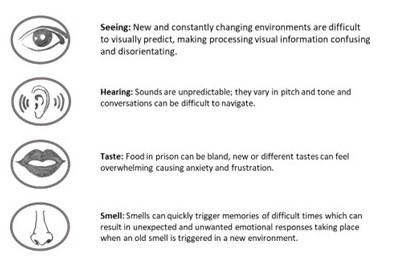
Considering our senses separately enables us to look at how they might be impacted by the experience of release:

In recent years there is an increased interest and a growing evidence base regarding the impact of sensory overload on a person’s ability to engage in everyday life and learn new skills. However little attention has been paid to how sensory overload can impact on a person’s experience of being released from prison. Consequently, little consideration has been given to the effect this can have on a person’s occupational performance in everyday tasks, and their feeling that they can cope with life after prison.

In 1969 Scott and Gendreau wrote that a person “cannot adjust to a sudden release into free society because his mental and emotional mechanisms are adjusted to the deprivation circumstances [of prison]. He cannot tolerate the myriad sensory input in normal environments with its pace, noise, confusion, and instant decision making. Anxiety, restlessness, sleeplessness, and irritability become so great in the released ex-inmate that he may seek means to return to prison with its retarded input and routine existence” (p.341).

Little has changed since 1969 regarding supporting people to prepare their sensory systems for release and enable them to manage this existential shock on the sensory system as they walk through the prison gates and start to navigate community living. However, with the growing interest in this area, and the evidence base that highlights the criticality of this support, we need to ensure that we act on this knowledge and evidence to better support people on their journey from prison out into the community.

In the chapter I co-wrote: “180 prisoners and the noise … it hits you, BANG!” Sensory systems, incarceration and resettlement[1] we identified some key strategies that can support people managing their emotions and behaviours particularly in preparation for release and as they transition from custody to the community. These include:

  • Understanding a person’s sensory preferences – it is helpful to know what sort of things calm and agitate a person prior to release to have some idea of how to support emotional regulation during times of high stress.
  • Developing a personalised place of safety – it is important to think about where a person is going to be released to and consider things that can be done to make it feel safe, such as where the bed is placed, the lighting of the room, the sounds they can hear and if they need ear plugs to support sleep etc.
  • Having meaningful structure and routine – this can feel containing and enable people to know what to expect and when, and plan how they can manage their time on release.  Having timetables that identify appointments and activities that will be taking place in the first few days and weeks post release is helpful.
  • Engaging in sensorimotor activities (activities that combine sensory experiences and physical movement e.g., yoga, gym-based activities, swimming and gardening) – can enable people to develop skills and engage in activities that support them to self-regulate when they are feeling overwhelmed.
  • Accessing sensory tool kits – these are personalised kits that are uniquely complied to support a person in managing their emotions and behaviours through sensory strategies and tools at times when they feel dysregulated. 

Getting release right is critical to supporting successful resettlement. Acknowledging the impact of sensory overload on a person’s ability to self-regulate in the first few days following release is essential.  Providing opportunities to enable people to manage their own risks and needs through better understanding of their sensory system can make life feel more tolerable in the first few days, and in the long term will assist people in their resettlement journey. Now is the time to use our knowledge and skills to start offering better support in this area at critical times in a person’s journey through custody and in their resettlement.


[1] Stickney, J., Budd, C. & Mark (2023). “180 prisoners and the noise… it hits you, BANG!”: Sensory systems, incarceration and resettlement. In Shingler, J. and Stickney, J. The Journey from Prison to Community (p. 85-102). Routledge.


[1] Shingler, J., & Stickney, J. (2023). “I can see freedom but I can’t have it”: Supporting people in the immediate aftermath of release. In The Journey from Prison to Community (p. 24-43). Routledge.

[2] Scott, G. D., & Gendreau, P. (1969). Psychiatric implications of sensory deprivation in a maximum security prison.

[3] Stickney, J., Hirons, A., & Jenner, H. (2023). “How could I know what to do?”: Supporting people in building practical skills for resettlement and reintegration. In The Journey from Prison to Community (p. 118-134). Routledge.

[4] AP – Approved Premise, multi-occupancy accommodation managed by the Probation Service.

[5] Canton, R. (2022). After-care, resettlement and social inclusion: The role of probation. Probation Journal, 69(3), 373-390.

Categories
Emotions sensory space Uncategorized Writing

Printing errors? Reading as Sensory Engagement

Tea Fredriksson

As any bookworm could attest, reading is a sensory experience. For example, you have to choose what tea or coffee to brew before sitting down with a book—what flavours go well with this particular book? Of course, before even reaching that step, you’d have to choose a book at your favourite library or bookstore. Having to choose between different books actualizes a lot of things outside of how good the blurb on the back makes it sound. Judging a book by its cover is one part of this, but so is the feel of the paper, and the weight and size of the book (avid readers might be familiar with thoughts like “can I bring this on the train, or will it make my bag too heavy?”, “do I really need another copy of this title just because this one is prettier than the one I have at home?”, or, for the anxious reader, “is this title too embarrassing to read in public?”). Sensory experiences abound, and that’s before we’ve even opened the book.

Reading is both physical and imaginary. For one thing, reading always happens somewhere—and that somewhere can add to, or detract from, the enjoyment we get. In this somewhere, we touch the page, and we imagine the book’s contents. If I read a book at home, and someone else reads it while imprisoned, did we read the same story? Maybe. The story was the same, but the experience of reading of it was probably not.

Different genres, too, lead to different ways of engaging with reading them—we might annotate a book we read for class, scribbling in the margins. We might read a thriller quickly, our pulse quickened by an unsettling turn of events. We might take extraordinary care not to crease the pages, or we might dog-ear them with reckless abandon. We might have a favourite reading chair, or we might struggle to focus on our book while we read in public transit. For anyone who has ever read a book aloud to someone else (or had one read to them), reading can take on a whole other level of sensory experience. Do you use different voices? How do you decide, spur of the moment, how different characters sound? Do you feel self-conscious about it? How does your audience respond? Suddenly, reading is a shared sensory landscape rather than a private one.

Of course, many of the sensory experiences that go into reading have to do with things outside of the book. But far from all of them. Reading, in short, conjures up whatever it is that unfolds in the story in ways that engage our senses. Perhaps most importantly, the process of reading is sensory in and of itself—words on the page conjure images, smells, tastes, and all sorts of emotions. Books make us cry, they make us laugh, they let us escape our current timespace and enter into another, or they bore us half to death (looking at you, third-grade history textbooks). While the story is in the book whether you open it or not, it isn’t until you turn the pages in the act of reading it that this story starts to unfold. Time, for example, does not pass in the story until you make it pass by reading the words as they flow. Reading, then, depends on familiar typesetting, where one word follows another in an order that makes sense—an order that feels safe, even if the story itself is unsettling. This brings me to what is, perhaps, the main point I wish to explore here: how does text itself, rather than the story it conveys, become sensory?

When I wrote my book exploring prison autobiographies, I grappled with questions of dis-ease and dis-order, unsettling timespaces, and frightening encounters. The narrators and characters in these stories offered plenty of opportunities for me to experience an array of uncomfortable feelings. However, I couldn’t help but notice how text itself, as a medium, sometimes struggles to convey certain unsettling moods. Creating atmosphere within the story is one thing, letting readers engage with a sort of imaginary emotional landscape in relation to characters and places in the story. We might feel saddened or frightened, but from a sort of vicarious viewpoint rather than for ourselves. Could text, then, cut through this vicarious layer to unsettle the reader themselves? Can it show, as well as tell? While academic writing might be an odd place for it, I wanted to play around with writing in a way where the text mirrored its contents. For example, my study dealt with uncanny dis/appearances, so part of the text dis

appeared.

Another element of this had to do with uncanny repetitions, which made me repeat a sentence on déjà vu a few times in a row in order to get the point across. The typesetters removed this repetition, thinking it was oh so very lucky that they found this error before the book went to print. That was one of several little things that had to be explained before the book was done; they found ‘errors’ and I went “no, no—this is wrong on purpose” (which was an odd-feeling thing to claim as an academic). To add a final example, otherness was a key theme in the study. Since otherness has to do with being somehow different from the mainstream, I used a different font for these particular  others. A friend, flipping through the pages of the published study (in other words, way past the point where I could request changes to the typesetting), asked me, in a bit of a panic, if I had seen the printing errors. While this was not quite the kind of emotional response I had in mind, it did show some element of what I was hoping for: They had responded to the text, before even reading the writing. What I’m getting at, then, is that by leaning into the view of reading as a sensory experience, and by breaking the familiar ways text behaves on the page, we might underscore the points we’re trying to make—or at least offer the reader a surprising way of engaging with our texts. Granted, since my study had to do with horror, this was perhaps easier than when dealing with more pleasant sensations. Then again, since you’re reading this, I’m guessing that you, too, might be conducting research of your own that deals with the less pleasant aspects of social life. Consider this an encouragement, an invitation, or a dare if you like, to bend the format of academic text in ways that make creative use of the sensory engagements that readers will have with your work.

Categories
Environment police power sensory space Uncategorized visual

Policing Dark Islands

Anna Souhami

One dark morning, I was standing on a hill in a howling gale in the Outer Hebrides, when I was surprised to see a police car in the distance. What did a police officer do in small, remote islands? What does policing look like when communities are small, scattered and separated by sea? Would police work be affected by the wind and rain that were then battering me? And why, after many years thinking about police work, didn’t I know?

This moment set in train an extended ethnography of policing in Shetland, the most peripheral archipelago in the UK. I wanted to explore how the historical preoccupation of criminology with the city had limited our imagination.  If our foundational research on policing had been conducted in remote islands rather than cities, what would we think was important in thinking about crime and its control? What would we notice that we currently do not see?

I soon discovered that one of the phenomena remote islands make inescapable is the dark: the visceral, overwhelming, sensory experience of immersion in darkness, and its effects on the exercise of state power.

Shetland is located over 200 miles north of the Scottish mainland in the centre of a ‘crossroads’ between Iceland, the Faroes, Scotland and Norway.   Its main connection with the UK mainland is by a 12 hour ferry from the Northeast of Scotland, though notoriously rough seas mean the journey can often take twice that. It can also be reached by propeller planes from Scottish airports, though the storms, 70mph winds and thick fog that batter the islands make this an unpredictable form of transport:  Flybe, the airline which served Shetland during my research, was known locally as ‘Fly Maybe’. 

So, in mid-December, armed with a suitcase full of seasickness tablets and some sturdy boots, I joined the young oil workers eating enormous plates of chips on the boat heading for Lerwick. Twelve hours later, I stepped out onto the deck in roaring winds, beside myself with excitement at my first glimpse of Shetland. 

I saw nothing.

Instead, I found myself enveloped in darkness, the quality of which I had never experienced before. It was impossible to tell where the land, sea and sky began or ended: the occasional tiny pinpricks of light which fleetingly appeared could have been from boats, houses or stars. This was my first experience of what islanders called ‘black dark’: an absence of light so profound that, as a police officer said, ‘you can’t let your dog off the lead as you’ll never find her again’.  Or as a former mainland officer put it, ‘you don’t know darkness until you’ve lived here. Here, there is nothing’. 

Yet while darkness may have been described in its absence – as ‘nothing’ – this was not how it was experienced. Instead, as I discovered, darkness is an acutely sensory experience. It is active, physical and alarming.

Light and darkness are central to the experience of life in remote Northern islands. Shetland experiences dramatic changes of light with continual light in midsummer (the Shetland phrase ‘simmer dim’ describes the brief dip in the light at the summer solstice) and in mid-winter, the time of my first arrival, only a few hours of watery grey daylight. Nights were not always dark: without clouds, auroras, stars and full moons lit up the sky making it possible to drive without headlights. The extraordinary experience of night illumination was so disorienting that one island police station had a list of full moon dates pinned to their front office to predict when people would ‘go crazy’.

However, more frequently, winter storms blacked out the moon and stars bringing immersion in darkness.  Staying in a little house at the end of a dark track next to a bay, I found myself overwhelmed by darkness. My fieldnotes describe tiredness, disorientation, and insomnia; feeling unable to leave my house, ‘hemmed in’ by a darkness that was ‘oppressive and total’.  To my astonishment, being submerged in darkness also brought with it a sense of creeping fear that was both existential and visceral. For the first time since a small child, I was afraid of the dark.

I soon realised these experiences were shared by the police officers navigating dark islands. All officers talked about darkness. They described how it interfered with their work: feeling exhausted and disoriented, getting lost, and not knowing in which direction they were driving. One officer came back from an unsuccessful house inquiry explaining: ‘There are no streetlights. It’s pitch black. It’s the darkest place I’ve ever been. I couldn’t find the bastard house.’ 

Yet darkness also affected officers more profoundly. It shaped the way they perceived the islands, and how they felt and moved within them.  

In the light islands were playgrounds for exploration. The starkness of the Shetland landscape became exciting:  we drove to remote cliffs to spot seals, orcas and otters on clear days, or to see shooting stars, red moons and auroras on clear nights. Officers described the colours of the land and sea, the sunsets they had seen, the wildlife and boats that passed. 

In the dark, however, islands became places of vulnerability. Officers described them as empty, lonely, barren places: ‘bleak’, ‘desolate’, depressing’, ‘shit’, ‘grey’.  Yet darkness wasn’t simply experienced as absence – of light, colour or pleasure. Instead, it was active, oppressive and visceral. Dark islands were hostile places.  Just as I felt ‘hemmed in’ in my house, officers described being crushed or consumed by darkness. It was penetrating, ‘claustrophobic’, ‘oppressive’; they described ‘sinking’ into the landscape.

Phenomenological research helps illuminate why darkness seems to generate this bodily sense of vulnerability.  Shaw (2015, p586) argues that in light, vision holds objects at a distance, becoming a ‘protective field’ which delineates the self from the world. In darkness, the boundaries between the body and environment are eroded (also Edensor 2013, Merleau-Ponty 1962, Morris 2011). Bodies become porous, leaving us open and vulnerable to the world outside. Or, as one officer described it, in darkness ‘I felt I was being swallowed by the island’.

For island officers, immersion in darkness was profoundly unsettling. As a result, officers drove quickly through dark places or avoided them entirely. Instead they headed to the comfort of the police station, or circulated around populated places with the safety of illuminated light. As one officer put it, when cloud cover at night meant there was no light at all, ‘that’s when you return to the station’. Islands became mapped through the light and the dark, structuring where officers went and what they did.

Where the police go, where they focus their attention, directly affects the use of state power. Research in dark islands suggest that their sensory experience of the environment, and the darkness and light in which they are submerged, is crucial to how police officers think, feel and move through the areas they police, and consequently what they do and who they encounter. So why have these phenomena been overlooked in police scholarship? As I have argued elsewhere (Souhami 2023), the consistency of the urban context of police research seems to have led us to overlook the physical environment of police work altogether. Remote Northern islands reveal that there is more to criminology than our preoccupations suggest. We should not be afraid of the dark.

For more on this research, see:

Souhami, A (2023): “Weather, Light and Darkness in Remote Island Policing: Expanding the Horizons of the Criminological Imagination”. The British Journal of Criminology. 63 (3) pp 634–650, https://doi.org/10.1093/bjc/azac052

You may also be interested in the ‘Just Humans’ podcast ‘Darkness: Dr Anna Souhami’ produced by the Scottish Centre for Crime and Justice Research:  https://www.sccjr.ac.uk/podcast/darkness-dr-anna-souhami/

References:

Edensor, T (2013): ‘Reconnecting with Darkness: Gloomy landscapes, lightless places’. Social and cultural geography 14, 446-65

Merleau-Ponty (1962): Phenomenology of Perception. Translated by C Smith. London: Routledge and Kegan Paul.

Morris, NJ (2011): ‘Night walking: darkness and sensory perception in a night-time landscape installation’. Cultural Geographies 18 (3), 315-342

Shaw, R (2015): ‘Controlling darkness: self, dark and the domestic night’. Cultural Geographies 22 (4), 585-600

Categories
power prison sensory smell Teaching

The Prison Mug: Perceptions of permission

Ross Little

I recently found a blue plastic prison issue mug in a brown cardboard box at home, sitting on top of a collection of classroom notes from a class I taught in prison. I was in the process of writing an article (Little and Warr, 2022) and thought I’d try to recall something of the sensory feel of that space. Instead, I was reminded that my handwriting is not always as clear as I had assumed it was. The ink had faded a little and the paper curled inwards at the edges, but otherwise was in good condition. However, it was the discovery of the mug that really transported me back to this former pedagogical space, one in which I co-facilitated an eight-week educational course. The course included students from De Montfort University and men serving long sentences at ‘HMP Lifer’. The mug might seem like an unlikely vehicle for such an evocative transportation, and yet to me it screams its institutional association.

To me, the mug is unmistakeably a prison mug. Its insipid light blue colour is distinctive. It might well be the sort of mug used in other institutional settings, but this is symbolically imbued with the essence of punishment. Its colour matches closely the faded light blue prison issue t-shirts worn by many of the men on the wings. It has a very plastic feel to it and is surprisingly lightweight, without substance, in contrast with the depth and weight of the sentences hanging over the prison learners in the classroom. It smells of plastic too, infused with a slight whiff of instant coffee, perhaps because it hasn’t had a very good wash yet, even after several years. Its authenticity has been preserved, like a relic from a bygone era found intact. The tasting notes of the coffee it contained promise that it “…makes a solid morning cup. It’s rich, bold, and robust…”. Just like me, I chortle inaccurately to myself.

I feel the need to clarify fairly early on that the mug was taken from one of our weekly sessions, hastily gathered up as we sought to depart the prison on time. The mug was taken accidentally, packed up in a box containing papers and stickers, photocopied readings and feedback sheets. This defence may not hold up in a court of law, but I know you trust my account.

The prison is not that far away, geographically speaking, from where I’m writing this now, at home. In other ways, however, it’s another world: where I am now there is the freedom to descend to the kitchen, fill up on coffee or snack on toast. I can choose something fresh and zesty or something warm and comforting, a new combination or something familiar. These are items that I’ve chosen, that create some sense of familiarity, curated for the moment. If the space has a smell, it is one that has been cultivated over time by its inhabitants, my family. It does not have that distinctive institutional smell of disinfectant mixed with blood, sweat and fear that a prison has. Or at least visitors have been too polite to mention it.

At the time of writing, I haven’t been back into the prison for a while, a period elongated by the experience of the Covid-19 pandemic and associated lockdowns. It feels like a long time since I was in the prison, and I miss the classroom space. It wasn’t an easy experience, because planning and organizing it from beyond the prison boundary can be stressful and tiring. As can the facilitation itself. Going through notes and interviews with participants helped transport me back to moments and sensations experienced in the prison classroom. The classroom itself generally felt like a convivial space, a chatty place where people engaged in conversation easily despite the constrained circumstances. This was a zone where people were able to express something of their real selves, exhibit different thoughts and feelings to the ones they typically felt able to show openly in their institution they ‘belonged’ to. It felt like an honest space, a space rendered sufficiently trustworthy for the people there to engage in conversation despite their deeply contrasting experiences of day-to-day life.

University students spoke about seeing the men as humans, as individuals they could relate to; with perspectives and experiences they could learn from. I remember clearly a university student explaining to me about how this experience had also helped to humanize myself and my colleague, university lecturers. Compared with a lecture theatre environment, she was more able to see us as individual people with real thoughts, views, emotions, a sense of humour and a life beyond university. I was slightly surprised, but it made sense, and I was pleased she felt able to say this. Some months later, I was lecturing during the pandemic lockdown and I was confronted with the realization that the experience of prattling away to my laptop alone in a room at home was likely further reducing my pedagogical humanity in the eyes of students.

Back in the prison classroom, and some of the thoughts, feelings and life experiences expressed weighed heavily on me and I took some of this away with me, without even realizing it at first. Finding the mug took me back to the session it came from, and then a previous session when we were taking a break.

At break-time, everyone mingled as a group. The second week was the first time during the course we were able to take in refreshments for the group. The prison had agreed to this and to provide the hot water in flasks, but nothing more. This contrasts with the experience of the very first course, in 2016, when we were eventually able to have lunch together from the restaurant. The food had been provided by the on-site restaurant and one of the prison students proudly showed off his baking skills. Now, the prison would not, or could not, provide refreshments because the restaurant had long since ‘temporarily’ closed, and has been ever since.  We were now allowed to take certain – limited – items in. We took in some biscuits, fruit, juice, teas and coffee. I was pleased with this, as I recognized from a previous course that break time is important in setting some sort of tone, in communicating something of the course essence. Commensality tends to be more limited in our society these days, especially in prisoner society. It can helpfully echo the social nature of learning and helps humanize the space. It helps put people more at ease and communicates something of the pedagogical equity we’re aiming for during the sessions. Of course, there were considerable differences between the living circumstances of the people in the room. However, for these moments, social interaction was enabled and normalized, and subsequent conversations suggested it was a very welcome part of the overall setting. Just being able to converse with ‘normal’ people from beyond the prison boundary, who had no power or interest in impeding their paths to official rehabilitation, was experienced as worthwhile and valuable. Paired with new, fresh, products from the outside world, the effect was a sensory delight.

So, for me the mug is associated with a break, and yet a continuation of the values in the space, with informal dialogue privileged to facilitate interaction and the exchange of information, ideas and stories. The mug provided people with a vehicle for activity, or inactivity: something to do (make a drink), a catalyst for conversation, or a way to remove oneself from interaction for a short while. But the mug was never the main event, nor could it be, especially when drinks would have tasted so much better from something designed with a little more sensory pleasure in mind.  The main event for me was the biscuits and these are good for generating abstract conversation (Little and Warr, 2022). There were some plainer classics (your ‘Nice’ biscuits – how do you pronounce that word?), some popular favourites (Jaffa Cakes are not cakes), through to some more luxurious chocolate coated options. These offerings were popular amongst some but the group was careful not to demolish them too quickly. There was no stashing of the goodies in socks, trackies and sleeves I had witnessed when running a similar (shorter) course in a local ‘resettlement’ prison. The most noteworthy observation, in fact, was a palpable initial reticence amongst the prison students to touch or consume the biscuits. ‘Are you sure we’re allowed these?’ I was asked by more than one prison learner. It took what felt like quite a while for one of the students to take a biscuit, despite there being some interest. It’s unusual for a group to resist the allure of such sugary treats. It’s also impossible to eat only one; fact. Based on my autoethnographic research replicated over many years.

Being genuinely asked by a grown man if they could eat a biscuit that had clearly been brought in partly for their benefit came as something of a shock to me. The reason became clear shortly afterwards when one of the prisoners explained that they had recently been explicitly told they should not eat the biscuits. It may even have been included in the prison’s pre-course information briefing session. They were led to believe from prior experience that indulging in biscuits could lead to a ‘nicking’ and they did not want to risk unnecessary aggro for the sake of a custard cream. Whatever the precise reason, it was clearly a shared understanding amongst the group and it took a surprisingly long time to encourage them that it would be ok, and without disciplinary consequence. It was in this moment I belatedly realized that at least some people in the room sensed that I had some power in proceedings, or responsibility, or both. I had been relatively oblivious to this until that point, and now it was being made explicit. Whilst this was ‘only’ about biscuits, the biscuits had become symbolic of these other currents related to power and permission. By the end of the session we were informed clearly not to bring in any shit biscuits again. By which was meant, none from a ‘basics’ range or that might be confused with something that might be easily available institutionally.

Whilst the biscuits, and the responses to them, were significant, they were not quite as big a hit as expected. They were definitely appreciated, but there were quite a few left. By the end of the break, this seemed less about perceptions of permission, and more about personal choice. For even more popular than the biscuits was the fruit that had been brought in; there were grapes and kiwis. I recall thinking that our inclusion of kiwis was a bit of a random touch. This was not the view of one of the prisoners. The unfamiliar fresh citrussy smells cut through the heavy, warm air like nothing else. The bright, natural fruity colours hypnotised their consumers for a few moments: ‘Woah, a kiwi; I haven’t had one of them in eight years’. Cue a conversation about the last time he had a kiwi and how the quality and quantity of fruit generally available in the prison was so limited, and poor. Likewise, the (decent, not from concentrate) fruit juice went down a storm. It reminded me of how important fresh fruit and vegetables are, especially in (island) communities when access is so restricted. It also reminded me that perceptions of what is valuable, are also highly contingent upon personal circumstances. 

So, the tea, biscuits and fruit were popular, appreciated and came to symbolise break time. They were a good way of bringing people together for a chat, enhancing the comfort in the classroom space and helped people feel more at ease with each other. A sign that break times were ‘working’ well further occurred when men ‘doing time’ brought in their own tea to share with the group. This human desire to engage in exchange provided a nice touch and validated our sense that this had become a convivial space in which to teach and to learn. We had several more breaktimes like this over the following weeks. And then they changed.

During a later session, perhaps the fifth, the biscuits were stopped. Whilst exiting the prison the previous week we were told not to bring in any more fruit or biscuits for the sessions. This was disappointing but we complied with the request, which was made by a member of the education department staff. Curious to know the reason, the only explanation we received was a concern about ‘conditioning’. Conditioning seemed to be a new buzzword that was being lobbed around by certain staff to explain or justify any new restriction or cutback that further impoverished the regime. This is not to deny the existence of manipulation between people in prison and people employed to hold them there. Indeed, in recent years, there has been an increase in instances of drugs, mobile phones and sim cards being found in prisons. In the year prior to our course, it was reported in the national press that a lack of experienced prison officers had been blamed, in part, for these challenges (The Guardian, 2018). This played a part in the sensitivity towards some items being brought into the prison, such as grapes, kiwis and custard creams. Meanwhile, a prison mug escaped undetected.

References

Little, R., & Warr, J. (2022). Abstraction, belonging and comfort in the prison classroom. Incarceration3(3). https://doi.org/10.1177/26326663221142759

The Guardian (2018) More than 2,500 prison officers disciplined in five years, MoJ figures show [accessed November 2022]

Categories
Uncategorized

Sensing surveillance

Lizzie Hughes

Surveillance is most commonly conceived of as something electronic or machinic. Something that is primarily a ruling body or state’s power, but also increasingly a part of the everyday life we are accustomed to in the West: CCTV cameras, passports, and security, yes, now also credit cards, phones, social media, online shopping. The idea of surveillance creeping into everyday life is not new (Marx, 1988). In these everyday imaginings, “surveillance” signifies events happening all around us, somethingthat we step into, hold, tap, log onto; something done onto our bodies that we experience, might benefit or get pleasure from, that might trap us, help to kill us, or something that we resist.

It is a similar story in most academic literature: “surveillance” is defined as an act done by a state or powerful institution onto a subject and/or population involving machine technology (Monahan, 2006). It’s fair to say that surveillance studies is dominated by a desire to analyse and interrogate this rapid advent of new technologies that expand and proliferate surveillance systems both in-line with and away from state power (Finn, 2011: 415). Undoubtedly, examining technology-mediated surveillance is important. But this focus on new developments conceals how surveillance has long been a tool of colonial practices that continues to disproportionately impact the lifeworlds of colonised subjects, whilst sustaining the global violence of lingering empire (Browne, 2015; Ogasawara, 2019). Moreover, as Dubrofsky and Magnet (2015: 3) note in their influential text Feminist Surveillance Studies, focusing on machines distracts from the fact that in ‘its most basic structure, the act of surveillance has always existed in some form as the action of observing or the condition of being observed’. A particularly sensory – and human – observation.

The broader conception of surveillance as human has produced some fascinating explorations into visual surveillance. In Surveillance & Society’sspecial edition entitled ‘People Watching People’, Andrejevic (2004: 481) describes ‘lateral surveillance’: ‘not the top-down monitoring of employees by employers, citizens by the state, but rather the peer-to-peer surveillance of spouses, friends, and relatives’. In the same edition, Zurawski (2004: 499) examines the Northern Irish ‘“culture of watching”’ between people that is contextually specific to a landscape of conflict. Social media is, of course, a powerful tool of human visual surveillance par excellence, as humans connect, watch, and evaluate each other across the globe (Trottier, 2016). Steve Mann’s (2002) concept of “sousveillance” reveals a space within surveillance whereby humans can utilise their own personal technologies to look back at those in power, indicating possibilities of agency and resistance. Away from machines entirely, in Dark Matters Browne (2015) examines surveillance’s colonial roots and coins “dark sousveillance”: a human countermodel to oppressive surveillance that emerges from sites of oppressed Blackness, offering hope for other ways of being. Similarly, Finn (2011) examines how “staring” and “being stared at” does a racialised visual surveillance to assign “belonging” and “unbelonging” along gendered lines within social spaces.

Being watched, watching others, watching ourselves. Familiar enough ideas – but what about the rest of the senses?

Within criminology there have been stimulating explorations into the importance of taking into account the total sensory mode: seeing and hearing, smelling, touching, tasting. The emergent field of “sensory criminology” highlighted in this blog shows how interrogating the affective phenomenological experience of being human enlivens studies of deviance, otherness, and criminality. In my own PhD thesis, I argue that essential to understanding the topic of surveillance is an examination of the full range of the senses and their individual and combined roles in practices of surveillance. With this expansive, affective view of sensation-as-surveillance, I study how surveillance is done by humans in everyday spaces and in everyday ways: put simply, I seek to sense surveillance.

One such everyday space is the gender-segregated public bathroom, a site of contested identity that, more so than any other social place, sustains rules about gender in ‘a quite literal way … mark[ing] people out as “normal” or deviant, law-abiding or criminal, safe or threatening’ (Barcan, 2005: 10-11). To enter, we must agree to the vulnerability of mixing with strangers at the same as revealing and opening our bodies. The public bathroom is also a site of significant sensory intensity saturated with sensory information: labels and signs, flickering lights, warm seats and door handles, banging doors, running liquids, flatulence, the stench of shit, piss, and bleach, coughing, mechanised gusts of hot air, shuffling feet. This sensory and affective intensity makes it an ideal site from which to explore how humans undertake a sensory surveillance of themselves and others around them in everyday spaces. And, in particular, in a space that increasingly features in the UK as a central arena for hostile attacks on trans people’s bathroom access (Jones and Slater, 2020). In the absence of formal gatekeepers comparing identity documents to bodies, such as the type you would find at an airport, the public bathroom is a site of concentrated informal governance. Individuals are empowered to informally police the space themselves in the pursuit of “safety” and “privacy”, in turn upholding particularly binary ‘gender laws’ (Barcan, 2005: 10-11). This pursuit manifests, in part, as sensory engagements with a latticework of spatial and bodily clues and cues that are used to “tell” who “belongs” where.

These clues and cues work simultaneously at the levels of architecture and the body, following deeply problematic binaries that make assumptions about bodily configuration. When we approach the public bathroom door – an architectural block cloaked as a common-sense object – and if we are able to enter, we undertake a series of complex, relational, and situational decisions that are part of our own self-regulation: What are we wearing? How are our bodies arranged? Do we match the space? What sensory signals are we giving off? Are we chatting in the ladies? Are we not-speaking in the men’s? Are we making sure to cover the sounds of piss, or openly farting? Are we in and out, or stuck in a queue complaining? All of this happens at a sensory level: we look at, we listen out for, we sniff, we touch. We feel our way in.

At the same time, we undertake a sensory assessment of those around us. For example, in my PhD I examine how assuming someone’s gender based on the length or their hair and their clothing style is visual surveillance; the assessment of someone’s vocal pitch as to whether they are a man or woman is aural; the smell of a place (so often used to describe the men’s) is olfactory. These sensory processes are not neutral: sensory attributes have long been assigned to some population groups in stereotypical and violent ways as part of the maintenance of homogenous power and normative borders. The ongoing patrolling of trans, queer, and non-normative bodies that in part occurs at the sensory level is connected to this history and demonstrates how the use of sensory evaluations is part of the ongoing construction of social power flows, as well as the surveillance and policing of gender. It is also leading to the increased verbal and physical harassment of different types of bodies in public bathrooms – because this assessment is not just about who “belongs” in what bathroom, but also about casting doubt onto some bodies who do not “seem right”, who are organised along a spectrum of “safe” to “dangerous” when being made “dangerous” can trigger a violent formal police response in worlds already hyperviolent for racialised queer and trans bodies.

In my thesis, I seek to explore the ways in which surveillance exists outside of and away from machines, and how it is so much more than watching others and being watched. Taking the public bathroom as an intense social site saturated with sensory surveillance I hope to add to, to complement, to provide another surveillant framework that attends to the complexity of human governance alive in everyday spaces. Sensing surveillance helps us to study the sensorium of everyday lifeworlds that construct and direct our experiences of ourselves and others, as well as account for the various sensory economies that are always at play, policing, informing, regulating. It helps us to see that surveillance does not just happen “over there” and is not something new – it is perpetual, endless.

References

Andrejevic M (2004) The work of watching one another: Lateral surveillance, risk, and governance. Surveillance & Society 2(4).

Barcan R (2005) Dirty spaces: Communication and contamination in men’s public toilets. Journal of International Women’s Studies 6(2): 7-23.

Browne S (2015) Dark matters. Duke University Press.

Dubrofsky RE and Magnet S (2015) Feminist surveillance studies. Duke University Press Durham, NC.

Finn RL (2011) Surveillant staring: Race and the everyday surveillance of South Asian women after 9/11. Surveillance & Society 8(4): 413-426.

Jones C and Slater J (2020) The toilet debate: Stalling trans possibilities and defending ‘women’s protected spaces’. The Sociological Review 68(4): 834-851.

Marx GT (1988) Undercover: police surveillance in America. Univ of California Press.

Monahan T (2006) Surveillance and security: Technological politics and power in everyday life. Taylor & Francis.

Ogasawara M (2019) Mainstreaming colonial experiences in surveillance studies. Surveillance & Society 17(5): 726-729.

Trottier D (2016) Social media as surveillance: Rethinking visibility in a converging world. Routledge.

Zurawski N (2004) ” I Know Where You Live!”–Aspects of Watching, Surveillance and Social Control in a Conflict Zone (Northern Ireland). Surveillance & Society 2(4).

Categories
Neurodiversity prison Research methods sound

Making Sense of the Sensorium

Kate Herrity

“I’m very glad you asked me that, Mrs Rawlinson. The term ‘holistic’ refers to my conviction that what we are concerned with here is the fundamental interconnectedness of all things. I do not concern myself with such petty things as fingerprint powder, telltale pieces of pocket fluff and inane footprints. I see the solution to each problem as being detectable in the pattern and web of the whole. The connections between causes and effects are often much more subtle and complex than we with our rough and ready understanding of the physical world might naturally suppose, Mrs Rawlinson” Douglas Adams, Dirk Gently’s Holistic Detective Agency

I’m an academic, a criminologist focusing on prisons research. I’m also dyspraxic. This means I tend to experience the world as a maelstrom of sounds, colours, and textures. This sensory information is a challenge to process. Bright lights and sharp sounds heighten my disorientation and difficulty making my way through space. Keeping track of legs and arms while in motion requires consuming levels of concentration. Floundering in real time as I attempt to impose memory to get from here to there – using sound for primitive echolocation in a clumsy attempt to forecast coming obstacles. This outward chaos echoes the indistinct, interconnected blurring mass of ideas, sensations, feelings. Sitting down to work, to make sense of this overwhelming sensorium, means gearing up to wrestle a many-tendrilled beast of distractions. I cast blindly for the words to explicate this confusion of sensorial input, to impose some form and order.

In new and hectic environments, I experience this sensory overload as physical discomfort. Loud, sudden sound stings my ears, freezing my thoughts. I recoil from bright light which dazzles and discombobulates. I avoid touching and being touched in unfamiliar surrounds lest its novelty proves too intense and jars with my attempts to navigate space. I constantly try to maintain a smooth projection of normality, as I balance unruly limbs and focus thoughts all the while under the threat of halting disruption by the addition of one curve ball, some new and unanticipated thing; an innocuous instruction or request.

Visiting prison for the first time as a library assistant, the sensory experience of this alien space lodged deep in my memory. Over ten years on (and having returned to this particular prison on a couple of subsequent occasions) I revisit that same sensation by degree, entering this closed and secret place as a researcher. The sounds, smells, and institutional hues intensify with each new creaking and clanging of an unlocked gate. Within the prison’s central control point, dizzying spurs (landings) stretch upwards and around in a sharp symphony of disorientating shouts, cries, bangs and jangles…Overwhelmed by this swirling soundscape, I lose all concentration.

What can this auditory deluge tell us about what it means to exist in prisons? How does it affect people and shape relationships within these most peculiar spaces? I feel through the inarticulable sensory fog, this thick plate glass, this just-too-much, for words to convey sensory experience of this social world, and fight to impose some sequence on this blurry collection of stuff. By focusing less on these distant, blunt-wordy tools, and more on the feelings, sounds and senses they can capture, the chaos calms. The sensory overload is partially abated, and I can begin to discern a story through the “fundamental interconnectedness” of all these things:

Now… where was I?

Categories
custody HumanRightsLaw Uncategorized

A human rights law perspective on sensory experience and dignity in detention

Elaine Webster and Natasa Mavronicola

Infliction of physical pain, non-consensual touch, slopping out, subjection to loud noise, social isolation – these are all experiences within penal settings of subjection to, or deprivation of, certain sensations, smells and sounds which are deeply relevant for understanding the nature of dignity violations. From our perspective as researchers analysing the interpretation of the right not to be subjected to torture, inhuman or degrading treatment or punishment, in particular in European human rights law, we reflect on how a human rights lens has potential to illuminate why those involved in the governance and/or oversight of penal institutions should be concerned with the sensory. At the same time, we reflect on what those of us engaged in illuminating and concretising human rights can learn from bringing the sensory into focus; on how it can deepen our understanding of what is actually going on at the level of individual experience, and in turn shape our understanding of what falls within the purview of a legal norm such as the right not to be subjected to torture or inhuman or degrading treatment or punishment.

The way that individuals experience dignity respect or disrespect is a core concern in the penal context. In human rights doctrine, dignity language is particularly prominent in relation to the experience of prisoners and other detainees, including in immigration detention. The Nelson Mandela Rules, dealing with the treatment of prisoners, state in the very first sentence of the very first rule that “all prisoners shall be treated with the respect due to their inherent dignity and value as human beings.”

This is a powerful, if uncertain, red line. A challenge for working with the dignity idea is that it doesn’t possess a neatly labelled, off-the-shelf meaning in human rights discourse (or any other discourse). International agreements and human rights treaties are not philosophical works; they only try to capture and convey a sense of shared, social values. To understand the substance of dignity from a human rights perspective then, we have to piece together fragments of these shared understandings with the texts, with the pronouncements of monitoring bodies about the circumstances before them, and with theoretical accounts of dignity’s meaning. When we do so, we see patterns and gain insight into connections between sensory experience and dignity, respect and disrespect, as we outline below.

While the idea of dignity may be associated with metaphysical properties, it is a multi-faceted notion and contemporary accounts embrace its richness. It is widely recognised that human dignity is bound up with embodiment, and that dignity violations are socially-embedded experiences. Besides the ways the sensory can play a key role in the distress and harm that certain circumstances can occasion, sensory experience can also form part of actual and symbolic communication of a person’s perceived exclusion from the human community. 

The sensory dimensions of physical torture in detention, perhaps the prototypical violation of human dignity, are well documented in testimony and scholarship. One example is Elaine Scarry’s landmark study in the 1980s, The Body in Pain, which connected the wrongness of torture, not only to physical sensation but also to loss of voice; a perverse substitution of ‘voice’ with ‘sound’ (chapter 1). Scarry explains how this perversion becomes a key dimension of the experience, devised to impact not only the person subjected to torture but also those subjected to hearing it.

Eventually the pain so deepens that the coherence of complaint is displaced by the sounds anterior to learned language. The tendency of pain not simply to resist expression but to destroy the capacity for speech is in torture renanacted in overt, exaggerated form. Even where torturers do not permanently eliminate the voice through mutilation or murder, they mime the work of pain by temporarily breaking off the voice, making it their own, making it speak their words, making it cry out when they want it to cry, be silent when they want it’s silence, turning it on and off, using its sound to abuse the one whose voice it is as well as other prisoners (p. 54).

As Oliver describes it in discussing Scarry’s account alongside survivor testimony, enforced “linguistic paralysis” becomes an act of exclusion (Oliver 2011, p. 92).

The connection between sensory experience and inhuman and degrading treatment or punishment is not as well documented. This is partly because these wrongs have been subject to less attention than the prototypical experience of torture; they are often seen as less ‘severe’ and thereby less concerning. These forms of treatment, however, should not be seen as being of lesser importance or impact on those who are subjected to them, and sensory experience can be integral to what makes treatment or punishment inhuman or degrading in character.

In the European Court of Human Rights’ (ECtHR) case law we find inhuman and degrading treatment and punishment often characterised by subjection to humiliation and/or suffering through manipulation of, or insensitivity towards, sensory experiences. We see this in noise subjection or sensory destabalisation through hooding as part of interrogation practices, such as the ‘five techniques’ of interrogation (hooding, noise subjection, stress positions, deprivation of sleep and deprivation of food and drink) that were the subject of a finding of inhuman and degrading treatment in Ireland v. United Kingdom (Ireland v. United Kingdom, 5310/71, 18 January 1978). Concretely, the continuous use of a dark hood as part of the “five techniques” served to cause not only substantial discomfort and disorientation, but also profound distress; Survivors of these ‘five techniques’, who are often referred to as the ‘Hooded Men’ have recounted having a a hood placed over their heads and being thrown off flying helicopters, not knowing that the helicopters were flying only a short distance from the ground. The debilitating implications of such ‘techniques’ have more recently been recognised in findings of torture in the context of CIA rendition and co-called ‘standard interrogation’ and ‘enhanced interrogation’ practices (e.g. Al Nashiri v. Poland, 28761/11, 24 July 2014) and the enduring image of the Hooded Man in Abu Ghraib. We also see a recognition of the significance of sensory experience in the ECtHR’s attention to such things as the cumulative effects of airplane noise and constant loudspeaker announcements on a child in immigration detention (see A.B. and others v France, 11593/12, 12 July 2016), or carelessness regarding the impact of not being able to hear or to see as a result of impairment (Ābele v Latvia, 60429/12, 5 October 2017; Slyusarev v Russia, 60333/00, 20 April 2010). Moreover, non-consensual physical impingement on one’s body is a recurring concern in case-law, from a slap on the face (Bouyid v. Belgium, 233380/09, 28 September 2015) to the performance of full body searches (Valašinas v. Lithuania, 44558/98, 24 July 2001). Further, the ECtHR has repeatedly underlined, in the context of the imposition of segregation in penal settings, that “complete sensory isolation, coupled with total social isolation can destroy the personality and constitutes a form of inhuman treatment” (Onoufriou v. Cyprus, 24407/04 10 December 2009, para. 69). Sensory experience does not constitute the full picture of dignity violations, but it can be a key aspect of treatment that reflects or communicates dignity and disrespect.

Recognising this is beneficial for furthering our understanding of dignity and its concretisation from within a human rights law perspective. In the context of human rights law – both legal instruments and case law – individual and communal experiences are filtered into the legal form, of proscriptive abstract statements and narratives retold for the purpose of judicial decision-making. As such, the totality of particular experiences is not – and cannot be – conveyed or appreciated in this forum. For this reason, we’ve found it interesting to reflect on how attention to sensory experience can help shape the delineation of dignity-respecting treatment beyond its partial rendering in legal texts, through a richer understanding of what is really going on at the level of an individual’s experiences of violations of the prohibition of torture, inhuman or degrading treatment or punishment.

Notably, there is substantial scope within the ECtHR’s case law on inhuman and degrading treatment for the recognition of the way in which (cumulative) sensory experiences, or lack thereof, may communicate, often in diffuse fashion, distinct from the “fanfare” (Luban 2014, p. 129) of torture, a denial of equal humanity; and how they may serve, intentionally or not, to wear someone down, or even break their spirit. Often this recognition is present, but goes unspoken – the sensory dimensions of one’s subjection to profound powerlessness, severe distress, or loss of hope, are often to be found between the lines of the Court’s reasoning – for example, when the Court sets out an acceptable square metres per person to avoid overcrowding (e.g. Muršić v. Croatia, 7334/13, 20 October 2016), or when it deems detention conditions to be ‘insanitary’ (e.g. Kalashnikov v. Russia, 47095/99, 15 July 2002), or describes prolonged solitary confinement as “one of the most serious measures which can be imposed within a prison” (e.g. A.B. v. Russia, 1439/06, 14 October 2010), para. 104, 112).

In a sphere of judicial decision-making where empathy can play a significant role (Heri 2021, chapter 7), it is worth asking: what would be the impact if human rights doctrine were to accommodate a more immersive sensory experience of the places and circumstances faced by individuals? How might such an approach inform judicial responses to carceral settings in particular? The “vividness of imagined experiences” (Webster 2018, p. 71) within judicial reasoning might be enhanced by a greater appreciation of sensory dimensions. While there seems to be something particularly relevant from a dignity perspective about the social gaze, the way that individuals see themselves, and the presence of onlookers in judgments surrounding torture, inhuman and/or degrading treatment or punishment, the significance of seeing need not negate the significance of sensing more broadly. There is space for these broader perspectives to enrich context-sensitive assessments (see discussion in Mavronicola 2021, p. 93-105) of when particular experiences fall within the scope of the prohibition of torture, inhuman and/or degrading treatment or punishment.

Foregrounding the sensory within human rights law perspectives could constitute a valuable resource, just as connecting the sensory to the language of dignity within criminological perspectives could constitute a valuable resource. And it goes without saying that, in scrutinising the experience of persons in detention, there is a continued need to engage creatively with all the resources we have available.


Categories
Interviewing power research sensory Uncategorized Victimology

Sensing towards justice: The importance of attending to the sensory when interviewing victim-survivors

Beth

‘you were so afraid

of my voice

I decided to be

afraid of it too’

-rupi kaur, Milk and Honey

Recently, whilst designing a research project, I decided to look back on and examine my own experiences of participating in criminological research. I wanted to reflect on how we design and conduct research, bringing in knowledge of how it feels to be on the other side of the screen. I am a victim-survivor of abuse and have taken part in a small number of academic projects relating to this over the years. As I have only taken part in online interviews, and with an awareness many victim-survivors will experience the process differently to the way I do, I decided to investigate, and this is where I discovered a gaping hole in our conversations. There is plenty written about ‘ethical’ practice with victims of crime (Newman et al, 2006; Burgess-Proctor, 2014), how academics experience conducting their own research (Rice, 2009; Ross, 2017), and how methods may be experienced by participants (see Hlavka et al, 2007 and Campbell et al, 2009). But notably, almost all of this is written by and filtered through researchers, usually based on post-interview questions about the participant’s experience of the process. I question the effectiveness of this. How freely can those who have just sat in their vulnerability critique those imbued with more power? Participants do not have the same space to communicate for themselves about their experiences of taking part, and it seems that this has resulted in the loss of some of the nuance of emotions and sensations that taking part in research as a victim of crime can elicit.

Your research projects come into our lives suddenly and unexpectedly. Most often this is via a social media post, perhaps seen on a Saturday afternoon whilst I am sat with my family. There is a juxtaposition in this, the softness and warmth of my home against the harsh reminder of the world that exists outside of and prior to this new reality I have created. The pain which permanently exists under the surface is brought to the fore. But something about the research draws my interest and makes me stop, or go back to it. Curiosity perhaps. Most people don’t want to hear about my past, my existence is too uncomfortable for them to acknowledge and so they strip it from me on my behalf. We don’t have to talk about that. But I want to talk about it, and suddenly my head is bursting with things I didn’t know I wanted to say.

The words are almost tumbling out as I type a controlled message offering my time. Tap, tap, tap. My finger hesitates over the little arrow before I hit send. An odd thing about participating in research as a victim of abuse is that alongside the desire to be heard, worry and shame creep in at this point. Worry because I now have all these things I want to say, and if they say no I will have nowhere to put them. I will be left scrabbling to contain them again. I know I will be disappointed because the child within who couldn’t speak now desperately wants to be heard. The shame sits in my having contacted this ever-so-important person at all. Abuse lies, tells you that you have nothing of value to offer. Shame is the feeling of taking up too much space, and of needing to squash yourself into the smallest possible version so as not to trouble anyone. I am probably wasting their time.

Something that often goes unconsidered when designing time or resource pressured research is how we will communicate with people if they do not fit our study, or if we have finished data collection. Sometimes these limits are framed as ensuring researchers are not ‘over collecting’ data so as not to upset people unnecessarily, which while intended to be ethical, is actually cruel in its denial. What may seem like an innocuous email to say no thank you, might be experienced as deeply painful to someone who has already given something of themselves. If it has to be, effectively communicating why the decision has been made alongside a sincere acknowledgement that you appreciate them taking the time to get in touch can make all the difference to someone who has been repeatedly told they are not enough.

But in this case they say yes, and the interview is arranged. The screen flicks on, and the things most immediately apparent to me are that I am not in control, and the attention is entirely on me. In a way which is hard to put my finger on this feels reminiscent of the crimes I experienced. The distance through the screen mimics the disconnect I once felt with the world around me. The invisible bubble. The Untouchable. Suddenly I am acutely aware of the chair digging into my back, of not knowing where to put my arms and legs. Everything feels wrong. I feel myself shift uncomfortably whilst I try to project the image that everything is okay. Smile. That’s what ‘in control’ looks like, right? Is it? I can’t quite remember. Adrenaline floods my body; I can hear my heartbeat and I can feel that I am shaking slightly. Thump-thump, thump-thump. I clench my muscles in an attempt to regain some control. All of my senses tunnel in on this interaction, and everything else around me almost ceases to exist. There is an eerie stillness in being hyperaware of your breathing, of the tenseness in your body, in perceiving the other person, offset by the relative silence around me as my brain mutes out background information. But I want to do this. I focus on the questions, and on saying what I want to convey. Time and space begin to contort as I narrate both in the then and the now.

I wonder what the researcher sees in this moment. I suspect not much. Many victim-survivors, especially adult survivors of childhood trauma, are experts at masking pain. We often hide our experiences for many years, learning as children to live in disguise. Online research makes it easier for me to mask my distress. I can position my screen so that all you see is my face. So that you don’t witness the shaking, the shifting, the fiddling with a piece of Blu Tack. Abuse taught me how to disassociate my mind from my body, and I subconsciously do that now. I have learnt to mute myself, to deny my own physicality. I have learnt to silence myself before I am silenced, as a form of control. To exist in a half form so that I might be palatable.

Researchers may develop a strategy for managing participants distress, but in order to implement this we need to have perceived it. This can be difficult if someone is not visibly upset. Using Fricker’s concept of ‘hermeneutical injustice’ (2007), it is hard for me to communicate my experiences in a way which others will understand without showing them the physical effect on me. Abuse is inherently sensory, I can explain it only in how it felt, in sounds, and smells. Without this framework it is hard for others to comprehend, but this level of detail can be hard for researchers to hear, and so many reject it. ‘I don’t want you to get upset, shall we stop’, centres the researcher and inadvertently communicates that this may be becoming too much for you. That you want to stop. For me, my becoming upset isn’t necessarily a negative thing. In fact this may be one of very few spaces I can express myself in an authentic way. ‘Remember that this is your space, we can do whatever you need ’ communicates that the participant is in control, and gives someone whose “no” has previously been ignored permission to advocate for themselves. To be present in their whole form. To exist.

Afterwards the adrenaline floods out of my body, like a tidal wave has crashed and dissipated, leaving me tired and drained. But this experience has also felt freeing; I have put down some of the heavy stones which I carry. Brené Brown once said that “shame thrives on secrecy, silence and judgement. Shame cannot survive being spoken” (2012). In the very act of speaking, in a scenario where I have the safety of remaining anonymous, some of the shame I feel has been drawn out and leached. I have released it, and it less so belongs to me. Each time I speak, my body feels a little lighter to inhabit. I feel proud, and the warm swell that starts in my chest grows and spreads down each arm and into my fingertips. I feel bigger somehow, like an unfurling, and it is one of those rare occasions where it feels good to take up space. To have grasped at power in the choice of speaking. Of, in some small way, helping those who will come after me. In this moment I feel strong, and defiant.

Something that has come to interest me is the question of whether there is a risk that participants may feel emotions ‘outside of normal experience’, and I wonder who’s experiences we are using to define ‘normal’? To those who have not experienced trauma, what I have described would seem to be ‘outside of normal experience’. But I exist within and navigate this space every day. When I watch a film or go online, I do so knowing that I could be confronted with abuse at any time. I go out in public knowing that men will sometimes stand a little too close behind me. I have learnt to navigate and manage these things because abuse is a life sentence. I will never cease to be a victim-survivor. There is an arrogance in the assumption that I do not live with my experiences outside of academia’s research interests.

My identity has been forcibly and irrevocably changed, but that does not mean that I will never be in a position to talk about my experiences. Yes, talking about it is painful, but the silencing hurts more. Returning to Fricker’s work (2007), there is violence in the testimonial injustice inflicted on those who have experienced abuse, in the academy’s refusal to accept our right to frame our own narrative and make our own decisions about our ability to participate safely. The chokehold of his hand and of his threats now manifests in the chokehold of others’ discomfort, and in my fear of being cast out. The body has an horrendous ability to remember and replicate the bodily sensations of being silenced. And so important things remain unspoken, and I remain unseen. Being told my truth cannot exist in the world because of someone else’s perception of what is an ‘acceptable’ level of emotion is akin to having my voice removed once more. It is the imposition of power, of being spoken for, in others attempts to manage ‘risk’.

As soon as I was made a victim of abuse my entire existence became defined by risk. My risk of poor mental health. Of relationship breakdowns. Of chronic illness. Nothing is ever defined in relation to my strength. My power. My capacity to create change. I am an adult with the rights to make my own decisions, and I can assure you that victim-survivors do not speak without careful consideration and assessment first. Finding the balance is tricky, but in our desire to protect our participants we must also take care not to stifle those who want to speak, because of our failure to confront our own discomfort and fear. If you are not prepared to hear then do not do research with victims of crime, or you will compound and become complicit in the violence of our forced dissonance from the self. 

Going back to rupi kaur’s poem, every day I become less afraid of my own voice. But in it’s assertions that it is acting in my best interests, I feel deeply the silencing and rejection from an academy which is afraid of hearing me.

Reference list

Brown, B. (2012) Listening to shame. [online video] Available from www.ted.com/talks/brene_brown_listening_to_shame/transcript?language=en

Burgess-Proctor, A. (2014) Methodological and ethical issues in feminist research with abused women: Reflections on participants’’ vulnerability and empowerment. Women’s Studies International Forum, 48.

Campbell, R., Adams, A., Wasco, S., Ahrens, C. and Sefl, T. (2009) Training Interviewers for Research on Sexual Violence: A Qualitative Study of Rape Survivors’ Recommendations for Interview Practice. Violence Against Women, 15(5).

Fricker, M. (2007) Epistemic Injustice: Power and the Ethics of Knowing. Oxford: Oxford University Press.  

Hlavka, H. Kruttschnitt, C. and Carbone-López, K. (2007) Revictimizing the victims? Interviewing women about interpersonal violence. Journal of Interpersonal Violence, 22(7).

Kaur, R. (2015) Milk and Honey. Missouri: Andrews McMeel Publishing.

Newman, E., Risch, E. and Kassam-Adams, N. (2006) Ethical Issues in Trauma-Related Research: A Review. Journal of Empirical Research on Human Research Ethics, 1(3).

Rice, C. (2009) Imagining the other? Ethical challenges of researching and writing women’s embodied lives. Feminism and psychology, 19(2).

Ross, L. (2017) An Account from the Inside: Examining the Emotional Impact of Qualitative Research Through the Lens of “Insider Research”. Qualitative Psychology, 4(3).

Categories
custody Emotions Psychology sensory

Interrogating the senses: Cognitive interviewing

Kate Herrity

Sensory criminology stresses the utility of broader, sensory experience for understanding processes of criminal justice. In doing so, it is all too easy to fall into the trap of over-emphasising the novelty of such approaches, but this would be to overlook the ways in which the sensory is deeply embedded in criminal justice practices. There are a host of exciting and innovative projects and people in a number of fields, doing vital work such as Forensic architecture, a research agency investigating an array of human and nature rights abuses, based at Goldsmiths using all manner of innovative approaches both applied and theoretical. Their Saydnaya project with Amnesty international is a persuasive demonstration of how the sensory can be combined with other techniques to powerful effect. They met with survivors and used their testimony to create an account of what went on behind the prison walls, using architectural and acoustic modelling. Kate McClean’s work in Sensory maps is another example of the ways foregrounding the sensory provide a means of deepening and broadening our understanding. The Odeuropa network, and their site host a number of innovative cross-disciplinary initiatives. It is not new developments I wish to focus on here, but the contention that the value of attending to the sensory is evident in established criminal justice practices – specifically in the form of cognitive interviewing – and that acknowledging this raises interesting and important questions for criminology.

Cognitive interviewing (CI) demarcates emotions and the senses, usefully distinguishing between these separate realms of experience. CI and the ideas that underpin it, provide an example of how sensory sources of knowledge are embedded in forms of criminal justice. Exploring these methods further reveals how an absence of dialogue between practice and theory has – in the case of the sensory – left theory lagging behind. Attending to the broader uses of sensory experience provides powerful instruction for research practice, and a means of deepening our understanding of violence and its impact.

Background

Cognitive interviewing is a technique used for accurate information retrieval and/or “research synthesis” in social science, forensic and health settings (e.g. Miller et al. 2014; Beatty and Willis 2007). CI is a means of improving the quality of questionnaire data as well as a host of other applications for gathering information, but has gained greatest traction as a technique for interviewing victims and witnesses following a crime – most usually of a more serious, violent nature. In England and Wales CI was nationally wheeled out in 1993 (Shepherd et al. 1999). Its implementation across Australian, American and Canadian police services has been somewhat piecemeal though encouraging witnesses to “rely on their senses” in the process of interview retrieval has a long history, if often focused on speedily concluding investigation and suspects’ testimony (Alpert et al 2012). It has been demonstrated to be more effective than either standard interviewing or hypnosis (Geiselmen et al 1985). Its precision has been built upon in subsequent refinements in both practice and theory, while retaining its two core objectives: retrieving as much accurate information as possible, while safeguarding the wellbeing of the interviewee.

How does it work?

CI works to increase the amount and accuracy of memory retrieval, by circumventing the trauma, arousal and/or anxiety induced by witnessing or being involved in a violent event and minimising the conflabulations (the filling of gaps in memory with believed but false recollection) and inaccuracies that can result. CI places the health and wellbeing of the interviewee at the centre of the process by increasing their agency and control over the course of the interview. This is underscored by the crossover in use of these techniques in therapeutic and forensic settings. While cognitive interviewing has been enhanced and further developed, the basic cognitive theory and principles of memory its retrieval remain; i)in times of stress and trauma memory is better elicited when the broad conditions of the event are recreated, ii)when the subject is encouraged to think about all manner of detail, and iii)when they are encouraged to revisit the event from different points and iv)different perspectives.

These four points of memory retrieval strongly insinuate the sensory. They encourage the foregrounding of detail and perspective which might otherwise be regarded as peripheral, thereby utilising the weaknesses and quirks of memory while under duress; e.g. the trauma and/or distress of being caught up in a violent event. Lieutenant Jason Potts illustrates this point when he quotes Lisak (2002): “Victims are often able to recall the texture of a rapist’s shirt before being able to remember if the suspect was wearing a hat”. Reliving rich and vivid sensory experience, or “flashbacks”, characterise intrusive recollections; a “hallmark” of post-traumatic stress disorder (Clancy et al. 2020). Lee Broadbent’s tweet powerfully illustrates the debilitating effects of these intrusive, traumatic revisitations for witnesses, victims and those caught up in the aftermath of violent events. Effects cognitive interviewing can work to manage.

It is increasingly acknowledged that these techniques are useful when interviewing suspects too. This more accurately reflects the significant number of perpetrators of violent offences who are identified as suffering from post-traumatic stress disorder and associated symptomscknowled. Acknowledging the complicated relationships between victim, perpetrator, violence and trauma also works to disrupt the simplistic binaries we tend to ascribe these categories (e.g. Ternes et al. 2019).

Why this matters

Cognitive interviewing has the subject/participants wellbeing at its core, providing a means of extending greater agency and control over the narrative course. This allows those being interviewed to reflect on their responses in was which extricate their emotional response from their recollections. In this way, sensory memories form part of a broader repertoire of coping strategies, lending greater power to the interviewee in ways which safeguard their wellbeing and protect them against additional trauma. This distinction between feeling and feelings, provides a useful means of distinguishing the sensory from the realm of emotions for which it often provides a powerful conduit. While memory of our senses can offer a compelling means of evoking emotion, they are entirely separate facets of human experience. The senses are not emotions and collapsing them risks obfuscating both our recognition of the epistemological and methodological potential of the sensory and our understanding of how we make sense of our world.

Potts persuasively argues that cognitive interviewing can enhance police legitimacy when dealing sensitively with victims and witnesses of crime. He demonstrates the value of considering how these long-established knowledges can be better and more consistently incorporated into practice. In the social sciences, these approaches to working with people who may be vulnerable and/or have suffered traumatic experiences, offers instruction for how we may proceed more ethically in the field. Attending to the sensory highlighted this in my own practice, providing me with a means of working carefully when researching sound in the prison environment. Considering the utlity of cognitive interviewing also serves to validate the role of the sensory in understanding matters criminological. In this aspect of criminology, theory is substantially behind practice. We speak about the iterative process between research and theory but attending more closely (and carefully) to the sensory reveals a chasm in communication between those of us who talk and teach and those of us who do and practice. The deeply embedded practices and wisdom of CI illustrate how impoverished our thinking can be in the absence of these conversations.

Being more sensitised to the sensory onslaught which characterises the aftermath of trauma allows us to better comprehend the profound toll of those working with violence and its aftermath. Accounting for how the sensory can be a source of intrusive recollection and distress allows for a more sensitive response to victims of violent crime, as Potts persuasively argued. More controversially, perhaps, this also carves out space for considering the impact of violence – as well as the often complicated and pre-existing relationship with it – for those who engagined in it. It is not so much the extension of these techniques in the field of interrogating suspects I argue for here, but rather what this affords us in greater and deeper understanding of a complex criminological phenomenon. Often, representations of violence become couched in those tensions between moral and legal discourse, to the detriment of disinterested inquiry. We cannot see, hear, smell, feel for the emotions that so frequently characterise responses to criminal justice (Karstedt et al 2011).

CI is an example of the ways in which the sensory informs practice and understanding in the realm of crime investigation. It also demonstrates the value of honouring the iterative process between practice and theory as it extends beyond our academic realm[1]. Here is a means of clearly distinguishing between our sensory and emotional worlds, and an opportunity to reassess our understanding of violence and trauma. Far from being a frivolous novelty, or an academic indulgence, exploring the ideas underpinning the development and deep-rootedness of CI illustrates the profound source of understanding offered by our senses.

For more on this, and the potentials of sensory methods for understanding criminological practices and processes, please see our forthcoming chapter: Herrity, K., Schmidt, B., Warr, J.J. “Sensory “Heteroglossia” and Social Control: Sensory Methodology and Method in Dodge, M., Faria, R. (eds) Qualitative Research in Criminology: Cutting Edge Methods. Springer

References

Alpert, G.P., Rojek, J. and Noble, J. (2012) ‘The cognitive interview in policing: negotiating control’, Australian Research Council, Centre for Excellence in Policing briefing paper, issue 13. Available online: https://core.ac.uk/download/pdf/30678703.pdf

Beatty, J.C., Willis, G.B. (2007) “Research synthesis: the practice of cognitive interviewing”, Public Opinion Quarterly 71(2): 287-311.

Broadbrent, L. (2021) [Twitter]12th August, Available at https://twitter.com/leembroad/status/1425948433731440644 Accessed 12th August 2021

Clancy, K.J., Albizu, A., Schmidt, N.B., Li, W. (2020) “Intrinsic sensory disinhibition contributes to intrusive re-experiencing in combat veterans” Nature: Scientific reports, no. 10, article no. 936 [online]: https://www-nature-com.ezp.lib.cam.ac.uk/articles/s41598-020-57963-2

Geiselman, R.E., Fisher, R.P, Mackinnon, D.P. and Holland, H.L. (1985) “Eyewitness memory enhancement in the police interview: cognitive retrieval mnemonics versus hypnosis”, Journal of Applied Psychology 70(2): 401-412.

Karstedt, S., Loader, I., Strang, H. (2011) (eds) Emotions, Crime and Justice. London: Hart Publishing

Potts, J. (2020) blog post “Enhanced interviewing techniques to improve memory recall” National Police Foundation 28th September Available at: https://www.policefoundation.org/improved-police-legitimacy-through-cognitive-interviewing-methods-the-challenges-of-memory-recall-post-traumatic-event/ Last accessed: 03/11/21

Shepherd, E., Mortimer, A., Turner, V. and Watson, J. (1999) ‘Spaced cognitive interviewing: facilitating therapeutic and forensic narration of traumatic memories’, Psychology, Crime and Law 5(1-2): 117-143.

Ternes, M., Cooper, B.S., Griesel, D. (2019) “The perpetration of violence and the experience of trauma: exploring predictors of PTSD symptoms in male violent offenders” International Journal of Forensic Health Vol.19, No.1


[1] I argue this, as well as demonstrate the instructive value of lived experience in my sensory penalities chapter: https://books.emeraldinsight.com/resources/pdfs/chapters/9781839097270-TYPE23-NR2.pdf