Categories
Environment police power prison probation research Research methods sensory Uncategorized

International Handbook of Sensory Criminology Series: 1

Introducing… Sensory Criminology: Expanding the Criminological Imagination

This short post marks the opening of a series dedicated to discussing each of the organising themes of the Routledge International Handbook of Sensory Criminology, in preparation for its launch. Each piece will leave comments open as an experiment in discussion. Please feel free to leave talking points or ask questions – we particularly welcome questions from students.

The book asks what the sensory can contribute to our understanding and pursuit of criminological inquiry? What might the value be, of attending to the sensory in social scientific and criminological investigation? What do we even mean by “the senses”? Conventionally thought of as being restricted to sight, sound, smell, touch, taste – and often laid out in that hierarchy – what happens if this is extended to include a broader range of perceptual stimuli? What happens to how we can utilise a sensory approach to criminology if we add clarity, distinguishing it from adjacent, but distinct, theoretical frameworks adopted by phenomenological and affective perspectives? How can we think about violence and its politics, how coloniality and imperialism frame our understandings of justice and punishment, narrative and the arts in the context of criminal justice – and its absence, Environmental harm and how criminal justice practices impose particular understandings of place, space, time and justice, and how the sensory can inform methodological approaches to the rapidly changing contours of criminology and society.

The handbook is dedicated to expanding these ideas and considering how developing a set of principles to guide our approach to sensory criminology works to allow for a deeper consideration of implications for decolonial thinking. This enhances capacity, we argue, for disrupting western empirical hierarchies and the social systems they both shore up and are reinforced by. The book aims to amplify voices and experiences from beyond the Global North and to expand the possibilities of our criminological imagination.

CONTENTS

Sensory Criminology: Expanding our Imagination   Kate Herrity, Kanupriya Sharma, Janani Umamaheswar, Jason Warr

Section 1: Sensory Politics of Violence

Sensing Violence: Traces, Echoes, and Afterlives Liam Gillespie, Kanupriya Sharma and Hannah Wilkinson

  1. Listening to Donald Trump’s Voice: ‘Fight like hell!’, the Capitol Hill Riots, and the Spectre of Teleprompter Trump Liam Gillespie             
  2. ‘SHUT YOUR FUCKING MOUTH’: Sound, Silence and Gender-Based Violence Amanda Holt and Sian Lewis
  3. The Sound of Violence: Paramilitary experience in Ireland Colm Walsh
  4. War, Colonialism and the Senses: “You can’t unsee or unhear that shit” Hannah Wilkinson

Section 2: Coloniality, Imperialism, and the Senses    

Recognising Abhorrent Legacies: Lessons for Sensory Criminology Onwubiko Agozino, Rose Boswell, Nontyatyambo Pearl Dastile, Sharon Gabie, Andrew Kettler, Macpherson Uchenna Nnam, Jessica Leigh Thornton, and Jason Warr

  1. Doing Justice Differently: A Pan-Africanist Perspective Nontyatyambo Pearl Dastile, Abiodun Omotayo Oladejo, and Macpherson Uchenna Nnam                 
  2. “I’ll Make You Shit!”: Olfactory Othering and the Necropolitics of Colonial Prisons Andrew Kettler 
  3. The Sensory Aspects of Abhorrent Heritage in South Africa Rosabelle Boswell, Jessica Leigh Thornton,  Sharon Gabie , Zanele Hartmann,  and Ismail Lagardien
  4. Decolonizing Sensory Rhetorics and Activism in Africana Prison Memoirs Onwubiko Agozino

Section 3: Sensory, Narrative, and the Arts         

Reimagining Justice through Creative Encounters and Sensory Knowing Glenda Acito, Lucy Cathcart Frödén, Fangyi Li, Lorenzo Natali, Nabil Ouassini, Kanupriya Sharma, Ozlem Turhal, and Raghavi Viswanath   

  1. Black light. Drawing, Music and Theatre as Sensory Practices in the Encounter Between Inmates and University Students Lorenzo Natali , Glenda Acito, and Ozlem Turhal 
  2. Crackle and Flicker: Music and Multisensory Experiences in Prison Lucy Cathcart Frödén and Áine Mangaoang       
  3. Seeing Museums as Criminological Spaces: An Affective Tale of Two Museum Visits Raghavi Viswanath and Fangyi Li
  4. ‘Sensory Criminology, Islamic Auditory Traditions, and Rehabilitation Nabil Ouassini and Anwar Ouassini                          

Section 4: Sensing (In)Justice        

From the Courtroom to the Street: The Sensory Dimensions of Racialised (In)justice Barbara Becnel, Dale Spencer, and Jason Warr

  1. Conflicting Senses, Victims, and the Courtroom: the case of Cindy Gladue Marcus Sibley and Dale Spencer    
  2. The Sensory Effects of Racial Profiling in Berlin’s KBO’s.  Melody Howse                          
  3. Racialized Punishment and the Sensorial Symbolism of Death Row for America’s Black Gangster Class Barbara Becnel             

Section 5: Environmental Harm and the Senses            

“The Way the Soil Crumbled in Their Hands”: Sensing Environmental Harms Amy Gibbons, Ascensión García Ruiz, Janani Umamaheswar, and Aysegul Yildirim

  1. Seeing and Sensing Environmental Harm: The Death of the British Countryside Amy Gibbons                 
  2. The Sensory Ocean: Exploring Noise and Light Pollution as Blue Crime Ascension Garcia-Ruiz
  3. Sensitising Criminology to Experiences of Environmental Noise Aysegul Yildirim

Section 6: Space, Place, and the Sensory           

Vivid and Vibrant Criminological Landscapes: Sense and Space Kevin Barnes-Ceeney, Priti Mohandas, and Janani Umamaheswar

  1. Dispossessed Realities: Houselessness, and Spatial Violence Luisa T. Schneider
  2. Release from Prison Day Kevin Barnes-Ceeney and Victoria Espinoza                        
  3. “I can’t breathe” Housing, Masculinities and Violence in Cape Town, South Africa Priti Mohandas
  4. Scrutinising Social Control in the City through the Senses Anna Di Ronco and Nina Peršak      

Section 7: Time, Justice, and the Sensory

Beholding Justice and Punishment Sneha Bhambri, Eamonn Carrabine, Kate Herrity, Arta Jalili-Idrissi and Jason Warr

  1. Sitting, Seeing and Getting Lost: The Sensory Aesthetics of Latvia’s Women’s Prison Arta Jalili-Idris
  2. Time, Temporality, and Chronoception Jason Warr
  3. It’s a Circus: The Production of Domestic Violence Proceedings in Lower Courts of Mumbai, India Sneha Bhambri
  4. Beholding Justice: Images of Punishment in Medieval and Early Modern Europe Eamonn Carrabine

Section 8: Sensory Methods

“They Are Not Like You and I”: Sensory Methods  Briony Anderson, Kate Herrity, Sarah Kingston and Mark Wood

  1. Sense and Insensibility: How Technologies Invite and Invisibilise Harm Briony Anderson, Mark A Wood, Jackson Wood, Will Arpke-Wales, and Flynn Pervan             
  2. Audio Criminology: Broadening the Criminological Imagination Through the Use of Audio Methods Sarah Kingston
  3. ‘Still feels like jail’: Sensing Danger, Bleakness and Friendship in a State-Run Home For Boys Mahuya Bandyopadhyay, Aishwarya Chandran and Sanjukta Manna

This project began life as a conversation between Tom Sutton and I (Kate Herrity) at the 2022 BSC conference. Shortly after, Kanupriya Sharma, Janani Umamaheswar and Jason Warr joined. The four of us divided up the eight sections which organise the book. Each of the authors of the three or four chapters within them were invited to take part in a discussion with one another about their work. These discussions formed the basis for each introduction section of the book. Since these sections are an accessible way of introducing the contents of the book in a way which lends a substantial project a coherent narrative, they seem like a sensible focus for discussion.

As with all projects, people decline and others drop out, representation is partial, interests and approaches of the editors are reflected in those invited to participate… We discuss all this at greater length and depth in the introduction, along with our hopes for the future and the guiding ethos of the book. We hope to invite more people to the table and enrich a conversation we do not aim to be the last word in.

Categories
Children Corrections custody Emotions food prison Uncategorized

Peanut Butter Jelly Time: Memories of a Former Juvenile Correctional Officer  

Nabil Ouassini

For most people, biting into a peanut butter and jelly sandwich can transport a grown person back into childhood. The creamy texture of peanut butter mixed with the sweet and tangy strawberry or grape jelly on doughy bread is a bite into one of the world’s popular comfort foods. The sandwich reminded me of my Batman lunchbox packed with my mother’s love during my carefree elementary school days. Unfortunately, during my years as a juvenile correctional officer at the Clark County Juvenile Detention Center in Las Vegas, Nevada, this familiar sandwich became a powerful sensory reminder of the complexities and ironies inherent within the American juvenile justice system.  

I worked as a juvenile correctional officer soon after I completed my bachelor’s degree from the University of Nevada, Las Vegas. I was not much older than many young teenagers in the facility. Along with the peanut butter sandwiches, I distinctly remember the process of entering our work shifts and the various smells throughout the units. When entering the facility, a monitored clinical environment, the sounds, and sights become etched into memory. The heavy doors, the echoes, and the constant sense of surveillance set a heavy tone for the atmosphere. I remember walking through these long, narrow hallways in the oldest unit in the detention center. The unit always had problems with flickering lights that made the darkness thick. As our eyes adjust to the dark, the musty walls and rusted iron bars remind us of the countless children and officers who spent time in these halls. The smells in the hallway contrasted between bleach and other industrial cleaners and the faint odor of sweat.

Peanut butter and jelly sandwiches are a staple for children worldwide and a quintessential symbol of childhood in the United States. The simple recipe makes these sandwiches the favorite lunch item for children in school playgrounds and the go-to meal between breaks at work for adults. In many families, affordability is a key factor in the sandwiches’ popularity, a practicality that, in my experience as a juvenile corrections officer, aligns with the cost-cutting measures found in carceral settings. Even in our detention facility, adult inmates from the nearest county jail were transported to prepare the meals for the juveniles. During my years, we would pass out the crustless version of the peanut butter and jelly sandwich made by Smucker’s as an evening snack for juveniles under our care. These sandwiches came in plastic wrappers that released a mixed aroma of artificial fruitiness and nutty peanut butter when ripped open. Biting into it, the white bread and peanut butter clung to the roof of the mouth while the jelly seeped disproportionately. The cafeteria staff would always leave a few extra sandwiches for the staff that we would eat with the youth. The taste of a peanut butter and jelly sandwich in the juvenile detention setting was peculiar, and the symbolism, even then, was never lost on me.  

Peanut butter and jelly sandwiches are emblematic of the care and nurture associated with family. In the juvenile detention setting, a space that represents lost freedoms, systemic failures, over-criminalization, and punitive punishment, the taste of a peanut butter jelly sandwich takes on a profoundly ironic tone. Stripped of its sentimentality, peanut butter and jelly become more than a sandwich when served to children in this environment. Unlike the prevailing narrative, the sandwich now represents the harsh reality of institutionalization and dehumanization of juveniles in the system. The sandwich in juvenile detention highlights the conflicts between the idealized perceptions of youth and the retributory nature of the juvenile justice system. Compared with the affectionate context and familial recipes traditionally reserved to make a tasty sandwich, the peanut butter and jelly sandwiches in detention were mass-produced and served in a cold, regimented, and adverse environment. The contrast represents a paradox of a sandwich symbolizing love and care reduced to a cheap snack to meet the juveniles’ basic nutritional needs.

In the years since, peanut butter and jelly sandwiches continue to remind me of my time working in detention. I remember how some juveniles devoured the sandwiches quickly while others slowly peeled the sandwich apart and took their time to enjoy the jelly first and then the peanut butter and bread. However, for the youth, consuming these sandwiches may inadvertently evoke negative feelings of lost innocence and a reminder of the distressing period of their lives. The symbolism of a food item meant to nourish and be a comfort food snack for children now arouses emotions of regret, anxiety, depression, and bitterness over their time spent in detention.    

Even in the years since, I have become preconditioned to think of the sights, smells, and noises, the memories and conversations I have had in the juvenile detention center when I bite and taste a peanut butter and jelly sandwich. My experiences with the sandwich, a symbol of childhood, oddly reveal the underlying contradictions of American juvenile justice, symbolized by the loss of innocence and systematic failures that contribute to recidivism. In this context, the sandwich goes from America’s beloved snack to a metaphor for the dissonance between childhood ideals and the realities of how society deals with its most vulnerable and detained population.  

* Jelly is the American equivalent of jam in other parts of the world.

Categories
Environment police sensory smell Uncategorized

The Pervasive and Unknown Effects of Sensory Experiences in Policing: An Autoethnographic Response

Marina Carbonell

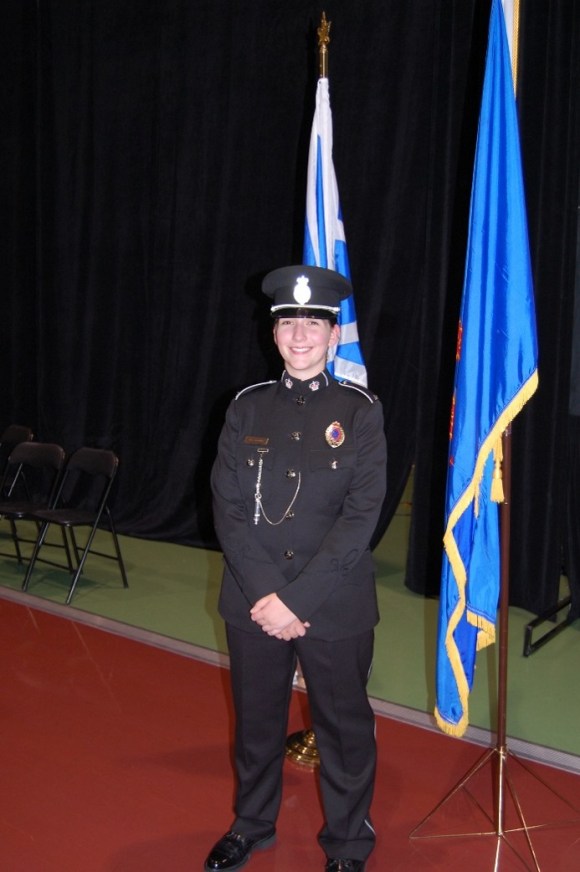
From 2007 to 2018, I served as a police officer with a provincial police service in Canada.  Starting on patrol, I also worked in communications, criminal investigation division, and forensics, I gained experience providing front-line response in a wide variety of emergency contexts. Prior to becoming a police officer, I spent my youth playing sports, specifically hockey and rugby, which resulted over the years in numerous sports-related injuries, including having my nose broken three times.

Figure 1: Graduation Day, 2007

Unbeknownst to me, my broken nose led to a deviated septum – a condition where the middle portion of the nose was twisted, obstructing airflow and preventing proper drainage. I knew my breathing was laboured; a girl in my police recruit class commented on how loud my breathing was, and I couldn’t run with an ‘in through the nose, out through the mouth’ pattern.  Finally, in the Winter of 2017, I saw an ear-nose-and-throat (ENT) doctor. I learned that the obstruction in my nose had created growths within my sinus cavities called polyps.  My nose needed to be reconstructed, and the polyps had to be removed.  The surgery went well; however, I could not have anticipated the results.  On the outside, my nose looked the same. On the inside, however, I quickly realized how poor my sense of smell had been once it had been fully restored.

Working in Forensics is unlike any other job. Calls range from minor incidents involving photographs of property damage and forensics processing of stolen vehicles, to crime scene management and analysis of complicated homicide scenes.  In my province, there is no coroner; every death at home is attended by patrol and forensics to rule out foul play.

Figure 2: Caught by the media while photographing a scene, 2017

The first few weeks after the surgery were tricky.  As my nose was healing on the inside, it would occasionally bleed if I got up too fast or bent over.  Normally, this wouldn’t be cause for concern; however, working in forensics brought the potential of introducing contamination into a crime scene. The last thing anyone wants to do is affect the integrity of a scene or necessitate questions about why your DNA is everywhere! This is commonly discussed in forensics; German police discovered scene contamination introduced by a cotton swab factory worker in Austria after the worker’s DNA was located at multiple scenes (Himmelreich, 2009).

After my nose healed, I quickly became aware of my heightened sense of smell. Before this point, I genuinely thought some people just experienced crime scenes and death differently than others in terms of fortitude, determination or tenacity. To say I was shocked is an understatement. Walking into a heavy smoker’s home, standing next to people with strong odours (good and not so good), and even the smells of diverse cuisines were astonishing compared to the previous complete absence.  The difference was jarring; I could smell the iron in blood, and the chemicals I used for processing, where there had been nothing before. Autopsies were a completely different experience, as was the newfound sensory overload of crime scenes. I was astonished by the difference, finding a huge disparity in my personal perception of my work as a result of regaining my sense of smell. The increased ability to smell made it challenging to leave work behind; my hands continued to smell like nitrile gloves, my skin seemed to exude the cleaning chemicals I used before leaving work, and unfavourable experiences lingered in my hair and on my clothes with apathetic vestige, making it harder to wash off the day. Smell, as a sense, is important, but it can also have lasting effects on well-being. Examining smell, Hur and colleagues found a strong correlation between smell and depression, with the prevalence of depression in individuals reporting negative or challenging smell experiences at nearly 40% (Hur et al., 2018).  Taste and smell problems can be the result of trauma to the head (Schechter & Henkin, 1974). Sense of smell can be influenced by fractures to the face (Drareni et al., 2021) and may be altered by diet (Liu et al, 2020; Stevenson et al., 2020), and salt intake (Henkin, 2014). Vestibular sensory systems may be negatively affected by sleep disruptions, impacting vision and balance (Besnard et al., 2018). Thus, police may be further at risk of sensory changes compared to others, as the profession involves physical altercations, shift work disrupting sleep, and often poor eating habits. These findings are especially timely, given the reported impacts on olfactory experiences by people recovering from COVID-19 (Coelho, 2022).

Souhami (2023) argues that police are affected by their sensory experiences, such as working in the dark, which influences how they work. I agree with Souhami that my perceptions in policing were altered in the dark, and I was aware of this influence. For my entire tenure as a police officer, I refused to watch horror movies for fear it would influence my ability to do my job – you can’t be afraid of fictitious movie characters when you’re running through the woods at night. Police work in an environment where perception is everything. The interpretation of threats helps us determine action, but our interpretation of the world around us is subjective. Fear is an adaptive mechanism intended to keep us safe (Gagnon et al., 2013); however, when afraid, we perceive situations as having more risk (Stefanucci & Proffitt, 2009). For police officers and other first responders, training emphasizes vigilance and safety. The work is stressful and is physically and mentally injurious (Pooley & Turns, 2021). The “anti-police rhetoric” is common (Pooley & Turns, 2021), with perceptions of vulnerability leading to increased hypervigilance as a means to maintain feelings of safety (Pooley & Turns, 2021). Hypervigilance can also be heightened as a symptom of posttraumatic stress, a further consequence of the work, with police experiencing higher rates of PTSD than the public (Carleton et al., 2018).

Souhami (2023) also describes police visual perceptions of their environment as imbued with feeling, calling for increased scholarship into sensile influences. In response, I would argue that there is significance beyond sight in our sensory experiences. It is not solely the vulnerability in the dark or our visual experiences that lead to a change in our perceptions, but the combination of our olfactory, vestibular, proprioceptor, auditory, tactile and oral sensations, known and unknown.

The dark itself is known; we are generally aware of our reduced perception and increased risk. The feeling of vulnerability tells us to pay attention, to be aware, to stay safe. I always preferred night shift, as a ‘night owl’ myself. Working at night felt less restricted with less traffic slowing down around me, fewer calls for service, and fewer car accidents to attend. In the summer months, the cool air was a reprieve from enduring body armour in the hot sun. Weekends were always busy, but weeknights sometimes permitted time to catch up on paperwork, actually eat a lunch on shift, and carried the hope of fewer files for follow during the following week.

Familiarity, however, makes a difference. During one call for service in my early patrol days, I responded to a domestic disturbance call in an area outside my regular district. It was dark, and I was in a part of town that I was unfamiliar with, dispatched there because the unit in the area was assigned to another matter on the busy summer Friday night. The newness of the area increased my attention and intensified my focus. The dark felt darker, and the air hinted at a crispness that should have been absent on a warm summer night. I remember the walk up the long driveway, the gravel crunching under my work boots, while I was trying to figure out which door I should knock at. Before I could knock at the door, a huge German Shepherd appeared on my flank out of nowhere, running forcefully at me, with explosive and thunderous barking. The dog ended up being friendly, but the fear induced by my lack of visual acuity, the sudden sound and intensity of the dog barking, and the abrupt disruption to my vestibular senses and proprioception system during the swift turn was disorienting in an unusual way. I was looking for risk as I was approaching the house, I felt aware, though that sense of awareness was spurious, and the subsequent shock was galvanizing.

The sensory input of the unknown is invisible and profound. We ignore our sense of smell until we have a head cold and lose taste. In policing, smell itself acts like a warning system; approaching a door, I would get a sense of what to expect.  During one call for service where a lady had passed away at home, the patrol officer tried to warn my colleague and I, both in forensics, about the scene inside. We immediately dismissed his comments, thinking patrol officers were always dramatic about death scenes. Entering the front door was like walking into a brick wall. The dozens of cats inside had saturated the air with heavy ammonia, and I felt like I could see the air waving, heavy with dolor. We knew we had to go upstairs, but each step was forced and burdensome like walking through water. The creak of each stair was deafening, the swoosh-swoosh-swoosh of our Tyvek protective suits redounding between our ears. The cats wanted attention, moving in and out between our legs, limiting the space on the cramped stairs. We got halfway up to the second floor when my colleague stopped solid. “We have to get out,” she said with veiled panic. I could feel the sweat coming down my forehead, and I could see it in her hair, too. I remember telling her that if we left, we would have to come back in, we were already halfway there. The following ten or fifteen seconds of eye contact between us felt like it lasted an hour. We would have to come back in.

Prior to surgery, I attributed my ability to withstand the challenges of policing to a personal aptitude or individual competency. Being able to experience the change in perception, while challenging, allowed me insight into how fundamental sensory experience is to functional ability, focus, capability, and coping. Schleiermacher, concerned with language, wrote, “every utterance corresponds to a sequence of thoughts of the utterer, and must therefore be able to be completely understood via the nature of the utterer, his mood, his aim” (Schleiermacher, 1998, p. 229). I would argue this conceptualization of language can be extended to our sensory experience; our perceptions are rooted in our context and standpoint in the moment and over time, which in turn, influences our experience and contextualizes our disposition and abilities. If, as voiced by Wittgenstein, “the limits of my language mean the limits of my world” (1922, p.201), our ability to understand and explain our experiences is vital to processing and conceptual expansion, and potentially, could have long reaching impacts for mental health, job satisfaction, and wellness. For example, understanding sensory needs holistically could influence perceptions and our choices. Something as simple as chewing gum can reduce stress during stimulus experiences (Yu et al, 2013), decrease the levels of cortisol in saliva (Tahara et al, 2007), and increase perception of performance and wellbeing (Smith et al., 2012). Gum chewing may also improve memory (Hirano et al., 2008) and positively influence attention (Hirano et al., 2013). For police, the influences on the visual, olfactory, tactile, vestibular, proprioceptor, gustatory, and auditory systems are complex and variable, and knowingly and unknowingly affect vulnerability and perceptions due to the conditions and environment in which police work. I agree with Souhami, we should not be afraid of the dark. But we must consider how the combination of perception, vulnerability, and all sensory aspects influence us in immeasurable, substantial ways. We still have to do the job, knowing the dog may not be friendly next time, knowing we will have to come back in.

Categories
Emotions Environment Gender nighttime sensory smell space Uncategorized

The Night-Self

Chloe Young

A sea of revellers, young people laughing and dancing in a club.

It all started with shimmering bodies, a sweaty room, and the strobe lights of my favourite club.

The glitter we had meticulously applied in my bedroom, just hours before, had sunk its way down the faces of my friends, the result of our bodies being pressed up against other sweaty strangers. Coming into the club from the street outside, you’d be hit with a nauseating wave of sweat, vodka, and a sickly warmth that’d cling to your hair. Disgusting. And yet… Magical. As I had looked around the room, I’d found myself wondering where else such unfamiliar bodies would collide and become one sweaty blur. Where else would I not only let a stranger’s sweat fall on me but choose to let it in the pursuit of joy, pleasure, and fun. What I didn’t know then, as my body thrashed around in time with the music, was that these questions would set in motion a PhD trying to understand the self we become in the night-time economy.

My passion for nightlife cannot be separated from a youth spent sneaking into pubs and clubs in my small town on the Welsh border. Armed with a fake ID and whatever alcohol I could steal from my mother’s cupboard, I knew even then that there was something unique about the world of nightlife. That it offered me something magical. Something new. Something different.

And, most fascinatingly of all, that I was different.

Even now, I can recall the smell of the first bar I snuck into. With just a whiff of the perfume that I used to wear at that age, something fruity and sweet with a twinge of burnt popcorn, I’m transported back to the sticky aftertaste of spilled booze and sugary beer. See, the club itself that had a certain smell built into its four walls… The synthetic scent of a low budget fog machine and its chemical haze reaching across the room, mingling with the aroma of too many spilled vodka cranberries. No matter how many times the floor must have been cleaned, the sour sugar had etched itself into the floorboards.

Then there were the human smells. Sharp floral undertones fighting against the unescapable stench of sweaty body odour. When you’d first walk in, the smell was a strong and almost unescapable stench. But, over time, the smell would encompass you until it was barely noticeable anymore. You’d become part of the messy throb of bodies until the question of whose sweat was whose was simply impossible to answer. The sweat would bead on brows, soak shirts, and blend into a mix you couldn’t distinguish yourself in. You could smell the heat radiating off our skin as the bodies packed in tighter, the music seemingly louder, and any traces of perfume long gone. Disgusting? Magical? Both.

See, I loved the “Night-Time Economy” (NTE) before I even knew what this term meant. While there is no standard definition for the NTE, this is a label given to a wide range of nightlife sites such as pubs, bars, clubs and their associated services. Despite all the label encompasses, the phrase has most often been used to refer to the economic activity of the night-time city. However, the NTE is so much more than an economy, and I ask whether something is missed when we attempt to bound and define the space through its commercial activity.

Instead, could the sensory elements of nightlife allow us to better understand the NTE and its happenings within? Would we better capture the NTE by understanding it as an affective atmosphere where normal daily life comes to be suspended for a moment of ‘in betweenness’ (Turner, 1967)? Thinking about the NTE in this way, beyond its bounded and regulated zones (Newton, 2015, Philpot et al, 2019) paves the way for an understanding of nightlife as a social arena both made up of and producing embodied experiences evoking shifts in behaviours, identities and relationships with risk. Is nightlife really just made up of disconnections and continuities with our daytime subjectivities?

Nightlife spaces are, to borrow Durkheim’s term, socially and sexually effervescent places. The environment, often loud and electric, offers ‘possibilities of pleasure, excess and gratification” (Measham, 2004, p343). And, most importantly, it primes bodies to behave in certain ways. But how?

This is where affectivity comes in.

Affectivity refers to the realm of the unconscious and of the passions, emotions, and moods that all play a role in shaping our world around us. Conceptualizations of affect allow us to go one step beyond what is merely felt and make sense of the unconscious realm. Vague, and yet often incredibly intense, affect is thus the sensation that a feeling then expresses (McCormack, 2008). McCormack offers us the perfect example of affectivity… we know how a room of dancing bodies feels before we could begin to put the sensation into words or assign it a feeling.

Affects can layer upon each other to create an atmosphere that, “like a haze” (Bohme, 1993) radiates from and through individuals. This haze is contagious and fills a space in a way that spreads and induces moods, relations, and behaviour that align with the atmosphere, rather than any personal morality. As such, the crowd can be brought closer together, both emotionally and in proximity, in the formation of an imagined community (Anderson, 1983). A community built upon the stickiness of sugary mixers and a sticky floor that won’t wash out of your shoes no matter how hard you try. But, also, the stickiness of an affective atmosphere that sticks to, and with, those within it.

‘Getting lost in the crowd’ is a phrase we’ve all heard before and feels apt here. Both for how individuals tune into the affective flows around them in the NTE, but also how a ‘day self’ can be lost in the NTE and replaced with our new ‘night-self’ with a new set of tolerances, desires, and ideas. See, nightlife venues can be vibrant, exciting, and electric – the perfect place to get “lost” in… and this isn’t something that just happens by accident. The deliberate usage of lighting, décor and music contribute to engineering an affective atmosphere (Tan, 2013), which in turn affects rhythmic relationships between bodies and their wider spacings (McCormack, 2008; Tan 2013).

These affective atmospheres don’t exist outside of the bodies experiencing them. Picture walking into an empty club. You’ve timed it wrong. Or maybe you’ve picked the right time but on the wrong night.  The music is still loud, the lights still flash… but it’s not the same. This space needs bodies within to ‘warm it up’ (Duff and Moore, 2015) and create the atmosphere that, ironically, those  very bodies are craving by going to a nightclub.

The way I write about, and photograph myself and my friends in the NTE, suggests it is a magical place of community, excitement, and affirmed identity. Which it can be… but isn’t always. It is no secret that the space is saturated with reports of violence, sexual assault and drug use. It’s then not surprising that the NTE is commonly thought about as a place of victimisation and violence.

There is no denying the dangers, darkness, and risk of the NTE, and any attempt to diminish this would be naïve but could also risk misunderstanding something incremental about nightlife…For, the pressing question is: why do we still go despite the potential risk and danger? Or…is this risk part of the attraction? Does it hold a seduction because we don’t always find this elsewhere? In suggesting risk becomes part of the allure of the NTE, is worth noting here that there is an important distinction to be made between feeling uncomfortable in a space and being unsafe (Nicholls, 2019).

For example, I’d feel extremely uncomfortable on a bungee jump at a great height- but would not actually unsafe (as long as I’m properly harnessed in that is!) So, despite the great waves of adrenaline pulsing through my body as I’d leap off the edge, I wouldn’t be in any danger. This distinction is important. Even the most reckless of adrenaline junkies who seek the thrill of “living on the edge” take actions to minimise the level of danger they put themselves in through a range of risk mitigation strategies. See… you can’t enjoy the thrill if the thrill kills you. Thus, when thinking about thrill seeking in the NTE, it is crucial that such behaviours involve the night-self losing control – in a controlled manner. Or, losing control but only temporarily (Briggs and Turner, 2011).

The controlled loss of control materialises across nightlife. This is not just in the risk-taking behaviours within, but in the way we let our bodies move, interact and leak. Outside of sports events, there are few places where a body may “leak” like they may in a nightclub, revelling in its sweaty form without becoming out of place. Bodies are typically expected to be bounded and any bodily materials that threaten this (tears, sweat, blood, urine) have come to transgress the edges of acceptability. While there is nothing inherently disgusting about these fluids, the sweaty, smelly, unbounded body has been cast as something inappropriate in our social spaces today.  But not necessarily for the night-self…

I always make sure to pack deodorant in my bag when going into the PhD office, scared to get caught out or be “smelly”. Yet, despite much more skin exposed and adrenaline induced sweat, I’d never bother to cram such a thing into my handbag when going clubbing. In the office, deliberate attempts are made to reduce the possibility for sweating through air-conditioning or architectural design (Waitt, 2014), but the NTE offers a unique thermodynamic environment and a very different set of norms about sweat itself. Pennay (2012) suggests that club spaces provide individuals with the chance to be grotesque and ‘occupy an uncivilized body for a night: to grin like a fool; to laugh too loud; to sweat it out on the dance floor; to flirt outrageously; talk well-meaning shite to strangers; feel sexual, carnal and exhilarated” (Jackson, 2004, p. 123 in Pennay, 2012). Crucially, this idea of “sweating it out” and being “sexual” challenges the conditions that people usually face in regulating their bodies to maintain a “professional” image. Perhaps then, people seek out the NTE not in spite of its so-called ‘grossness,’ but because of it; sweaty bodies in the NTE are liberated to leak, sweat, ooze, but most importantly, to interact with other bodies and their fluids outside of gendered bodily structures. So, reflecting on my opening story, maybe that is why I don’t mind other bodies sweating on me as I dance, hair stuck to my face, arms up, and glitter rolling down my cheeks.

Then the lights come on. The air feels heavier, and the smell of danger loiters in the corners of the club as bodies fight their way to pile out onto the street, each on a mission to get a taxi or find a chip shop still open. The music, replaced by a chorus of drunken shouts, rings in your ears as your sweaty clothes cling to you like a second skin you can’t shed.  The air outside is like a slap to the face as your body is hit with reality carrying on outside of your night. Someone’s laughing… Someone’s crying… Someone’s throwing up. Sweat begins to dry down your back as your skin still hums from the vibration of dancing bodies, the smell of quickly stagnating and stale clothes. The sound of bare feet slapping along the pavement rings out as shoes are kicked off for the walk home, wet hair dripping with a concoction of spilled drinks, tears, and sweat. The taste of makeup sliding off your faces, leaking its way down onto white tops that had been carefully chosen and spritzed with perfume just hours before. The leaky, messy, dripping body… Free. For tonight at least.

Nightlife offers us something truly unique, and the chance to be unique. The NTE is magical, scary, and extremely messy… but also special. Trying to understand the NTE through a bounded and overly sober approach would be to neglect what makes nightlife what it is and why it plays such a big role in sociality today. As continue to research the “Night-self” and its affective capacity, allure, subjectivity, tolerance, and vulnerability, I hope to make sense of the NTE in a way that speaks to a truth about the space that has been so often overlooked… That the night-time economy is so different to any other space precisely because we’re different within it.

References

Anderson, B. (1983). Imagined Communities: Reflections on the Origin and Spread of Nationalism. London: Verso.

Bohme, G. (1993) ‘Atmosphere as the fundamental concept of a new aesthetics’ Thesis Eleven 36: 113-126

Briggs, D., & Turner, T. (2011). Risk, transgression and substance use: An ethnography of young British tourists in Ibiza. Studies of Transition States and Societies3(2)

Duff, C., & Moore, D. (2015). Going out, getting about: atmospheres of mobility in Melbourne’s night-time economy. Social & Cultural Geography, 16(3), 299-314.

Jackson, P. (2004). Inside clubbing: Sensual experiments in the art of being human. Oxford: Berg

McCormack, D. P. (2008). Geographies for moving bodies: Thinking, dancing, spaces. Geography Compass, 2(6), 1822-1836.

Measham, F. (2004). Play space: Historical and socio-cultural reflections on drugs, licensed leisure locations, commercialisation and control. International journal of drug policy, 15(5-6), 337-345.

Newton, A. (2015). Crime and the NTE: multi-classification crime (MCC) hot spots in time and space. Crime Science, 4(1), 1-12.

Nicholls, E., & Nicholls, E. (2019). ‘People Don’t See You if You’re a Woman and You’re Not Really Dressed Up’: Visibility and Risk. Negotiating Femininities in the Neoliberal Night-Time Economy: Too Much of a Girl?, 207-252.

Pennay, A. (2012). Carnal pleasures and grotesque bodies: Regulating the body during a “big night out” of alcohol and party drug use. Contemporary Drug Problems, 39(3), 397-428.

Philpot, R., Liebst, L. S., Møller, K. K., Lindegaard, M. R., & Levine, M. (2019). Capturing violence in the night-time economy: A review of established and emerging methodologies. Aggression and violent behavior, 46, 56-65.

Tan, Q. H. (2013). Flirtatious geographies: Clubs as spaces for the performance of affective heterosexualities. Gender, Place & Culture, 20(6), 718-736.

Waitt, G. (2014). Bodies that sweat: the affective responses of young women in Wollongong, New South Wales, Australia. Gender, Place & Culture, 21(6), 666-682.

Categories
History overcrowding prison smell

eau de Durham

Michael Spurr

From my room on the third floor of St Chad’s College I would look out across the river and watch the prisoners in Durham Gaol take their daily exercise. Walking round and round in circles. Always in circles. I walked past the gaol myself, most days, en route to the Economic History Department ( or sometimes en route to the Dun Cow ) but like most students (and most people) I really didn’t give the prison much thought. Then a Careers Adviser asked if I’d ever considered the Prison Service as a career. I hadn’t, but the conversation sparked an interest and shortly afterwards I found myself outside the Victorian gate waiting to enter a prison for the first time. ‘Why are you thinking of joining the Prison Service’ asked the Governor, apparently bemused that a Durham University student wanted to visit his prison. But he had organised an Assistant Governor, Jim Phillips, to take me round and that visit set the direction for my working life.


There are two things I remember most vividly from that afternoon. The first was my shock at finding remand prisoners, unconvicted and therefore innocent in the eyes of the law, in the worst living conditions. Three to a cell designed for one with only a bucket for a toilet and locked up for most of the day with nothing to do. The second was the smell – or as one Officer put it the ‘eau de Durham’. It was pungent, an institutional odour but particular and unique to prison. A combination of cleaning fluid and carbolic soap masking the stench of bodily fluids, slop buckets, and tobacco (cannabis and other drugs were not quite so prevalent then). It was an unmistakeable prison smell or to be more precise an unmistakeable local prison smell – for it was local prisons which suffered gross overcrowding, where unconvicted prisoners were held three to a cell with nothing to do and where slopping out was the daily routine. It was a smell I came to know intimately when I became a Prison Officer at HMP Leeds.


And it was at Leeds that I learned, to my surprise, that many unconvicted prisoners did their best to prolong their time on remand. You see it counted towards any subsequent sentence and, whilst living conditions were grim, you were held locally, could have a visit for 15 minutes every day, and you could receive food and drink from your visitors! Two pints of beer or a bottle of wine a day were permitted -though being Yorkshire in 1983 there wasn’t much call for wine. Oh the joy of the visits search detail which meant not only searching prisoners but also decanting beer into jugs; delving into pies; straining stews; and exploring curries for contraband before taking them up to the landings for the men. All these smells added further depth to the distinct prison odour requiring even more cleaning fluid and carbolic soap the next day.


Then there was the original ‘barmy army’ – the cleaning party whose job it was to pick up the ‘shit’ parcels thrown out of cell windows along with the discarded food – a feast for the pigeons and the rats. The men did it with stoic good humour but it wasn’t a job for the faint hearted! A trip to the Bathhouse on C Wing for a shower was a daily reward for the ‘barmies’ but for most prisoners that luxury was at best a weekly event – and only then if you were lucky. Holding around 1300 prisoners in a prison built for 550 created its own challenges. Staff were simply relieved to complete the ‘daily miracle’ and get through the day. Prisoners acquiesced and largely did what was required because that was how it was and stepping out of line risked unofficial physical punishment and an overcrowding draft to Durham or further afield. It was a world invisible and ignored by those outside; ignored that is until it all boiled over at Strangeways in 1990 and riots followed across the country.

The resulting Woolf Report proposed radical changes to the Prison system. An end to overcrowding and provision of proper sanitation in cells were two of its main recommendations. Thirty years on, to our shame, overcrowding is still with us ( around 20 000 prisoners are housed in cells designed for fewer people) but slopping out officially ended on 12 April 1996 and the environment in local prisons was dramatically changed as a result. Unconvicted prisoners had, by then already lost their right to have food and drink brought into prison; showers were increased and moved onto individual living units; and then eventually tobacco was banned (though illicit substances are still smoked in most prisons). These reforms -particularly the ending of slopping out -have permanently changed the environment for prisoners and staff – and definitely for the better!


Prisons today continue to provide a unique and immersive sensory experience. Living conditions for many prisoners, particularly in Victorian gaols -starved of investment, remain very poor (far from what should be acceptable in the twenty first century) but the dreadful unsanitary conditions found in local prisons in the 1980’s have thankfully been consigned to history. Still I will never forget that smell – it has permeated my senses forever!

Categories
prison PrisonFamilies Touch

Staying in touch

Natalie Booth

A number of claims have been made regarding the importance of prisoners staying in touch with their family through prison visits, firstly from a humanitarian perspective of enabling family members to see each other, but also regarding the impact of maintaining family ties for successful rehabilitation, reintegration into society and reduced re-offending (Dixey and Woodall, 2012: 29[i]).

There is now a wealth of literature suggesting that, where possible, people in custody should be encouraged and supported to ‘stay in touch’ with their relatives, friends and/or significant others. Yet, in the context of prison, the phrase ‘stay in touch’ cannot and should not be understood in the literal sense. Aside from a short embrace at the start (and perhaps at the end) of a prison visit, physical interaction – touch – between a prisoner and a loved one is not generally allowed. This is perhaps why Dixey and Woodall have suggested that staying in touch is more likely focussed on another of our senses – sight.

A recent trip to the visitor’s centre of a female prison left me thinking more about the sensory aspects of visiting. Initially, I was drawn to the look of the prison – the institutional ooze of the place – the lino floors that squelch with every step, and the generic, grey painted walls, the ‘fire retardant’ doors and those low squishy chairs with scratchy fabric that you get both in the doctor’s waiting area and our university offices. They’re normally a bland colour – brown, beige or, if you’re lucky, green!

There’s also a smell. Stuffiness underscored with bleach or other cleaning materials. The smell might take you to other institutional settings – a hospital or, in my case, roaming my school corridors after hours, after the cleaners had been. While I talk about a recent trip to the visitors centre, I know this isn’t the first time my senses have been enlivened by the visitors centre. There’s no doubt my memory has previously transported back to those school corridors. However, it was the first time I really considered touch.

Feel. Stroke. Press. Hold. Pat. Embrace. Cuddle. Hug. Lean. Snuggle. Touch.

Tactility and physicality were brought even more strongly into focus during my discussion with a visitor. This greying male visitor half-jokingly remarked that ‘the officers touch me more when I come here than my wife of 30 years!’ While at first we both chuckled at this comment, when our eyes connected, we both felt the sting of truth which underscored his observation of ‘the visit’.  Indeed, the pat down search from the officers – much like that which you might experience at an airport – is likely strong competition for the short embrace he was permitted with this wife when he first entered the visiting hall.

This competition was twofold. First, in its duration. Second, in the level of intimacy it involved.

I am referring to a ‘normal’, social visit at a prison which likely lasts around an hour and takes place fortnightly for sentenced prisoners. It is not my intention to consider what his statement signals about prison security. Instead, the discussion here focuses on a reflection on the interactions, connections, communications which are – and which are not – possible within this space. Recalling visits I have attended, I find myself questioning afresh some of the observed interactions…

How a young couple, used to living together, used to sleeping next to each other every night, copes with a 5 second embrace once every 14 days? How they navigate sitting across a table from one another for an hour when they’re accustomed to snuggling up on a sofa for whole evenings at a time? How a brief, brush of their hands out of view of the prison officer reminds them of the time when they could walk hand-in-hand?

What about a mother seeking to hold, to calm, soothe and help ameliorate the pain, the vulnerability, the worry their adult incarcerated child is displaying? What happens when a sob escapes? When tears trickle down a cheek waiting to be wiped away by Mum who, instead, cannot reach across the table to fulfil what she might feel is her intrinsic, maternal responsibility?

How must it feel to parent in prison? To be a parent who may be allowed to hold a young child on their knee while stationed at their designated table in the visits hall, but who cannot get up, chase, play, run, tumble or jump around with their young child in the children’s play area? Who cannot lift their child up and make noises and gestures which turn their child into an imaginary aeroplane? Or bounce them around to the tune of ‘the Grand old Duke of York’?

Visits contain intrinsically personal moments, feelings and experiences in a particularly stark, institutional and very public space. I am not suggesting that all physicality appropriate within the home or private spaces would be – or could be – directly replicated within the social visiting environment.  Yet, this does not mean that opportunities for tactility are not appropriate at any time or place within the prison.

To some degree or other there are existing opportunities for tactility in prisons. In prisons overseas some couples are permitted conjugal visits. Whereas, many prisons serving England and Wales offer extended visiting days, sometimes called ‘family days’, ‘lifer days’, or ‘children’s days’. Some prisons have overnight facilities for mothers and children[ii], while others have recently introduced family rooms[iii]. After the initial searching, security at these events is generally reduced meaning that movement and interaction is more readily available[iv]. This includes opportunities for appropriate (e.g. non-sexual) physical contact.

Importantly, we should not get into the habit of arguing that the availability of some extended visits in some prisons serving England and Wales provides exemption from questioning the significance of touch…or its absence. This is especially relevant when there are so many discussions in research and policy emphasising the benefits of ‘contact’ for individuals experiencing a period of enforced separation by imprisonment[v]. We are talking about husbands, wives, partners, mothers, fathers, grandparents, aunties, uncles, brothers, sisters and friends who, in the prison, may be trying to continue performing their roles and, in the future, may wish to resume previously held identities. How might increased tactility aid these ventures?

Beginning to engage in this kind of sensory questioning has – at least for me – raised more questions than it has answered. At an extreme, I am wondering whether it would be possible for people separated by imprisonment to stay in touch by actually staying in touch…


[i] Dixey, R., and Woodall, J., (2012) The significance of ‘the visit’ in an English category-B prison: views from prisoners, prisoners’ families and prison staff. Community, Work and Family, 15 (1), pp.29-47.

[ii] e.g. Acorn House at HMP Askham Grange.

[iii] e.g. recently created family rooms at HMP Oakwood.

[iv] See: Booth, N., (2018) Family Matters: A critical examination of family visits for imprisoned mothers and their children. Prison Service Journal, 238. Available: https://www.crimeandjustice.org.uk/publications/psj/prison-service-journal-238.

[v] e.g. Lord Farmer., (2019) The Importance of Strengthening Female Offenders’ Family and other Relationships to Prevent Reoffending and Reduce Intergenerational Crime. London: Ministry of Justice.