Categories
Environment police power prison probation research Research methods sensory Uncategorized

International Handbook of Sensory Criminology Series: 1

Introducing… Sensory Criminology: Expanding the Criminological Imagination

This short post marks the opening of a series dedicated to discussing each of the organising themes of the Routledge International Handbook of Sensory Criminology, in preparation for its launch. Each piece will leave comments open as an experiment in discussion. Please feel free to leave talking points or ask questions – we particularly welcome questions from students.

The book asks what the sensory can contribute to our understanding and pursuit of criminological inquiry? What might the value be, of attending to the sensory in social scientific and criminological investigation? What do we even mean by “the senses”? Conventionally thought of as being restricted to sight, sound, smell, touch, taste – and often laid out in that hierarchy – what happens if this is extended to include a broader range of perceptual stimuli? What happens to how we can utilise a sensory approach to criminology if we add clarity, distinguishing it from adjacent, but distinct, theoretical frameworks adopted by phenomenological and affective perspectives? How can we think about violence and its politics, how coloniality and imperialism frame our understandings of justice and punishment, narrative and the arts in the context of criminal justice – and its absence, Environmental harm and how criminal justice practices impose particular understandings of place, space, time and justice, and how the sensory can inform methodological approaches to the rapidly changing contours of criminology and society.

The handbook is dedicated to expanding these ideas and considering how developing a set of principles to guide our approach to sensory criminology works to allow for a deeper consideration of implications for decolonial thinking. This enhances capacity, we argue, for disrupting western empirical hierarchies and the social systems they both shore up and are reinforced by. The book aims to amplify voices and experiences from beyond the Global North and to expand the possibilities of our criminological imagination.

CONTENTS

Sensory Criminology: Expanding our Imagination   Kate Herrity, Kanupriya Sharma, Janani Umamaheswar, Jason Warr

Section 1: Sensory Politics of Violence

Sensing Violence: Traces, Echoes, and Afterlives Liam Gillespie, Kanupriya Sharma and Hannah Wilkinson

  1. Listening to Donald Trump’s Voice: ‘Fight like hell!’, the Capitol Hill Riots, and the Spectre of Teleprompter Trump Liam Gillespie             
  2. ‘SHUT YOUR FUCKING MOUTH’: Sound, Silence and Gender-Based Violence Amanda Holt and Sian Lewis
  3. The Sound of Violence: Paramilitary experience in Ireland Colm Walsh
  4. War, Colonialism and the Senses: “You can’t unsee or unhear that shit” Hannah Wilkinson

Section 2: Coloniality, Imperialism, and the Senses    

Recognising Abhorrent Legacies: Lessons for Sensory Criminology Onwubiko Agozino, Rose Boswell, Nontyatyambo Pearl Dastile, Sharon Gabie, Andrew Kettler, Macpherson Uchenna Nnam, Jessica Leigh Thornton, and Jason Warr

  1. Doing Justice Differently: A Pan-Africanist Perspective Nontyatyambo Pearl Dastile, Abiodun Omotayo Oladejo, and Macpherson Uchenna Nnam                 
  2. “I’ll Make You Shit!”: Olfactory Othering and the Necropolitics of Colonial Prisons Andrew Kettler 
  3. The Sensory Aspects of Abhorrent Heritage in South Africa Rosabelle Boswell, Jessica Leigh Thornton,  Sharon Gabie , Zanele Hartmann,  and Ismail Lagardien
  4. Decolonizing Sensory Rhetorics and Activism in Africana Prison Memoirs Onwubiko Agozino

Section 3: Sensory, Narrative, and the Arts         

Reimagining Justice through Creative Encounters and Sensory Knowing Glenda Acito, Lucy Cathcart Frödén, Fangyi Li, Lorenzo Natali, Nabil Ouassini, Kanupriya Sharma, Ozlem Turhal, and Raghavi Viswanath   

  1. Black light. Drawing, Music and Theatre as Sensory Practices in the Encounter Between Inmates and University Students Lorenzo Natali , Glenda Acito, and Ozlem Turhal 
  2. Crackle and Flicker: Music and Multisensory Experiences in Prison Lucy Cathcart Frödén and Áine Mangaoang       
  3. Seeing Museums as Criminological Spaces: An Affective Tale of Two Museum Visits Raghavi Viswanath and Fangyi Li
  4. ‘Sensory Criminology, Islamic Auditory Traditions, and Rehabilitation Nabil Ouassini and Anwar Ouassini                          

Section 4: Sensing (In)Justice        

From the Courtroom to the Street: The Sensory Dimensions of Racialised (In)justice Barbara Becnel, Dale Spencer, and Jason Warr

  1. Conflicting Senses, Victims, and the Courtroom: the case of Cindy Gladue Marcus Sibley and Dale Spencer    
  2. The Sensory Effects of Racial Profiling in Berlin’s KBO’s.  Melody Howse                          
  3. Racialized Punishment and the Sensorial Symbolism of Death Row for America’s Black Gangster Class Barbara Becnel             

Section 5: Environmental Harm and the Senses            

“The Way the Soil Crumbled in Their Hands”: Sensing Environmental Harms Amy Gibbons, Ascensión García Ruiz, Janani Umamaheswar, and Aysegul Yildirim

  1. Seeing and Sensing Environmental Harm: The Death of the British Countryside Amy Gibbons                 
  2. The Sensory Ocean: Exploring Noise and Light Pollution as Blue Crime Ascension Garcia-Ruiz
  3. Sensitising Criminology to Experiences of Environmental Noise Aysegul Yildirim

Section 6: Space, Place, and the Sensory           

Vivid and Vibrant Criminological Landscapes: Sense and Space Kevin Barnes-Ceeney, Priti Mohandas, and Janani Umamaheswar

  1. Dispossessed Realities: Houselessness, and Spatial Violence Luisa T. Schneider
  2. Release from Prison Day Kevin Barnes-Ceeney and Victoria Espinoza                        
  3. “I can’t breathe” Housing, Masculinities and Violence in Cape Town, South Africa Priti Mohandas
  4. Scrutinising Social Control in the City through the Senses Anna Di Ronco and Nina Peršak      

Section 7: Time, Justice, and the Sensory

Beholding Justice and Punishment Sneha Bhambri, Eamonn Carrabine, Kate Herrity, Arta Jalili-Idrissi and Jason Warr

  1. Sitting, Seeing and Getting Lost: The Sensory Aesthetics of Latvia’s Women’s Prison Arta Jalili-Idris
  2. Time, Temporality, and Chronoception Jason Warr
  3. It’s a Circus: The Production of Domestic Violence Proceedings in Lower Courts of Mumbai, India Sneha Bhambri
  4. Beholding Justice: Images of Punishment in Medieval and Early Modern Europe Eamonn Carrabine

Section 8: Sensory Methods

“They Are Not Like You and I”: Sensory Methods  Briony Anderson, Kate Herrity, Sarah Kingston and Mark Wood

  1. Sense and Insensibility: How Technologies Invite and Invisibilise Harm Briony Anderson, Mark A Wood, Jackson Wood, Will Arpke-Wales, and Flynn Pervan             
  2. Audio Criminology: Broadening the Criminological Imagination Through the Use of Audio Methods Sarah Kingston
  3. ‘Still feels like jail’: Sensing Danger, Bleakness and Friendship in a State-Run Home For Boys Mahuya Bandyopadhyay, Aishwarya Chandran and Sanjukta Manna

This project began life as a conversation between Tom Sutton and I (Kate Herrity) at the 2022 BSC conference. Shortly after, Kanupriya Sharma, Janani Umamaheswar and Jason Warr joined. The four of us divided up the eight sections which organise the book. Each of the authors of the three or four chapters within them were invited to take part in a discussion with one another about their work. These discussions formed the basis for each introduction section of the book. Since these sections are an accessible way of introducing the contents of the book in a way which lends a substantial project a coherent narrative, they seem like a sensible focus for discussion.

As with all projects, people decline and others drop out, representation is partial, interests and approaches of the editors are reflected in those invited to participate… We discuss all this at greater length and depth in the introduction, along with our hopes for the future and the guiding ethos of the book. We hope to invite more people to the table and enrich a conversation we do not aim to be the last word in.

Categories
Drug Use Music sensory Uncategorized

Getting into the purple drank: An aesthetic and sensory perspective on lean culture

Cosimo Sidoti

Music and psychoactive substances have always gone hand in hand. Their relationship has been embedded in cultural practices since the earliest expressions of human creativity. This music and drug nexus extends beyond the representational domain where drug references appear explicitly in lyrics or visual portrayals. More critically, it operates within a non-representational register, wherein the sonic, visual, and lyrical dimensions of music converge to evoke a multisensorial experience that approximates, simulates, or enhances the embodied sensation of drug consumption and intoxication. It is this immersive capacity to affectively and sensorially reproduce drug experiences that underpins the deeply symbiotic relationship between music and drug cultures. Reggae and cannabis, psychedelic rock and LSD, acid house and ecstasy are some of the most well-known cultural entanglements – both within and beyond academia. Yet, one of the most enduring and tightly interwoven nexuses, though rarely foregrounded in scholarly literature, is the relationship between hip-hop music and lean.

Lean, also known as purple drank, sizzurp, mud, dirty sprite, or even liquid heroin, as commonly referred to in many songs, is a mixture of codeine-based cough syrups and fizzy soft drinks. It resembles the visual appearance of a cocktail where the active ingredient is codeine, a weak opioid that, when used non-medically or recreationally, falls under the broader category of ‘downers’ – psychoactive substances known for their sedative effects. It typically induces a sense of euphoria and inner warmth, making users feel relaxed, chilled, and sleepy. Its spectacularisation through hip-hop music has contributed to the development of lean culture that sinks its roots among African American communities in the Southern United States in the early 1990s. This culture has since been transmitted, imitated, and adapted globally, transcending its meaningful socio-economic and political context of structural inequalities, and illustrating its global allure and affective resonance far beyond its origins.

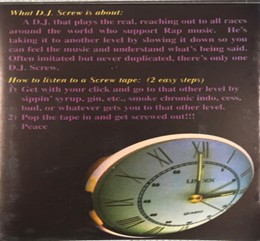
The birthplace of lean can be traced back to Houston, Texas, where it became closely associated with the local hip-hop scene in the 1990s. At the heart of this cultural emergence was the iconic Houston-based hip-hop artist DJ Screw who pioneered a specific hip-hop music genre known as Chopped and Screwed (or Screwed and Chopped) that consisted of remixing hip-hop records by slowing down their tempo (Walker, 2022). Although DJ Screw’s legacy expands far beyond lean as he revolutionised the future of hip-hop music as we know it today, his unique music has often been described as sounding tailor-made for the experience of being high on lean as suggested by DJ Screw himself in one of his tape albums released in 1995 (see Image 1). Just as the music seems designed to be experienced while high on lean, the drug itself feels as though it was made to inspire and create this sound.

The defining characteristic of the Chopped and Screwed sonic aesthetic – blending with the experience of lean – lies in its ability to distort the listener’s perception of time. This temporal disorientation is evoked through slowed-down tempos, stretched-out vocals, and repetitive looping, all of which encapsulate the dissociative, slowed-down, and relaxing sensations associated with being high on lean. Over time, this distinctive sound alongside the use of lean and its (more-than) representations was taken up, reworked, and evolved by a range of music artists into other hip-hop music genres such as trap, drill, and SoundCloud rap (as well as some of their subgenres, such as Rage, Plugg, and so on). This also extended into entirely new music genres beyond hip-hop music such as Vaporwave, emerging in the early 2010s. These sonic elements were further transformed through digital reproduction, incorporating lo-fi techniques, synthesisers, and autotuned vocals that made an even more distorted and imperfect sound. Moreover, as the time of DJ Screw’s cassettes soon passed, these sonic elements were fused with visual aesthetics through music videos consisting of wavy, slow-moving effects and purple[1] hues that not only enhanced this temporal disassociation but also introduced an ambiguous spatiality, inducing a dream-like feeling and atmosphere in which everything seems to float – detached from any concrete sense of place associated with lean.

The symbolic markers of lean as represented in many music videos – including both its main ingredients as the cough syrups and soda bottles, and its paraphernalia as double stacked cups[2] and baby bottles[3] – are often more than represented through these visual effects that appear as surreal and hallucinatory. Therefore, the auratic properties of lean as evoked by the audiovision of such types of music draw viewers into immersive and sensory atmospheres. Many of my interviewees within lean culture recalled their first social encounters with lean through hip-hop music videos not merely as moments of recognition but as affectively charged experiences where the “coolness” attributed to lean exceeds its material properties and resides in its capacity to be represented and more-than represented in multiple aesthetics and meanings that makes it feel endlessly adaptable and culturally resonant. Their initial reaction was often one of surprise and curiosity – “What the fuck is this?” – followed by a sense of encountering something distinctive and unique. They described lean as “a thing no one had ever seen before” and “exclusive, like it was rare”. Here, viewers record of their first attraction to the aesthetic of lean resonate with each other: “wow that looks cool” or “I just thought it looked cool”. These resonances fold back into beliefs and desires to be cool themselves: “when I was little, I thought it was cool to sip lean, it makes you the cool guy”.

The aesthetic of preparing and consuming lean is conveyed through music via sounds, visuals, and lyrics, where the tastes, smells, textures, and colours of lean function as affective channels of transmission. Auditory cues – such as the clinking of ice cubes, the pouring of syrup into a cup, the snap of a soda can opening, or the hiss of escaping gas from a soda bottle – are frequently included within the sonic production and representation of sensory signatures that evoke the ritual of preparing lean. Visually, the brightly coloured mixture of cough syrup and soda creates vivid displays of purples and pinks, used in music videos that draw on the drink’s aesthetic visual appeal. Lyrically, artists explicitly describe lean in terms of excessive sweetness by portraying it as intensely sugary, flavourful, and candy-like in its tasting appeal, while also emphasising the syrup’s thick, viscous, mud-like consistency.

From spectators to spect-actors, listeners and viewers are far from passive consumers; instead, they actively and creatively imitate and readapt artistic performances in which the act of viewing itself is one of action and embodiment (Rancière, 2009). Across all my interviews, the aesthetic of lean was a prominent draw for those belonging to this culture. Respondents reflected on an experience which fully engaged their senses and made the use of lean a multisensorial experience. Among the most prominent sensory features is its intense sweetness, often compared to the taste of candy. While the exact flavour can vary depending on the brand and type of cough syrup – ranging from cherry and strawberry to mint, blackcurrant, or apple – as well as the choice of soda used as a mixer (commonly referred to as “cut”), the overpowering sweet and sugary taste remains a constant. This sweetness is so pronounced that lean is sipped rather than gulped, that is why members of this culture are indeed called sippers. Closely tied to taste is the distinctive smell of lean, which emerges from its sweetness and is highly appreciated by users. Many sippers like the sweet and sugary taste of lean and its smell:

I don’t drink alcohol, I drink lean instead… and my brothers also because it tastes cherry. You mix it with tropical sprite or fanta or whatever you want and man it’s so…if you would like a candy when you were a kid, lean is gonna be a great enemy to you, because it has such a good taste…” (EM from Switzerland, personal communication, 14th January 2025)

That’s the thing too which is crazy that a lot of people don’t know is that like it blows me away that they created lean, like real lean… it tastes good! That’s what blows me away. Like it doesn’t taste like cough syrup… the stuff that you are not supposed to sip like lean that’s the shit that tastes gross, that tastes like medicine, that tastes nasty” (VD from Canada, personal communication, 21st January 2025)

The smell, the colour, and the taste.[…] Oh I love lean. I like the smell… you know wine connoisseurs? When they smell, they drink, they swish it around their mouth, they taste… “yeah that smells good, I like this one”. I’m like that with lean, I consider myself a lean connoisseur.”  (OP from the UK, personal communication, 10th February 2025)

Depending on the type of flavour, the colour of the cough syrup changes accordingly. Cherry-flavoured syrup tends to be red or purple, strawberry is typically pink, mint and apple are green, and blackcurrant is usually purple, among others. Besides the taste, the choice of the type of fizzy soft drink to use is mostly guided by visual aesthetics based on colour compatibility. Only clear or lightly coloured sodas are accepted; for instance, Coca-Cola is never used to make lean, and instead, Sprite – being transparent and relatively neutral in flavour – has become the soda most closely associated with lean. Nonetheless, sippers enjoy experimenting with colour combinations, for instance, pairing purple or red cough syrups with yellow pineapple sodas is a popular choice, as they like the visual contrast of the two colours mixing.

“[I like] the colour that it’s green and or purple and it’s really beautiful to my eyes.” (OS from Mali, personal communication, 07th February 2025)

[About lean, I like] the aesthetic, the bottle, the colours, the drug, the flow, the taste, […], I like to play with the colours, taste some new flavours, all that type of stuff…” (VR from Portugal, personal communication, 13th January 2025) Texture has also frequently been highlighted by respondents as a crucial element in the visual and sensory appeal of preparing lean. In particular, the thickness of the cough syrup plays a fundamental role during the mixture related to the ritualised process of making lean. When syrups with a dense and viscous consistency, like mud, are poured into sodas, the visual effect of the two liquids interacting – especially the slow descent of the syrup dropping into the soda – is considered visually satisfying. Conversely, syrups that are too diluted or watery are strongly disliked by users, as they lack the desired texture and fail to produce the same visually compelling effect.

Benelin [South African codeine-based cough syrup] texture is so thick, it tastes like medicine, it doesn’t taste like sweet even… that, I could drink it straight out the bottle, but with StillPane or others is thinner and is so sweet, so I cannot… I have to mix it…the texture, yeah I love it! It looks good, it looks pleasing!” (TG from South Africa, personal communication, 14th November 2024)

The liquid one is not really good because it’s too liquid… I don’t like it because of the aesthetic but if I need to drink it just to get high I’ll drink it, no problem… but the one that I prefer and looks good it’s the thick syrup.” (MD from Brazil, personal communication, 06th January 2025)

The texture of the cough syrup draws attention to the centrality of tactility in its everyday consumption in relation to the ritualised process of making lean through a series of sensory and textural stages. The first phase, known as pouring up, involves pouring the cough syrup into a bottle of fizzy soft drink (see Image 2). The two bottles are not held at a strict right 90 degrees angle, but rather at a subtle incline so that the syrup gently drops into the soda and goes down the side of the bottle to sediment at the bottom by creating a stratified texture because of the two different liquid densities (see Image 3).

Image 2 Sippers’ preparation ritual: Pouring Up

Source: Screenshots retrieved from Instagram stories

Image 3 Sippers’ preparation ritual: Syrup sedimented at the bottom

The next phase is called flipping, in which, once the pouring up is done, the bottle is closed and inverted by grasping the lid (see Image 4). This upside-down rotation facilitates the slow merging of the two liquids without flattening the drink. Finally, the mixture is transferred into a cup by culminating the ritual (see Image 5) where the process – with its gestures and tactile feel – is just as essential, if not more so, than the consumption itself as highlighted by most of my respondents.

Image 4 Sippers’ preparation ritual: Flipping
                        Image 5 Sippers’ preparation ritual: Pouring the mixture into the cup

Yeah bro, I can’t lie, I love it bro. Me personally, I love the way it drops into the soda and flips. Honestly, me personally, I’m more addicted to the actual pour up, the actual like pouring up the soda, flipping it, watching the lean twirl inside the soda and drop to the bottom, and the colour changing and mix into a nice beautiful pink colour. Like bro I’m in love with that, that is what gets me excited when I pour up.” (VD from Canada, personal communication, 21st January 2025)

I think the addiction is more than just the opioid addiction, the addiction for me is the taste, the smell, the pouring up, the whole activity of drinking lean is what I’m addicted to more so than the actual medicine itself. It’s deep, the status it gives you, the feeling it gives you, the way it makes you feel when you pouring up…” (OC from the UK, personal communication, 10th February 2025)

It’s the ritual, pouring up, flipping a bottle, that ritual… the baby bottle, stuff like that. Mostly because I think my brain associates it with feeling good you know. That’s what I enjoy about it, but also like I hang out with my friends, we just pour up “okay, let’s pour up” you know together… sometimes I do it alone also…” (MD from Brazil, personal communication, 23rd January 2025)

The ritualism surrounding the preparation of lean emerged as one of the most frequently observed daily practices within lean culture during my fieldwork on social media platforms, especially Instagram, where it was predominantly shared through short videos in Instagram stories. These stories not only revealed the tactile and visual aspects of the preparation process during the pouring up and flipping but were also consistently accompanied by hip-hop tracks about lean highlighting, once again, the importance of sound while sipping lean and its multisensorial experience.

The presence of mobile phones to either record or take pictures of the ritual for preparing lean is also an integral part of this process. As much as the cough syrups, fizzy soft drinks, the cups, and baby bottles, therefore, mobile phones are part of the embodied and multisensorial experience that are needed as both a tool for documentation[1] and a medium through which this ritual is performed, shared, and spread worldwide within digital spaces. As such, social media platforms represent newly produced social spaces for drug cultures, to consume, perform, and share drug experiences at the blurred intersections of the online and offline (Manning, 2014). They also exemplify how imitative propagation and affective contagiousness unfold through the aesthetics of lean, rapidly transcending geographical and socio-cultural barriers and evolving into globalising cultural trends.

As criminologists increasingly advocate for an aesthetic and sensory turn in Criminology (McClanahan and South, 2020), significant progress has been made in exploring various criminological issues through these emerging theoretical and methodological lenses (see Herrity et al., 2021; Young, 2023; Holt and Lewis, 2024; etc…). The perspective I have offered on lean culture invites drug scholars to further explore the relevance of aesthetics and sensory experiences in contemporary recreational drug trends among young people worldwide. By doing so, it encourages discussions that could provide fresh insights into evolving patterns of drug consumption and contribute to a broader (sub)cultural analytical perspective that extends beyond the meanings of drugs and their motivations for use.

References

Herrity, K., Schmidt, B., and Warr, J. (2021). Sensory Penalities: Exploring the Senses in Spaces of Punishment and Social Control. London: Emerald.

Holt, A., and Lewis, S. (2024). A Sense of Danger: Gender-Based Violence and the Quest for a Sensory Criminology. Feminist Criminology, 19 (1), 3–24.

Manning, P. (2014). Drugs and popular culture in the age of new media. London: Routledge.

McClanahan, B. and South, N. (2020). All Knowledge Begins with the Senses: Towards a Sensory Criminology. The British Journal of Criminology, 60(1), 3–23.

Rancière, J. (2011). The emancipated spectator. (G. Elliott, Trans.). London, UK: Verso.

Sherratt, Y. (2007). Adorno’s aesthetic concept of aura. Philosophy & Social Criticism. 33(2), 155-177.

Walker, L. S. (2022). DJ Screw: A Life in Slow Revolution. Austin: University of Texas Press.

Young, A. (2023). Listening Criminologically: On the Materiality and Relationality of Sound. Criminological Encounters, 6, 146–56.


[1] Although lean can appear in different colours, it is most commonly associated with the colour purple.

[2] A double stacked cup, or simply double cup, is where one is supposed to sip lean. The reason for the use of double cups is to insulate the drink that needs to be sipped cold and to announce the consumption of lean as part of its visual aesthetic.

[3] Baby bottles are used to dose the cough syrup. One line of syrup, as marked on the baby bottle, would be an ounce and so on.

[4] Documenting the use of lean is important for “real” sippers as proof of their long-lasting relationship with lean that differentiates them from the so-called trend sippers, as those considered within the culture who sip momentarily just because it’s trending.

Categories
Environment police sensory smell Uncategorized

The Pervasive and Unknown Effects of Sensory Experiences in Policing: An Autoethnographic Response

Marina Carbonell

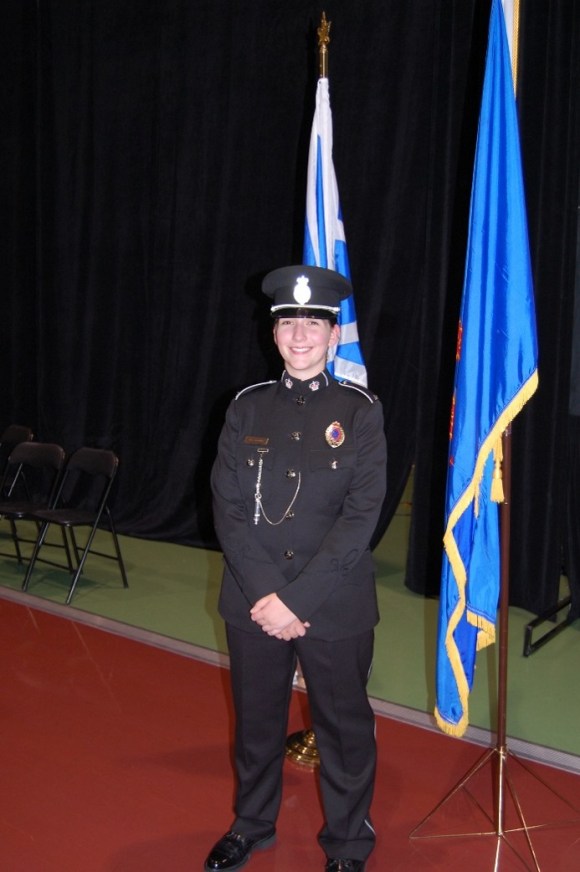
From 2007 to 2018, I served as a police officer with a provincial police service in Canada.  Starting on patrol, I also worked in communications, criminal investigation division, and forensics, I gained experience providing front-line response in a wide variety of emergency contexts. Prior to becoming a police officer, I spent my youth playing sports, specifically hockey and rugby, which resulted over the years in numerous sports-related injuries, including having my nose broken three times.

Figure 1: Graduation Day, 2007

Unbeknownst to me, my broken nose led to a deviated septum – a condition where the middle portion of the nose was twisted, obstructing airflow and preventing proper drainage. I knew my breathing was laboured; a girl in my police recruit class commented on how loud my breathing was, and I couldn’t run with an ‘in through the nose, out through the mouth’ pattern.  Finally, in the Winter of 2017, I saw an ear-nose-and-throat (ENT) doctor. I learned that the obstruction in my nose had created growths within my sinus cavities called polyps.  My nose needed to be reconstructed, and the polyps had to be removed.  The surgery went well; however, I could not have anticipated the results.  On the outside, my nose looked the same. On the inside, however, I quickly realized how poor my sense of smell had been once it had been fully restored.

Working in Forensics is unlike any other job. Calls range from minor incidents involving photographs of property damage and forensics processing of stolen vehicles, to crime scene management and analysis of complicated homicide scenes.  In my province, there is no coroner; every death at home is attended by patrol and forensics to rule out foul play.

Figure 2: Caught by the media while photographing a scene, 2017

The first few weeks after the surgery were tricky.  As my nose was healing on the inside, it would occasionally bleed if I got up too fast or bent over.  Normally, this wouldn’t be cause for concern; however, working in forensics brought the potential of introducing contamination into a crime scene. The last thing anyone wants to do is affect the integrity of a scene or necessitate questions about why your DNA is everywhere! This is commonly discussed in forensics; German police discovered scene contamination introduced by a cotton swab factory worker in Austria after the worker’s DNA was located at multiple scenes (Himmelreich, 2009).

After my nose healed, I quickly became aware of my heightened sense of smell. Before this point, I genuinely thought some people just experienced crime scenes and death differently than others in terms of fortitude, determination or tenacity. To say I was shocked is an understatement. Walking into a heavy smoker’s home, standing next to people with strong odours (good and not so good), and even the smells of diverse cuisines were astonishing compared to the previous complete absence.  The difference was jarring; I could smell the iron in blood, and the chemicals I used for processing, where there had been nothing before. Autopsies were a completely different experience, as was the newfound sensory overload of crime scenes. I was astonished by the difference, finding a huge disparity in my personal perception of my work as a result of regaining my sense of smell. The increased ability to smell made it challenging to leave work behind; my hands continued to smell like nitrile gloves, my skin seemed to exude the cleaning chemicals I used before leaving work, and unfavourable experiences lingered in my hair and on my clothes with apathetic vestige, making it harder to wash off the day. Smell, as a sense, is important, but it can also have lasting effects on well-being. Examining smell, Hur and colleagues found a strong correlation between smell and depression, with the prevalence of depression in individuals reporting negative or challenging smell experiences at nearly 40% (Hur et al., 2018).  Taste and smell problems can be the result of trauma to the head (Schechter & Henkin, 1974). Sense of smell can be influenced by fractures to the face (Drareni et al., 2021) and may be altered by diet (Liu et al, 2020; Stevenson et al., 2020), and salt intake (Henkin, 2014). Vestibular sensory systems may be negatively affected by sleep disruptions, impacting vision and balance (Besnard et al., 2018). Thus, police may be further at risk of sensory changes compared to others, as the profession involves physical altercations, shift work disrupting sleep, and often poor eating habits. These findings are especially timely, given the reported impacts on olfactory experiences by people recovering from COVID-19 (Coelho, 2022).

Souhami (2023) argues that police are affected by their sensory experiences, such as working in the dark, which influences how they work. I agree with Souhami that my perceptions in policing were altered in the dark, and I was aware of this influence. For my entire tenure as a police officer, I refused to watch horror movies for fear it would influence my ability to do my job – you can’t be afraid of fictitious movie characters when you’re running through the woods at night. Police work in an environment where perception is everything. The interpretation of threats helps us determine action, but our interpretation of the world around us is subjective. Fear is an adaptive mechanism intended to keep us safe (Gagnon et al., 2013); however, when afraid, we perceive situations as having more risk (Stefanucci & Proffitt, 2009). For police officers and other first responders, training emphasizes vigilance and safety. The work is stressful and is physically and mentally injurious (Pooley & Turns, 2021). The “anti-police rhetoric” is common (Pooley & Turns, 2021), with perceptions of vulnerability leading to increased hypervigilance as a means to maintain feelings of safety (Pooley & Turns, 2021). Hypervigilance can also be heightened as a symptom of posttraumatic stress, a further consequence of the work, with police experiencing higher rates of PTSD than the public (Carleton et al., 2018).

Souhami (2023) also describes police visual perceptions of their environment as imbued with feeling, calling for increased scholarship into sensile influences. In response, I would argue that there is significance beyond sight in our sensory experiences. It is not solely the vulnerability in the dark or our visual experiences that lead to a change in our perceptions, but the combination of our olfactory, vestibular, proprioceptor, auditory, tactile and oral sensations, known and unknown.

The dark itself is known; we are generally aware of our reduced perception and increased risk. The feeling of vulnerability tells us to pay attention, to be aware, to stay safe. I always preferred night shift, as a ‘night owl’ myself. Working at night felt less restricted with less traffic slowing down around me, fewer calls for service, and fewer car accidents to attend. In the summer months, the cool air was a reprieve from enduring body armour in the hot sun. Weekends were always busy, but weeknights sometimes permitted time to catch up on paperwork, actually eat a lunch on shift, and carried the hope of fewer files for follow during the following week.

Familiarity, however, makes a difference. During one call for service in my early patrol days, I responded to a domestic disturbance call in an area outside my regular district. It was dark, and I was in a part of town that I was unfamiliar with, dispatched there because the unit in the area was assigned to another matter on the busy summer Friday night. The newness of the area increased my attention and intensified my focus. The dark felt darker, and the air hinted at a crispness that should have been absent on a warm summer night. I remember the walk up the long driveway, the gravel crunching under my work boots, while I was trying to figure out which door I should knock at. Before I could knock at the door, a huge German Shepherd appeared on my flank out of nowhere, running forcefully at me, with explosive and thunderous barking. The dog ended up being friendly, but the fear induced by my lack of visual acuity, the sudden sound and intensity of the dog barking, and the abrupt disruption to my vestibular senses and proprioception system during the swift turn was disorienting in an unusual way. I was looking for risk as I was approaching the house, I felt aware, though that sense of awareness was spurious, and the subsequent shock was galvanizing.

The sensory input of the unknown is invisible and profound. We ignore our sense of smell until we have a head cold and lose taste. In policing, smell itself acts like a warning system; approaching a door, I would get a sense of what to expect.  During one call for service where a lady had passed away at home, the patrol officer tried to warn my colleague and I, both in forensics, about the scene inside. We immediately dismissed his comments, thinking patrol officers were always dramatic about death scenes. Entering the front door was like walking into a brick wall. The dozens of cats inside had saturated the air with heavy ammonia, and I felt like I could see the air waving, heavy with dolor. We knew we had to go upstairs, but each step was forced and burdensome like walking through water. The creak of each stair was deafening, the swoosh-swoosh-swoosh of our Tyvek protective suits redounding between our ears. The cats wanted attention, moving in and out between our legs, limiting the space on the cramped stairs. We got halfway up to the second floor when my colleague stopped solid. “We have to get out,” she said with veiled panic. I could feel the sweat coming down my forehead, and I could see it in her hair, too. I remember telling her that if we left, we would have to come back in, we were already halfway there. The following ten or fifteen seconds of eye contact between us felt like it lasted an hour. We would have to come back in.

Prior to surgery, I attributed my ability to withstand the challenges of policing to a personal aptitude or individual competency. Being able to experience the change in perception, while challenging, allowed me insight into how fundamental sensory experience is to functional ability, focus, capability, and coping. Schleiermacher, concerned with language, wrote, “every utterance corresponds to a sequence of thoughts of the utterer, and must therefore be able to be completely understood via the nature of the utterer, his mood, his aim” (Schleiermacher, 1998, p. 229). I would argue this conceptualization of language can be extended to our sensory experience; our perceptions are rooted in our context and standpoint in the moment and over time, which in turn, influences our experience and contextualizes our disposition and abilities. If, as voiced by Wittgenstein, “the limits of my language mean the limits of my world” (1922, p.201), our ability to understand and explain our experiences is vital to processing and conceptual expansion, and potentially, could have long reaching impacts for mental health, job satisfaction, and wellness. For example, understanding sensory needs holistically could influence perceptions and our choices. Something as simple as chewing gum can reduce stress during stimulus experiences (Yu et al, 2013), decrease the levels of cortisol in saliva (Tahara et al, 2007), and increase perception of performance and wellbeing (Smith et al., 2012). Gum chewing may also improve memory (Hirano et al., 2008) and positively influence attention (Hirano et al., 2013). For police, the influences on the visual, olfactory, tactile, vestibular, proprioceptor, gustatory, and auditory systems are complex and variable, and knowingly and unknowingly affect vulnerability and perceptions due to the conditions and environment in which police work. I agree with Souhami, we should not be afraid of the dark. But we must consider how the combination of perception, vulnerability, and all sensory aspects influence us in immeasurable, substantial ways. We still have to do the job, knowing the dog may not be friendly next time, knowing we will have to come back in.

Categories
Emotions Environment Gender nighttime sensory smell space Uncategorized

The Night-Self

Chloe Young

A sea of revellers, young people laughing and dancing in a club.

It all started with shimmering bodies, a sweaty room, and the strobe lights of my favourite club.

The glitter we had meticulously applied in my bedroom, just hours before, had sunk its way down the faces of my friends, the result of our bodies being pressed up against other sweaty strangers. Coming into the club from the street outside, you’d be hit with a nauseating wave of sweat, vodka, and a sickly warmth that’d cling to your hair. Disgusting. And yet… Magical. As I had looked around the room, I’d found myself wondering where else such unfamiliar bodies would collide and become one sweaty blur. Where else would I not only let a stranger’s sweat fall on me but choose to let it in the pursuit of joy, pleasure, and fun. What I didn’t know then, as my body thrashed around in time with the music, was that these questions would set in motion a PhD trying to understand the self we become in the night-time economy.

My passion for nightlife cannot be separated from a youth spent sneaking into pubs and clubs in my small town on the Welsh border. Armed with a fake ID and whatever alcohol I could steal from my mother’s cupboard, I knew even then that there was something unique about the world of nightlife. That it offered me something magical. Something new. Something different.

And, most fascinatingly of all, that I was different.

Even now, I can recall the smell of the first bar I snuck into. With just a whiff of the perfume that I used to wear at that age, something fruity and sweet with a twinge of burnt popcorn, I’m transported back to the sticky aftertaste of spilled booze and sugary beer. See, the club itself that had a certain smell built into its four walls… The synthetic scent of a low budget fog machine and its chemical haze reaching across the room, mingling with the aroma of too many spilled vodka cranberries. No matter how many times the floor must have been cleaned, the sour sugar had etched itself into the floorboards.

Then there were the human smells. Sharp floral undertones fighting against the unescapable stench of sweaty body odour. When you’d first walk in, the smell was a strong and almost unescapable stench. But, over time, the smell would encompass you until it was barely noticeable anymore. You’d become part of the messy throb of bodies until the question of whose sweat was whose was simply impossible to answer. The sweat would bead on brows, soak shirts, and blend into a mix you couldn’t distinguish yourself in. You could smell the heat radiating off our skin as the bodies packed in tighter, the music seemingly louder, and any traces of perfume long gone. Disgusting? Magical? Both.

See, I loved the “Night-Time Economy” (NTE) before I even knew what this term meant. While there is no standard definition for the NTE, this is a label given to a wide range of nightlife sites such as pubs, bars, clubs and their associated services. Despite all the label encompasses, the phrase has most often been used to refer to the economic activity of the night-time city. However, the NTE is so much more than an economy, and I ask whether something is missed when we attempt to bound and define the space through its commercial activity.

Instead, could the sensory elements of nightlife allow us to better understand the NTE and its happenings within? Would we better capture the NTE by understanding it as an affective atmosphere where normal daily life comes to be suspended for a moment of ‘in betweenness’ (Turner, 1967)? Thinking about the NTE in this way, beyond its bounded and regulated zones (Newton, 2015, Philpot et al, 2019) paves the way for an understanding of nightlife as a social arena both made up of and producing embodied experiences evoking shifts in behaviours, identities and relationships with risk. Is nightlife really just made up of disconnections and continuities with our daytime subjectivities?

Nightlife spaces are, to borrow Durkheim’s term, socially and sexually effervescent places. The environment, often loud and electric, offers ‘possibilities of pleasure, excess and gratification” (Measham, 2004, p343). And, most importantly, it primes bodies to behave in certain ways. But how?

This is where affectivity comes in.

Affectivity refers to the realm of the unconscious and of the passions, emotions, and moods that all play a role in shaping our world around us. Conceptualizations of affect allow us to go one step beyond what is merely felt and make sense of the unconscious realm. Vague, and yet often incredibly intense, affect is thus the sensation that a feeling then expresses (McCormack, 2008). McCormack offers us the perfect example of affectivity… we know how a room of dancing bodies feels before we could begin to put the sensation into words or assign it a feeling.

Affects can layer upon each other to create an atmosphere that, “like a haze” (Bohme, 1993) radiates from and through individuals. This haze is contagious and fills a space in a way that spreads and induces moods, relations, and behaviour that align with the atmosphere, rather than any personal morality. As such, the crowd can be brought closer together, both emotionally and in proximity, in the formation of an imagined community (Anderson, 1983). A community built upon the stickiness of sugary mixers and a sticky floor that won’t wash out of your shoes no matter how hard you try. But, also, the stickiness of an affective atmosphere that sticks to, and with, those within it.

‘Getting lost in the crowd’ is a phrase we’ve all heard before and feels apt here. Both for how individuals tune into the affective flows around them in the NTE, but also how a ‘day self’ can be lost in the NTE and replaced with our new ‘night-self’ with a new set of tolerances, desires, and ideas. See, nightlife venues can be vibrant, exciting, and electric – the perfect place to get “lost” in… and this isn’t something that just happens by accident. The deliberate usage of lighting, décor and music contribute to engineering an affective atmosphere (Tan, 2013), which in turn affects rhythmic relationships between bodies and their wider spacings (McCormack, 2008; Tan 2013).

These affective atmospheres don’t exist outside of the bodies experiencing them. Picture walking into an empty club. You’ve timed it wrong. Or maybe you’ve picked the right time but on the wrong night.  The music is still loud, the lights still flash… but it’s not the same. This space needs bodies within to ‘warm it up’ (Duff and Moore, 2015) and create the atmosphere that, ironically, those  very bodies are craving by going to a nightclub.

The way I write about, and photograph myself and my friends in the NTE, suggests it is a magical place of community, excitement, and affirmed identity. Which it can be… but isn’t always. It is no secret that the space is saturated with reports of violence, sexual assault and drug use. It’s then not surprising that the NTE is commonly thought about as a place of victimisation and violence.

There is no denying the dangers, darkness, and risk of the NTE, and any attempt to diminish this would be naïve but could also risk misunderstanding something incremental about nightlife…For, the pressing question is: why do we still go despite the potential risk and danger? Or…is this risk part of the attraction? Does it hold a seduction because we don’t always find this elsewhere? In suggesting risk becomes part of the allure of the NTE, is worth noting here that there is an important distinction to be made between feeling uncomfortable in a space and being unsafe (Nicholls, 2019).

For example, I’d feel extremely uncomfortable on a bungee jump at a great height- but would not actually unsafe (as long as I’m properly harnessed in that is!) So, despite the great waves of adrenaline pulsing through my body as I’d leap off the edge, I wouldn’t be in any danger. This distinction is important. Even the most reckless of adrenaline junkies who seek the thrill of “living on the edge” take actions to minimise the level of danger they put themselves in through a range of risk mitigation strategies. See… you can’t enjoy the thrill if the thrill kills you. Thus, when thinking about thrill seeking in the NTE, it is crucial that such behaviours involve the night-self losing control – in a controlled manner. Or, losing control but only temporarily (Briggs and Turner, 2011).

The controlled loss of control materialises across nightlife. This is not just in the risk-taking behaviours within, but in the way we let our bodies move, interact and leak. Outside of sports events, there are few places where a body may “leak” like they may in a nightclub, revelling in its sweaty form without becoming out of place. Bodies are typically expected to be bounded and any bodily materials that threaten this (tears, sweat, blood, urine) have come to transgress the edges of acceptability. While there is nothing inherently disgusting about these fluids, the sweaty, smelly, unbounded body has been cast as something inappropriate in our social spaces today.  But not necessarily for the night-self…

I always make sure to pack deodorant in my bag when going into the PhD office, scared to get caught out or be “smelly”. Yet, despite much more skin exposed and adrenaline induced sweat, I’d never bother to cram such a thing into my handbag when going clubbing. In the office, deliberate attempts are made to reduce the possibility for sweating through air-conditioning or architectural design (Waitt, 2014), but the NTE offers a unique thermodynamic environment and a very different set of norms about sweat itself. Pennay (2012) suggests that club spaces provide individuals with the chance to be grotesque and ‘occupy an uncivilized body for a night: to grin like a fool; to laugh too loud; to sweat it out on the dance floor; to flirt outrageously; talk well-meaning shite to strangers; feel sexual, carnal and exhilarated” (Jackson, 2004, p. 123 in Pennay, 2012). Crucially, this idea of “sweating it out” and being “sexual” challenges the conditions that people usually face in regulating their bodies to maintain a “professional” image. Perhaps then, people seek out the NTE not in spite of its so-called ‘grossness,’ but because of it; sweaty bodies in the NTE are liberated to leak, sweat, ooze, but most importantly, to interact with other bodies and their fluids outside of gendered bodily structures. So, reflecting on my opening story, maybe that is why I don’t mind other bodies sweating on me as I dance, hair stuck to my face, arms up, and glitter rolling down my cheeks.

Then the lights come on. The air feels heavier, and the smell of danger loiters in the corners of the club as bodies fight their way to pile out onto the street, each on a mission to get a taxi or find a chip shop still open. The music, replaced by a chorus of drunken shouts, rings in your ears as your sweaty clothes cling to you like a second skin you can’t shed.  The air outside is like a slap to the face as your body is hit with reality carrying on outside of your night. Someone’s laughing… Someone’s crying… Someone’s throwing up. Sweat begins to dry down your back as your skin still hums from the vibration of dancing bodies, the smell of quickly stagnating and stale clothes. The sound of bare feet slapping along the pavement rings out as shoes are kicked off for the walk home, wet hair dripping with a concoction of spilled drinks, tears, and sweat. The taste of makeup sliding off your faces, leaking its way down onto white tops that had been carefully chosen and spritzed with perfume just hours before. The leaky, messy, dripping body… Free. For tonight at least.

Nightlife offers us something truly unique, and the chance to be unique. The NTE is magical, scary, and extremely messy… but also special. Trying to understand the NTE through a bounded and overly sober approach would be to neglect what makes nightlife what it is and why it plays such a big role in sociality today. As continue to research the “Night-self” and its affective capacity, allure, subjectivity, tolerance, and vulnerability, I hope to make sense of the NTE in a way that speaks to a truth about the space that has been so often overlooked… That the night-time economy is so different to any other space precisely because we’re different within it.

References

Anderson, B. (1983). Imagined Communities: Reflections on the Origin and Spread of Nationalism. London: Verso.

Bohme, G. (1993) ‘Atmosphere as the fundamental concept of a new aesthetics’ Thesis Eleven 36: 113-126

Briggs, D., & Turner, T. (2011). Risk, transgression and substance use: An ethnography of young British tourists in Ibiza. Studies of Transition States and Societies3(2)

Duff, C., & Moore, D. (2015). Going out, getting about: atmospheres of mobility in Melbourne’s night-time economy. Social & Cultural Geography, 16(3), 299-314.

Jackson, P. (2004). Inside clubbing: Sensual experiments in the art of being human. Oxford: Berg

McCormack, D. P. (2008). Geographies for moving bodies: Thinking, dancing, spaces. Geography Compass, 2(6), 1822-1836.

Measham, F. (2004). Play space: Historical and socio-cultural reflections on drugs, licensed leisure locations, commercialisation and control. International journal of drug policy, 15(5-6), 337-345.

Newton, A. (2015). Crime and the NTE: multi-classification crime (MCC) hot spots in time and space. Crime Science, 4(1), 1-12.

Nicholls, E., & Nicholls, E. (2019). ‘People Don’t See You if You’re a Woman and You’re Not Really Dressed Up’: Visibility and Risk. Negotiating Femininities in the Neoliberal Night-Time Economy: Too Much of a Girl?, 207-252.

Pennay, A. (2012). Carnal pleasures and grotesque bodies: Regulating the body during a “big night out” of alcohol and party drug use. Contemporary Drug Problems, 39(3), 397-428.

Philpot, R., Liebst, L. S., Møller, K. K., Lindegaard, M. R., & Levine, M. (2019). Capturing violence in the night-time economy: A review of established and emerging methodologies. Aggression and violent behavior, 46, 56-65.

Tan, Q. H. (2013). Flirtatious geographies: Clubs as spaces for the performance of affective heterosexualities. Gender, Place & Culture, 20(6), 718-736.

Waitt, G. (2014). Bodies that sweat: the affective responses of young women in Wollongong, New South Wales, Australia. Gender, Place & Culture, 21(6), 666-682.

Categories
Emotions Environment Pedagogy sensory Teaching Uncategorized Writing

Eating Lemons: Teaching the sensory

Jason Warr

“For the first time in my criminology degree I can actually see the theories and ideas in my own life, outside, in the street.” (Final Year Criminology student, module Feedback (shared with permission.)

Autumn Term. University of Nottingham. 2023. For the first time in the UK I taught a full elective module on Sensory Criminology. Aimed at final year Criminology, Sociology, and Liberal Arts students the idea was to introduce students to the complexities of revisiting the criminological canon through considering the varying ‘sensoria’ that shape our experiential reality and understanding of the world. The basic point being that we, as human beings, are sensory creatures, we smell, we touch, we hear, and we see. These elements of our experience fundamentally shape not just our realities but, necessarily, how we experience and understand issues of crime, victimisation, and criminal justice.

Designing the course was one thing, selling it to students (and other staff members) who had not encountered such ideas before was something quite different. How do you convince students that smell can play a profound role in the experience of victimhood and criminal investigation when they have never really considered the idea of smell in their own lives? What of chronoception and the passing of time in terms of routine activities or sound in relation to green criminology? With developing the module came an explicit awareness that I was going to have to ask students to think about their studies in significantly different ways, and to challenge their learning as they had never considered. I was worried that they would not come with me. I was worried that challenging their pre-existent/nascent ways of criminological and sociological thinking, and asking them to develop a new criminological imagination, was going to go properly Pete Tong.

I need not have worried.

In terms of selling the module it very rapidly became evident that students ‘got’ it. Prior to running the module, I was explaining the basic concepts to a group of students and explored the rather silly, esoteric, and narrative convention of the ‘smell of fear’. I posed the equally silly question, “Does fear have a smell?”. Given this is a common phrase it seemed a useful place to start. Most of the students mentioned ‘acridness’ bitterness’ or sharpness (terms often used to describe this sensory marker of emotion in literature), but one student, a young Black woman from East London, laughed and went “sure, the absence of cocoa butter!”. The other Black students laughed; they immediately got the joke (both about Black skin care and being Black in white spaces), others just looked baffled. However, what it made clear was that students, even those not necessarily engaged or interested in taking the module, could see the links between complex socio-political concepts and the material, corporeal world in which they existed. Simple.

Not so simple …

I designed the module to cover a wide range of quite complex topics, which brought together both classic and novel criminological literature and, to continue the piracy of criminology as a rendezvous subject, coupled it with both novel and challenging sensorial anthropological and sociological developments. At its core, the module focused on the sensory through three distinct issues: 1. The communicative functions and symbolic interactionism of sensory experience; 2. The sensory/emotion/context divide; and, 3. The practices of thick description. There were two assessment points. The first assessment asked students to explore a sensory experience descriptively and analytically. The idea being to explore the complexities of communicating the interiority of sensory experience through written text. The second assessment asked students to sensorially examine a specific ‘space’ of their choosing. The aim was to think through research methodologies, ethics, and forms of analysis that go beyond the subjectively perceptual. Both assessments were designed to allow students to be creative in writing and thinking. By the end of the module students would have an understanding of:

  • The history of sensory social science
  • The development of sensory criminology
  • Sensory criminology and the philosophy of the social sciences
  • Methods of sensory research
  • The ethics of sensory research
  • Differing sensory studies in penality and criminology
  • How sensory criminology can challenge traditional criminological theory
  • Sensory victimology

Perhaps the most interesting but complex element of teaching the module was to get students to think through both the distinctions between the Senses, the relationship between them (intersensoriality) – especially as this relates to interoceptive (internal body states) and exteroceptive (external stimuli) senses and the shared yet often subjectively interpreted experience of sensescapes. Think about hearing a police siren – the intepretation is both singular and communal. This is distinct from the emotions that the sensory can evince and how we often substitute emotive descriptors for sensory ones when talking about the experience of sensoria, and the relationship between these issues and the spatialised/relational contexts in which said senses and emotions are being evoked. This is a core element of sensory criminology – affect and the sensory are distinct and to collapse them into a singular framework is to miss the point (and an entire world of analysis). Yet this is common to written English. To make the point, in the first seminar, I invited students to eat a lemon at the same time (I made sure no one was allergic) and then to write a few sentences describing the experience … but they could not use the words ‘bitter’, ‘sharp’, or ‘sour’ (seriously, try this, it’s not easy). Once those word options were removed, most students fell back on the same emotional signifiers (highlighting the degree to which the experience was shared) to explain the experience yet acknowledged that this did not really capture the reality of the sensation experienced. That was the way in.

One of the core problems of developing a sensory criminology is that many scholars have just not got it. They have either attempted to reduce it to something it is explicitly not (affect studies or embodied phenomenology – these are distinct fields in and of themselves) or, by ignoring the symbolic and material communications inherent to sensory experience have dismissed it as descriptively superficial. It has been interesting to see scholars who pride themselves on being analytically open-minded fail to escape the buttressed borders of their entrenched epistemic and methodological schema. They have clutched these comfort blankets so firmly that they cannot stretch a criminological imagination rendered brittle by repeated, but narrowly focused, use. This was not true of the students on the module. It has been a pleasure to see them open mindedly grapple with, and question, the complexities of trying to disentangle and understand criminological sensoria. This was evident in getting the students to think through the Sensory > Emotion <> Context problem.

The Sensory > Emotion <> Context problem, in many ways, sits at the heart of teaching (and understanding) Sensory Criminology. The problem itself is fairly easy to explain but demands a complex, multi-level, degree of analysis/explanation of any sensory event in order to capture it. So, what is the problem: it is that the sensations we experience communicate information that necessarily evokes emotional and cognitive responses, but both the communicated information and those subsequent emotional and cognitive responses are inherently contingent on context. The same sensation can therefore evoke varying responses dependent on differing settings. Take, for instance, hearing footsteps in the dark (a theme raised across all seminar groups by a wide number of female students) or seeing the blue lights of emergency vehicles. The emotional response to each of these can be utterly contextually contingent. If you are a young woman walking home alone from a club, the timbre of the sound of footsteps can utterly change the response (i.e. rushed heavy tread as opposed to the click clack of high heels), as can directionality (towards or away), or even proximity to a ‘safe’ space. To understand these experiences, at a minimum, we need to consider issues of time, space, geography, locale, gender, power, relations, company, rhythms, activity, sound localisation, temperature, lighting, history, weather, and much, much more. Without much prompting the students got it, and immediately understood how this related to other criminological issues they had been studying (from causal models of crime to victimology to green/environmental issues to state crimes), and what it meant for thinking through a seemingly simple issue. It also allowed them to think through criminological concepts as they related to their own lives and experiences.

It was this ability for students, regardless of lives lived, to ‘see’ the topicality beyond the materiality of the classroom and apply the ideas, which allowed them to grasp and utilise the concepts in quite complex ways in the assessments. As third year students you would expect this to be standard, but even at this level getting students to engage and have the confidence to apply new ideas can be difficult. We over-assess students (and children more broadly) in ways that is, pedagogically (and emotionally), detrimental. This requires a sector wide conversation – not that this will be possible whilst we have an educationally ignorant Government. Anyway, the first step in doing this was in seminars where I would repeatedly ask students to both think through how you communicate a subjective sensory experience and to then analyse it. This led us to Geertz’s ‘thick description’.  The purpose here was, in seminars and in preparation for the first assessment, to describe quite simple (non-criminological) sensory experience in as much, and as rich, detail as possible in order to communicate the sensation, and its context, in such a way as that someone not experiencing it, would be able to (to create a form of verstehen).

This was designed to do three things: first, allow students to develop their writing in creative ways (something the modern university actively and pedagogically discourages) and to explore the interiority of their experience; second, to consider their audience (beyond a marker) and what the communication of that interiority can involve for others; and, third, to begin to consider how the sensory and experience can be turned into data that can be analysed. This was the goal of the first assessment; to describe a sensory experience in five hundred words, and then analyse that piece of writing (1,000 words). Writing in terms of what is known about sensory studies and how that could be related to wider sociological/criminological issues. For instance, one student wrote about their morning coffee and the role of smell and taste in social routines; another spoke about perfume and scents and their link to familial relations and homemaking; others wrote on connections between the sensoria of clubs, the carnivalesque, and deviant leisure. The writing was rich, the detail profoundly communicative, and the skills on display impressive.

The first half of the module and assessment focused on the relationship between the subjective and the communal as it related to understanding and analysing the sensory. The latter half focused on the spatial and the criminological. This gave students the opportunity to apply skills developed in the first half of the module to the criminological analysis of space. I encouraged students to understand those Lefebvrean notions of space and place, and how the sensory may provide new ways to do this if applied to criminological issues or theory. For instance, could we explore sound, rhythmanalysis, and Routine Activity Theory? Does Guardianship (or its absence) have an audible quality? May the acoustic rhythm of a space play a part in the decision making of those who commit crimes in that space? What about Labelling Theory? Does scent and smell play a part in the way we marginalise and label others? If so, how, why, and what communication is being conferred that allows for this? Can this analysis be applied to Racist logics and policing? The possibilities and combinations of this were endless and gave students a way into a canon that had, until that point, seemed abstract.

The results in the final assessment were testament to the students grasp of rich, thick description, criminological theory, concepts of space/place, and application of a sensorial analysis. One student wrote, vividly, on how the sights, smells, sounds, and textures of Las Ramblas in Barcelona create a polyrhythmic environment that in and of itself creates criminal opportunities in ways not applicable to other urban spaces. Another wrote about the front door as a portal and the relationship between arrythmia and household routines as they may relate to crime. Others wrote about traversing the urban night-time economy and the way sounds, and their absence, can contribute to the gendered fear of crime. There was explorations of parks, lanes, alleyways, shops, pubs, kitchens, public toilets, and carparks. Topics of hate, VAWG, violence, theft, drug dealing/taking, policing, car crimes, and racism were covered. Criminological theory as disparate as Environmental Crime Prevention through to Drug Normalisation, and even Zemiology were considered, and unpacked. I know I am biased (and incredibly proud of my students – I told them this) but these were some of the richest and most critical student essays that I have ever marked (even if some did use Wilson and Kelling in rather odd, and unaware ways). The breadth of reading beyond the course material was impressive and extensive. I nearly got altitude sickness from some of the marks I gave (moderated and approved).

So, what did I learn form teaching Sensory Criminology for the first time? I had built quite a rapport with the students (I had 78) and asked them for quite brutal feedback … they took me at face value. Ouch. However, even in their critique it was evident that they had understood the pedagogy inherent to the module design and the aims of the module. They gave me useful advice on where the gaps in their knowledge and skills lay and how my assumptions about these issues had compounded their difficulties. In light of these comments, I will be adjusting some of my seminar tasks. However, beyond that, one of the things I learnt was that lecturer cynicism about students and their learning is really an ‘us’ problem, rather than a ‘them’ problem. It was clear from the start that students were both reading the set list ahead and backwards. They would raise concepts in discussions that we had yet to cover and were linking these to those covered earlier in the module. I have rarely seen that before. The students were taking ownership of their own subjective learning, despite the scaffolding of conceptual learning built into the module. I have not quite unpicked what it is about the teaching of the sensory that a) allowed for that; b) enabled them to interrogate and thus shape their own learning (oddly something similar to the disruption of ordering that is central to cognitive interviewing, a topic that we explored at various points of the module); and, c) to develop their reflexive learning, and pursue lines of interest through the module topics in ways that made sense to them (including the iterative process of revisiting texts when encountering new ones). If I can pin that down …

Categories
Emotions sensory space Uncategorized Writing

Printing errors? Reading as Sensory Engagement

Tea Fredriksson

As any bookworm could attest, reading is a sensory experience. For example, you have to choose what tea or coffee to brew before sitting down with a book—what flavours go well with this particular book? Of course, before even reaching that step, you’d have to choose a book at your favourite library or bookstore. Having to choose between different books actualizes a lot of things outside of how good the blurb on the back makes it sound. Judging a book by its cover is one part of this, but so is the feel of the paper, and the weight and size of the book (avid readers might be familiar with thoughts like “can I bring this on the train, or will it make my bag too heavy?”, “do I really need another copy of this title just because this one is prettier than the one I have at home?”, or, for the anxious reader, “is this title too embarrassing to read in public?”). Sensory experiences abound, and that’s before we’ve even opened the book.

Reading is both physical and imaginary. For one thing, reading always happens somewhere—and that somewhere can add to, or detract from, the enjoyment we get. In this somewhere, we touch the page, and we imagine the book’s contents. If I read a book at home, and someone else reads it while imprisoned, did we read the same story? Maybe. The story was the same, but the experience of reading of it was probably not.

Different genres, too, lead to different ways of engaging with reading them—we might annotate a book we read for class, scribbling in the margins. We might read a thriller quickly, our pulse quickened by an unsettling turn of events. We might take extraordinary care not to crease the pages, or we might dog-ear them with reckless abandon. We might have a favourite reading chair, or we might struggle to focus on our book while we read in public transit. For anyone who has ever read a book aloud to someone else (or had one read to them), reading can take on a whole other level of sensory experience. Do you use different voices? How do you decide, spur of the moment, how different characters sound? Do you feel self-conscious about it? How does your audience respond? Suddenly, reading is a shared sensory landscape rather than a private one.

Of course, many of the sensory experiences that go into reading have to do with things outside of the book. But far from all of them. Reading, in short, conjures up whatever it is that unfolds in the story in ways that engage our senses. Perhaps most importantly, the process of reading is sensory in and of itself—words on the page conjure images, smells, tastes, and all sorts of emotions. Books make us cry, they make us laugh, they let us escape our current timespace and enter into another, or they bore us half to death (looking at you, third-grade history textbooks). While the story is in the book whether you open it or not, it isn’t until you turn the pages in the act of reading it that this story starts to unfold. Time, for example, does not pass in the story until you make it pass by reading the words as they flow. Reading, then, depends on familiar typesetting, where one word follows another in an order that makes sense—an order that feels safe, even if the story itself is unsettling. This brings me to what is, perhaps, the main point I wish to explore here: how does text itself, rather than the story it conveys, become sensory?

When I wrote my book exploring prison autobiographies, I grappled with questions of dis-ease and dis-order, unsettling timespaces, and frightening encounters. The narrators and characters in these stories offered plenty of opportunities for me to experience an array of uncomfortable feelings. However, I couldn’t help but notice how text itself, as a medium, sometimes struggles to convey certain unsettling moods. Creating atmosphere within the story is one thing, letting readers engage with a sort of imaginary emotional landscape in relation to characters and places in the story. We might feel saddened or frightened, but from a sort of vicarious viewpoint rather than for ourselves. Could text, then, cut through this vicarious layer to unsettle the reader themselves? Can it show, as well as tell? While academic writing might be an odd place for it, I wanted to play around with writing in a way where the text mirrored its contents. For example, my study dealt with uncanny dis/appearances, so part of the text dis

appeared.

Another element of this had to do with uncanny repetitions, which made me repeat a sentence on déjà vu a few times in a row in order to get the point across. The typesetters removed this repetition, thinking it was oh so very lucky that they found this error before the book went to print. That was one of several little things that had to be explained before the book was done; they found ‘errors’ and I went “no, no—this is wrong on purpose” (which was an odd-feeling thing to claim as an academic). To add a final example, otherness was a key theme in the study. Since otherness has to do with being somehow different from the mainstream, I used a different font for these particular  others. A friend, flipping through the pages of the published study (in other words, way past the point where I could request changes to the typesetting), asked me, in a bit of a panic, if I had seen the printing errors. While this was not quite the kind of emotional response I had in mind, it did show some element of what I was hoping for: They had responded to the text, before even reading the writing. What I’m getting at, then, is that by leaning into the view of reading as a sensory experience, and by breaking the familiar ways text behaves on the page, we might underscore the points we’re trying to make—or at least offer the reader a surprising way of engaging with our texts. Granted, since my study had to do with horror, this was perhaps easier than when dealing with more pleasant sensations. Then again, since you’re reading this, I’m guessing that you, too, might be conducting research of your own that deals with the less pleasant aspects of social life. Consider this an encouragement, an invitation, or a dare if you like, to bend the format of academic text in ways that make creative use of the sensory engagements that readers will have with your work.

Categories
Environment police power sensory space Uncategorized visual

Policing Dark Islands

Anna Souhami

One dark morning, I was standing on a hill in a howling gale in the Outer Hebrides, when I was surprised to see a police car in the distance. What did a police officer do in small, remote islands? What does policing look like when communities are small, scattered and separated by sea? Would police work be affected by the wind and rain that were then battering me? And why, after many years thinking about police work, didn’t I know?

This moment set in train an extended ethnography of policing in Shetland, the most peripheral archipelago in the UK. I wanted to explore how the historical preoccupation of criminology with the city had limited our imagination.  If our foundational research on policing had been conducted in remote islands rather than cities, what would we think was important in thinking about crime and its control? What would we notice that we currently do not see?

I soon discovered that one of the phenomena remote islands make inescapable is the dark: the visceral, overwhelming, sensory experience of immersion in darkness, and its effects on the exercise of state power.

Shetland is located over 200 miles north of the Scottish mainland in the centre of a ‘crossroads’ between Iceland, the Faroes, Scotland and Norway.   Its main connection with the UK mainland is by a 12 hour ferry from the Northeast of Scotland, though notoriously rough seas mean the journey can often take twice that. It can also be reached by propeller planes from Scottish airports, though the storms, 70mph winds and thick fog that batter the islands make this an unpredictable form of transport:  Flybe, the airline which served Shetland during my research, was known locally as ‘Fly Maybe’. 

So, in mid-December, armed with a suitcase full of seasickness tablets and some sturdy boots, I joined the young oil workers eating enormous plates of chips on the boat heading for Lerwick. Twelve hours later, I stepped out onto the deck in roaring winds, beside myself with excitement at my first glimpse of Shetland. 

I saw nothing.

Instead, I found myself enveloped in darkness, the quality of which I had never experienced before. It was impossible to tell where the land, sea and sky began or ended: the occasional tiny pinpricks of light which fleetingly appeared could have been from boats, houses or stars. This was my first experience of what islanders called ‘black dark’: an absence of light so profound that, as a police officer said, ‘you can’t let your dog off the lead as you’ll never find her again’.  Or as a former mainland officer put it, ‘you don’t know darkness until you’ve lived here. Here, there is nothing’. 

Yet while darkness may have been described in its absence – as ‘nothing’ – this was not how it was experienced. Instead, as I discovered, darkness is an acutely sensory experience. It is active, physical and alarming.

Light and darkness are central to the experience of life in remote Northern islands. Shetland experiences dramatic changes of light with continual light in midsummer (the Shetland phrase ‘simmer dim’ describes the brief dip in the light at the summer solstice) and in mid-winter, the time of my first arrival, only a few hours of watery grey daylight. Nights were not always dark: without clouds, auroras, stars and full moons lit up the sky making it possible to drive without headlights. The extraordinary experience of night illumination was so disorienting that one island police station had a list of full moon dates pinned to their front office to predict when people would ‘go crazy’.

However, more frequently, winter storms blacked out the moon and stars bringing immersion in darkness.  Staying in a little house at the end of a dark track next to a bay, I found myself overwhelmed by darkness. My fieldnotes describe tiredness, disorientation, and insomnia; feeling unable to leave my house, ‘hemmed in’ by a darkness that was ‘oppressive and total’.  To my astonishment, being submerged in darkness also brought with it a sense of creeping fear that was both existential and visceral. For the first time since a small child, I was afraid of the dark.

I soon realised these experiences were shared by the police officers navigating dark islands. All officers talked about darkness. They described how it interfered with their work: feeling exhausted and disoriented, getting lost, and not knowing in which direction they were driving. One officer came back from an unsuccessful house inquiry explaining: ‘There are no streetlights. It’s pitch black. It’s the darkest place I’ve ever been. I couldn’t find the bastard house.’ 

Yet darkness also affected officers more profoundly. It shaped the way they perceived the islands, and how they felt and moved within them.  

In the light islands were playgrounds for exploration. The starkness of the Shetland landscape became exciting:  we drove to remote cliffs to spot seals, orcas and otters on clear days, or to see shooting stars, red moons and auroras on clear nights. Officers described the colours of the land and sea, the sunsets they had seen, the wildlife and boats that passed. 

In the dark, however, islands became places of vulnerability. Officers described them as empty, lonely, barren places: ‘bleak’, ‘desolate’, depressing’, ‘shit’, ‘grey’.  Yet darkness wasn’t simply experienced as absence – of light, colour or pleasure. Instead, it was active, oppressive and visceral. Dark islands were hostile places.  Just as I felt ‘hemmed in’ in my house, officers described being crushed or consumed by darkness. It was penetrating, ‘claustrophobic’, ‘oppressive’; they described ‘sinking’ into the landscape.

Phenomenological research helps illuminate why darkness seems to generate this bodily sense of vulnerability.  Shaw (2015, p586) argues that in light, vision holds objects at a distance, becoming a ‘protective field’ which delineates the self from the world. In darkness, the boundaries between the body and environment are eroded (also Edensor 2013, Merleau-Ponty 1962, Morris 2011). Bodies become porous, leaving us open and vulnerable to the world outside. Or, as one officer described it, in darkness ‘I felt I was being swallowed by the island’.

For island officers, immersion in darkness was profoundly unsettling. As a result, officers drove quickly through dark places or avoided them entirely. Instead they headed to the comfort of the police station, or circulated around populated places with the safety of illuminated light. As one officer put it, when cloud cover at night meant there was no light at all, ‘that’s when you return to the station’. Islands became mapped through the light and the dark, structuring where officers went and what they did.

Where the police go, where they focus their attention, directly affects the use of state power. Research in dark islands suggest that their sensory experience of the environment, and the darkness and light in which they are submerged, is crucial to how police officers think, feel and move through the areas they police, and consequently what they do and who they encounter. So why have these phenomena been overlooked in police scholarship? As I have argued elsewhere (Souhami 2023), the consistency of the urban context of police research seems to have led us to overlook the physical environment of police work altogether. Remote Northern islands reveal that there is more to criminology than our preoccupations suggest. We should not be afraid of the dark.

For more on this research, see:

Souhami, A (2023): “Weather, Light and Darkness in Remote Island Policing: Expanding the Horizons of the Criminological Imagination”. The British Journal of Criminology. 63 (3) pp 634–650, https://doi.org/10.1093/bjc/azac052

You may also be interested in the ‘Just Humans’ podcast ‘Darkness: Dr Anna Souhami’ produced by the Scottish Centre for Crime and Justice Research:  https://www.sccjr.ac.uk/podcast/darkness-dr-anna-souhami/

References:

Edensor, T (2013): ‘Reconnecting with Darkness: Gloomy landscapes, lightless places’. Social and cultural geography 14, 446-65

Merleau-Ponty (1962): Phenomenology of Perception. Translated by C Smith. London: Routledge and Kegan Paul.

Morris, NJ (2011): ‘Night walking: darkness and sensory perception in a night-time landscape installation’. Cultural Geographies 18 (3), 315-342

Shaw, R (2015): ‘Controlling darkness: self, dark and the domestic night’. Cultural Geographies 22 (4), 585-600

Categories
power prison sensory smell Teaching

The Prison Mug: Perceptions of permission

Ross Little

I recently found a blue plastic prison issue mug in a brown cardboard box at home, sitting on top of a collection of classroom notes from a class I taught in prison. I was in the process of writing an article (Little and Warr, 2022) and thought I’d try to recall something of the sensory feel of that space. Instead, I was reminded that my handwriting is not always as clear as I had assumed it was. The ink had faded a little and the paper curled inwards at the edges, but otherwise was in good condition. However, it was the discovery of the mug that really transported me back to this former pedagogical space, one in which I co-facilitated an eight-week educational course. The course included students from De Montfort University and men serving long sentences at ‘HMP Lifer’. The mug might seem like an unlikely vehicle for such an evocative transportation, and yet to me it screams its institutional association.

To me, the mug is unmistakeably a prison mug. Its insipid light blue colour is distinctive. It might well be the sort of mug used in other institutional settings, but this is symbolically imbued with the essence of punishment. Its colour matches closely the faded light blue prison issue t-shirts worn by many of the men on the wings. It has a very plastic feel to it and is surprisingly lightweight, without substance, in contrast with the depth and weight of the sentences hanging over the prison learners in the classroom. It smells of plastic too, infused with a slight whiff of instant coffee, perhaps because it hasn’t had a very good wash yet, even after several years. Its authenticity has been preserved, like a relic from a bygone era found intact. The tasting notes of the coffee it contained promise that it “…makes a solid morning cup. It’s rich, bold, and robust…”. Just like me, I chortle inaccurately to myself.

I feel the need to clarify fairly early on that the mug was taken from one of our weekly sessions, hastily gathered up as we sought to depart the prison on time. The mug was taken accidentally, packed up in a box containing papers and stickers, photocopied readings and feedback sheets. This defence may not hold up in a court of law, but I know you trust my account.

The prison is not that far away, geographically speaking, from where I’m writing this now, at home. In other ways, however, it’s another world: where I am now there is the freedom to descend to the kitchen, fill up on coffee or snack on toast. I can choose something fresh and zesty or something warm and comforting, a new combination or something familiar. These are items that I’ve chosen, that create some sense of familiarity, curated for the moment. If the space has a smell, it is one that has been cultivated over time by its inhabitants, my family. It does not have that distinctive institutional smell of disinfectant mixed with blood, sweat and fear that a prison has. Or at least visitors have been too polite to mention it.

At the time of writing, I haven’t been back into the prison for a while, a period elongated by the experience of the Covid-19 pandemic and associated lockdowns. It feels like a long time since I was in the prison, and I miss the classroom space. It wasn’t an easy experience, because planning and organizing it from beyond the prison boundary can be stressful and tiring. As can the facilitation itself. Going through notes and interviews with participants helped transport me back to moments and sensations experienced in the prison classroom. The classroom itself generally felt like a convivial space, a chatty place where people engaged in conversation easily despite the constrained circumstances. This was a zone where people were able to express something of their real selves, exhibit different thoughts and feelings to the ones they typically felt able to show openly in their institution they ‘belonged’ to. It felt like an honest space, a space rendered sufficiently trustworthy for the people there to engage in conversation despite their deeply contrasting experiences of day-to-day life.

University students spoke about seeing the men as humans, as individuals they could relate to; with perspectives and experiences they could learn from. I remember clearly a university student explaining to me about how this experience had also helped to humanize myself and my colleague, university lecturers. Compared with a lecture theatre environment, she was more able to see us as individual people with real thoughts, views, emotions, a sense of humour and a life beyond university. I was slightly surprised, but it made sense, and I was pleased she felt able to say this. Some months later, I was lecturing during the pandemic lockdown and I was confronted with the realization that the experience of prattling away to my laptop alone in a room at home was likely further reducing my pedagogical humanity in the eyes of students.

Back in the prison classroom, and some of the thoughts, feelings and life experiences expressed weighed heavily on me and I took some of this away with me, without even realizing it at first. Finding the mug took me back to the session it came from, and then a previous session when we were taking a break.

At break-time, everyone mingled as a group. The second week was the first time during the course we were able to take in refreshments for the group. The prison had agreed to this and to provide the hot water in flasks, but nothing more. This contrasts with the experience of the very first course, in 2016, when we were eventually able to have lunch together from the restaurant. The food had been provided by the on-site restaurant and one of the prison students proudly showed off his baking skills. Now, the prison would not, or could not, provide refreshments because the restaurant had long since ‘temporarily’ closed, and has been ever since.  We were now allowed to take certain – limited – items in. We took in some biscuits, fruit, juice, teas and coffee. I was pleased with this, as I recognized from a previous course that break time is important in setting some sort of tone, in communicating something of the course essence. Commensality tends to be more limited in our society these days, especially in prisoner society. It can helpfully echo the social nature of learning and helps humanize the space. It helps put people more at ease and communicates something of the pedagogical equity we’re aiming for during the sessions. Of course, there were considerable differences between the living circumstances of the people in the room. However, for these moments, social interaction was enabled and normalized, and subsequent conversations suggested it was a very welcome part of the overall setting. Just being able to converse with ‘normal’ people from beyond the prison boundary, who had no power or interest in impeding their paths to official rehabilitation, was experienced as worthwhile and valuable. Paired with new, fresh, products from the outside world, the effect was a sensory delight.

So, for me the mug is associated with a break, and yet a continuation of the values in the space, with informal dialogue privileged to facilitate interaction and the exchange of information, ideas and stories. The mug provided people with a vehicle for activity, or inactivity: something to do (make a drink), a catalyst for conversation, or a way to remove oneself from interaction for a short while. But the mug was never the main event, nor could it be, especially when drinks would have tasted so much better from something designed with a little more sensory pleasure in mind.  The main event for me was the biscuits and these are good for generating abstract conversation (Little and Warr, 2022). There were some plainer classics (your ‘Nice’ biscuits – how do you pronounce that word?), some popular favourites (Jaffa Cakes are not cakes), through to some more luxurious chocolate coated options. These offerings were popular amongst some but the group was careful not to demolish them too quickly. There was no stashing of the goodies in socks, trackies and sleeves I had witnessed when running a similar (shorter) course in a local ‘resettlement’ prison. The most noteworthy observation, in fact, was a palpable initial reticence amongst the prison students to touch or consume the biscuits. ‘Are you sure we’re allowed these?’ I was asked by more than one prison learner. It took what felt like quite a while for one of the students to take a biscuit, despite there being some interest. It’s unusual for a group to resist the allure of such sugary treats. It’s also impossible to eat only one; fact. Based on my autoethnographic research replicated over many years.

Being genuinely asked by a grown man if they could eat a biscuit that had clearly been brought in partly for their benefit came as something of a shock to me. The reason became clear shortly afterwards when one of the prisoners explained that they had recently been explicitly told they should not eat the biscuits. It may even have been included in the prison’s pre-course information briefing session. They were led to believe from prior experience that indulging in biscuits could lead to a ‘nicking’ and they did not want to risk unnecessary aggro for the sake of a custard cream. Whatever the precise reason, it was clearly a shared understanding amongst the group and it took a surprisingly long time to encourage them that it would be ok, and without disciplinary consequence. It was in this moment I belatedly realized that at least some people in the room sensed that I had some power in proceedings, or responsibility, or both. I had been relatively oblivious to this until that point, and now it was being made explicit. Whilst this was ‘only’ about biscuits, the biscuits had become symbolic of these other currents related to power and permission. By the end of the session we were informed clearly not to bring in any shit biscuits again. By which was meant, none from a ‘basics’ range or that might be confused with something that might be easily available institutionally.

Whilst the biscuits, and the responses to them, were significant, they were not quite as big a hit as expected. They were definitely appreciated, but there were quite a few left. By the end of the break, this seemed less about perceptions of permission, and more about personal choice. For even more popular than the biscuits was the fruit that had been brought in; there were grapes and kiwis. I recall thinking that our inclusion of kiwis was a bit of a random touch. This was not the view of one of the prisoners. The unfamiliar fresh citrussy smells cut through the heavy, warm air like nothing else. The bright, natural fruity colours hypnotised their consumers for a few moments: ‘Woah, a kiwi; I haven’t had one of them in eight years’. Cue a conversation about the last time he had a kiwi and how the quality and quantity of fruit generally available in the prison was so limited, and poor. Likewise, the (decent, not from concentrate) fruit juice went down a storm. It reminded me of how important fresh fruit and vegetables are, especially in (island) communities when access is so restricted. It also reminded me that perceptions of what is valuable, are also highly contingent upon personal circumstances. 

So, the tea, biscuits and fruit were popular, appreciated and came to symbolise break time. They were a good way of bringing people together for a chat, enhancing the comfort in the classroom space and helped people feel more at ease with each other. A sign that break times were ‘working’ well further occurred when men ‘doing time’ brought in their own tea to share with the group. This human desire to engage in exchange provided a nice touch and validated our sense that this had become a convivial space in which to teach and to learn. We had several more breaktimes like this over the following weeks. And then they changed.

During a later session, perhaps the fifth, the biscuits were stopped. Whilst exiting the prison the previous week we were told not to bring in any more fruit or biscuits for the sessions. This was disappointing but we complied with the request, which was made by a member of the education department staff. Curious to know the reason, the only explanation we received was a concern about ‘conditioning’. Conditioning seemed to be a new buzzword that was being lobbed around by certain staff to explain or justify any new restriction or cutback that further impoverished the regime. This is not to deny the existence of manipulation between people in prison and people employed to hold them there. Indeed, in recent years, there has been an increase in instances of drugs, mobile phones and sim cards being found in prisons. In the year prior to our course, it was reported in the national press that a lack of experienced prison officers had been blamed, in part, for these challenges (The Guardian, 2018). This played a part in the sensitivity towards some items being brought into the prison, such as grapes, kiwis and custard creams. Meanwhile, a prison mug escaped undetected.

References

Little, R., & Warr, J. (2022). Abstraction, belonging and comfort in the prison classroom. Incarceration3(3). https://doi.org/10.1177/26326663221142759

The Guardian (2018) More than 2,500 prison officers disciplined in five years, MoJ figures show [accessed November 2022]

Categories
Interviewing power research sensory Uncategorized Victimology

Sensing towards justice: The importance of attending to the sensory when interviewing victim-survivors

Beth

‘you were so afraid

of my voice

I decided to be

afraid of it too’

-rupi kaur, Milk and Honey

Recently, whilst designing a research project, I decided to look back on and examine my own experiences of participating in criminological research. I wanted to reflect on how we design and conduct research, bringing in knowledge of how it feels to be on the other side of the screen. I am a victim-survivor of abuse and have taken part in a small number of academic projects relating to this over the years. As I have only taken part in online interviews, and with an awareness many victim-survivors will experience the process differently to the way I do, I decided to investigate, and this is where I discovered a gaping hole in our conversations. There is plenty written about ‘ethical’ practice with victims of crime (Newman et al, 2006; Burgess-Proctor, 2014), how academics experience conducting their own research (Rice, 2009; Ross, 2017), and how methods may be experienced by participants (see Hlavka et al, 2007 and Campbell et al, 2009). But notably, almost all of this is written by and filtered through researchers, usually based on post-interview questions about the participant’s experience of the process. I question the effectiveness of this. How freely can those who have just sat in their vulnerability critique those imbued with more power? Participants do not have the same space to communicate for themselves about their experiences of taking part, and it seems that this has resulted in the loss of some of the nuance of emotions and sensations that taking part in research as a victim of crime can elicit.

Your research projects come into our lives suddenly and unexpectedly. Most often this is via a social media post, perhaps seen on a Saturday afternoon whilst I am sat with my family. There is a juxtaposition in this, the softness and warmth of my home against the harsh reminder of the world that exists outside of and prior to this new reality I have created. The pain which permanently exists under the surface is brought to the fore. But something about the research draws my interest and makes me stop, or go back to it. Curiosity perhaps. Most people don’t want to hear about my past, my existence is too uncomfortable for them to acknowledge and so they strip it from me on my behalf. We don’t have to talk about that. But I want to talk about it, and suddenly my head is bursting with things I didn’t know I wanted to say.

The words are almost tumbling out as I type a controlled message offering my time. Tap, tap, tap. My finger hesitates over the little arrow before I hit send. An odd thing about participating in research as a victim of abuse is that alongside the desire to be heard, worry and shame creep in at this point. Worry because I now have all these things I want to say, and if they say no I will have nowhere to put them. I will be left scrabbling to contain them again. I know I will be disappointed because the child within who couldn’t speak now desperately wants to be heard. The shame sits in my having contacted this ever-so-important person at all. Abuse lies, tells you that you have nothing of value to offer. Shame is the feeling of taking up too much space, and of needing to squash yourself into the smallest possible version so as not to trouble anyone. I am probably wasting their time.

Something that often goes unconsidered when designing time or resource pressured research is how we will communicate with people if they do not fit our study, or if we have finished data collection. Sometimes these limits are framed as ensuring researchers are not ‘over collecting’ data so as not to upset people unnecessarily, which while intended to be ethical, is actually cruel in its denial. What may seem like an innocuous email to say no thank you, might be experienced as deeply painful to someone who has already given something of themselves. If it has to be, effectively communicating why the decision has been made alongside a sincere acknowledgement that you appreciate them taking the time to get in touch can make all the difference to someone who has been repeatedly told they are not enough.

But in this case they say yes, and the interview is arranged. The screen flicks on, and the things most immediately apparent to me are that I am not in control, and the attention is entirely on me. In a way which is hard to put my finger on this feels reminiscent of the crimes I experienced. The distance through the screen mimics the disconnect I once felt with the world around me. The invisible bubble. The Untouchable. Suddenly I am acutely aware of the chair digging into my back, of not knowing where to put my arms and legs. Everything feels wrong. I feel myself shift uncomfortably whilst I try to project the image that everything is okay. Smile. That’s what ‘in control’ looks like, right? Is it? I can’t quite remember. Adrenaline floods my body; I can hear my heartbeat and I can feel that I am shaking slightly. Thump-thump, thump-thump. I clench my muscles in an attempt to regain some control. All of my senses tunnel in on this interaction, and everything else around me almost ceases to exist. There is an eerie stillness in being hyperaware of your breathing, of the tenseness in your body, in perceiving the other person, offset by the relative silence around me as my brain mutes out background information. But I want to do this. I focus on the questions, and on saying what I want to convey. Time and space begin to contort as I narrate both in the then and the now.

I wonder what the researcher sees in this moment. I suspect not much. Many victim-survivors, especially adult survivors of childhood trauma, are experts at masking pain. We often hide our experiences for many years, learning as children to live in disguise. Online research makes it easier for me to mask my distress. I can position my screen so that all you see is my face. So that you don’t witness the shaking, the shifting, the fiddling with a piece of Blu Tack. Abuse taught me how to disassociate my mind from my body, and I subconsciously do that now. I have learnt to mute myself, to deny my own physicality. I have learnt to silence myself before I am silenced, as a form of control. To exist in a half form so that I might be palatable.

Researchers may develop a strategy for managing participants distress, but in order to implement this we need to have perceived it. This can be difficult if someone is not visibly upset. Using Fricker’s concept of ‘hermeneutical injustice’ (2007), it is hard for me to communicate my experiences in a way which others will understand without showing them the physical effect on me. Abuse is inherently sensory, I can explain it only in how it felt, in sounds, and smells. Without this framework it is hard for others to comprehend, but this level of detail can be hard for researchers to hear, and so many reject it. ‘I don’t want you to get upset, shall we stop’, centres the researcher and inadvertently communicates that this may be becoming too much for you. That you want to stop. For me, my becoming upset isn’t necessarily a negative thing. In fact this may be one of very few spaces I can express myself in an authentic way. ‘Remember that this is your space, we can do whatever you need ’ communicates that the participant is in control, and gives someone whose “no” has previously been ignored permission to advocate for themselves. To be present in their whole form. To exist.

Afterwards the adrenaline floods out of my body, like a tidal wave has crashed and dissipated, leaving me tired and drained. But this experience has also felt freeing; I have put down some of the heavy stones which I carry. Brené Brown once said that “shame thrives on secrecy, silence and judgement. Shame cannot survive being spoken” (2012). In the very act of speaking, in a scenario where I have the safety of remaining anonymous, some of the shame I feel has been drawn out and leached. I have released it, and it less so belongs to me. Each time I speak, my body feels a little lighter to inhabit. I feel proud, and the warm swell that starts in my chest grows and spreads down each arm and into my fingertips. I feel bigger somehow, like an unfurling, and it is one of those rare occasions where it feels good to take up space. To have grasped at power in the choice of speaking. Of, in some small way, helping those who will come after me. In this moment I feel strong, and defiant.

Something that has come to interest me is the question of whether there is a risk that participants may feel emotions ‘outside of normal experience’, and I wonder who’s experiences we are using to define ‘normal’? To those who have not experienced trauma, what I have described would seem to be ‘outside of normal experience’. But I exist within and navigate this space every day. When I watch a film or go online, I do so knowing that I could be confronted with abuse at any time. I go out in public knowing that men will sometimes stand a little too close behind me. I have learnt to navigate and manage these things because abuse is a life sentence. I will never cease to be a victim-survivor. There is an arrogance in the assumption that I do not live with my experiences outside of academia’s research interests.

My identity has been forcibly and irrevocably changed, but that does not mean that I will never be in a position to talk about my experiences. Yes, talking about it is painful, but the silencing hurts more. Returning to Fricker’s work (2007), there is violence in the testimonial injustice inflicted on those who have experienced abuse, in the academy’s refusal to accept our right to frame our own narrative and make our own decisions about our ability to participate safely. The chokehold of his hand and of his threats now manifests in the chokehold of others’ discomfort, and in my fear of being cast out. The body has an horrendous ability to remember and replicate the bodily sensations of being silenced. And so important things remain unspoken, and I remain unseen. Being told my truth cannot exist in the world because of someone else’s perception of what is an ‘acceptable’ level of emotion is akin to having my voice removed once more. It is the imposition of power, of being spoken for, in others attempts to manage ‘risk’.

As soon as I was made a victim of abuse my entire existence became defined by risk. My risk of poor mental health. Of relationship breakdowns. Of chronic illness. Nothing is ever defined in relation to my strength. My power. My capacity to create change. I am an adult with the rights to make my own decisions, and I can assure you that victim-survivors do not speak without careful consideration and assessment first. Finding the balance is tricky, but in our desire to protect our participants we must also take care not to stifle those who want to speak, because of our failure to confront our own discomfort and fear. If you are not prepared to hear then do not do research with victims of crime, or you will compound and become complicit in the violence of our forced dissonance from the self. 

Going back to rupi kaur’s poem, every day I become less afraid of my own voice. But in it’s assertions that it is acting in my best interests, I feel deeply the silencing and rejection from an academy which is afraid of hearing me.

Reference list

Brown, B. (2012) Listening to shame. [online video] Available from www.ted.com/talks/brene_brown_listening_to_shame/transcript?language=en

Burgess-Proctor, A. (2014) Methodological and ethical issues in feminist research with abused women: Reflections on participants’’ vulnerability and empowerment. Women’s Studies International Forum, 48.

Campbell, R., Adams, A., Wasco, S., Ahrens, C. and Sefl, T. (2009) Training Interviewers for Research on Sexual Violence: A Qualitative Study of Rape Survivors’ Recommendations for Interview Practice. Violence Against Women, 15(5).

Fricker, M. (2007) Epistemic Injustice: Power and the Ethics of Knowing. Oxford: Oxford University Press.  

Hlavka, H. Kruttschnitt, C. and Carbone-López, K. (2007) Revictimizing the victims? Interviewing women about interpersonal violence. Journal of Interpersonal Violence, 22(7).

Kaur, R. (2015) Milk and Honey. Missouri: Andrews McMeel Publishing.

Newman, E., Risch, E. and Kassam-Adams, N. (2006) Ethical Issues in Trauma-Related Research: A Review. Journal of Empirical Research on Human Research Ethics, 1(3).

Rice, C. (2009) Imagining the other? Ethical challenges of researching and writing women’s embodied lives. Feminism and psychology, 19(2).

Ross, L. (2017) An Account from the Inside: Examining the Emotional Impact of Qualitative Research Through the Lens of “Insider Research”. Qualitative Psychology, 4(3).

Categories
custody Emotions Psychology sensory

Interrogating the senses: Cognitive interviewing

Kate Herrity

Sensory criminology stresses the utility of broader, sensory experience for understanding processes of criminal justice. In doing so, it is all too easy to fall into the trap of over-emphasising the novelty of such approaches, but this would be to overlook the ways in which the sensory is deeply embedded in criminal justice practices. There are a host of exciting and innovative projects and people in a number of fields, doing vital work such as Forensic architecture, a research agency investigating an array of human and nature rights abuses, based at Goldsmiths using all manner of innovative approaches both applied and theoretical. Their Saydnaya project with Amnesty international is a persuasive demonstration of how the sensory can be combined with other techniques to powerful effect. They met with survivors and used their testimony to create an account of what went on behind the prison walls, using architectural and acoustic modelling. Kate McClean’s work in Sensory maps is another example of the ways foregrounding the sensory provide a means of deepening and broadening our understanding. The Odeuropa network, and their site host a number of innovative cross-disciplinary initiatives. It is not new developments I wish to focus on here, but the contention that the value of attending to the sensory is evident in established criminal justice practices – specifically in the form of cognitive interviewing – and that acknowledging this raises interesting and important questions for criminology.

Cognitive interviewing (CI) demarcates emotions and the senses, usefully distinguishing between these separate realms of experience. CI and the ideas that underpin it, provide an example of how sensory sources of knowledge are embedded in forms of criminal justice. Exploring these methods further reveals how an absence of dialogue between practice and theory has – in the case of the sensory – left theory lagging behind. Attending to the broader uses of sensory experience provides powerful instruction for research practice, and a means of deepening our understanding of violence and its impact.

Background

Cognitive interviewing is a technique used for accurate information retrieval and/or “research synthesis” in social science, forensic and health settings (e.g. Miller et al. 2014; Beatty and Willis 2007). CI is a means of improving the quality of questionnaire data as well as a host of other applications for gathering information, but has gained greatest traction as a technique for interviewing victims and witnesses following a crime – most usually of a more serious, violent nature. In England and Wales CI was nationally wheeled out in 1993 (Shepherd et al. 1999). Its implementation across Australian, American and Canadian police services has been somewhat piecemeal though encouraging witnesses to “rely on their senses” in the process of interview retrieval has a long history, if often focused on speedily concluding investigation and suspects’ testimony (Alpert et al 2012). It has been demonstrated to be more effective than either standard interviewing or hypnosis (Geiselmen et al 1985). Its precision has been built upon in subsequent refinements in both practice and theory, while retaining its two core objectives: retrieving as much accurate information as possible, while safeguarding the wellbeing of the interviewee.

How does it work?

CI works to increase the amount and accuracy of memory retrieval, by circumventing the trauma, arousal and/or anxiety induced by witnessing or being involved in a violent event and minimising the conflabulations (the filling of gaps in memory with believed but false recollection) and inaccuracies that can result. CI places the health and wellbeing of the interviewee at the centre of the process by increasing their agency and control over the course of the interview. This is underscored by the crossover in use of these techniques in therapeutic and forensic settings. While cognitive interviewing has been enhanced and further developed, the basic cognitive theory and principles of memory its retrieval remain; i)in times of stress and trauma memory is better elicited when the broad conditions of the event are recreated, ii)when the subject is encouraged to think about all manner of detail, and iii)when they are encouraged to revisit the event from different points and iv)different perspectives.

These four points of memory retrieval strongly insinuate the sensory. They encourage the foregrounding of detail and perspective which might otherwise be regarded as peripheral, thereby utilising the weaknesses and quirks of memory while under duress; e.g. the trauma and/or distress of being caught up in a violent event. Lieutenant Jason Potts illustrates this point when he quotes Lisak (2002): “Victims are often able to recall the texture of a rapist’s shirt before being able to remember if the suspect was wearing a hat”. Reliving rich and vivid sensory experience, or “flashbacks”, characterise intrusive recollections; a “hallmark” of post-traumatic stress disorder (Clancy et al. 2020). Lee Broadbent’s tweet powerfully illustrates the debilitating effects of these intrusive, traumatic revisitations for witnesses, victims and those caught up in the aftermath of violent events. Effects cognitive interviewing can work to manage.

It is increasingly acknowledged that these techniques are useful when interviewing suspects too. This more accurately reflects the significant number of perpetrators of violent offences who are identified as suffering from post-traumatic stress disorder and associated symptomscknowled. Acknowledging the complicated relationships between victim, perpetrator, violence and trauma also works to disrupt the simplistic binaries we tend to ascribe these categories (e.g. Ternes et al. 2019).

Why this matters

Cognitive interviewing has the subject/participants wellbeing at its core, providing a means of extending greater agency and control over the narrative course. This allows those being interviewed to reflect on their responses in was which extricate their emotional response from their recollections. In this way, sensory memories form part of a broader repertoire of coping strategies, lending greater power to the interviewee in ways which safeguard their wellbeing and protect them against additional trauma. This distinction between feeling and feelings, provides a useful means of distinguishing the sensory from the realm of emotions for which it often provides a powerful conduit. While memory of our senses can offer a compelling means of evoking emotion, they are entirely separate facets of human experience. The senses are not emotions and collapsing them risks obfuscating both our recognition of the epistemological and methodological potential of the sensory and our understanding of how we make sense of our world.

Potts persuasively argues that cognitive interviewing can enhance police legitimacy when dealing sensitively with victims and witnesses of crime. He demonstrates the value of considering how these long-established knowledges can be better and more consistently incorporated into practice. In the social sciences, these approaches to working with people who may be vulnerable and/or have suffered traumatic experiences, offers instruction for how we may proceed more ethically in the field. Attending to the sensory highlighted this in my own practice, providing me with a means of working carefully when researching sound in the prison environment. Considering the utlity of cognitive interviewing also serves to validate the role of the sensory in understanding matters criminological. In this aspect of criminology, theory is substantially behind practice. We speak about the iterative process between research and theory but attending more closely (and carefully) to the sensory reveals a chasm in communication between those of us who talk and teach and those of us who do and practice. The deeply embedded practices and wisdom of CI illustrate how impoverished our thinking can be in the absence of these conversations.

Being more sensitised to the sensory onslaught which characterises the aftermath of trauma allows us to better comprehend the profound toll of those working with violence and its aftermath. Accounting for how the sensory can be a source of intrusive recollection and distress allows for a more sensitive response to victims of violent crime, as Potts persuasively argued. More controversially, perhaps, this also carves out space for considering the impact of violence – as well as the often complicated and pre-existing relationship with it – for those who engagined in it. It is not so much the extension of these techniques in the field of interrogating suspects I argue for here, but rather what this affords us in greater and deeper understanding of a complex criminological phenomenon. Often, representations of violence become couched in those tensions between moral and legal discourse, to the detriment of disinterested inquiry. We cannot see, hear, smell, feel for the emotions that so frequently characterise responses to criminal justice (Karstedt et al 2011).

CI is an example of the ways in which the sensory informs practice and understanding in the realm of crime investigation. It also demonstrates the value of honouring the iterative process between practice and theory as it extends beyond our academic realm[1]. Here is a means of clearly distinguishing between our sensory and emotional worlds, and an opportunity to reassess our understanding of violence and trauma. Far from being a frivolous novelty, or an academic indulgence, exploring the ideas underpinning the development and deep-rootedness of CI illustrates the profound source of understanding offered by our senses.

For more on this, and the potentials of sensory methods for understanding criminological practices and processes, please see our forthcoming chapter: Herrity, K., Schmidt, B., Warr, J.J. “Sensory “Heteroglossia” and Social Control: Sensory Methodology and Method in Dodge, M., Faria, R. (eds) Qualitative Research in Criminology: Cutting Edge Methods. Springer

References

Alpert, G.P., Rojek, J. and Noble, J. (2012) ‘The cognitive interview in policing: negotiating control’, Australian Research Council, Centre for Excellence in Policing briefing paper, issue 13. Available online: https://core.ac.uk/download/pdf/30678703.pdf

Beatty, J.C., Willis, G.B. (2007) “Research synthesis: the practice of cognitive interviewing”, Public Opinion Quarterly 71(2): 287-311.

Broadbrent, L. (2021) [Twitter]12th August, Available at https://twitter.com/leembroad/status/1425948433731440644 Accessed 12th August 2021

Clancy, K.J., Albizu, A., Schmidt, N.B., Li, W. (2020) “Intrinsic sensory disinhibition contributes to intrusive re-experiencing in combat veterans” Nature: Scientific reports, no. 10, article no. 936 [online]: https://www-nature-com.ezp.lib.cam.ac.uk/articles/s41598-020-57963-2

Geiselman, R.E., Fisher, R.P, Mackinnon, D.P. and Holland, H.L. (1985) “Eyewitness memory enhancement in the police interview: cognitive retrieval mnemonics versus hypnosis”, Journal of Applied Psychology 70(2): 401-412.

Karstedt, S., Loader, I., Strang, H. (2011) (eds) Emotions, Crime and Justice. London: Hart Publishing

Potts, J. (2020) blog post “Enhanced interviewing techniques to improve memory recall” National Police Foundation 28th September Available at: https://www.policefoundation.org/improved-police-legitimacy-through-cognitive-interviewing-methods-the-challenges-of-memory-recall-post-traumatic-event/ Last accessed: 03/11/21

Shepherd, E., Mortimer, A., Turner, V. and Watson, J. (1999) ‘Spaced cognitive interviewing: facilitating therapeutic and forensic narration of traumatic memories’, Psychology, Crime and Law 5(1-2): 117-143.

Ternes, M., Cooper, B.S., Griesel, D. (2019) “The perpetration of violence and the experience of trauma: exploring predictors of PTSD symptoms in male violent offenders” International Journal of Forensic Health Vol.19, No.1


[1] I argue this, as well as demonstrate the instructive value of lived experience in my sensory penalities chapter: https://books.emeraldinsight.com/resources/pdfs/chapters/9781839097270-TYPE23-NR2.pdf