Categories
Environment police power prison probation research Research methods sensory Uncategorized

International Handbook of Sensory Criminology Series: 1

Introducing… Sensory Criminology: Expanding the Criminological Imagination

This short post marks the opening of a series dedicated to discussing each of the organising themes of the Routledge International Handbook of Sensory Criminology, in preparation for its launch. Each piece will leave comments open as an experiment in discussion. Please feel free to leave talking points or ask questions – we particularly welcome questions from students.

The book asks what the sensory can contribute to our understanding and pursuit of criminological inquiry? What might the value be, of attending to the sensory in social scientific and criminological investigation? What do we even mean by “the senses”? Conventionally thought of as being restricted to sight, sound, smell, touch, taste – and often laid out in that hierarchy – what happens if this is extended to include a broader range of perceptual stimuli? What happens to how we can utilise a sensory approach to criminology if we add clarity, distinguishing it from adjacent, but distinct, theoretical frameworks adopted by phenomenological and affective perspectives? How can we think about violence and its politics, how coloniality and imperialism frame our understandings of justice and punishment, narrative and the arts in the context of criminal justice – and its absence, Environmental harm and how criminal justice practices impose particular understandings of place, space, time and justice, and how the sensory can inform methodological approaches to the rapidly changing contours of criminology and society.

The handbook is dedicated to expanding these ideas and considering how developing a set of principles to guide our approach to sensory criminology works to allow for a deeper consideration of implications for decolonial thinking. This enhances capacity, we argue, for disrupting western empirical hierarchies and the social systems they both shore up and are reinforced by. The book aims to amplify voices and experiences from beyond the Global North and to expand the possibilities of our criminological imagination.

CONTENTS

Sensory Criminology: Expanding our Imagination   Kate Herrity, Kanupriya Sharma, Janani Umamaheswar, Jason Warr

Section 1: Sensory Politics of Violence

Sensing Violence: Traces, Echoes, and Afterlives Liam Gillespie, Kanupriya Sharma and Hannah Wilkinson

  1. Listening to Donald Trump’s Voice: ‘Fight like hell!’, the Capitol Hill Riots, and the Spectre of Teleprompter Trump Liam Gillespie             
  2. ‘SHUT YOUR FUCKING MOUTH’: Sound, Silence and Gender-Based Violence Amanda Holt and Sian Lewis
  3. The Sound of Violence: Paramilitary experience in Ireland Colm Walsh
  4. War, Colonialism and the Senses: “You can’t unsee or unhear that shit” Hannah Wilkinson

Section 2: Coloniality, Imperialism, and the Senses    

Recognising Abhorrent Legacies: Lessons for Sensory Criminology Onwubiko Agozino, Rose Boswell, Nontyatyambo Pearl Dastile, Sharon Gabie, Andrew Kettler, Macpherson Uchenna Nnam, Jessica Leigh Thornton, and Jason Warr

  1. Doing Justice Differently: A Pan-Africanist Perspective Nontyatyambo Pearl Dastile, Abiodun Omotayo Oladejo, and Macpherson Uchenna Nnam                 
  2. “I’ll Make You Shit!”: Olfactory Othering and the Necropolitics of Colonial Prisons Andrew Kettler 
  3. The Sensory Aspects of Abhorrent Heritage in South Africa Rosabelle Boswell, Jessica Leigh Thornton,  Sharon Gabie , Zanele Hartmann,  and Ismail Lagardien
  4. Decolonizing Sensory Rhetorics and Activism in Africana Prison Memoirs Onwubiko Agozino

Section 3: Sensory, Narrative, and the Arts         

Reimagining Justice through Creative Encounters and Sensory Knowing Glenda Acito, Lucy Cathcart Frödén, Fangyi Li, Lorenzo Natali, Nabil Ouassini, Kanupriya Sharma, Ozlem Turhal, and Raghavi Viswanath   

  1. Black light. Drawing, Music and Theatre as Sensory Practices in the Encounter Between Inmates and University Students Lorenzo Natali , Glenda Acito, and Ozlem Turhal 
  2. Crackle and Flicker: Music and Multisensory Experiences in Prison Lucy Cathcart Frödén and Áine Mangaoang       
  3. Seeing Museums as Criminological Spaces: An Affective Tale of Two Museum Visits Raghavi Viswanath and Fangyi Li
  4. ‘Sensory Criminology, Islamic Auditory Traditions, and Rehabilitation Nabil Ouassini and Anwar Ouassini                          

Section 4: Sensing (In)Justice        

From the Courtroom to the Street: The Sensory Dimensions of Racialised (In)justice Barbara Becnel, Dale Spencer, and Jason Warr

  1. Conflicting Senses, Victims, and the Courtroom: the case of Cindy Gladue Marcus Sibley and Dale Spencer    
  2. The Sensory Effects of Racial Profiling in Berlin’s KBO’s.  Melody Howse                          
  3. Racialized Punishment and the Sensorial Symbolism of Death Row for America’s Black Gangster Class Barbara Becnel             

Section 5: Environmental Harm and the Senses            

“The Way the Soil Crumbled in Their Hands”: Sensing Environmental Harms Amy Gibbons, Ascensión García Ruiz, Janani Umamaheswar, and Aysegul Yildirim

  1. Seeing and Sensing Environmental Harm: The Death of the British Countryside Amy Gibbons                 
  2. The Sensory Ocean: Exploring Noise and Light Pollution as Blue Crime Ascension Garcia-Ruiz
  3. Sensitising Criminology to Experiences of Environmental Noise Aysegul Yildirim

Section 6: Space, Place, and the Sensory           

Vivid and Vibrant Criminological Landscapes: Sense and Space Kevin Barnes-Ceeney, Priti Mohandas, and Janani Umamaheswar

  1. Dispossessed Realities: Houselessness, and Spatial Violence Luisa T. Schneider
  2. Release from Prison Day Kevin Barnes-Ceeney and Victoria Espinoza                        
  3. “I can’t breathe” Housing, Masculinities and Violence in Cape Town, South Africa Priti Mohandas
  4. Scrutinising Social Control in the City through the Senses Anna Di Ronco and Nina Peršak      

Section 7: Time, Justice, and the Sensory

Beholding Justice and Punishment Sneha Bhambri, Eamonn Carrabine, Kate Herrity, Arta Jalili-Idrissi and Jason Warr

  1. Sitting, Seeing and Getting Lost: The Sensory Aesthetics of Latvia’s Women’s Prison Arta Jalili-Idris
  2. Time, Temporality, and Chronoception Jason Warr
  3. It’s a Circus: The Production of Domestic Violence Proceedings in Lower Courts of Mumbai, India Sneha Bhambri
  4. Beholding Justice: Images of Punishment in Medieval and Early Modern Europe Eamonn Carrabine

Section 8: Sensory Methods

“They Are Not Like You and I”: Sensory Methods  Briony Anderson, Kate Herrity, Sarah Kingston and Mark Wood

  1. Sense and Insensibility: How Technologies Invite and Invisibilise Harm Briony Anderson, Mark A Wood, Jackson Wood, Will Arpke-Wales, and Flynn Pervan             
  2. Audio Criminology: Broadening the Criminological Imagination Through the Use of Audio Methods Sarah Kingston
  3. ‘Still feels like jail’: Sensing Danger, Bleakness and Friendship in a State-Run Home For Boys Mahuya Bandyopadhyay, Aishwarya Chandran and Sanjukta Manna

This project began life as a conversation between Tom Sutton and I (Kate Herrity) at the 2022 BSC conference. Shortly after, Kanupriya Sharma, Janani Umamaheswar and Jason Warr joined. The four of us divided up the eight sections which organise the book. Each of the authors of the three or four chapters within them were invited to take part in a discussion with one another about their work. These discussions formed the basis for each introduction section of the book. Since these sections are an accessible way of introducing the contents of the book in a way which lends a substantial project a coherent narrative, they seem like a sensible focus for discussion.

As with all projects, people decline and others drop out, representation is partial, interests and approaches of the editors are reflected in those invited to participate… We discuss all this at greater length and depth in the introduction, along with our hopes for the future and the guiding ethos of the book. We hope to invite more people to the table and enrich a conversation we do not aim to be the last word in.

Categories
custody Emotions Environment Neurodiversity probation Uncategorized

The Sensory Experience of Release: Reflections

Jennifer Stickney

Release is often full of hope, expectations of a better life and images of freedom that involve living life to the full[1]. The reality of release can be quite different. Being a prisoner involves significant loss: loss of freedom, loss of choice, loss of communication, loss of possessions, loss of relationships[2] and loss of normal every day sensory experiences that support people in interpreting and navigating the world around them.  It is therefore important that we understand the impact of this loss on the release experience. By doing this we are able to support people as they are released from prison to resettle into the community[3].

In Jays’ poem below he describes his realisation of the loss he has experienced through his offence and being in prison, and the impact this has had on his release.

Free to be Blind

Have you tried seeing the world through eyes that can only see the past?

Have you tried taking steps on the road I walk … consumed in darkness?

What’s freedom if it’s lived within a personal prison?

I’m only willing to accept your future if somehow I am invisible… if my voice made no sound, if my existence was just a memory that you don’t have.

Yes, I am free but don’t be blind to my pain!

I still live with my guilt backed inside my soul,

I can’t see what you see… I can’t see a person.

My reflection has no meaning.

My smile is just a mask.

My laughter only a sound you hear.

What’s freedom if a person isn’t truly free?

What’s a future if it includes me?

Jays’ poem depicts a sensorial numbness. His words suggest an inability to feels sensations, relying on others to use their senses to notice his voice, his smile, in essence notice him as he is unable to notice himself. When he is overwhelmed, Jay’s body is unable to recognise or interpret sensory information around him resulting in him feeling numb. To keep himself feeling safe from the unknown of release Jay has built a personal prison around himself, which limits the sensations he experiences and enables him to avoid the feelings of being overwhelmed and unable to cope. However, by doing this he struggles to see how he can feel free and move forward with his life in the community.

Tony compared his experience of release to one of coming out of segregation.

“I was in seg for 18 moths solid. On my own with no one else around.  When I came out of seg it was mad. Having people around, people talking everywhere. People everywhere.  It was mad.  I couldn’t understand what was going on.  When people spoke to me, they sounded like Pinky and Perky you know…, I couldn’t make sense of what they were saying.  I still don’t like being around lots of people, it makes …too many voices, too many people. When I first came out of jail I went to an AP[4]. I had the same experience as I did coming out of seg.  Everything was different, it looked different, felt different. When people spoke to me their voices all merged, like Pinky and Perky talking together – I couldn’t understand what they were saying or what I needed to do.”

Both James’ and Tony’s words highlight how sensory experiences can impact on emotional regulation. The stress of being released from custody exacerbates people’s arousal states and it is therefore unsurprising that this is a time when an individual needs tools and skills to help them manage unwanted and unhelpful feelings associated with sensory overload.

We know and can understand that people being released from prison following long custodial sentences are likely to need some support with the practical aspects of reintegrating back into society. However, in my experience little thought, or consideration is given to the impact of the sensory shock of release, and the immediate effect this can have on a person’s ability to manage the daily tasks required to navigate the community.

For some people I have worked with, release from custody can feel like an existential shock[5]: a sensory explosion. When their body is not able manage the sensory input it is experiencing, this can trigger the fight, flight or freeze response. The visual sensory experience of the world outside prison is tangible for even those of us who have spent just a few hours at a time visiting them: the space, colours, the shapes and how things move is so different from the generally grey, austere prison buildings. Sounds in the community can be enormously overwhelming, the unfamiliar sound of babies and children, emergency vehicle sirens, the cacophony of noise that is the norm in busy towns or on public transport.  The touch of a person brushing by in the street can be very triggering for someone who has not experienced touch for many years. The smells of petrol, sewers, smoke, flowers and fresh grass can be reminders of the past but unfamiliar in the present, and the pace of life, the speed with which vehicles move nowadays, the rush of people getting to appointments, are so different from the experience inside prison.

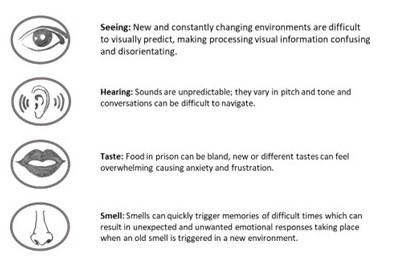
Considering our senses separately enables us to look at how they might be impacted by the experience of release:

In recent years there is an increased interest and a growing evidence base regarding the impact of sensory overload on a person’s ability to engage in everyday life and learn new skills. However little attention has been paid to how sensory overload can impact on a person’s experience of being released from prison. Consequently, little consideration has been given to the effect this can have on a person’s occupational performance in everyday tasks, and their feeling that they can cope with life after prison.

In 1969 Scott and Gendreau wrote that a person “cannot adjust to a sudden release into free society because his mental and emotional mechanisms are adjusted to the deprivation circumstances [of prison]. He cannot tolerate the myriad sensory input in normal environments with its pace, noise, confusion, and instant decision making. Anxiety, restlessness, sleeplessness, and irritability become so great in the released ex-inmate that he may seek means to return to prison with its retarded input and routine existence” (p.341).

Little has changed since 1969 regarding supporting people to prepare their sensory systems for release and enable them to manage this existential shock on the sensory system as they walk through the prison gates and start to navigate community living. However, with the growing interest in this area, and the evidence base that highlights the criticality of this support, we need to ensure that we act on this knowledge and evidence to better support people on their journey from prison out into the community.

In the chapter I co-wrote: “180 prisoners and the noise … it hits you, BANG!” Sensory systems, incarceration and resettlement[1] we identified some key strategies that can support people managing their emotions and behaviours particularly in preparation for release and as they transition from custody to the community. These include:

  • Understanding a person’s sensory preferences – it is helpful to know what sort of things calm and agitate a person prior to release to have some idea of how to support emotional regulation during times of high stress.
  • Developing a personalised place of safety – it is important to think about where a person is going to be released to and consider things that can be done to make it feel safe, such as where the bed is placed, the lighting of the room, the sounds they can hear and if they need ear plugs to support sleep etc.
  • Having meaningful structure and routine – this can feel containing and enable people to know what to expect and when, and plan how they can manage their time on release.  Having timetables that identify appointments and activities that will be taking place in the first few days and weeks post release is helpful.
  • Engaging in sensorimotor activities (activities that combine sensory experiences and physical movement e.g., yoga, gym-based activities, swimming and gardening) – can enable people to develop skills and engage in activities that support them to self-regulate when they are feeling overwhelmed.
  • Accessing sensory tool kits – these are personalised kits that are uniquely complied to support a person in managing their emotions and behaviours through sensory strategies and tools at times when they feel dysregulated. 

Getting release right is critical to supporting successful resettlement. Acknowledging the impact of sensory overload on a person’s ability to self-regulate in the first few days following release is essential.  Providing opportunities to enable people to manage their own risks and needs through better understanding of their sensory system can make life feel more tolerable in the first few days, and in the long term will assist people in their resettlement journey. Now is the time to use our knowledge and skills to start offering better support in this area at critical times in a person’s journey through custody and in their resettlement.


[1] Stickney, J., Budd, C. & Mark (2023). “180 prisoners and the noise… it hits you, BANG!”: Sensory systems, incarceration and resettlement. In Shingler, J. and Stickney, J. The Journey from Prison to Community (p. 85-102). Routledge.


[1] Shingler, J., & Stickney, J. (2023). “I can see freedom but I can’t have it”: Supporting people in the immediate aftermath of release. In The Journey from Prison to Community (p. 24-43). Routledge.

[2] Scott, G. D., & Gendreau, P. (1969). Psychiatric implications of sensory deprivation in a maximum security prison.

[3] Stickney, J., Hirons, A., & Jenner, H. (2023). “How could I know what to do?”: Supporting people in building practical skills for resettlement and reintegration. In The Journey from Prison to Community (p. 118-134). Routledge.

[4] AP – Approved Premise, multi-occupancy accommodation managed by the Probation Service.

[5] Canton, R. (2022). After-care, resettlement and social inclusion: The role of probation. Probation Journal, 69(3), 373-390.

Categories
probation research sound space

Soundscapes of Probation

Jake Phillips

Many of the posts on this site have explored the sensorial experiences of punishment in novel and exciting ways. Most of them focus on the sights, sounds and smells of the prison as a site of punishment and these posts have got me thinking about how I might better understand probation and community sanctions (my own area of interest) if I take a more sensorial approach.

Probation has rarely been subjected to the kind of sensory analysis advocated by those who run and contribute to the Sensory Criminology project. The projects Picturing Probation and Supervisible (both undertaken as part of the COST funded project on Offender Supervision in Europe) sought to explore what probation looks like (as does the work by Rita Shah in the US). Yet probation offices are full of sounds and very few people seem to have explored them (as far as I know – please feel free to correct me if I’m wrong!). And so, as requested by the editors of this blog I have returned to my fieldnotes from an ethnographic study of probation (conducted 2009-2010) and reflected on more recent research which has taken me around both Community Rehabilitation Company and National Probation Service offices across England and Wales to think about what probation sounds like. A somewhat brief analysis of these notes has led me to identify three distinct ‘sounds of probation’: the sound of the office; the sound of the building; and the sound of conversation.

The first ‘sound’ that I identified when I looked back through my notes and thought about what I hear when in a probation office (bearing in mind I tend to spend time watching and listening rather than doing) is that of ‘the office’, by which I mean the space where staff sit and to which clients rarely have access. I have previously called this the backstage of probation and, in many ways, it’s where much of what constitutes probation practice occurs. Perhaps unsurprisingly, the main sound in this space is the computer and other technologies upon which probation practice increasingly depends. As I noted during the first day of observations in a probation office during my PhD:

The office is large with about 11 banks of 6 desks. It is open plan with privacy screens between each desk. Each desk has a computer and a phone … Most people are typing or are on the phone- there’s a bit of general chat/banter as people come in but otherwise there isn’t much interaction going on between people. Each desk has a coffee jar/tea bags on as there is no communal tea fund – it seems that milk is the only thing shared. The air is alive with the tip-tap of keyboards and the ring-ring of unanswered telephones.

The sound of telephones ringing was a constant during those hours I spent listening, observing, and chatting to people about their work in probation. In addition to the sound of typing, a related and very common sound was that of someone announcing that ‘The computers are down… again’. The computers in one office would go down so frequently that it just seemed part and parcel of probation practice in the late 2000s. I hear the new IT equipment invested in by the National Probation Service in the last 18 months means things are much more stable – and so this particular sound might be understood as an indicator of how things have changed in recent years.

When the computers went down, the sound, and so the atmosphere, of the office would change. Some people would take the opportunity to get out of the office – either for a break or a much-neglected home visit. Others would resort to filing (yes, this was in the days when there were still paper files) while others would start chatting – about work, or about home. Others would be stressed – the computers going down was no excuse for not getting that OASys done by the end of the day. My point is that when the network went down, the office would suddenly fill with different noises. I have always been struck by how the computer directs probation work, but analysing this work through sound changes that understanding. It alerts us to what replaces ‘normal’ probation work when a key tool is out of action, and it accentuates the underlying stresses of the job.

The second sound is that of the building. Again, this is dominated by technology, but this time overlaid with the sounds of risk and security. The sound of the building is the sound of people asking to be let in via an intercom or the sound of a door being unlocked remotely or with a fob, allowing service users access to otherwise locked rooms and corridors. Occasionally it’s the sound of a panic alarm, more often than not set off accidentally by a curious child who’s attending probation with their parent.

These ‘building sounds’ convey something about what constitutes modern day probation. Through these sounds, probation becomes about security and risk: service users not being allowed access to officers’ spaces, panic alarms being situated around the building, buzzers and intercoms controlling peoples’ lives. It also highlights what it means to be a probation officer. Probation officers cannot be found by simply ringing their phone or walking to their desk: they need tannoying. There can be few other public buildings which still make use of tannoys quite like probation offices. It puts them in the same realm as train stations, doctor’s surgeries, supermarkets. It gives the impression of bureaucracy, importance, and busyness.

The third ‘sound’ of probation acts as a counterpoint to the previous two. During the many hours I’ve spent in probation offices the sound of conversation is a constant and, indeed, conversation is present in both the ‘sound of the office’ and the ‘sound of the building’. In spite of probation becoming increasingly reliant on technology, probation staff still overwhelmingly (in my experience) do the work because they want to help people. Moreover, they believe that the way to do this is through the officer-client relationship. Without conversation it is hard to create relationships and so we can see the sound of conversation as being at the heart of what many people would describe as ‘quality’ probation practice. Thus, the sound (or, conversely, lack of) of conversation (including both content and tone) between a client and member of staff tells us something about how probation functions.

But it’s the more casual, ad hoc conversations which I find particularly interesting. Many of these take place in the waiting room and all tell a story. Such conversations may take place between staff and former service users, such as in the following example, taken from my fieldnotes:

Accompanied Jim on a home visit. As we went through the waiting room he stopped and chatted to a former service user:

Jim: Oh no, you’re not back here are you?!

Former service user: No [laughing] – just here with me mate

Jim: Oh good – you did so well when you were here, good to see you again

Former service user: You too [they then had a brief catch up before departing with a shake of the hands]

In the car Jim told me about the service user, how he’d ‘properly turned his life around’ during and after his time no probation. He seemed genuinely pleased to have bumped into him.

But the waiting room is also home to conversations between service users, or between service users and their family members and they all tell us something about what probation is all about. I’ve heard conversations between old cell mates who haven’t seen each other since they were last in prison, or friends from school who, similarly, have not been in touch for many years. The probation office brings people who would otherwise have remained estranged together – perhaps only ephemerally, perhaps permanently: my snatched sounds are not enough to tell us any more than this. But I also hear people bemoaning the fact that they have to attend, complaining about the wait or asking for help with their bus fare home. For these people there is no doubt that probation is a hindrance. In a probation office, the sound of people worrying about being late for their appointment is also the sound of the power that probation officers hold over their clients. These are the sounds of liberty versus incarceration; a powerful reminder of how being under probation supervision can be experienced in painful ways.

The sound of these conversations – in the waiting room and in the office – suggest probation as a place where lives mingle – sometimes briefly, sometimes after a long period of absence and – in many cases – over a long period of time. And so, they are about how important the probation office can be in some people’s lives. The probation soundscape of probation can be the difference between freedom and incarceration, an aural manifestation of what Fergus McNeill calls the ‘malopticon’ but also, importantly, a place of human encounter.

A few years ago, I wrote about the architecture of probation offices, suggesting that the layout of an office and the way people use it reflects probation policy and shapes staff and service users’ experiences of probation. It is worth reflecting on what the sound of a probation office tells us about probation and how people may experience it. The noise of the office and the widespread use of technology seems to suggest – to me at least – an organisation which is predicated on efficiency and bureaucracy but which has encounter – both positive and negative – as an underpinning notion.

The ‘sound’ of probation, therefore, can represent both the good and the bad of how probation in England and Wales has developed in recent years. It reflects the bureaucratisation and technologisation of the service as well as the constraints it places on service users’ lives and relationships. But it also reminds us that at the heart of probation (for most of the staff and many of the service users who I have spoken to over the years) sits the relationship: that bond between people which is so important, whether engaged in the criminal justice system or not.

I write this in the middle of a global pandemic: probation offices will be sounding very different indeed at the moment. A few people are going into work, but most are working from home. What does the sound of probation at home tell us about community sanctions in a pandemic? Fewer chats and no incidental conversations will be limiting the connection that occurs within and through the probation office. But equally, there are no locked doors, intercoms, or tannoy announcements trying to find people who may be otherwise busy. People have talked to me about how they have been having more meaningful conversations with their service users, especially on socially distanced walks: in my mind, the sound of probation in these circumstances becomes the sound of cars, the weather and bird song rather than computers, tannoys and locked doors. Perhaps these are sounds which take us back to the days of ‘advise, assist and befriend’ where it was considered normal to meet a service user in a café or even, according to some of my more ‘old skool’ participants, the pub. As with many aspects of this pandemic, probation at home presents both opportunities and challenges – the key will be to hang on to the positives as things return to normal.

Above all, this brief reflection reinforces the point – already encapsulated by other posts on this blog – that analysing penality and penal institutions sensorially complements and augments existing knowledge about how that system of punishment functions. Paying attention to the ‘sound of probation’ has told me something about what probation is, how it functions and how people experience it and I hope that others respond to the editors of this blog by analysing probation and other forms of punishment in this way.