Categories
Environment police power prison probation research Research methods sensory Uncategorized

International Handbook of Sensory Criminology Series: 1

Introducing… Sensory Criminology: Expanding the Criminological Imagination

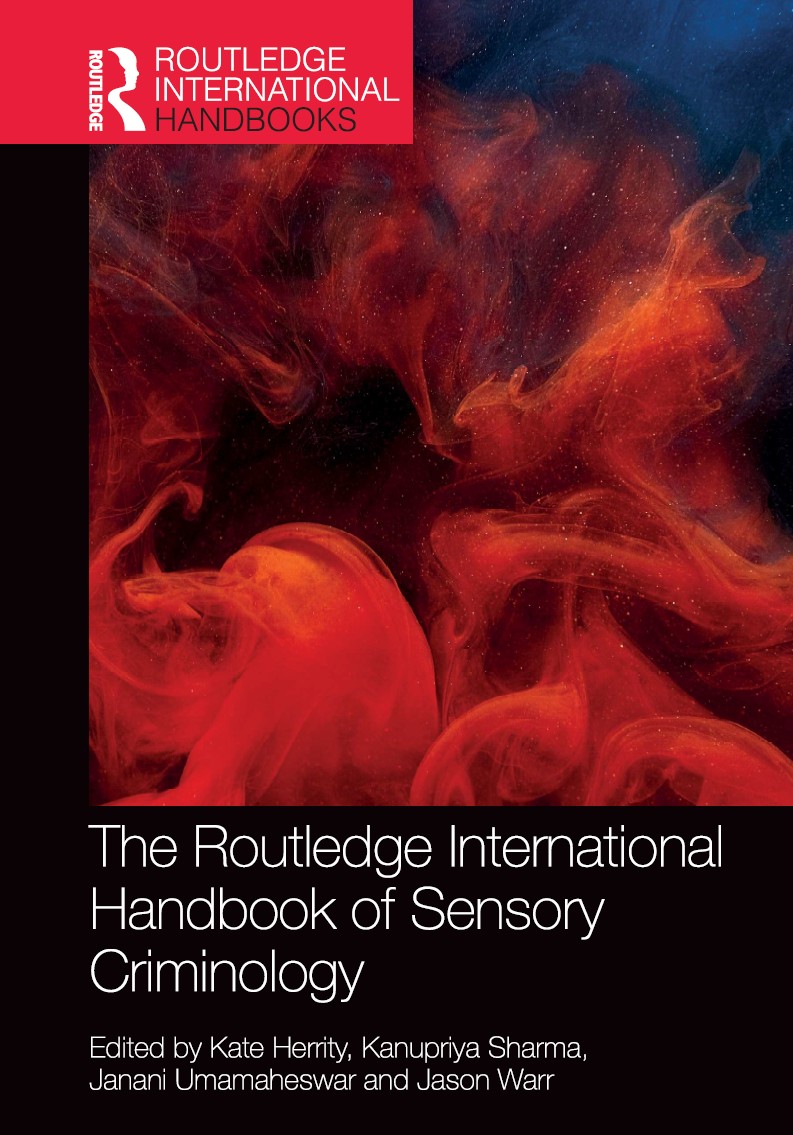
This short post marks the opening of a series dedicated to discussing each of the organising themes of the Routledge International Handbook of Sensory Criminology, in preparation for its launch. Each piece will leave comments open as an experiment in discussion. Please feel free to leave talking points or ask questions – we particularly welcome questions from students.

The book asks what the sensory can contribute to our understanding and pursuit of criminological inquiry? What might the value be, of attending to the sensory in social scientific and criminological investigation? What do we even mean by “the senses”? Conventionally thought of as being restricted to sight, sound, smell, touch, taste – and often laid out in that hierarchy – what happens if this is extended to include a broader range of perceptual stimuli? What happens to how we can utilise a sensory approach to criminology if we add clarity, distinguishing it from adjacent, but distinct, theoretical frameworks adopted by phenomenological and affective perspectives? How can we think about violence and its politics, how coloniality and imperialism frame our understandings of justice and punishment, narrative and the arts in the context of criminal justice – and its absence, Environmental harm and how criminal justice practices impose particular understandings of place, space, time and justice, and how the sensory can inform methodological approaches to the rapidly changing contours of criminology and society.

The handbook is dedicated to expanding these ideas and considering how developing a set of principles to guide our approach to sensory criminology works to allow for a deeper consideration of implications for decolonial thinking. This enhances capacity, we argue, for disrupting western empirical hierarchies and the social systems they both shore up and are reinforced by. The book aims to amplify voices and experiences from beyond the Global North and to expand the possibilities of our criminological imagination.

CONTENTS

Sensory Criminology: Expanding our Imagination   Kate Herrity, Kanupriya Sharma, Janani Umamaheswar, Jason Warr

Section 1: Sensory Politics of Violence

Sensing Violence: Traces, Echoes, and Afterlives Liam Gillespie, Kanupriya Sharma and Hannah Wilkinson

  1. Listening to Donald Trump’s Voice: ‘Fight like hell!’, the Capitol Hill Riots, and the Spectre of Teleprompter Trump Liam Gillespie             
  2. ‘SHUT YOUR FUCKING MOUTH’: Sound, Silence and Gender-Based Violence Amanda Holt and Sian Lewis
  3. The Sound of Violence: Paramilitary experience in Ireland Colm Walsh
  4. War, Colonialism and the Senses: “You can’t unsee or unhear that shit” Hannah Wilkinson

Section 2: Coloniality, Imperialism, and the Senses    

Recognising Abhorrent Legacies: Lessons for Sensory Criminology Onwubiko Agozino, Rose Boswell, Nontyatyambo Pearl Dastile, Sharon Gabie, Andrew Kettler, Macpherson Uchenna Nnam, Jessica Leigh Thornton, and Jason Warr

  1. Doing Justice Differently: A Pan-Africanist Perspective Nontyatyambo Pearl Dastile, Abiodun Omotayo Oladejo, and Macpherson Uchenna Nnam                 
  2. “I’ll Make You Shit!”: Olfactory Othering and the Necropolitics of Colonial Prisons Andrew Kettler 
  3. The Sensory Aspects of Abhorrent Heritage in South Africa Rosabelle Boswell, Jessica Leigh Thornton,  Sharon Gabie , Zanele Hartmann,  and Ismail Lagardien
  4. Decolonizing Sensory Rhetorics and Activism in Africana Prison Memoirs Onwubiko Agozino

Section 3: Sensory, Narrative, and the Arts         

Reimagining Justice through Creative Encounters and Sensory Knowing Glenda Acito, Lucy Cathcart Frödén, Fangyi Li, Lorenzo Natali, Nabil Ouassini, Kanupriya Sharma, Ozlem Turhal, and Raghavi Viswanath   

  1. Black light. Drawing, Music and Theatre as Sensory Practices in the Encounter Between Inmates and University Students Lorenzo Natali , Glenda Acito, and Ozlem Turhal 
  2. Crackle and Flicker: Music and Multisensory Experiences in Prison Lucy Cathcart Frödén and Áine Mangaoang       
  3. Seeing Museums as Criminological Spaces: An Affective Tale of Two Museum Visits Raghavi Viswanath and Fangyi Li
  4. ‘Sensory Criminology, Islamic Auditory Traditions, and Rehabilitation Nabil Ouassini and Anwar Ouassini                          

Section 4: Sensing (In)Justice        

From the Courtroom to the Street: The Sensory Dimensions of Racialised (In)justice Barbara Becnel, Dale Spencer, and Jason Warr

  1. Conflicting Senses, Victims, and the Courtroom: the case of Cindy Gladue Marcus Sibley and Dale Spencer    
  2. The Sensory Effects of Racial Profiling in Berlin’s KBO’s.  Melody Howse                          
  3. Racialized Punishment and the Sensorial Symbolism of Death Row for America’s Black Gangster Class Barbara Becnel             

Section 5: Environmental Harm and the Senses            

“The Way the Soil Crumbled in Their Hands”: Sensing Environmental Harms Amy Gibbons, Ascensión García Ruiz, Janani Umamaheswar, and Aysegul Yildirim

  1. Seeing and Sensing Environmental Harm: The Death of the British Countryside Amy Gibbons                 
  2. The Sensory Ocean: Exploring Noise and Light Pollution as Blue Crime Ascension Garcia-Ruiz
  3. Sensitising Criminology to Experiences of Environmental Noise Aysegul Yildirim

Section 6: Space, Place, and the Sensory           

Vivid and Vibrant Criminological Landscapes: Sense and Space Kevin Barnes-Ceeney, Priti Mohandas, and Janani Umamaheswar

  1. Dispossessed Realities: Houselessness, and Spatial Violence Luisa T. Schneider
  2. Release from Prison Day Kevin Barnes-Ceeney and Victoria Espinoza                        
  3. “I can’t breathe” Housing, Masculinities and Violence in Cape Town, South Africa Priti Mohandas
  4. Scrutinising Social Control in the City through the Senses Anna Di Ronco and Nina Peršak      

Section 7: Time, Justice, and the Sensory

Beholding Justice and Punishment Sneha Bhambri, Eamonn Carrabine, Kate Herrity, Arta Jalili-Idrissi and Jason Warr

  1. Sitting, Seeing and Getting Lost: The Sensory Aesthetics of Latvia’s Women’s Prison Arta Jalili-Idris
  2. Time, Temporality, and Chronoception Jason Warr
  3. It’s a Circus: The Production of Domestic Violence Proceedings in Lower Courts of Mumbai, India Sneha Bhambri
  4. Beholding Justice: Images of Punishment in Medieval and Early Modern Europe Eamonn Carrabine

Section 8: Sensory Methods

“They Are Not Like You and I”: Sensory Methods  Briony Anderson, Kate Herrity, Sarah Kingston and Mark Wood

  1. Sense and Insensibility: How Technologies Invite and Invisibilise Harm Briony Anderson, Mark A Wood, Jackson Wood, Will Arpke-Wales, and Flynn Pervan             
  2. Audio Criminology: Broadening the Criminological Imagination Through the Use of Audio Methods Sarah Kingston
  3. ‘Still feels like jail’: Sensing Danger, Bleakness and Friendship in a State-Run Home For Boys Mahuya Bandyopadhyay, Aishwarya Chandran and Sanjukta Manna

This project began life as a conversation between Tom Sutton and I (Kate Herrity) at the 2022 BSC conference. Shortly after, Kanupriya Sharma, Janani Umamaheswar and Jason Warr joined. The four of us divided up the eight sections which organise the book. Each of the authors of the three or four chapters within them were invited to take part in a discussion with one another about their work. These discussions formed the basis for each introduction section of the book. Since these sections are an accessible way of introducing the contents of the book in a way which lends a substantial project a coherent narrative, they seem like a sensible focus for discussion.

As with all projects, people decline and others drop out, representation is partial, interests and approaches of the editors are reflected in those invited to participate… We discuss all this at greater length and depth in the introduction, along with our hopes for the future and the guiding ethos of the book. We hope to invite more people to the table and enrich a conversation we do not aim to be the last word in.

Categories
Environment police power sensory space Uncategorized visual

Policing Dark Islands

Anna Souhami

One dark morning, I was standing on a hill in a howling gale in the Outer Hebrides, when I was surprised to see a police car in the distance. What did a police officer do in small, remote islands? What does policing look like when communities are small, scattered and separated by sea? Would police work be affected by the wind and rain that were then battering me? And why, after many years thinking about police work, didn’t I know?

This moment set in train an extended ethnography of policing in Shetland, the most peripheral archipelago in the UK. I wanted to explore how the historical preoccupation of criminology with the city had limited our imagination.  If our foundational research on policing had been conducted in remote islands rather than cities, what would we think was important in thinking about crime and its control? What would we notice that we currently do not see?

I soon discovered that one of the phenomena remote islands make inescapable is the dark: the visceral, overwhelming, sensory experience of immersion in darkness, and its effects on the exercise of state power.

Shetland is located over 200 miles north of the Scottish mainland in the centre of a ‘crossroads’ between Iceland, the Faroes, Scotland and Norway.   Its main connection with the UK mainland is by a 12 hour ferry from the Northeast of Scotland, though notoriously rough seas mean the journey can often take twice that. It can also be reached by propeller planes from Scottish airports, though the storms, 70mph winds and thick fog that batter the islands make this an unpredictable form of transport:  Flybe, the airline which served Shetland during my research, was known locally as ‘Fly Maybe’. 

So, in mid-December, armed with a suitcase full of seasickness tablets and some sturdy boots, I joined the young oil workers eating enormous plates of chips on the boat heading for Lerwick. Twelve hours later, I stepped out onto the deck in roaring winds, beside myself with excitement at my first glimpse of Shetland. 

I saw nothing.

Instead, I found myself enveloped in darkness, the quality of which I had never experienced before. It was impossible to tell where the land, sea and sky began or ended: the occasional tiny pinpricks of light which fleetingly appeared could have been from boats, houses or stars. This was my first experience of what islanders called ‘black dark’: an absence of light so profound that, as a police officer said, ‘you can’t let your dog off the lead as you’ll never find her again’.  Or as a former mainland officer put it, ‘you don’t know darkness until you’ve lived here. Here, there is nothing’. 

Yet while darkness may have been described in its absence – as ‘nothing’ – this was not how it was experienced. Instead, as I discovered, darkness is an acutely sensory experience. It is active, physical and alarming.

Light and darkness are central to the experience of life in remote Northern islands. Shetland experiences dramatic changes of light with continual light in midsummer (the Shetland phrase ‘simmer dim’ describes the brief dip in the light at the summer solstice) and in mid-winter, the time of my first arrival, only a few hours of watery grey daylight. Nights were not always dark: without clouds, auroras, stars and full moons lit up the sky making it possible to drive without headlights. The extraordinary experience of night illumination was so disorienting that one island police station had a list of full moon dates pinned to their front office to predict when people would ‘go crazy’.

However, more frequently, winter storms blacked out the moon and stars bringing immersion in darkness.  Staying in a little house at the end of a dark track next to a bay, I found myself overwhelmed by darkness. My fieldnotes describe tiredness, disorientation, and insomnia; feeling unable to leave my house, ‘hemmed in’ by a darkness that was ‘oppressive and total’.  To my astonishment, being submerged in darkness also brought with it a sense of creeping fear that was both existential and visceral. For the first time since a small child, I was afraid of the dark.

I soon realised these experiences were shared by the police officers navigating dark islands. All officers talked about darkness. They described how it interfered with their work: feeling exhausted and disoriented, getting lost, and not knowing in which direction they were driving. One officer came back from an unsuccessful house inquiry explaining: ‘There are no streetlights. It’s pitch black. It’s the darkest place I’ve ever been. I couldn’t find the bastard house.’ 

Yet darkness also affected officers more profoundly. It shaped the way they perceived the islands, and how they felt and moved within them.  

In the light islands were playgrounds for exploration. The starkness of the Shetland landscape became exciting:  we drove to remote cliffs to spot seals, orcas and otters on clear days, or to see shooting stars, red moons and auroras on clear nights. Officers described the colours of the land and sea, the sunsets they had seen, the wildlife and boats that passed. 

In the dark, however, islands became places of vulnerability. Officers described them as empty, lonely, barren places: ‘bleak’, ‘desolate’, depressing’, ‘shit’, ‘grey’.  Yet darkness wasn’t simply experienced as absence – of light, colour or pleasure. Instead, it was active, oppressive and visceral. Dark islands were hostile places.  Just as I felt ‘hemmed in’ in my house, officers described being crushed or consumed by darkness. It was penetrating, ‘claustrophobic’, ‘oppressive’; they described ‘sinking’ into the landscape.

Phenomenological research helps illuminate why darkness seems to generate this bodily sense of vulnerability.  Shaw (2015, p586) argues that in light, vision holds objects at a distance, becoming a ‘protective field’ which delineates the self from the world. In darkness, the boundaries between the body and environment are eroded (also Edensor 2013, Merleau-Ponty 1962, Morris 2011). Bodies become porous, leaving us open and vulnerable to the world outside. Or, as one officer described it, in darkness ‘I felt I was being swallowed by the island’.

For island officers, immersion in darkness was profoundly unsettling. As a result, officers drove quickly through dark places or avoided them entirely. Instead they headed to the comfort of the police station, or circulated around populated places with the safety of illuminated light. As one officer put it, when cloud cover at night meant there was no light at all, ‘that’s when you return to the station’. Islands became mapped through the light and the dark, structuring where officers went and what they did.

Where the police go, where they focus their attention, directly affects the use of state power. Research in dark islands suggest that their sensory experience of the environment, and the darkness and light in which they are submerged, is crucial to how police officers think, feel and move through the areas they police, and consequently what they do and who they encounter. So why have these phenomena been overlooked in police scholarship? As I have argued elsewhere (Souhami 2023), the consistency of the urban context of police research seems to have led us to overlook the physical environment of police work altogether. Remote Northern islands reveal that there is more to criminology than our preoccupations suggest. We should not be afraid of the dark.

For more on this research, see:

Souhami, A (2023): “Weather, Light and Darkness in Remote Island Policing: Expanding the Horizons of the Criminological Imagination”. The British Journal of Criminology. 63 (3) pp 634–650, https://doi.org/10.1093/bjc/azac052

You may also be interested in the ‘Just Humans’ podcast ‘Darkness: Dr Anna Souhami’ produced by the Scottish Centre for Crime and Justice Research:  https://www.sccjr.ac.uk/podcast/darkness-dr-anna-souhami/

References:

Edensor, T (2013): ‘Reconnecting with Darkness: Gloomy landscapes, lightless places’. Social and cultural geography 14, 446-65

Merleau-Ponty (1962): Phenomenology of Perception. Translated by C Smith. London: Routledge and Kegan Paul.

Morris, NJ (2011): ‘Night walking: darkness and sensory perception in a night-time landscape installation’. Cultural Geographies 18 (3), 315-342

Shaw, R (2015): ‘Controlling darkness: self, dark and the domestic night’. Cultural Geographies 22 (4), 585-600

Categories
power prison sensory smell Teaching

The Prison Mug: Perceptions of permission

Ross Little

I recently found a blue plastic prison issue mug in a brown cardboard box at home, sitting on top of a collection of classroom notes from a class I taught in prison. I was in the process of writing an article (Little and Warr, 2022) and thought I’d try to recall something of the sensory feel of that space. Instead, I was reminded that my handwriting is not always as clear as I had assumed it was. The ink had faded a little and the paper curled inwards at the edges, but otherwise was in good condition. However, it was the discovery of the mug that really transported me back to this former pedagogical space, one in which I co-facilitated an eight-week educational course. The course included students from De Montfort University and men serving long sentences at ‘HMP Lifer’. The mug might seem like an unlikely vehicle for such an evocative transportation, and yet to me it screams its institutional association.

To me, the mug is unmistakeably a prison mug. Its insipid light blue colour is distinctive. It might well be the sort of mug used in other institutional settings, but this is symbolically imbued with the essence of punishment. Its colour matches closely the faded light blue prison issue t-shirts worn by many of the men on the wings. It has a very plastic feel to it and is surprisingly lightweight, without substance, in contrast with the depth and weight of the sentences hanging over the prison learners in the classroom. It smells of plastic too, infused with a slight whiff of instant coffee, perhaps because it hasn’t had a very good wash yet, even after several years. Its authenticity has been preserved, like a relic from a bygone era found intact. The tasting notes of the coffee it contained promise that it “…makes a solid morning cup. It’s rich, bold, and robust…”. Just like me, I chortle inaccurately to myself.

I feel the need to clarify fairly early on that the mug was taken from one of our weekly sessions, hastily gathered up as we sought to depart the prison on time. The mug was taken accidentally, packed up in a box containing papers and stickers, photocopied readings and feedback sheets. This defence may not hold up in a court of law, but I know you trust my account.

The prison is not that far away, geographically speaking, from where I’m writing this now, at home. In other ways, however, it’s another world: where I am now there is the freedom to descend to the kitchen, fill up on coffee or snack on toast. I can choose something fresh and zesty or something warm and comforting, a new combination or something familiar. These are items that I’ve chosen, that create some sense of familiarity, curated for the moment. If the space has a smell, it is one that has been cultivated over time by its inhabitants, my family. It does not have that distinctive institutional smell of disinfectant mixed with blood, sweat and fear that a prison has. Or at least visitors have been too polite to mention it.

At the time of writing, I haven’t been back into the prison for a while, a period elongated by the experience of the Covid-19 pandemic and associated lockdowns. It feels like a long time since I was in the prison, and I miss the classroom space. It wasn’t an easy experience, because planning and organizing it from beyond the prison boundary can be stressful and tiring. As can the facilitation itself. Going through notes and interviews with participants helped transport me back to moments and sensations experienced in the prison classroom. The classroom itself generally felt like a convivial space, a chatty place where people engaged in conversation easily despite the constrained circumstances. This was a zone where people were able to express something of their real selves, exhibit different thoughts and feelings to the ones they typically felt able to show openly in their institution they ‘belonged’ to. It felt like an honest space, a space rendered sufficiently trustworthy for the people there to engage in conversation despite their deeply contrasting experiences of day-to-day life.

University students spoke about seeing the men as humans, as individuals they could relate to; with perspectives and experiences they could learn from. I remember clearly a university student explaining to me about how this experience had also helped to humanize myself and my colleague, university lecturers. Compared with a lecture theatre environment, she was more able to see us as individual people with real thoughts, views, emotions, a sense of humour and a life beyond university. I was slightly surprised, but it made sense, and I was pleased she felt able to say this. Some months later, I was lecturing during the pandemic lockdown and I was confronted with the realization that the experience of prattling away to my laptop alone in a room at home was likely further reducing my pedagogical humanity in the eyes of students.

Back in the prison classroom, and some of the thoughts, feelings and life experiences expressed weighed heavily on me and I took some of this away with me, without even realizing it at first. Finding the mug took me back to the session it came from, and then a previous session when we were taking a break.

At break-time, everyone mingled as a group. The second week was the first time during the course we were able to take in refreshments for the group. The prison had agreed to this and to provide the hot water in flasks, but nothing more. This contrasts with the experience of the very first course, in 2016, when we were eventually able to have lunch together from the restaurant. The food had been provided by the on-site restaurant and one of the prison students proudly showed off his baking skills. Now, the prison would not, or could not, provide refreshments because the restaurant had long since ‘temporarily’ closed, and has been ever since.  We were now allowed to take certain – limited – items in. We took in some biscuits, fruit, juice, teas and coffee. I was pleased with this, as I recognized from a previous course that break time is important in setting some sort of tone, in communicating something of the course essence. Commensality tends to be more limited in our society these days, especially in prisoner society. It can helpfully echo the social nature of learning and helps humanize the space. It helps put people more at ease and communicates something of the pedagogical equity we’re aiming for during the sessions. Of course, there were considerable differences between the living circumstances of the people in the room. However, for these moments, social interaction was enabled and normalized, and subsequent conversations suggested it was a very welcome part of the overall setting. Just being able to converse with ‘normal’ people from beyond the prison boundary, who had no power or interest in impeding their paths to official rehabilitation, was experienced as worthwhile and valuable. Paired with new, fresh, products from the outside world, the effect was a sensory delight.

So, for me the mug is associated with a break, and yet a continuation of the values in the space, with informal dialogue privileged to facilitate interaction and the exchange of information, ideas and stories. The mug provided people with a vehicle for activity, or inactivity: something to do (make a drink), a catalyst for conversation, or a way to remove oneself from interaction for a short while. But the mug was never the main event, nor could it be, especially when drinks would have tasted so much better from something designed with a little more sensory pleasure in mind.  The main event for me was the biscuits and these are good for generating abstract conversation (Little and Warr, 2022). There were some plainer classics (your ‘Nice’ biscuits – how do you pronounce that word?), some popular favourites (Jaffa Cakes are not cakes), through to some more luxurious chocolate coated options. These offerings were popular amongst some but the group was careful not to demolish them too quickly. There was no stashing of the goodies in socks, trackies and sleeves I had witnessed when running a similar (shorter) course in a local ‘resettlement’ prison. The most noteworthy observation, in fact, was a palpable initial reticence amongst the prison students to touch or consume the biscuits. ‘Are you sure we’re allowed these?’ I was asked by more than one prison learner. It took what felt like quite a while for one of the students to take a biscuit, despite there being some interest. It’s unusual for a group to resist the allure of such sugary treats. It’s also impossible to eat only one; fact. Based on my autoethnographic research replicated over many years.

Being genuinely asked by a grown man if they could eat a biscuit that had clearly been brought in partly for their benefit came as something of a shock to me. The reason became clear shortly afterwards when one of the prisoners explained that they had recently been explicitly told they should not eat the biscuits. It may even have been included in the prison’s pre-course information briefing session. They were led to believe from prior experience that indulging in biscuits could lead to a ‘nicking’ and they did not want to risk unnecessary aggro for the sake of a custard cream. Whatever the precise reason, it was clearly a shared understanding amongst the group and it took a surprisingly long time to encourage them that it would be ok, and without disciplinary consequence. It was in this moment I belatedly realized that at least some people in the room sensed that I had some power in proceedings, or responsibility, or both. I had been relatively oblivious to this until that point, and now it was being made explicit. Whilst this was ‘only’ about biscuits, the biscuits had become symbolic of these other currents related to power and permission. By the end of the session we were informed clearly not to bring in any shit biscuits again. By which was meant, none from a ‘basics’ range or that might be confused with something that might be easily available institutionally.

Whilst the biscuits, and the responses to them, were significant, they were not quite as big a hit as expected. They were definitely appreciated, but there were quite a few left. By the end of the break, this seemed less about perceptions of permission, and more about personal choice. For even more popular than the biscuits was the fruit that had been brought in; there were grapes and kiwis. I recall thinking that our inclusion of kiwis was a bit of a random touch. This was not the view of one of the prisoners. The unfamiliar fresh citrussy smells cut through the heavy, warm air like nothing else. The bright, natural fruity colours hypnotised their consumers for a few moments: ‘Woah, a kiwi; I haven’t had one of them in eight years’. Cue a conversation about the last time he had a kiwi and how the quality and quantity of fruit generally available in the prison was so limited, and poor. Likewise, the (decent, not from concentrate) fruit juice went down a storm. It reminded me of how important fresh fruit and vegetables are, especially in (island) communities when access is so restricted. It also reminded me that perceptions of what is valuable, are also highly contingent upon personal circumstances. 

So, the tea, biscuits and fruit were popular, appreciated and came to symbolise break time. They were a good way of bringing people together for a chat, enhancing the comfort in the classroom space and helped people feel more at ease with each other. A sign that break times were ‘working’ well further occurred when men ‘doing time’ brought in their own tea to share with the group. This human desire to engage in exchange provided a nice touch and validated our sense that this had become a convivial space in which to teach and to learn. We had several more breaktimes like this over the following weeks. And then they changed.

During a later session, perhaps the fifth, the biscuits were stopped. Whilst exiting the prison the previous week we were told not to bring in any more fruit or biscuits for the sessions. This was disappointing but we complied with the request, which was made by a member of the education department staff. Curious to know the reason, the only explanation we received was a concern about ‘conditioning’. Conditioning seemed to be a new buzzword that was being lobbed around by certain staff to explain or justify any new restriction or cutback that further impoverished the regime. This is not to deny the existence of manipulation between people in prison and people employed to hold them there. Indeed, in recent years, there has been an increase in instances of drugs, mobile phones and sim cards being found in prisons. In the year prior to our course, it was reported in the national press that a lack of experienced prison officers had been blamed, in part, for these challenges (The Guardian, 2018). This played a part in the sensitivity towards some items being brought into the prison, such as grapes, kiwis and custard creams. Meanwhile, a prison mug escaped undetected.

References

Little, R., & Warr, J. (2022). Abstraction, belonging and comfort in the prison classroom. Incarceration3(3). https://doi.org/10.1177/26326663221142759

The Guardian (2018) More than 2,500 prison officers disciplined in five years, MoJ figures show [accessed November 2022]

Categories
Interviewing power research sensory Uncategorized Victimology

Sensing towards justice: The importance of attending to the sensory when interviewing victim-survivors

Beth

‘you were so afraid

of my voice

I decided to be

afraid of it too’

-rupi kaur, Milk and Honey

Recently, whilst designing a research project, I decided to look back on and examine my own experiences of participating in criminological research. I wanted to reflect on how we design and conduct research, bringing in knowledge of how it feels to be on the other side of the screen. I am a victim-survivor of abuse and have taken part in a small number of academic projects relating to this over the years. As I have only taken part in online interviews, and with an awareness many victim-survivors will experience the process differently to the way I do, I decided to investigate, and this is where I discovered a gaping hole in our conversations. There is plenty written about ‘ethical’ practice with victims of crime (Newman et al, 2006; Burgess-Proctor, 2014), how academics experience conducting their own research (Rice, 2009; Ross, 2017), and how methods may be experienced by participants (see Hlavka et al, 2007 and Campbell et al, 2009). But notably, almost all of this is written by and filtered through researchers, usually based on post-interview questions about the participant’s experience of the process. I question the effectiveness of this. How freely can those who have just sat in their vulnerability critique those imbued with more power? Participants do not have the same space to communicate for themselves about their experiences of taking part, and it seems that this has resulted in the loss of some of the nuance of emotions and sensations that taking part in research as a victim of crime can elicit.

Your research projects come into our lives suddenly and unexpectedly. Most often this is via a social media post, perhaps seen on a Saturday afternoon whilst I am sat with my family. There is a juxtaposition in this, the softness and warmth of my home against the harsh reminder of the world that exists outside of and prior to this new reality I have created. The pain which permanently exists under the surface is brought to the fore. But something about the research draws my interest and makes me stop, or go back to it. Curiosity perhaps. Most people don’t want to hear about my past, my existence is too uncomfortable for them to acknowledge and so they strip it from me on my behalf. We don’t have to talk about that. But I want to talk about it, and suddenly my head is bursting with things I didn’t know I wanted to say.

The words are almost tumbling out as I type a controlled message offering my time. Tap, tap, tap. My finger hesitates over the little arrow before I hit send. An odd thing about participating in research as a victim of abuse is that alongside the desire to be heard, worry and shame creep in at this point. Worry because I now have all these things I want to say, and if they say no I will have nowhere to put them. I will be left scrabbling to contain them again. I know I will be disappointed because the child within who couldn’t speak now desperately wants to be heard. The shame sits in my having contacted this ever-so-important person at all. Abuse lies, tells you that you have nothing of value to offer. Shame is the feeling of taking up too much space, and of needing to squash yourself into the smallest possible version so as not to trouble anyone. I am probably wasting their time.

Something that often goes unconsidered when designing time or resource pressured research is how we will communicate with people if they do not fit our study, or if we have finished data collection. Sometimes these limits are framed as ensuring researchers are not ‘over collecting’ data so as not to upset people unnecessarily, which while intended to be ethical, is actually cruel in its denial. What may seem like an innocuous email to say no thank you, might be experienced as deeply painful to someone who has already given something of themselves. If it has to be, effectively communicating why the decision has been made alongside a sincere acknowledgement that you appreciate them taking the time to get in touch can make all the difference to someone who has been repeatedly told they are not enough.

But in this case they say yes, and the interview is arranged. The screen flicks on, and the things most immediately apparent to me are that I am not in control, and the attention is entirely on me. In a way which is hard to put my finger on this feels reminiscent of the crimes I experienced. The distance through the screen mimics the disconnect I once felt with the world around me. The invisible bubble. The Untouchable. Suddenly I am acutely aware of the chair digging into my back, of not knowing where to put my arms and legs. Everything feels wrong. I feel myself shift uncomfortably whilst I try to project the image that everything is okay. Smile. That’s what ‘in control’ looks like, right? Is it? I can’t quite remember. Adrenaline floods my body; I can hear my heartbeat and I can feel that I am shaking slightly. Thump-thump, thump-thump. I clench my muscles in an attempt to regain some control. All of my senses tunnel in on this interaction, and everything else around me almost ceases to exist. There is an eerie stillness in being hyperaware of your breathing, of the tenseness in your body, in perceiving the other person, offset by the relative silence around me as my brain mutes out background information. But I want to do this. I focus on the questions, and on saying what I want to convey. Time and space begin to contort as I narrate both in the then and the now.

I wonder what the researcher sees in this moment. I suspect not much. Many victim-survivors, especially adult survivors of childhood trauma, are experts at masking pain. We often hide our experiences for many years, learning as children to live in disguise. Online research makes it easier for me to mask my distress. I can position my screen so that all you see is my face. So that you don’t witness the shaking, the shifting, the fiddling with a piece of Blu Tack. Abuse taught me how to disassociate my mind from my body, and I subconsciously do that now. I have learnt to mute myself, to deny my own physicality. I have learnt to silence myself before I am silenced, as a form of control. To exist in a half form so that I might be palatable.

Researchers may develop a strategy for managing participants distress, but in order to implement this we need to have perceived it. This can be difficult if someone is not visibly upset. Using Fricker’s concept of ‘hermeneutical injustice’ (2007), it is hard for me to communicate my experiences in a way which others will understand without showing them the physical effect on me. Abuse is inherently sensory, I can explain it only in how it felt, in sounds, and smells. Without this framework it is hard for others to comprehend, but this level of detail can be hard for researchers to hear, and so many reject it. ‘I don’t want you to get upset, shall we stop’, centres the researcher and inadvertently communicates that this may be becoming too much for you. That you want to stop. For me, my becoming upset isn’t necessarily a negative thing. In fact this may be one of very few spaces I can express myself in an authentic way. ‘Remember that this is your space, we can do whatever you need ’ communicates that the participant is in control, and gives someone whose “no” has previously been ignored permission to advocate for themselves. To be present in their whole form. To exist.

Afterwards the adrenaline floods out of my body, like a tidal wave has crashed and dissipated, leaving me tired and drained. But this experience has also felt freeing; I have put down some of the heavy stones which I carry. Brené Brown once said that “shame thrives on secrecy, silence and judgement. Shame cannot survive being spoken” (2012). In the very act of speaking, in a scenario where I have the safety of remaining anonymous, some of the shame I feel has been drawn out and leached. I have released it, and it less so belongs to me. Each time I speak, my body feels a little lighter to inhabit. I feel proud, and the warm swell that starts in my chest grows and spreads down each arm and into my fingertips. I feel bigger somehow, like an unfurling, and it is one of those rare occasions where it feels good to take up space. To have grasped at power in the choice of speaking. Of, in some small way, helping those who will come after me. In this moment I feel strong, and defiant.

Something that has come to interest me is the question of whether there is a risk that participants may feel emotions ‘outside of normal experience’, and I wonder who’s experiences we are using to define ‘normal’? To those who have not experienced trauma, what I have described would seem to be ‘outside of normal experience’. But I exist within and navigate this space every day. When I watch a film or go online, I do so knowing that I could be confronted with abuse at any time. I go out in public knowing that men will sometimes stand a little too close behind me. I have learnt to navigate and manage these things because abuse is a life sentence. I will never cease to be a victim-survivor. There is an arrogance in the assumption that I do not live with my experiences outside of academia’s research interests.

My identity has been forcibly and irrevocably changed, but that does not mean that I will never be in a position to talk about my experiences. Yes, talking about it is painful, but the silencing hurts more. Returning to Fricker’s work (2007), there is violence in the testimonial injustice inflicted on those who have experienced abuse, in the academy’s refusal to accept our right to frame our own narrative and make our own decisions about our ability to participate safely. The chokehold of his hand and of his threats now manifests in the chokehold of others’ discomfort, and in my fear of being cast out. The body has an horrendous ability to remember and replicate the bodily sensations of being silenced. And so important things remain unspoken, and I remain unseen. Being told my truth cannot exist in the world because of someone else’s perception of what is an ‘acceptable’ level of emotion is akin to having my voice removed once more. It is the imposition of power, of being spoken for, in others attempts to manage ‘risk’.

As soon as I was made a victim of abuse my entire existence became defined by risk. My risk of poor mental health. Of relationship breakdowns. Of chronic illness. Nothing is ever defined in relation to my strength. My power. My capacity to create change. I am an adult with the rights to make my own decisions, and I can assure you that victim-survivors do not speak without careful consideration and assessment first. Finding the balance is tricky, but in our desire to protect our participants we must also take care not to stifle those who want to speak, because of our failure to confront our own discomfort and fear. If you are not prepared to hear then do not do research with victims of crime, or you will compound and become complicit in the violence of our forced dissonance from the self. 

Going back to rupi kaur’s poem, every day I become less afraid of my own voice. But in it’s assertions that it is acting in my best interests, I feel deeply the silencing and rejection from an academy which is afraid of hearing me.

Reference list

Brown, B. (2012) Listening to shame. [online video] Available from www.ted.com/talks/brene_brown_listening_to_shame/transcript?language=en

Burgess-Proctor, A. (2014) Methodological and ethical issues in feminist research with abused women: Reflections on participants’’ vulnerability and empowerment. Women’s Studies International Forum, 48.

Campbell, R., Adams, A., Wasco, S., Ahrens, C. and Sefl, T. (2009) Training Interviewers for Research on Sexual Violence: A Qualitative Study of Rape Survivors’ Recommendations for Interview Practice. Violence Against Women, 15(5).

Fricker, M. (2007) Epistemic Injustice: Power and the Ethics of Knowing. Oxford: Oxford University Press.  

Hlavka, H. Kruttschnitt, C. and Carbone-López, K. (2007) Revictimizing the victims? Interviewing women about interpersonal violence. Journal of Interpersonal Violence, 22(7).

Kaur, R. (2015) Milk and Honey. Missouri: Andrews McMeel Publishing.

Newman, E., Risch, E. and Kassam-Adams, N. (2006) Ethical Issues in Trauma-Related Research: A Review. Journal of Empirical Research on Human Research Ethics, 1(3).

Rice, C. (2009) Imagining the other? Ethical challenges of researching and writing women’s embodied lives. Feminism and psychology, 19(2).

Ross, L. (2017) An Account from the Inside: Examining the Emotional Impact of Qualitative Research Through the Lens of “Insider Research”. Qualitative Psychology, 4(3).

Categories
power taste Women

A proper brew: sensory recollections of my time in prison

Danica J.M. Darley

My memory is crap. It’s a standing joke with my sister. I have no recollection of holidays we took as kids, favourite toys, friend’s birthday parties or family pets. Years of ingesting too much alcohol and fatty foods probably hasn’t helped the matter and many a counsellor has told me that it’s my brain’s way of suppressing childhood trauma. So, imagine my surprise when at work last year a taste transported me back to a situation I would much rather have forgotten. A cost cutting exercise at the day centre for young people with learning disabilities – where I worked throughout my undergraduate degree – had led them to downgrade the usual Yorkshire ‘proper brew’ tea bags to a much cheaper version. On that sunny morning in June I was sent back (thankfully only figuratively) to prison.

In July 2014 I started an 11 month prison sentence in Scotland’s only prison for women, the infamous Cornton Vale.  I had never been in prison, never even really been in trouble with the Police, and here I was wrenched away from my home in England, my husband and my 16 month old daughter for an offence I had committed 7 years previously.  My brain has done its usual trick of hiding many of the events that unfolded in the next 5 months, spent in that run down 1970’s building. However, what it chooses to whisper often comes back as recollections triggered by my senses.

Taste has always been one of the biggest triggers for my memory, helping me to recall the emotions, practicalities and surroundings of some of the most important and mundane situations of my life.  Many mothers will tell you about how good (or awful) the first thing they eat after giving birth to their children is.  For me, that was a soggy cheese sandwich on plain white bread with some sort of value, low fat spread.  I’ve never had a better cheese sandwich in my life! Bound up inextricably with that waxy cheese slice is the memory of becoming a mum for the first time, and all that goes with that, the feelings of love, exhaustion, pain, fear and overwhelming joy.

The taste of that cheap teabag whisked me back to the cramped ‘staff’ room at the side of the card workshop where I spent much of my days in ‘The Vale’. The tea was made from the cheapest possible tea bag that the Scottish Prison Service could lay their hands on. The taste was more akin to the mud soup you would whip up as a kid than any sort of tea I had tasted before, strangely chemically tasting and earthy all at the same time.  However, as is so often the case with food and drink, tea was part of a ritual. Breaks from the job were an important part of the rhythm of the day in prison, they gave us an opportunity to chat, vent, seek advice, size each other up and decide if we wanted to invest time in a friendship with our fellow prisoners. So I endured, I made tea, gratefully took tea made by others, screwed up my nose and swallowed down cup after cup of bargain basement, lukewarm, only slightly brown prison tea. 

However, I was one of the lucky ones. I had a job in the prison that meant I made a few pounds every week and I had a supportive family on the outside who could afford to send in money for me to buy the things I needed whilst in prison.  I didn’t smoke and kept my head down, choosing to spend much of it in the gym, in education or reading in my cell.  All of this meant that I was able to afford the luxury of a pack of Tetley tea bags every other week off of my shop sheet!  It’s funny the things that suddenly become important to you when you have little else to focus your mind or attention on.  Shop day was the best day of the week, ask anyone who’s been in prison and they’ll tell you that, and the best thing I got from the shop was my delicious, longed for ‘proper’ tea bags.

Having time, space (and the privilege) to now reflect on my experience in prison I realise that this sensorial taste experience can really help us to unlock important insights into how we view imprisonment, prisoners and the physical spaces in which people are locked up.  For me, it throws up questions about how society views people who are sent to prison. Is the fact that the prison service provides prisoners with the cheapest of everything representative of the way that prisoners are viewed by the wider population?  Could we not stand the ensuing moral panic created if prisoners were to be given Tetley? If, like many a liberal prison officer will tell you, the punishment is not in fact the prison experience but the deprivation of liberty itself, should the dehumanizing conditions in prison be something that people have to endure? There are also questions around the self-worth of prisoners. So many of the women that I met in prison came from awful situations which forced them to often unquestioningly accept the hand that they were dealt. They coped with life by just putting up with all the crap that was thrown at them and I wonder if the acceptance of the most foul tasting tea could be seen as indicative of their life experiences? A life that had so often ground them down that they didn’t see the point of sticking their head over the parapet and demanding better. 

All of this from a cup of fetid, brown liquid?

For me, the biggest thing that this sensorial recollection has brought was gratitude. That sounds ridiculous, but in some ways I am grateful for the experience of being in prison. Don’t get me wrong, there is so much work that needs to be done to reform all our systems so that they deliver much fairer, less harmful and just (in the truest sense of the word) outcomes for everyone whose lives they touch. However, the ability to recall in brilliant technicolor my prison experience opened my eyes, not only to how lucky I was, but to how I was wasting the opportunities that life had given me. It helped me see the world of opportunity that was before me, and set me on a path that will hopefully lead to me getting my PhD and helping to affect some really positive changes for people who come into conflict with the law. Three years of undergraduate study has given me the opportunity to retrospectively apply my sociological lens to my time in prison, and it’s interesting to do this from a sensory perspective. The senses allow us to get up close and personal with not only a person’s individual experience but with the emotions, sensations, thoughts and all the messiness that comes with that.  It allows us to more deeply interrogate and hopefully understand the situation from all angles, and perhaps come up with more creative and innovative solutions as a result. 

Categories
Ministry Of Justice power research sound space

Experiencing Research Interviews at the Ministry of Justice

Harry Annison

I like to walk to the Ministry of Justice. In part because you just can’t beat the Waterloo Sunset (so to speak); in part for the symbolism of a route that takes me past the Houses of Parliament, past the Supreme Court and past an assortment of other government departments. I can navigate most of it on auto-pilot by now. Off the train at Waterloo, racing to beat the crowds at the barriers. Out onto the South Bank. I squeeze past the endless waves of tourists near the London Eye, experience never teaching me that a quick pace is impossible. Over Westminster Bridge, usually dotted with bagpipers and tourists smiling at their selfie-stick phones. I use the road to skirt around people, until I remember this is ill-advised in central London. I push on through the hordes, wading through treacle. The air is thick with dirt. I arrive.

The brutalist exterior of 102 Petty France looms over me. It is a magnificent building, in its own way. I look up; take it in. Architectuul tells me that it is “a big, assertive building which succeeds in its job as a symbol of government authority and a landmark on the local skyline”. It is somewhat facile to describe it as prison-like, with its cold, concrete exterior and resistance to the outside world. But it is just that. I am a little early. I stroll down the side street, Queen Anne’s Gate. A plaque on the side of this mega-building tells me that Jeremy Bentham lived in a house on this site. I gaze through a barred gate. I could be free, launched into the open air of St James Park. I turn back.

Built in 1976, 102 Petty France was extensively modified from 2003 before the Ministry of Justice eventually became its new tenant in 2007. A high glass roof was installed, covering the former rear courtyard, meaning that there is now a large bright atrium at the building’s core. This contains a café, seating across various levels and glass-boxed meeting rooms. It looks remarkably like one of those overly-optimistic architect’s visualisations of how a space will be utilised: it feels light and spacious and there is a thrum of activity. Things happen here; power is held within these walls. I like being here, but feel a pang of guilt: I am there to talk about prisons, about punishment, about pain.

Getting past reception can be a challenge. They never seem to know the person I am meeting, to the point of doubting their existence to me. Initially this would induce panic in me. “Shit, I’ve got it wrong. Why didn’t I double check the details? What an idiot!” As I become more experienced, I realise that this seemed to be reception’s default approach for anyone. “Justice Secretary? Nope. Have you got a mobile number for them?” So, over time, my reaction shifts from panic to amusement. (And being more organised in asking for a contact number in advance). I sit and wait to be collected from reception.

I notice the whirr of a coffee machine: there is a brightly coloured mobile coffee shop shaped like a little tuk-tuk in the reception of the Ministry of Justice. I ponder the meeting at which this was decided to be A Good Thing. It is squeezed into the frontage, fitting – just – in amongst the anti-terrorist defences that have been installed. Out of the window I glimpse smokers, hanging around the huge strategically-placed planters on the pavement outside; more situational crime control in action. I hope that I’m collected soon; the longer I wait the more liable I am to have my bag searched by the security guards who inhabit the reception area. It would only take a moment, but it’s aggravating. My interviewee arrives.

Small talk, as we walk from reception, through the security ‘pods’ (think Derek Smalls in Spinal Tap) and to our meeting room. We walk past the signage for ‘independent’ bodies who are in fact physically based in the Ministry of Justice’s flagship building. This is normally coupled with a quip by the person I am meeting with. At the time this passes as polite chit-chat. But on reflection its importance strikes me more clearly: they mention it – and are primed to mention it – because they feel the problem. Every time they walk someone past it. Every single day.

A more recent experience involves the act of actually finding a space to meet. One interviewee had told me in advance that we might need to sit in the atrium as meeting rooms were hard to come by. It happens again. And again! And then, it became difficult even to find a table in the café. “Look forward to seeing you at 12. I’ll work in the café from mid-morning, before all the tables are taken.” What is going on?

Once I’m attuned to this situation, it can become hard not to be distracted by it. I notice people walking across my eyeline, like animals prowling the savannah looking for their prey. A free table! And they’re down, out of sight. I have also found myself, more than once, in a glass-boxed meeting room designed, I can only assume, for two-thirds of a small adult human. Being packt like sardines in a crushd tin box does not make for the best interview, it must be said.

These sometimes rather farcical experiences tell the tale, in their own way, of the crushing grip of austerity on the Ministry of Justice. Personal desks are being taken away; hot-desking is in. Partial home-working is another scheme, intended to reduce the need for office space. Different parts of government, and semi-independent bodies overseen by the MoJ, are moved in (and out), re-organisations to try to squeeze some more value (in a certain sense) out of this central London prime real estate. To the extent that this evokes the senses, it is a sense of impermanence and transience (there are always moving boxes somewhere, if you look for them), coupled with a low-level friction (people have been doing ‘more with less’, for a decade now).

My concluding observation is one that perhaps I shouldn’t admit, as a purported expert in penal policy: the Ministry of Justice makes no sense. Job roles change all the time. If you’re lucky, you may find an organogram (imagine a family tree, but for job roles) that putatively tells you who-does-what. You will invariably find that it is out of date, or does not help much on the specific issue you are researching, or both. The policy/operations boundary and related organisational schematics wash in, and out, like the tide. The organisations within 102 Petty France are contingent social constructions; they are in a permanent state of near-becoming.

Put another way, HMPPS is very much not the MoJ, and the MoJ is very much not HMPPS (or NOMS, as it was previously). Talking to insiders about issues that required a precise understanding of the current MoJ-HMPPS (and related organisational) dynamics would sometimes remind me of my French exchange trips as a young boy, trying to follow the rapid-fire chatter of my French family.

The observation that organisations – just like cultures, historical events and so on – are inherently resistant to efforts at a single and coherent account (and perhaps become more so, the more one learns about them), is by no means novel. I have myself explored what the Ministry of Justice ‘is’ from an interpretive analytical perspective, examining the narratives and webs of belief relied upon by penal policy makers.

Here, I have reflected on my sensory experiences of conducting research interviews in the Ministry of Justice headquarters, 102 Petty France, over recent years. This will hopefully be of interest to some, and perhaps even helpful to others. At the same time, I have a hunch that there is much more to investigate, to learn, and to theorise, about the sensory experience of being in spaces devoted to the development and maintenance of criminal justice policy, in addition to the direct study of spaces of punishment and social control.

Note: This account is an amalgamation of numerous visits to 102 Petty France, in part to ensure the anonymity of research respondents. To the extent that it can be said to take place at a particular moment in time, it occurred in spring 2018. For those planning to conduct their own research on penal politics and policy making, I am told that the appendix to my book Dangerous Politics, ‘Studying Penal Policymaking: Access, Ethics, and Power Relations’ is helpful and am happy to share the text with anyone who cannot access the book.

Categories
Comparative Penology power Sensory Penalities

A Taste of… Ethiopian Notes

Ian O’Donnell

Ian O’Donnell’s chapter in “Sensory Penalities” describes the assault on his senses that characterised a series of visits to a prison in southern Ethiopia. Foregrounding facets of the research experience that are seldom given the benefit of sustained academic attention it addresses themes of going, seeing, hearing, smelling, tasting, touching, being, reflecting and comparing. What follows is a collection of excerpts from the chapter, with the addition of photographs which are not included in the book (full citation at the end of the piece).

Going

In 2016, Paddy Moran, a missionary priest, invited me to accompany him to a prison in the Southern Nations, Nationalities and Peoples’ Regional State of Ethiopia, where he had been working for many years. The brief was fairly loose. I was to make a visit, see what struck me and prepare a short report in conclusion. These were unusually unspecific instructions (but none the less welcome for that) for one who is used to being trammelled by the bureaucratic demands of grant-making bodies. I updated my travel insurance, arranged for the necessary vaccinations and set off.

I had visited prisons in Europe, the United States and Australia but never in Africa, and it was difficult to prepare in advance by reading – a particular disadvantage for a bibliophile – as the pertinent literature was virtually non-existent. In short, I had no sense of potential pitfalls or pratfalls. For someone who had been studying prisons for almost 30 years, this was a reminder of early days in the field when uncertainty reigned.

Seeing

The prison that I visited (for a week in 2016 and for a few days in each of the two following years) resembled a small and bustling village with a population of around 2,000 men and 100 women. It was located in a large town, a short drive from the main thoroughfare with its traffic honking and braking, drivers shouting and waving, livestock wandering, in a weirdly crash-free synchrony. There was a steep and potholed hill up to the prison where progress was slow and pedestrians waved and greeted Fr Moran and myself as we progressed – swervingly – towards the prison gate in a battered jeep.

The immediate vicinity was busy with traders touting for business, the ubiquitous three-wheeled, blue-liveried, bajaj taxis whizzing around collecting and delivering passengers, sometimes perilously overloaded, children walking to school and playing. A metal sign had been erected just inside the gate upon which one of the prisoners had painted an almost life-size representation of a member of staff in camouflage-style uniform. The sign requested visitors to stop and cooperate with any security checks. The figure in the painting offered a respectful salute, suggesting an ethos of cooperation rather than coercion. Not being able to read the official language, Amharic, was a challenge that I had neither the time nor the talent to overcome. It was impossible for me to make sense of the written word, its mystery adding to its elegance in this stranger’s eyes.

Touching and being

The heat and humidity were bearable but whenever I sat down with my interpreter to speak to prisoners in a dormitory a crowd soon gathered, sitting, standing and crouching around us. They were curious, never menacing; always keen to listen to the discussion and to offer their own observations. There was little in the way of natural light and when the group in attendance grew large the atmosphere could be somewhat stifling. I was an object of some curiosity in a place where Irish professors were seldom, if ever, encountered. There were some challenges for my kinaesthetic sense. Sitting on impossibly small stools conducting interviews was not conducive to comfort for a gangly researcher with a notebook on his knee. I needed to watch my step walking on the compound’s uneven mud paths; they were dry during my visits which made them less hazardous than they would otherwise have been. A sense of always being in a racial minority was a novelty for me – I was told that I was the first white man to visit the prison farm – but this difference was not denigrated. I had a sense of being out of place linguistically, culturally, geographically and also temporally

Not long before going to Ethiopia I visited a supermax prison in the United States. It is difficult to imagine a wider sensory gulf than that existing between the sterility and stimulus-poor environment of the supermax and the vibrancy and all-out assault on the senses that was the Ethiopian prison compound.

O’Donnell, I. (2021) “Ethiopian Notes” in Herrity, K., Schmidt, B.E., Warr, J. (eds) Sensory Penalities: Exploring the Senses in Spaces of Punishment and Social Control, pp. 203–216. Sensory Penalities is now available here: https://books.emeraldinsight.com/page/detail/Sensory-Penalities/?K=9781839097270

Categories
Emotions police power sound

The knock

Jason Warr

The other day I was lain abed, taking advantage of the snooze alarm, dozy with the warm snuggled hug of the memory foam topper keeping me from the day. Parched, gritty eyed, in comforting dark when I was torn from my state by Bang … BANG, BANG!

I was immediately alert, up, on edge, worried, looking for the fresh Adidas, thrown back, awaiting the later crash as the door succumbed to uniformed baton and boot. The sounds of the banging immediately transported me back to a former time and a “6 in the Morning …”[1] moment that I was not, until this moment, aware had been haunting me. Fortunately, this time it was not the police. It was just an impatient delivery driver bringing some novelty to the door (unlike some advisory others we’re adhering to lockdown rules) and had ignored the doorbell and had just slammed fist to door. However, it got me to thinking about the police and The Knock.

Thus far many of the blog posts that have been presented here have focused on the sensorial nature of the prison and conducting research therein. This is understandable as the admins are all currently prison researchers and thus many of our connections are in the same field. However, the aim here has always been to expand our work and thinking beyond the realm of prisons and our book on Sensory Penalities into the wider realm of a sensory criminology. Here I aim to discuss one element of that: namely, the symbolism enmeshed within the police actions of knocking on a door.

Kate Herrity[2] notes that sounds such as banging (in one section of her thesis she discusses banging on cell doors) are symbolically communicative. The rhythm, timbre, volume, pitch, and tone of the ‘bang’ convey a range of messages and information. From calls for attention, to dissatisfaction, to alarm and panic, to anger – all can be contained within those sounds. She also argues that in order to understand the sound environment, the soundscape, of the prison (and thus in order to understand the prison), we need to become attuned to those sounds in order to be able to interpret and discuss their relevance and meaning within the social ecology of that environment. I contend here that we can extend such thinking to explore the relevance and meaning of police behaviours – here specifically the Knock.

Knocking is an interesting phenomenon in and of itself. There are whole articles and essays based on this.[3] The interpretations of ‘knocks’ is a complex neuro-social interaction which comprises varying neuro-functions conjoined with forms of social cognition[4]. There is the identification of both the action itself (becoming aware of the sound) and the form (discerning location and component of the sound) and then a process of contextual interpretation – what does the sound/knock mean? Ordinarily, and evidently, a knock represents an external person’s expressed desire and intention to gain some access into the space from which a door currently blocks their progress. The knock, therefore represents an intent[5]. However, there is a complex relationship of cultural expectation, mores, and manners involved in the act of a knock. Evidenced by the fact that some ‘knocks’ on a door can be considered rude – you will know what I mean by that. Think about that, you will have some recognition already that some forms of ‘knock’ are inappropriate. BANGBANGBANG when bringing a cup of tea to someone on a conference call for instance. Yet, though we have some recognition of this when asked to contemplate it, it is nevertheless one of those simplistic acts in our quotidian lives that is much more complex than we ever really bother to consider.

When it comes to the police, and their knocking on your door, this is complicated by the function of their knocking. Or in deed not knocking. In the US policing literature, there is a wide range of critical explorations on the controversial policy and practice of the ‘No-Knock’ warrant – whereby the police can gain access to a property without the ordinary provision of having to ‘knock’ on the door[6]. When it comes to police practice there is a great deal of symbolic communication layered into the sounds of their knocking or decisions not to knock. Due to the delivery drivers rude awakening of my imagination it made me realise that I have been subjected to varying forms of the ‘the knock’ by the police. There is no singular knock here, instead there is a multitude of aural communications, being proffered by differing forms of the knock. Here I explore three.

tap … tap, Tap

When I was 17 a friend of mine died. The police who attended the scene asked me to accompany them to the family’s home in order to break the news to my friend’s mum. It was the first and only time I ever got into a police car willingly. Fuck knows I did not want to go but … what do you do? I remember so vividly how nervous the two officers, one older male, the other a younger woman, were on the way there. It was the first time I had ever seen people who I associated with power, hostility, and ill-treatment seem vulnerable. The ride there was filled with pained silence. They had seen the devastation wrought on the child of the person we were on our way to see. The closer we got the more nervous we all got. As we reached the house, I felt sick with dread. The officers approached the door and gave the door a tentative tap, followed by a brief pause, and then two more taps. The last of which seemed more assertive – tap … tap, Tap.

Tap, Tap … Tap, Tap

Sat in my flat in East London, minding my own business, watching tv, there came a Tap, Tap … Tap Tap at my front door. There was a weird, proprietary air to the knock on the door. As I disentangled myself from the cushions on the sofa in order to answer the door there came a further Tap, Tap … Tap, Tap. It was, as most knocks are a call for attention, but interlaced into this knocking was something of authority, confidence, and impatience. It made me hesitate. Nervous. Alert. Ready for a confrontation, violence if needs be. When I opened the door there were police officers, a number, strategically placed at the portal, eying the locked security gate with suspicion. Nerves, fight or flight instincts began to kick in, until I noticed another set of officers at the door opposite. “Sorry to bother you sir, but there was an incident outside last night, and we’re just checking to see if you saw or heard anything”.

Routine. Breathe …

BANG, BANGBANGBANG, BANGBANGBANG

Crash. Splinter. Baton and boot.

“6 in the morning, police at my door, Fresh Adidas squeak across the bathroom floor, Out my back window I make an escape …”[7]

Except I didn’t escape from the flat. I barely made it out of bed before hands and boots were on me. Blurs of black and white. Pain, sharp, intense. Shouts ringing loud but incoherent. I had no idea why they were there but … that was nothing new. It was the last time though. There is nuance to the communicative, and symbolically communicative, actions of the knock. Here, by exploring just three forms of knock employed by police officers we can begin to see how the act of knocking on a door, with differing intents, can be discerned. We tend not to think about the sensory element of actions of, or performances by, those who wield power. Yet they are there. If we are to have a greater understanding of the interactivity of that power with the public then we need to begin to start taking these sensory elements more seriously. There are questions to explore and to be answered. This is what sensory criminology aims to do, revisit much of our criminological understanding and see if there are facets that we have, hitherto missed.


[1] Ice-T (1986) “6 ‘N the Morning”, Rhyme Pays, Techno Hop Records, Warner Bros, Los Angeles: California.

[2] Herrity, K. (2019). Rhythms and Routines: Sounding Order in a Local Men’s Prison Through Aural Ethnography., Doctoral Thesis., University of Leicester., Leicester https://ethos.bl.uk/OrderDetails.do?uin=uk.bl.ethos.794058

[3] For instance, von Wright, G. (1988). An essay on door-knocking. Rechtstheorie, 19(3), 275-288.

[4] Lemaitre, G. Pyles, J. A. Halpern, A. R. Navolio, N. Lehet, M. and Heller,L. M. (2018). Who’s that Knocking at My Door? Neural Bases of Sound Source Identification, Cerebral Cortex, Vol. 28(3): 805–818.

[5] See 3.

[6] See: Dolan, B. (2019). To knock or not to knock: No-knock warrants and confrontational policing. St. John’s Law Review, 93(1), 201-232.

Goddard, J. M. (1995). The destruction of evidence exception to the knock and announce rule: call for protection of fourth amendment rights. Boston University Law Review, 75(2), 449-476.

[7] See 1.

Categories
Emotions power prison research sound

‘Feeling’ feelings

Kate Herrity

Privileging the sensory has implications for how we understand how we know as well as what we know. The process of working with our patient, pioneering contributors has been a lesson (as we hope to discuss elsewhere) in the kind of editors we want to be as well as how significant a departure this presents from academic convention. As the most junior and least experienced of the three of us this was particularly valuable for me. I have contributed to edited and reviewed works but never before assumed this role. For me it has been formative; an intimate process of collaborative and supportive exploration rather than distanced and dictatorial. I hope this is reflected in people’s engagement with the book. I am not about to reflect in depth on the editorial process here but rather a particular, recurring, issue that prompted further interrogation.  I have spoken about the distinction between feeling and feelings before[1]. I may well do so again as I try to better understand the role of the sensory in prison social spaces, though there are broader implications here for epistemology and emotion in criminal justice and criminology.

Foregrounding the sensory brought the distinction between senses and emotion, as well as between privileging the sensory and reflexivity in to stark relief. Prompting academics to reflect on this more sharply demarcated the distinctions between these facets of knowledge and experience, and in so doing added clarity to both. There are linguistic obstacles as well as cultural ones that must be vaulted or circumvented when asking of someone “what did that ‘feel’ like?” but reaching further than whether they were happy or sad, safe or unsettled to what was mediating those emotions in the social world they sought to understand, and what reflecting on ‘feeling’ those ‘feelings’ taught them about those spaces. Rather than drawing on research on the complex relationship between emotion and sensory perception[2], I want to reflect on rather more direct demonstrations of this relationship by using a couple of examples of the surprising ways this has manifested.

I was in the second year of my PhD when I presented at the carceral geography conference in snowy Birmingham:[3] https://carceralgeography.com/conferences/2nd-international-conference-for-carceral-geography-11-12-dec-2017-university-of-birmingham/conference-programme-2017/1b-health-and-wellbeing/. I was nervous at finding myself in such illustrious company. This was one of few presentations I had given at that point, and, I think, the first time I attempted to illustrate the significance of a focus on sound by banging on furniture. I had pillaged our kitchen for suitable tools – a pestle and a souvenir bottle opener – for makeshift percussion. I reached the appropriate point in my talk and dutifully banged out the different rhythms of cell-door banging as a means of exploring the meanings they signified. Sound, I argued was a site both of symbolic violence and power contestations, a means of expressing dissent or warning from those captive and invisible (though not inaudible) behind the door. I had failed to appreciate quite what potency this might have for someone in the audience suddenly transported back to prison by my amateur banging on the table. He taught me a valuable lesson that day about how sound can traverse time[4]. He also taught me about my insensitivity. I was torn between trying to offer comfort and carve him space to process his visible emotion. He was keen to impress upon me that he was not in a negative place, but rather that the banging had “taken him back there” with a forcefulness he had not anticipated any more than I. What I interpreted as distress was, rather, a man fielding a sudden deluge of memories, smells, textures, sounds, of a time he had left behind but was with him still.

Approaching the end of my fieldwork I attended a conference (the Crime and Control ethnography symposia are always worth it if you can[5]). Many of my friends were there and one in particular, a year behind me, was struggling with her fieldwork. She felt uncomfortable in the prison space but couldn’t work out why. She felt guilty when it came time to leave and struggled to reconcile that with the genuine relationships she had forged throughout her time as both researcher and volunteer. Others speak far more eloquently than I about the contradictions of drawing on your stranger status and humanity to equal if conflicting degree as researcher. In the context of prisons where emotions of all in the community run so very high, this can be painfully intense. If ethnography is about stories then the doing of it is surely about the relationships and meanings they serve to underscore. I wanted to offer her comfort. I do not think it is incidental that I drew on sensory experience, the feeling, in an attempt to offer comfort and support to her emotional state, her feelings, as a way of telling her she was not alone:

https://leicester.figshare.com/articles/Rhythms_and_routines_Sounding_order_and_survival_in_a_local_men_s_prison_using_aural_ethnography/762884 [6]

Leaving (for M)

Emerging from the airlock
Metallic clunk; The freedom signal
Ringing in my ears
Quickening pace
My nostrils hungry for that biting burst of evening air
I speed to slough that lingering scent
The burning afterimage of this place
That clings beneath the skin I vainly scrub
With soap and wine.
Is this enough?

I stand in shitty remnants of your rage
I walk your vale of cries and shouts
Your bangs and crashes
Laugh too loud
My pleasure in your company clear
I hope for better futures for you
Far from here
And yet I fear
This isn’t going to be enough

Wandering aimless through the streets
I see your face on cardboard-cloistered,
Doorway bundles
Watch your ghostly presence weave amongst
The living
As they mindless tread
My memories scar those grubby pavement beds
And now you haunt my fitful sleep
I know

This cannot ever be enough

The sensory is both source and conduit for an array of knowledge, as well as a powerful medium of emotion. Sound – and the sensory more broadly – offers a means of collapsing distance in time, space and between people, evoking shared memories and experience. Privileging the sensory creates a site for scrutinising the social function of shared emotions summoned by it. The relationship between sensory and emotional realms is intimately intertwined but closer interrogation demands we expand our vocabulary to recognise they are nevertheless distinct. Only in so doing are we able to get within, amongst and underneath these facets of our social world, to develop our ability to interrogate the ‘feel’ of our ‘feelings’.


[1] Herrity, K. (2020) “Some people can’t hear, so they have to feel”: exploring sensory experience and collapsing distance in prisons research” Early Career Academics Network Bulletin, Howard League for Penal Reform January 2020, No. 43 https://howardleague.org/wp-content/uploads/2020/01/ECAN-Autumn-2019-final-draft-2.pdf

[2] E.g. Kelley, N.J.,Schmeichal, B.J. (2014) “The effects of negative emotions on sensory perception: fear, but not anger decreases tactile sensitivity” Frontiers in Psychology, Vol.5, Pp942. Goodman, S. (2010) Sonic Warfare: Sound, affect and the ecology of fear. Massachusetts: Massachusetts Institute of Technology Press

[3] This is an audio recording of a talk given at the Second Carceral geography conference (Herrity, K. (2017) “Sound, Space and Time: A rhythmanalysis of prison life” 2nd Carceral Geography Conference, University of Birmingham, December 2017.

[4] David Toop (2010) speaks explores this in Sinister resonance: the mediumship of the listener. London Bloomsbury. Sound, he argues, is a haunting.

[5] https://crimeandcontrolethnography.wordpress.com/2018/06/19/crime-and-control-ethnography-symposium-2018-call-for-participants/ Here’s a link to the 2018 call in Glasgow which was class.

[6] Soundfiles accompanying my thesis (within the thesis the reader is directed to listen at specific points of the discussion. I include them here for those who have not heard a prison soundscape: Herrity, Katherine Zoe (2019): Rhythms and routines: Sounding order and survival in a local men’s prison using aural ethnography. University of Leicester. Dataset. https://doi.org/10.25392/leicester.data.7628846.v1

Categories
power prison Touch

The Power of Touch

Jason Warr

I stand there, powerless.

I feel the hands on me, rubbing along my arms, my collar, my chest.

Moving down my body. I grit my teeth.

The unwelcome hands continue their slow journey around my body, assured, strong, practised, down over my stomach, around the waist of my scratchy, well worn, aged and threadbare jeans, down my outer thighs, halting, returning, towards my groin.

I brace myself.

I feel vulnerable. Small.

I want to punch them in their face, to fight them, to take back some power … but I don’t. I acquiesce.

I let it happen.

Anger.

Shame.  

The hands stop.

He says: “Next”.

I amble on, hating myself.

Power. The prison is a manifestation of power. In its very fibre, in its practices, and in its purpose the prison is designed around the issue of power. That power is often encoded not just in the practices and ethos of the institution but also in the manner in which it subjects you to specific forms of sensory experience. Perhaps the most blatant of which is touch. As a prisoner you are forced to endure the touch of powerful others on a daily basis. There is little gentleness, no thoughtfulness, no comfort to these touches. In the texture of this touch is woven the matrices of penal power that you, as a prisoner, are now forced to endure. You are subjected to multiple bodily violations of person and privacy on a daily basis. Leaving the wing, leaving the workshop, gym, exercise yard, library, education department, medical wing, every breach of a portal means you are subject to a search, a rub down. More hands, unwanted hands, rubbing, pawing, at you.

It is not just in prison though that someone like me is subject to the hostile touch of powerful others. The vignette above is about prison but could, just as easily, have been any of the times it occurred on road. As a person of colour, a person of mixed ethnicity, it was a reality that shaped my growing up. A reality not shared by many of my friends. I was 8 years old when I suffered my first stop and search at the hands of police. I was walking home from school with one of best friends of the time, Mark. Mark was slight, light brown hair, blue eyed. Not me, I was what they used to call ‘swarthy’. A police car swerved and mounted the pavement next to us. The officer said I ‘looked’ like someone they were looking for. They sent Mark on, leaving me alone with them. I don’t remember the words but I remember the hands, the touch, the power. It was not the last time that I, a child of indiscernible ethnicity, would be subjected to the powered touch of a search. I never told my family about this, I was ashamed. It became a regularity throughout my childhood. As it does for so many of us, but so few of you.

For many of us there is a continuum here. Power is physically imposed upon us through unwanted touch. If you react to that touch negatively, you prove the threat that you are, and that just invites more hands, more unwanted touch, more powerful others imposing their will, and the power of the state, on you. They touch. You are powerless. There is no preventing it. How many videos do we now see on a daily basis of white police officers stopping young people of colour, touching, escalating? If you are lucky this intimate intrusion stops there, something that filters its way into the seething bank of shamed memories that shape your habitus. If you’re not lucky then it continues, out of sight, in the van, the station, the custody suite. The power increases, as does the intimacy of the touching and searching. However, sometimes it does not stop there. Sometimes it carries on, for decades …

I feel the hands on me

You never really come to terms with it. You do become inured and conditioned into the routine. Arms up, legs slightly apart, passive, waiting for the touching to commence. To cease. Move along. The person behind you undergoing the same routine humiliation of practised indifference. Power. Theirs. Your lack of it. In every touch is a reinforcement of your status, your position, your vulnerability, your lack of autonomy, the deprivation of your freedom. Your status is encoded within those touches. Day in, day out the touches come and tell you who you are, what you are, but more importantly, what you are not, who you are not.

In the 12 years I spent in prison I was subjected to more than 8,700 rub-down searches. That was 8,700 times that I was forced to endure the hands of someone else being placed, with power, on my body. 8,700 times I was forced into bodily acquiescence. That’s not even including strip searches. Its one of those prison tropes that you see replicated in the prurient prison films that litter our popular media, the reception process and the strip search. These are often inaccurate and played for the fetishistic and voyeuristic gaze of true crime connoisseurs. The reality is that people, persons, our fellow citizens, are those who are subjected to these searches. Not just in reception either. During my years in prison I was strip searched at least twice a week, 52 weeks a year, for 12 years. That is more than 1,000 times where I was forced to take my clothes off in front of two officers. Nearly every visit. Every piss test (that’s a whole different story of voyeuristic discomfort and sensory horror). Remove your clothes they say, you do. There is a routine, a ritual, that is designed to ‘preserve your dignity’ – it doesn’t. It doesn’t take away that your nakedness, physical, emotional, psychological, is being coerced, under threat of punitive action.

Nakedness, coerced. It is a strange sensory experience, the ritualised humiliation of handing over your clothes to be rummaged, of exposing your naked skin to the cold and fetid air and judgemental gaze. A gaze that takes on a securitised caress. You stand there, skin exposed, and can feel, physically feel, their gaze on you. Again, it is the imposition of power and rendering of powerlessness. It is always uncomfortable, awkward. The sensations come thick and fast and are, eventually, just as quickly dismissed, ignored. Ordinarily the sensory data you are subjected to, as an embodied entity passing through the corporeal world, inform your interaction with that world. However, in the midst of a strip-search the overwhelming sensory experience is one denied, ignored (as much as possible), best forgotten. Pushed to the back of your mind to lie, in the dark, festering away with all the other resentments the prison has inflicted upon you. There they conjoin with all those seething memories of imposed touch that were inflicted upon you on road, by the creeping, groping hands of different authorities.

Anger. Shame.

I have been lucky in my life to never have been physically or sexually abused as we commonly define those offences. So many who come into contact with our criminal justice system, from police to prison, have not been so lucky. So many have had lives blighted by prolonged and continual abuse of every physical description. How do they experience the coerced nakedness, the unwanted touch, the imposition of powerful hands? What consequence does inflicting this breach of bodily autonomy have, what long term effects on psyche and self? What does it do to those who do the searches? Does it desensitise them to the laying of hands on powerless others? Do they even recognise the powerlessness of the ‘other’? This is a sensory practice/experience that we, as a society, inflict on 10s of thousands of our citizens every single day – yet we have little understanding of what effect this may have. We perhaps need to think about that …