Categories
Environment police power prison probation research Research methods sensory Uncategorized

International Handbook of Sensory Criminology Series: 1

Introducing… Sensory Criminology: Expanding the Criminological Imagination

This short post marks the opening of a series dedicated to discussing each of the organising themes of the Routledge International Handbook of Sensory Criminology, in preparation for its launch. Each piece will leave comments open as an experiment in discussion. Please feel free to leave talking points or ask questions – we particularly welcome questions from students.

The book asks what the sensory can contribute to our understanding and pursuit of criminological inquiry? What might the value be, of attending to the sensory in social scientific and criminological investigation? What do we even mean by “the senses”? Conventionally thought of as being restricted to sight, sound, smell, touch, taste – and often laid out in that hierarchy – what happens if this is extended to include a broader range of perceptual stimuli? What happens to how we can utilise a sensory approach to criminology if we add clarity, distinguishing it from adjacent, but distinct, theoretical frameworks adopted by phenomenological and affective perspectives? How can we think about violence and its politics, how coloniality and imperialism frame our understandings of justice and punishment, narrative and the arts in the context of criminal justice – and its absence, Environmental harm and how criminal justice practices impose particular understandings of place, space, time and justice, and how the sensory can inform methodological approaches to the rapidly changing contours of criminology and society.

The handbook is dedicated to expanding these ideas and considering how developing a set of principles to guide our approach to sensory criminology works to allow for a deeper consideration of implications for decolonial thinking. This enhances capacity, we argue, for disrupting western empirical hierarchies and the social systems they both shore up and are reinforced by. The book aims to amplify voices and experiences from beyond the Global North and to expand the possibilities of our criminological imagination.

CONTENTS

Sensory Criminology: Expanding our Imagination   Kate Herrity, Kanupriya Sharma, Janani Umamaheswar, Jason Warr

Section 1: Sensory Politics of Violence

Sensing Violence: Traces, Echoes, and Afterlives Liam Gillespie, Kanupriya Sharma and Hannah Wilkinson

  1. Listening to Donald Trump’s Voice: ‘Fight like hell!’, the Capitol Hill Riots, and the Spectre of Teleprompter Trump Liam Gillespie             
  2. ‘SHUT YOUR FUCKING MOUTH’: Sound, Silence and Gender-Based Violence Amanda Holt and Sian Lewis
  3. The Sound of Violence: Paramilitary experience in Ireland Colm Walsh
  4. War, Colonialism and the Senses: “You can’t unsee or unhear that shit” Hannah Wilkinson

Section 2: Coloniality, Imperialism, and the Senses    

Recognising Abhorrent Legacies: Lessons for Sensory Criminology Onwubiko Agozino, Rose Boswell, Nontyatyambo Pearl Dastile, Sharon Gabie, Andrew Kettler, Macpherson Uchenna Nnam, Jessica Leigh Thornton, and Jason Warr

  1. Doing Justice Differently: A Pan-Africanist Perspective Nontyatyambo Pearl Dastile, Abiodun Omotayo Oladejo, and Macpherson Uchenna Nnam                 
  2. “I’ll Make You Shit!”: Olfactory Othering and the Necropolitics of Colonial Prisons Andrew Kettler 
  3. The Sensory Aspects of Abhorrent Heritage in South Africa Rosabelle Boswell, Jessica Leigh Thornton,  Sharon Gabie , Zanele Hartmann,  and Ismail Lagardien
  4. Decolonizing Sensory Rhetorics and Activism in Africana Prison Memoirs Onwubiko Agozino

Section 3: Sensory, Narrative, and the Arts         

Reimagining Justice through Creative Encounters and Sensory Knowing Glenda Acito, Lucy Cathcart Frödén, Fangyi Li, Lorenzo Natali, Nabil Ouassini, Kanupriya Sharma, Ozlem Turhal, and Raghavi Viswanath   

  1. Black light. Drawing, Music and Theatre as Sensory Practices in the Encounter Between Inmates and University Students Lorenzo Natali , Glenda Acito, and Ozlem Turhal 
  2. Crackle and Flicker: Music and Multisensory Experiences in Prison Lucy Cathcart Frödén and Áine Mangaoang       
  3. Seeing Museums as Criminological Spaces: An Affective Tale of Two Museum Visits Raghavi Viswanath and Fangyi Li
  4. ‘Sensory Criminology, Islamic Auditory Traditions, and Rehabilitation Nabil Ouassini and Anwar Ouassini                          

Section 4: Sensing (In)Justice        

From the Courtroom to the Street: The Sensory Dimensions of Racialised (In)justice Barbara Becnel, Dale Spencer, and Jason Warr

  1. Conflicting Senses, Victims, and the Courtroom: the case of Cindy Gladue Marcus Sibley and Dale Spencer    
  2. The Sensory Effects of Racial Profiling in Berlin’s KBO’s.  Melody Howse                          
  3. Racialized Punishment and the Sensorial Symbolism of Death Row for America’s Black Gangster Class Barbara Becnel             

Section 5: Environmental Harm and the Senses            

“The Way the Soil Crumbled in Their Hands”: Sensing Environmental Harms Amy Gibbons, Ascensión García Ruiz, Janani Umamaheswar, and Aysegul Yildirim

  1. Seeing and Sensing Environmental Harm: The Death of the British Countryside Amy Gibbons                 
  2. The Sensory Ocean: Exploring Noise and Light Pollution as Blue Crime Ascension Garcia-Ruiz
  3. Sensitising Criminology to Experiences of Environmental Noise Aysegul Yildirim

Section 6: Space, Place, and the Sensory           

Vivid and Vibrant Criminological Landscapes: Sense and Space Kevin Barnes-Ceeney, Priti Mohandas, and Janani Umamaheswar

  1. Dispossessed Realities: Houselessness, and Spatial Violence Luisa T. Schneider
  2. Release from Prison Day Kevin Barnes-Ceeney and Victoria Espinoza                        
  3. “I can’t breathe” Housing, Masculinities and Violence in Cape Town, South Africa Priti Mohandas
  4. Scrutinising Social Control in the City through the Senses Anna Di Ronco and Nina Peršak      

Section 7: Time, Justice, and the Sensory

Beholding Justice and Punishment Sneha Bhambri, Eamonn Carrabine, Kate Herrity, Arta Jalili-Idrissi and Jason Warr

  1. Sitting, Seeing and Getting Lost: The Sensory Aesthetics of Latvia’s Women’s Prison Arta Jalili-Idris
  2. Time, Temporality, and Chronoception Jason Warr
  3. It’s a Circus: The Production of Domestic Violence Proceedings in Lower Courts of Mumbai, India Sneha Bhambri
  4. Beholding Justice: Images of Punishment in Medieval and Early Modern Europe Eamonn Carrabine

Section 8: Sensory Methods

“They Are Not Like You and I”: Sensory Methods  Briony Anderson, Kate Herrity, Sarah Kingston and Mark Wood

  1. Sense and Insensibility: How Technologies Invite and Invisibilise Harm Briony Anderson, Mark A Wood, Jackson Wood, Will Arpke-Wales, and Flynn Pervan             
  2. Audio Criminology: Broadening the Criminological Imagination Through the Use of Audio Methods Sarah Kingston
  3. ‘Still feels like jail’: Sensing Danger, Bleakness and Friendship in a State-Run Home For Boys Mahuya Bandyopadhyay, Aishwarya Chandran and Sanjukta Manna

This project began life as a conversation between Tom Sutton and I (Kate Herrity) at the 2022 BSC conference. Shortly after, Kanupriya Sharma, Janani Umamaheswar and Jason Warr joined. The four of us divided up the eight sections which organise the book. Each of the authors of the three or four chapters within them were invited to take part in a discussion with one another about their work. These discussions formed the basis for each introduction section of the book. Since these sections are an accessible way of introducing the contents of the book in a way which lends a substantial project a coherent narrative, they seem like a sensible focus for discussion.

As with all projects, people decline and others drop out, representation is partial, interests and approaches of the editors are reflected in those invited to participate… We discuss all this at greater length and depth in the introduction, along with our hopes for the future and the guiding ethos of the book. We hope to invite more people to the table and enrich a conversation we do not aim to be the last word in.

Categories
Environment police sensory smell Uncategorized

The Pervasive and Unknown Effects of Sensory Experiences in Policing: An Autoethnographic Response

Marina Carbonell

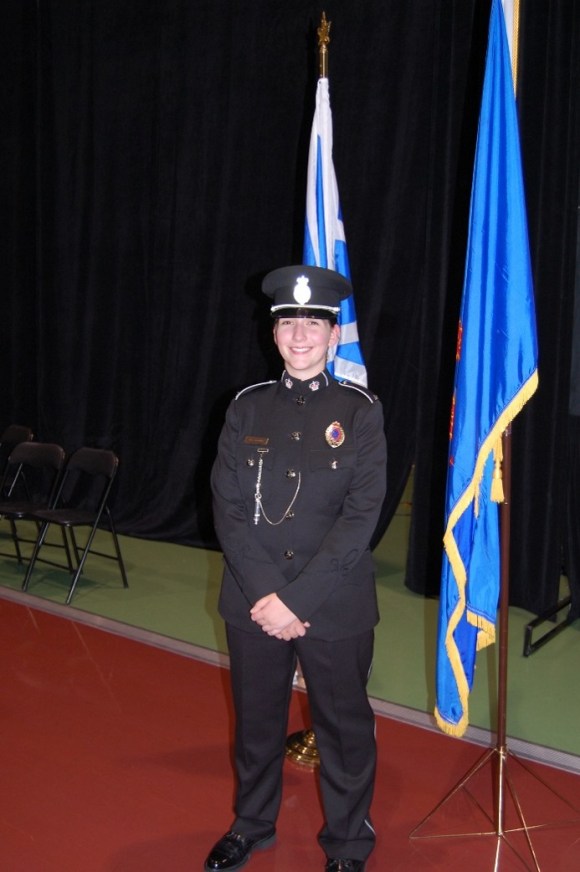
From 2007 to 2018, I served as a police officer with a provincial police service in Canada.  Starting on patrol, I also worked in communications, criminal investigation division, and forensics, I gained experience providing front-line response in a wide variety of emergency contexts. Prior to becoming a police officer, I spent my youth playing sports, specifically hockey and rugby, which resulted over the years in numerous sports-related injuries, including having my nose broken three times.

Figure 1: Graduation Day, 2007

Unbeknownst to me, my broken nose led to a deviated septum – a condition where the middle portion of the nose was twisted, obstructing airflow and preventing proper drainage. I knew my breathing was laboured; a girl in my police recruit class commented on how loud my breathing was, and I couldn’t run with an ‘in through the nose, out through the mouth’ pattern.  Finally, in the Winter of 2017, I saw an ear-nose-and-throat (ENT) doctor. I learned that the obstruction in my nose had created growths within my sinus cavities called polyps.  My nose needed to be reconstructed, and the polyps had to be removed.  The surgery went well; however, I could not have anticipated the results.  On the outside, my nose looked the same. On the inside, however, I quickly realized how poor my sense of smell had been once it had been fully restored.

Working in Forensics is unlike any other job. Calls range from minor incidents involving photographs of property damage and forensics processing of stolen vehicles, to crime scene management and analysis of complicated homicide scenes.  In my province, there is no coroner; every death at home is attended by patrol and forensics to rule out foul play.

Figure 2: Caught by the media while photographing a scene, 2017

The first few weeks after the surgery were tricky.  As my nose was healing on the inside, it would occasionally bleed if I got up too fast or bent over.  Normally, this wouldn’t be cause for concern; however, working in forensics brought the potential of introducing contamination into a crime scene. The last thing anyone wants to do is affect the integrity of a scene or necessitate questions about why your DNA is everywhere! This is commonly discussed in forensics; German police discovered scene contamination introduced by a cotton swab factory worker in Austria after the worker’s DNA was located at multiple scenes (Himmelreich, 2009).

After my nose healed, I quickly became aware of my heightened sense of smell. Before this point, I genuinely thought some people just experienced crime scenes and death differently than others in terms of fortitude, determination or tenacity. To say I was shocked is an understatement. Walking into a heavy smoker’s home, standing next to people with strong odours (good and not so good), and even the smells of diverse cuisines were astonishing compared to the previous complete absence.  The difference was jarring; I could smell the iron in blood, and the chemicals I used for processing, where there had been nothing before. Autopsies were a completely different experience, as was the newfound sensory overload of crime scenes. I was astonished by the difference, finding a huge disparity in my personal perception of my work as a result of regaining my sense of smell. The increased ability to smell made it challenging to leave work behind; my hands continued to smell like nitrile gloves, my skin seemed to exude the cleaning chemicals I used before leaving work, and unfavourable experiences lingered in my hair and on my clothes with apathetic vestige, making it harder to wash off the day. Smell, as a sense, is important, but it can also have lasting effects on well-being. Examining smell, Hur and colleagues found a strong correlation between smell and depression, with the prevalence of depression in individuals reporting negative or challenging smell experiences at nearly 40% (Hur et al., 2018).  Taste and smell problems can be the result of trauma to the head (Schechter & Henkin, 1974). Sense of smell can be influenced by fractures to the face (Drareni et al., 2021) and may be altered by diet (Liu et al, 2020; Stevenson et al., 2020), and salt intake (Henkin, 2014). Vestibular sensory systems may be negatively affected by sleep disruptions, impacting vision and balance (Besnard et al., 2018). Thus, police may be further at risk of sensory changes compared to others, as the profession involves physical altercations, shift work disrupting sleep, and often poor eating habits. These findings are especially timely, given the reported impacts on olfactory experiences by people recovering from COVID-19 (Coelho, 2022).

Souhami (2023) argues that police are affected by their sensory experiences, such as working in the dark, which influences how they work. I agree with Souhami that my perceptions in policing were altered in the dark, and I was aware of this influence. For my entire tenure as a police officer, I refused to watch horror movies for fear it would influence my ability to do my job – you can’t be afraid of fictitious movie characters when you’re running through the woods at night. Police work in an environment where perception is everything. The interpretation of threats helps us determine action, but our interpretation of the world around us is subjective. Fear is an adaptive mechanism intended to keep us safe (Gagnon et al., 2013); however, when afraid, we perceive situations as having more risk (Stefanucci & Proffitt, 2009). For police officers and other first responders, training emphasizes vigilance and safety. The work is stressful and is physically and mentally injurious (Pooley & Turns, 2021). The “anti-police rhetoric” is common (Pooley & Turns, 2021), with perceptions of vulnerability leading to increased hypervigilance as a means to maintain feelings of safety (Pooley & Turns, 2021). Hypervigilance can also be heightened as a symptom of posttraumatic stress, a further consequence of the work, with police experiencing higher rates of PTSD than the public (Carleton et al., 2018).

Souhami (2023) also describes police visual perceptions of their environment as imbued with feeling, calling for increased scholarship into sensile influences. In response, I would argue that there is significance beyond sight in our sensory experiences. It is not solely the vulnerability in the dark or our visual experiences that lead to a change in our perceptions, but the combination of our olfactory, vestibular, proprioceptor, auditory, tactile and oral sensations, known and unknown.

The dark itself is known; we are generally aware of our reduced perception and increased risk. The feeling of vulnerability tells us to pay attention, to be aware, to stay safe. I always preferred night shift, as a ‘night owl’ myself. Working at night felt less restricted with less traffic slowing down around me, fewer calls for service, and fewer car accidents to attend. In the summer months, the cool air was a reprieve from enduring body armour in the hot sun. Weekends were always busy, but weeknights sometimes permitted time to catch up on paperwork, actually eat a lunch on shift, and carried the hope of fewer files for follow during the following week.

Familiarity, however, makes a difference. During one call for service in my early patrol days, I responded to a domestic disturbance call in an area outside my regular district. It was dark, and I was in a part of town that I was unfamiliar with, dispatched there because the unit in the area was assigned to another matter on the busy summer Friday night. The newness of the area increased my attention and intensified my focus. The dark felt darker, and the air hinted at a crispness that should have been absent on a warm summer night. I remember the walk up the long driveway, the gravel crunching under my work boots, while I was trying to figure out which door I should knock at. Before I could knock at the door, a huge German Shepherd appeared on my flank out of nowhere, running forcefully at me, with explosive and thunderous barking. The dog ended up being friendly, but the fear induced by my lack of visual acuity, the sudden sound and intensity of the dog barking, and the abrupt disruption to my vestibular senses and proprioception system during the swift turn was disorienting in an unusual way. I was looking for risk as I was approaching the house, I felt aware, though that sense of awareness was spurious, and the subsequent shock was galvanizing.

The sensory input of the unknown is invisible and profound. We ignore our sense of smell until we have a head cold and lose taste. In policing, smell itself acts like a warning system; approaching a door, I would get a sense of what to expect.  During one call for service where a lady had passed away at home, the patrol officer tried to warn my colleague and I, both in forensics, about the scene inside. We immediately dismissed his comments, thinking patrol officers were always dramatic about death scenes. Entering the front door was like walking into a brick wall. The dozens of cats inside had saturated the air with heavy ammonia, and I felt like I could see the air waving, heavy with dolor. We knew we had to go upstairs, but each step was forced and burdensome like walking through water. The creak of each stair was deafening, the swoosh-swoosh-swoosh of our Tyvek protective suits redounding between our ears. The cats wanted attention, moving in and out between our legs, limiting the space on the cramped stairs. We got halfway up to the second floor when my colleague stopped solid. “We have to get out,” she said with veiled panic. I could feel the sweat coming down my forehead, and I could see it in her hair, too. I remember telling her that if we left, we would have to come back in, we were already halfway there. The following ten or fifteen seconds of eye contact between us felt like it lasted an hour. We would have to come back in.

Prior to surgery, I attributed my ability to withstand the challenges of policing to a personal aptitude or individual competency. Being able to experience the change in perception, while challenging, allowed me insight into how fundamental sensory experience is to functional ability, focus, capability, and coping. Schleiermacher, concerned with language, wrote, “every utterance corresponds to a sequence of thoughts of the utterer, and must therefore be able to be completely understood via the nature of the utterer, his mood, his aim” (Schleiermacher, 1998, p. 229). I would argue this conceptualization of language can be extended to our sensory experience; our perceptions are rooted in our context and standpoint in the moment and over time, which in turn, influences our experience and contextualizes our disposition and abilities. If, as voiced by Wittgenstein, “the limits of my language mean the limits of my world” (1922, p.201), our ability to understand and explain our experiences is vital to processing and conceptual expansion, and potentially, could have long reaching impacts for mental health, job satisfaction, and wellness. For example, understanding sensory needs holistically could influence perceptions and our choices. Something as simple as chewing gum can reduce stress during stimulus experiences (Yu et al, 2013), decrease the levels of cortisol in saliva (Tahara et al, 2007), and increase perception of performance and wellbeing (Smith et al., 2012). Gum chewing may also improve memory (Hirano et al., 2008) and positively influence attention (Hirano et al., 2013). For police, the influences on the visual, olfactory, tactile, vestibular, proprioceptor, gustatory, and auditory systems are complex and variable, and knowingly and unknowingly affect vulnerability and perceptions due to the conditions and environment in which police work. I agree with Souhami, we should not be afraid of the dark. But we must consider how the combination of perception, vulnerability, and all sensory aspects influence us in immeasurable, substantial ways. We still have to do the job, knowing the dog may not be friendly next time, knowing we will have to come back in.

Categories
Environment police power sensory space Uncategorized visual

Policing Dark Islands

Anna Souhami

One dark morning, I was standing on a hill in a howling gale in the Outer Hebrides, when I was surprised to see a police car in the distance. What did a police officer do in small, remote islands? What does policing look like when communities are small, scattered and separated by sea? Would police work be affected by the wind and rain that were then battering me? And why, after many years thinking about police work, didn’t I know?

This moment set in train an extended ethnography of policing in Shetland, the most peripheral archipelago in the UK. I wanted to explore how the historical preoccupation of criminology with the city had limited our imagination.  If our foundational research on policing had been conducted in remote islands rather than cities, what would we think was important in thinking about crime and its control? What would we notice that we currently do not see?

I soon discovered that one of the phenomena remote islands make inescapable is the dark: the visceral, overwhelming, sensory experience of immersion in darkness, and its effects on the exercise of state power.

Shetland is located over 200 miles north of the Scottish mainland in the centre of a ‘crossroads’ between Iceland, the Faroes, Scotland and Norway.   Its main connection with the UK mainland is by a 12 hour ferry from the Northeast of Scotland, though notoriously rough seas mean the journey can often take twice that. It can also be reached by propeller planes from Scottish airports, though the storms, 70mph winds and thick fog that batter the islands make this an unpredictable form of transport:  Flybe, the airline which served Shetland during my research, was known locally as ‘Fly Maybe’. 

So, in mid-December, armed with a suitcase full of seasickness tablets and some sturdy boots, I joined the young oil workers eating enormous plates of chips on the boat heading for Lerwick. Twelve hours later, I stepped out onto the deck in roaring winds, beside myself with excitement at my first glimpse of Shetland. 

I saw nothing.

Instead, I found myself enveloped in darkness, the quality of which I had never experienced before. It was impossible to tell where the land, sea and sky began or ended: the occasional tiny pinpricks of light which fleetingly appeared could have been from boats, houses or stars. This was my first experience of what islanders called ‘black dark’: an absence of light so profound that, as a police officer said, ‘you can’t let your dog off the lead as you’ll never find her again’.  Or as a former mainland officer put it, ‘you don’t know darkness until you’ve lived here. Here, there is nothing’. 

Yet while darkness may have been described in its absence – as ‘nothing’ – this was not how it was experienced. Instead, as I discovered, darkness is an acutely sensory experience. It is active, physical and alarming.

Light and darkness are central to the experience of life in remote Northern islands. Shetland experiences dramatic changes of light with continual light in midsummer (the Shetland phrase ‘simmer dim’ describes the brief dip in the light at the summer solstice) and in mid-winter, the time of my first arrival, only a few hours of watery grey daylight. Nights were not always dark: without clouds, auroras, stars and full moons lit up the sky making it possible to drive without headlights. The extraordinary experience of night illumination was so disorienting that one island police station had a list of full moon dates pinned to their front office to predict when people would ‘go crazy’.

However, more frequently, winter storms blacked out the moon and stars bringing immersion in darkness.  Staying in a little house at the end of a dark track next to a bay, I found myself overwhelmed by darkness. My fieldnotes describe tiredness, disorientation, and insomnia; feeling unable to leave my house, ‘hemmed in’ by a darkness that was ‘oppressive and total’.  To my astonishment, being submerged in darkness also brought with it a sense of creeping fear that was both existential and visceral. For the first time since a small child, I was afraid of the dark.

I soon realised these experiences were shared by the police officers navigating dark islands. All officers talked about darkness. They described how it interfered with their work: feeling exhausted and disoriented, getting lost, and not knowing in which direction they were driving. One officer came back from an unsuccessful house inquiry explaining: ‘There are no streetlights. It’s pitch black. It’s the darkest place I’ve ever been. I couldn’t find the bastard house.’ 

Yet darkness also affected officers more profoundly. It shaped the way they perceived the islands, and how they felt and moved within them.  

In the light islands were playgrounds for exploration. The starkness of the Shetland landscape became exciting:  we drove to remote cliffs to spot seals, orcas and otters on clear days, or to see shooting stars, red moons and auroras on clear nights. Officers described the colours of the land and sea, the sunsets they had seen, the wildlife and boats that passed. 

In the dark, however, islands became places of vulnerability. Officers described them as empty, lonely, barren places: ‘bleak’, ‘desolate’, depressing’, ‘shit’, ‘grey’.  Yet darkness wasn’t simply experienced as absence – of light, colour or pleasure. Instead, it was active, oppressive and visceral. Dark islands were hostile places.  Just as I felt ‘hemmed in’ in my house, officers described being crushed or consumed by darkness. It was penetrating, ‘claustrophobic’, ‘oppressive’; they described ‘sinking’ into the landscape.

Phenomenological research helps illuminate why darkness seems to generate this bodily sense of vulnerability.  Shaw (2015, p586) argues that in light, vision holds objects at a distance, becoming a ‘protective field’ which delineates the self from the world. In darkness, the boundaries between the body and environment are eroded (also Edensor 2013, Merleau-Ponty 1962, Morris 2011). Bodies become porous, leaving us open and vulnerable to the world outside. Or, as one officer described it, in darkness ‘I felt I was being swallowed by the island’.

For island officers, immersion in darkness was profoundly unsettling. As a result, officers drove quickly through dark places or avoided them entirely. Instead they headed to the comfort of the police station, or circulated around populated places with the safety of illuminated light. As one officer put it, when cloud cover at night meant there was no light at all, ‘that’s when you return to the station’. Islands became mapped through the light and the dark, structuring where officers went and what they did.

Where the police go, where they focus their attention, directly affects the use of state power. Research in dark islands suggest that their sensory experience of the environment, and the darkness and light in which they are submerged, is crucial to how police officers think, feel and move through the areas they police, and consequently what they do and who they encounter. So why have these phenomena been overlooked in police scholarship? As I have argued elsewhere (Souhami 2023), the consistency of the urban context of police research seems to have led us to overlook the physical environment of police work altogether. Remote Northern islands reveal that there is more to criminology than our preoccupations suggest. We should not be afraid of the dark.

For more on this research, see:

Souhami, A (2023): “Weather, Light and Darkness in Remote Island Policing: Expanding the Horizons of the Criminological Imagination”. The British Journal of Criminology. 63 (3) pp 634–650, https://doi.org/10.1093/bjc/azac052

You may also be interested in the ‘Just Humans’ podcast ‘Darkness: Dr Anna Souhami’ produced by the Scottish Centre for Crime and Justice Research:  https://www.sccjr.ac.uk/podcast/darkness-dr-anna-souhami/

References:

Edensor, T (2013): ‘Reconnecting with Darkness: Gloomy landscapes, lightless places’. Social and cultural geography 14, 446-65

Merleau-Ponty (1962): Phenomenology of Perception. Translated by C Smith. London: Routledge and Kegan Paul.

Morris, NJ (2011): ‘Night walking: darkness and sensory perception in a night-time landscape installation’. Cultural Geographies 18 (3), 315-342

Shaw, R (2015): ‘Controlling darkness: self, dark and the domestic night’. Cultural Geographies 22 (4), 585-600

Categories
Emotions police power sound

The knock

Jason Warr

The other day I was lain abed, taking advantage of the snooze alarm, dozy with the warm snuggled hug of the memory foam topper keeping me from the day. Parched, gritty eyed, in comforting dark when I was torn from my state by Bang … BANG, BANG!

I was immediately alert, up, on edge, worried, looking for the fresh Adidas, thrown back, awaiting the later crash as the door succumbed to uniformed baton and boot. The sounds of the banging immediately transported me back to a former time and a “6 in the Morning …”[1] moment that I was not, until this moment, aware had been haunting me. Fortunately, this time it was not the police. It was just an impatient delivery driver bringing some novelty to the door (unlike some advisory others we’re adhering to lockdown rules) and had ignored the doorbell and had just slammed fist to door. However, it got me to thinking about the police and The Knock.

Thus far many of the blog posts that have been presented here have focused on the sensorial nature of the prison and conducting research therein. This is understandable as the admins are all currently prison researchers and thus many of our connections are in the same field. However, the aim here has always been to expand our work and thinking beyond the realm of prisons and our book on Sensory Penalities into the wider realm of a sensory criminology. Here I aim to discuss one element of that: namely, the symbolism enmeshed within the police actions of knocking on a door.

Kate Herrity[2] notes that sounds such as banging (in one section of her thesis she discusses banging on cell doors) are symbolically communicative. The rhythm, timbre, volume, pitch, and tone of the ‘bang’ convey a range of messages and information. From calls for attention, to dissatisfaction, to alarm and panic, to anger – all can be contained within those sounds. She also argues that in order to understand the sound environment, the soundscape, of the prison (and thus in order to understand the prison), we need to become attuned to those sounds in order to be able to interpret and discuss their relevance and meaning within the social ecology of that environment. I contend here that we can extend such thinking to explore the relevance and meaning of police behaviours – here specifically the Knock.

Knocking is an interesting phenomenon in and of itself. There are whole articles and essays based on this.[3] The interpretations of ‘knocks’ is a complex neuro-social interaction which comprises varying neuro-functions conjoined with forms of social cognition[4]. There is the identification of both the action itself (becoming aware of the sound) and the form (discerning location and component of the sound) and then a process of contextual interpretation – what does the sound/knock mean? Ordinarily, and evidently, a knock represents an external person’s expressed desire and intention to gain some access into the space from which a door currently blocks their progress. The knock, therefore represents an intent[5]. However, there is a complex relationship of cultural expectation, mores, and manners involved in the act of a knock. Evidenced by the fact that some ‘knocks’ on a door can be considered rude – you will know what I mean by that. Think about that, you will have some recognition already that some forms of ‘knock’ are inappropriate. BANGBANGBANG when bringing a cup of tea to someone on a conference call for instance. Yet, though we have some recognition of this when asked to contemplate it, it is nevertheless one of those simplistic acts in our quotidian lives that is much more complex than we ever really bother to consider.

When it comes to the police, and their knocking on your door, this is complicated by the function of their knocking. Or in deed not knocking. In the US policing literature, there is a wide range of critical explorations on the controversial policy and practice of the ‘No-Knock’ warrant – whereby the police can gain access to a property without the ordinary provision of having to ‘knock’ on the door[6]. When it comes to police practice there is a great deal of symbolic communication layered into the sounds of their knocking or decisions not to knock. Due to the delivery drivers rude awakening of my imagination it made me realise that I have been subjected to varying forms of the ‘the knock’ by the police. There is no singular knock here, instead there is a multitude of aural communications, being proffered by differing forms of the knock. Here I explore three.

tap … tap, Tap

When I was 17 a friend of mine died. The police who attended the scene asked me to accompany them to the family’s home in order to break the news to my friend’s mum. It was the first and only time I ever got into a police car willingly. Fuck knows I did not want to go but … what do you do? I remember so vividly how nervous the two officers, one older male, the other a younger woman, were on the way there. It was the first time I had ever seen people who I associated with power, hostility, and ill-treatment seem vulnerable. The ride there was filled with pained silence. They had seen the devastation wrought on the child of the person we were on our way to see. The closer we got the more nervous we all got. As we reached the house, I felt sick with dread. The officers approached the door and gave the door a tentative tap, followed by a brief pause, and then two more taps. The last of which seemed more assertive – tap … tap, Tap.

Tap, Tap … Tap, Tap

Sat in my flat in East London, minding my own business, watching tv, there came a Tap, Tap … Tap Tap at my front door. There was a weird, proprietary air to the knock on the door. As I disentangled myself from the cushions on the sofa in order to answer the door there came a further Tap, Tap … Tap, Tap. It was, as most knocks are a call for attention, but interlaced into this knocking was something of authority, confidence, and impatience. It made me hesitate. Nervous. Alert. Ready for a confrontation, violence if needs be. When I opened the door there were police officers, a number, strategically placed at the portal, eying the locked security gate with suspicion. Nerves, fight or flight instincts began to kick in, until I noticed another set of officers at the door opposite. “Sorry to bother you sir, but there was an incident outside last night, and we’re just checking to see if you saw or heard anything”.

Routine. Breathe …

BANG, BANGBANGBANG, BANGBANGBANG

Crash. Splinter. Baton and boot.

“6 in the morning, police at my door, Fresh Adidas squeak across the bathroom floor, Out my back window I make an escape …”[7]

Except I didn’t escape from the flat. I barely made it out of bed before hands and boots were on me. Blurs of black and white. Pain, sharp, intense. Shouts ringing loud but incoherent. I had no idea why they were there but … that was nothing new. It was the last time though. There is nuance to the communicative, and symbolically communicative, actions of the knock. Here, by exploring just three forms of knock employed by police officers we can begin to see how the act of knocking on a door, with differing intents, can be discerned. We tend not to think about the sensory element of actions of, or performances by, those who wield power. Yet they are there. If we are to have a greater understanding of the interactivity of that power with the public then we need to begin to start taking these sensory elements more seriously. There are questions to explore and to be answered. This is what sensory criminology aims to do, revisit much of our criminological understanding and see if there are facets that we have, hitherto missed.


[1] Ice-T (1986) “6 ‘N the Morning”, Rhyme Pays, Techno Hop Records, Warner Bros, Los Angeles: California.

[2] Herrity, K. (2019). Rhythms and Routines: Sounding Order in a Local Men’s Prison Through Aural Ethnography., Doctoral Thesis., University of Leicester., Leicester https://ethos.bl.uk/OrderDetails.do?uin=uk.bl.ethos.794058

[3] For instance, von Wright, G. (1988). An essay on door-knocking. Rechtstheorie, 19(3), 275-288.

[4] Lemaitre, G. Pyles, J. A. Halpern, A. R. Navolio, N. Lehet, M. and Heller,L. M. (2018). Who’s that Knocking at My Door? Neural Bases of Sound Source Identification, Cerebral Cortex, Vol. 28(3): 805–818.

[5] See 3.

[6] See: Dolan, B. (2019). To knock or not to knock: No-knock warrants and confrontational policing. St. John’s Law Review, 93(1), 201-232.

Goddard, J. M. (1995). The destruction of evidence exception to the knock and announce rule: call for protection of fourth amendment rights. Boston University Law Review, 75(2), 449-476.

[7] See 1.