Jennifer Stickney
Release is often full of hope, expectations of a better life and images of freedom that involve living life to the full[1]. The reality of release can be quite different. Being a prisoner involves significant loss: loss of freedom, loss of choice, loss of communication, loss of possessions, loss of relationships[2] and loss of normal every day sensory experiences that support people in interpreting and navigating the world around them. It is therefore important that we understand the impact of this loss on the release experience. By doing this we are able to support people as they are released from prison to resettle into the community[3].
In Jays’ poem below he describes his realisation of the loss he has experienced through his offence and being in prison, and the impact this has had on his release.
Free to be Blind
Have you tried seeing the world through eyes that can only see the past?
Have you tried taking steps on the road I walk … consumed in darkness?
What’s freedom if it’s lived within a personal prison?
I’m only willing to accept your future if somehow I am invisible… if my voice made no sound, if my existence was just a memory that you don’t have.
Yes, I am free but don’t be blind to my pain!
I still live with my guilt backed inside my soul,
I can’t see what you see… I can’t see a person.
My reflection has no meaning.
My smile is just a mask.
My laughter only a sound you hear.
What’s freedom if a person isn’t truly free?
What’s a future if it includes me?
Jays’ poem depicts a sensorial numbness. His words suggest an inability to feels sensations, relying on others to use their senses to notice his voice, his smile, in essence notice him as he is unable to notice himself. When he is overwhelmed, Jay’s body is unable to recognise or interpret sensory information around him resulting in him feeling numb. To keep himself feeling safe from the unknown of release Jay has built a personal prison around himself, which limits the sensations he experiences and enables him to avoid the feelings of being overwhelmed and unable to cope. However, by doing this he struggles to see how he can feel free and move forward with his life in the community.
Tony compared his experience of release to one of coming out of segregation.
“I was in seg for 18 moths solid. On my own with no one else around. When I came out of seg it was mad. Having people around, people talking everywhere. People everywhere. It was mad. I couldn’t understand what was going on. When people spoke to me, they sounded like Pinky and Perky you know…, I couldn’t make sense of what they were saying. I still don’t like being around lots of people, it makes …too many voices, too many people. When I first came out of jail I went to an AP[4]. I had the same experience as I did coming out of seg. Everything was different, it looked different, felt different. When people spoke to me their voices all merged, like Pinky and Perky talking together – I couldn’t understand what they were saying or what I needed to do.”
Both James’ and Tony’s words highlight how sensory experiences can impact on emotional regulation. The stress of being released from custody exacerbates people’s arousal states and it is therefore unsurprising that this is a time when an individual needs tools and skills to help them manage unwanted and unhelpful feelings associated with sensory overload.
We know and can understand that people being released from prison following long custodial sentences are likely to need some support with the practical aspects of reintegrating back into society. However, in my experience little thought, or consideration is given to the impact of the sensory shock of release, and the immediate effect this can have on a person’s ability to manage the daily tasks required to navigate the community.
For some people I have worked with, release from custody can feel like an existential shock[5]: a sensory explosion. When their body is not able manage the sensory input it is experiencing, this can trigger the fight, flight or freeze response. The visual sensory experience of the world outside prison is tangible for even those of us who have spent just a few hours at a time visiting them: the space, colours, the shapes and how things move is so different from the generally grey, austere prison buildings. Sounds in the community can be enormously overwhelming, the unfamiliar sound of babies and children, emergency vehicle sirens, the cacophony of noise that is the norm in busy towns or on public transport. The touch of a person brushing by in the street can be very triggering for someone who has not experienced touch for many years. The smells of petrol, sewers, smoke, flowers and fresh grass can be reminders of the past but unfamiliar in the present, and the pace of life, the speed with which vehicles move nowadays, the rush of people getting to appointments, are so different from the experience inside prison.
Considering our senses separately enables us to look at how they might be impacted by the experience of release:


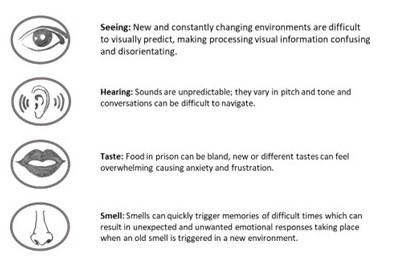

In recent years there is an increased interest and a growing evidence base regarding the impact of sensory overload on a person’s ability to engage in everyday life and learn new skills. However little attention has been paid to how sensory overload can impact on a person’s experience of being released from prison. Consequently, little consideration has been given to the effect this can have on a person’s occupational performance in everyday tasks, and their feeling that they can cope with life after prison.
In 1969 Scott and Gendreau wrote that a person “cannot adjust to a sudden release into free society because his mental and emotional mechanisms are adjusted to the deprivation circumstances [of prison]. He cannot tolerate the myriad sensory input in normal environments with its pace, noise, confusion, and instant decision making. Anxiety, restlessness, sleeplessness, and irritability become so great in the released ex-inmate that he may seek means to return to prison with its retarded input and routine existence” (p.341).
Little has changed since 1969 regarding supporting people to prepare their sensory systems for release and enable them to manage this existential shock on the sensory system as they walk through the prison gates and start to navigate community living. However, with the growing interest in this area, and the evidence base that highlights the criticality of this support, we need to ensure that we act on this knowledge and evidence to better support people on their journey from prison out into the community.
In the chapter I co-wrote: “180 prisoners and the noise … it hits you, BANG!” Sensory systems, incarceration and resettlement[1] we identified some key strategies that can support people managing their emotions and behaviours particularly in preparation for release and as they transition from custody to the community. These include:
- Understanding a person’s sensory preferences – it is helpful to know what sort of things calm and agitate a person prior to release to have some idea of how to support emotional regulation during times of high stress.
- Developing a personalised place of safety – it is important to think about where a person is going to be released to and consider things that can be done to make it feel safe, such as where the bed is placed, the lighting of the room, the sounds they can hear and if they need ear plugs to support sleep etc.
- Having meaningful structure and routine – this can feel containing and enable people to know what to expect and when, and plan how they can manage their time on release. Having timetables that identify appointments and activities that will be taking place in the first few days and weeks post release is helpful.
- Engaging in sensorimotor activities (activities that combine sensory experiences and physical movement e.g., yoga, gym-based activities, swimming and gardening) – can enable people to develop skills and engage in activities that support them to self-regulate when they are feeling overwhelmed.
- Accessing sensory tool kits – these are personalised kits that are uniquely complied to support a person in managing their emotions and behaviours through sensory strategies and tools at times when they feel dysregulated.
Getting release right is critical to supporting successful resettlement. Acknowledging the impact of sensory overload on a person’s ability to self-regulate in the first few days following release is essential. Providing opportunities to enable people to manage their own risks and needs through better understanding of their sensory system can make life feel more tolerable in the first few days, and in the long term will assist people in their resettlement journey. Now is the time to use our knowledge and skills to start offering better support in this area at critical times in a person’s journey through custody and in their resettlement.
[1] Stickney, J., Budd, C. & Mark (2023). “180 prisoners and the noise… it hits you, BANG!”: Sensory systems, incarceration and resettlement. In Shingler, J. and Stickney, J. The Journey from Prison to Community (p. 85-102). Routledge.
[1] Shingler, J., & Stickney, J. (2023). “I can see freedom but I can’t have it”: Supporting people in the immediate aftermath of release. In The Journey from Prison to Community (p. 24-43). Routledge.
[2] Scott, G. D., & Gendreau, P. (1969). Psychiatric implications of sensory deprivation in a maximum security prison.
[3] Stickney, J., Hirons, A., & Jenner, H. (2023). “How could I know what to do?”: Supporting people in building practical skills for resettlement and reintegration. In The Journey from Prison to Community (p. 118-134). Routledge.
[4] AP – Approved Premise, multi-occupancy accommodation managed by the Probation Service.
[5] Canton, R. (2022). After-care, resettlement and social inclusion: The role of probation. Probation Journal, 69(3), 373-390.
 Sensory Criminology