For most people, biting into a peanut butter and jelly sandwich can transport a grown person back into childhood. The creamy texture of peanut butter mixed with the sweet and tangy strawberry or grape jelly on doughy bread is a bite into one of the world’s popular comfort foods. The sandwich reminded me of my Batman lunchbox packed with my mother’s love during my carefree elementary school days. Unfortunately, during my years as a juvenile correctional officer at the Clark County Juvenile Detention Center in Las Vegas, Nevada, this familiar sandwich became a powerful sensory reminder of the complexities and ironies inherent within the American juvenile justice system.
I worked as a juvenile correctional officer soon after I completed my bachelor’s degree from the University of Nevada, Las Vegas. I was not much older than many young teenagers in the facility. Along with the peanut butter sandwiches, I distinctly remember the process of entering our work shifts and the various smells throughout the units. When entering the facility, a monitored clinical environment, the sounds, and sights become etched into memory. The heavy doors, the echoes, and the constant sense of surveillance set a heavy tone for the atmosphere. I remember walking through these long, narrow hallways in the oldest unit in the detention center. The unit always had problems with flickering lights that made the darkness thick. As our eyes adjust to the dark, the musty walls and rusted iron bars remind us of the countless children and officers who spent time in these halls. The smells in the hallway contrasted between bleach and other industrial cleaners and the faint odor of sweat.
Peanut butter and jelly sandwiches are a staple for children worldwide and a quintessential symbol of childhood in the United States. The simple recipe makes these sandwiches the favorite lunch item for children in school playgrounds and the go-to meal between breaks at work for adults. In many families, affordability is a key factor in the sandwiches’ popularity, a practicality that, in my experience as a juvenile corrections officer, aligns with the cost-cutting measures found in carceral settings. Even in our detention facility, adult inmates from the nearest county jail were transported to prepare the meals for the juveniles. During my years, we would pass out the crustless version of the peanut butter and jelly sandwich made by Smucker’s as an evening snack for juveniles under our care. These sandwiches came in plastic wrappers that released a mixed aroma of artificial fruitiness and nutty peanut butter when ripped open. Biting into it, the white bread and peanut butter clung to the roof of the mouth while the jelly seeped disproportionately. The cafeteria staff would always leave a few extra sandwiches for the staff that we would eat with the youth. The taste of a peanut butter and jelly sandwich in the juvenile detention setting was peculiar, and the symbolism, even then, was never lost on me.
Peanut butter and jelly sandwiches are emblematic of the care and nurture associated with family. In the juvenile detention setting, a space that represents lost freedoms, systemic failures, over-criminalization, and punitive punishment, the taste of a peanut butter jelly sandwich takes on a profoundly ironic tone. Stripped of its sentimentality, peanut butter and jelly become more than a sandwich when served to children in this environment. Unlike the prevailing narrative, the sandwich now represents the harsh reality of institutionalization and dehumanization of juveniles in the system. The sandwich in juvenile detention highlights the conflicts between the idealized perceptions of youth and the retributory nature of the juvenile justice system. Compared with the affectionate context and familial recipes traditionally reserved to make a tasty sandwich, the peanut butter and jelly sandwiches in detention were mass-produced and served in a cold, regimented, and adverse environment. The contrast represents a paradox of a sandwich symbolizing love and care reduced to a cheap snack to meet the juveniles’ basic nutritional needs.
In the years since, peanut butter and jelly sandwiches continue to remind me of my time working in detention. I remember how some juveniles devoured the sandwiches quickly while others slowly peeled the sandwich apart and took their time to enjoy the jelly first and then the peanut butter and bread. However, for the youth, consuming these sandwiches may inadvertently evoke negative feelings of lost innocence and a reminder of the distressing period of their lives. The symbolism of a food item meant to nourish and be a comfort food snack for children now arouses emotions of regret, anxiety, depression, and bitterness over their time spent in detention.
Even in the years since, I have become preconditioned to think of the sights, smells, and noises, the memories and conversations I have had in the juvenile detention center when I bite and taste a peanut butter and jelly sandwich. My experiences with the sandwich, a symbol of childhood, oddly reveal the underlying contradictions of American juvenile justice, symbolized by the loss of innocence and systematic failures that contribute to recidivism. In this context, the sandwich goes from America’s beloved snack to a metaphor for the dissonance between childhood ideals and the realities of how society deals with its most vulnerable and detained population.
* Jelly is the American equivalent of jam in other parts of the world.
Release is often full of hope, expectations of a better life and images of freedom that involve living life to the full[1]. The reality of release can be quite different. Being a prisoner involves significant loss: loss of freedom, loss of choice, loss of communication, loss of possessions, loss of relationships[2] and loss of normal every day sensory experiences that support people in interpreting and navigating the world around them. It is therefore important that we understand the impact of this loss on the release experience. By doing this we are able to support people as they are released from prison to resettle into the community[3].
In Jays’ poem below he describes his realisation of the loss he has experienced through his offence and being in prison, and the impact this has had on his release.
Free to be Blind
Have you tried seeing the world through eyes that can only see the past?
Have you tried taking steps on the road I walk … consumed in darkness?
What’s freedom if it’s lived within a personal prison?
I’m only willing to accept your future if somehow I am invisible… if my voice made no sound, if my existence was just a memory that you don’t have.
Yes, I am free but don’t be blind to my pain!
I still live with my guilt backed inside my soul,
I can’t see what you see… I can’t see a person.
My reflection has no meaning.
My smile is just a mask.
My laughter only a sound you hear.
What’s freedom if a person isn’t truly free?
What’s a future if it includes me?
Jays’ poem depicts a sensorial numbness. His words suggest an inability to feels sensations, relying on others to use their senses to notice his voice, his smile, in essence notice him as he is unable to notice himself. When he is overwhelmed, Jay’s body is unable to recognise or interpret sensory information around him resulting in him feeling numb. To keep himself feeling safe from the unknown of release Jay has built a personal prison around himself, which limits the sensations he experiences and enables him to avoid the feelings of being overwhelmed and unable to cope. However, by doing this he struggles to see how he can feel free and move forward with his life in the community.
Tony compared his experience of release to one of coming out of segregation.
“I was in seg for 18 moths solid. On my own with no one else around. When I came out of seg it was mad. Having people around, people talking everywhere. People everywhere. It was mad. I couldn’t understand what was going on. When people spoke to me, they sounded like Pinky and Perky you know…, I couldn’t make sense of what they were saying. I still don’t like being around lots of people, it makes …too many voices, too many people. When I first came out of jail I went to an AP[4]. I had the same experience as I did coming out of seg. Everything was different, it looked different, felt different. When people spoke to me their voices all merged, like Pinky and Perky talking together – I couldn’t understand what they were saying or what I needed to do.”
Both James’ and Tony’s words highlight how sensory experiences can impact on emotional regulation. The stress of being released from custody exacerbates people’s arousal states and it is therefore unsurprising that this is a time when an individual needs tools and skills to help them manage unwanted and unhelpful feelings associated with sensory overload.
We know and can understand that people being released from prison following long custodial sentences are likely to need some support with the practical aspects of reintegrating back into society. However, in my experience little thought, or consideration is given to the impact of the sensory shock of release, and the immediate effect this can have on a person’s ability to manage the daily tasks required to navigate the community.
For some people I have worked with, release from custody can feel like an existential shock[5]: a sensory explosion. When their body is not able manage the sensory input it is experiencing, this can trigger the fight, flight or freeze response. The visual sensory experience of the world outside prison is tangible for even those of us who have spent just a few hours at a time visiting them: the space, colours, the shapes and how things move is so different from the generally grey, austere prison buildings. Sounds in the community can be enormously overwhelming, the unfamiliar sound of babies and children, emergency vehicle sirens, the cacophony of noise that is the norm in busy towns or on public transport. The touch of a person brushing by in the street can be very triggering for someone who has not experienced touch for many years. The smells of petrol, sewers, smoke, flowers and fresh grass can be reminders of the past but unfamiliar in the present, and the pace of life, the speed with which vehicles move nowadays, the rush of people getting to appointments, are so different from the experience inside prison.
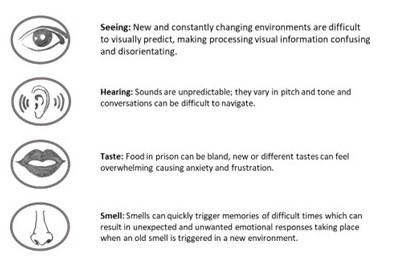
Considering our senses separately enables us to look at how they might be impacted by the experience of release:
In recent years there is an increased interest and a growing evidence base regarding the impact of sensory overload on a person’s ability to engage in everyday life and learn new skills. However little attention has been paid to how sensory overload can impact on a person’s experience of being released from prison. Consequently, little consideration has been given to the effect this can have on a person’s occupational performance in everyday tasks, and their feeling that they can cope with life after prison.
In 1969 Scott and Gendreau wrote that a person “cannot adjust to a sudden release into free society because his mental and emotional mechanisms are adjusted to the deprivation circumstances [of prison]. He cannot tolerate the myriad sensory input in normal environments with its pace, noise, confusion, and instant decision making. Anxiety, restlessness, sleeplessness, and irritability become so great in the released ex-inmate that he may seek means to return to prison with its retarded input and routine existence” (p.341).
Little has changed since 1969 regarding supporting people to prepare their sensory systems for release and enable them to manage this existential shock on the sensory system as they walk through the prison gates and start to navigate community living. However, with the growing interest in this area, and the evidence base that highlights the criticality of this support, we need to ensure that we act on this knowledge and evidence to better support people on their journey from prison out into the community.
In the chapter I co-wrote: “180 prisoners and the noise … it hits you, BANG!” Sensory systems, incarceration and resettlement[1] we identified some key strategies that can support people managing their emotions and behaviours particularly in preparation for release and as they transition from custody to the community. These include:
Understanding a person’s sensory preferences – it is helpful to know what sort of things calm and agitate a person prior to release to have some idea of how to support emotional regulation during times of high stress.
Developing a personalised place of safety – it is important to think about where a person is going to be released to and consider things that can be done to make it feel safe, such as where the bed is placed, the lighting of the room, the sounds they can hear and if they need ear plugs to support sleep etc.
Having meaningful structure and routine – this can feel containing and enable people to know what to expect and when, and plan how they can manage their time on release. Having timetables that identify appointments and activities that will be taking place in the first few days and weeks post release is helpful.
Engaging in sensorimotor activities (activities that combine sensory experiences and physical movement e.g., yoga, gym-based activities, swimming and gardening) – can enable people to develop skills and engage in activities that support them to self-regulate when they are feeling overwhelmed.
Accessing sensory tool kits – these are personalised kits that are uniquely complied to support a person in managing their emotions and behaviours through sensory strategies and tools at times when they feel dysregulated.
Getting release right is critical to supporting successful resettlement. Acknowledging the impact of sensory overload on a person’s ability to self-regulate in the first few days following release is essential. Providing opportunities to enable people to manage their own risks and needs through better understanding of their sensory system can make life feel more tolerable in the first few days, and in the long term will assist people in their resettlement journey. Now is the time to use our knowledge and skills to start offering better support in this area at critical times in a person’s journey through custody and in their resettlement.
[1] Shingler, J., & Stickney, J. (2023). “I can see freedom but I can’t have it”: Supporting people in the immediate aftermath of release. In The Journey from Prison to Community (p. 24-43). Routledge.
[2]Scott, G. D., & Gendreau, P. (1969). Psychiatric implications of sensory deprivation in a maximum security prison.
[3] Stickney, J., Hirons, A., & Jenner, H. (2023). “How could I know what to do?”: Supporting people in building practical skills for resettlement and reintegration. In The Journey from Prison to Community (p. 118-134). Routledge.
[4] AP – Approved Premise, multi-occupancy accommodation managed by the Probation Service.
[5] Canton, R. (2022). After-care, resettlement and social inclusion: The role of probation. Probation Journal, 69(3), 373-390.
Infliction of physical pain, non-consensual touch, slopping out, subjection to loud noise, social isolation – these are all experiences within penal settings of subjection to, or deprivation of, certain sensations, smells and sounds which are deeply relevant for understanding the nature of dignity violations. From our perspective as researchers analysing the interpretation of the right not to be subjected to torture, inhuman or degrading treatment or punishment, in particular in European human rights law, we reflect on how a human rights lens has potential to illuminate why those involved in the governance and/or oversight of penal institutions should be concerned with the sensory. At the same time, we reflect on what those of us engaged in illuminating and concretising human rights can learn from bringing the sensory into focus; on how it can deepen our understanding of what is actually going on at the level of individual experience, and in turn shape our understanding of what falls within the purview of a legal norm such as the right not to be subjected to torture or inhuman or degrading treatment or punishment.
The way that individuals experience dignity respect or disrespect is a core concern in the penal context. In human rights doctrine, dignity language is particularly prominent in relation to the experience of prisoners and other detainees, including in immigration detention. The Nelson Mandela Rules, dealing with the treatment of prisoners, state in the very first sentence of the very first rule that “all prisoners shall be treated with the respect due to their inherent dignity and value as human beings.”
This is a powerful, if uncertain, red line. A challenge for working with the dignity idea is that it doesn’t possess a neatly labelled, off-the-shelf meaning in human rights discourse (or any other discourse). International agreements and human rights treaties are not philosophical works; they only try to capture and convey a sense of shared, social values. To understand the substance of dignity from a human rights perspective then, we have to piece together fragments of these shared understandings with the texts, with the pronouncements of monitoring bodies about the circumstances before them, and with theoretical accounts of dignity’s meaning. When we do so, we see patterns and gain insight into connections between sensory experience and dignity, respect and disrespect, as we outline below.
While the idea of dignity may be associated with metaphysical properties, it is a multi-faceted notion and contemporary accounts embrace its richness. It is widely recognised that human dignity is bound up with embodiment, and that dignity violations are socially-embedded experiences. Besides the ways the sensory can play a key role in the distress and harm that certain circumstances can occasion, sensory experience can also form part of actual and symbolic communication of a person’s perceived exclusion from the human community.
The sensory dimensions of physical torture in detention, perhaps the prototypical violation of human dignity, are well documented in testimony and scholarship. One example is Elaine Scarry’s landmark study in the 1980s, The Body in Pain, which connected the wrongness of torture, not only to physical sensation but also to loss of voice; a perverse substitution of ‘voice’ with ‘sound’ (chapter 1). Scarry explains how this perversion becomes a key dimension of the experience, devised to impact not only the person subjected to torture but also those subjected to hearing it.
Eventually the pain so deepens that the coherence of complaint is displaced by the sounds anterior to learned language. The tendency of pain not simply to resist expression but to destroy the capacity for speech is in torture renanacted in overt, exaggerated form. Even where torturers do not permanently eliminate the voice through mutilation or murder, they mime the work of pain by temporarily breaking off the voice, making it their own, making it speak their words, making it cry out when they want it to cry, be silent when they want it’s silence, turning it on and off, using its sound to abuse the one whose voice it is as well as other prisoners (p. 54).
As Oliver describes it in discussing Scarry’s account alongside survivor testimony, enforced “linguistic paralysis” becomes an act of exclusion (Oliver 2011, p. 92).
The connection between sensory experience and inhuman and degrading treatment or punishment is not as well documented. This is partly because these wrongs have been subject to less attention than the prototypical experience of torture; they are often seen as less ‘severe’ and thereby less concerning. These forms of treatment, however, should not be seen as being of lesser importance or impact on those who are subjected to them, and sensory experience can be integral to what makes treatment or punishment inhuman or degrading in character.
In the European Court of Human Rights’ (ECtHR) case law we find inhuman and degrading treatment and punishment often characterised by subjection to humiliation and/or suffering through manipulation of, or insensitivity towards, sensory experiences. We see this in noise subjection or sensory destabalisation through hooding as part of interrogation practices, such as the ‘five techniques’ of interrogation (hooding, noise subjection, stress positions, deprivation of sleep and deprivation of food and drink) that were the subject of a finding of inhuman and degrading treatment in Ireland v. United Kingdom (Ireland v. United Kingdom, 5310/71, 18 January 1978). Concretely, the continuous use of a dark hood as part of the “five techniques” served to cause not only substantial discomfort and disorientation, but also profound distress; Survivors of these ‘five techniques’, who are often referred to as the ‘Hooded Men’ have recounted having a a hood placed over their heads and being thrown off flying helicopters, not knowing that the helicopters were flying only a short distance from the ground. The debilitating implications of such ‘techniques’ have more recently been recognised in findings of torture in the context of CIA rendition and co-called ‘standard interrogation’ and ‘enhanced interrogation’ practices (e.g. Al Nashiri v. Poland, 28761/11, 24 July 2014) and the enduring image of the Hooded Man in Abu Ghraib. We also see a recognition of the significance of sensory experience in the ECtHR’s attention to such things as the cumulative effects of airplane noise and constant loudspeaker announcements on a child in immigration detention (see A.B. and others v France, 11593/12, 12 July 2016), or carelessness regarding the impact of not being able to hear or to see as a result of impairment (Ābele v Latvia, 60429/12, 5 October 2017; Slyusarev v Russia, 60333/00, 20 April 2010). Moreover, non-consensual physical impingement on one’s body is a recurring concern in case-law, from a slap on the face (Bouyid v. Belgium, 233380/09, 28 September 2015) to the performance of full body searches (Valašinas v. Lithuania, 44558/98, 24 July 2001). Further, the ECtHR has repeatedly underlined, in the context of the imposition of segregation in penal settings, that “complete sensory isolation, coupled with total social isolation can destroy the personality and constitutes a form of inhuman treatment” (Onoufriou v. Cyprus, 24407/04 10 December 2009, para. 69). Sensory experience does not constitute the full picture of dignity violations, but it can be a key aspect of treatment that reflects or communicates dignity and disrespect.
Recognising this is beneficial for furthering our understanding of dignity and its concretisation from within a human rights law perspective. In the context of human rights law – both legal instruments and case law – individual and communal experiences are filtered into the legal form, of proscriptive abstract statements and narratives retold for the purpose of judicial decision-making. As such, the totality of particular experiences is not – and cannot be – conveyed or appreciated in this forum. For this reason, we’ve found it interesting to reflect on how attention to sensory experience can help shape the delineation of dignity-respecting treatment beyond its partial rendering in legal texts, through a richer understanding of what is really going on at the level of an individual’s experiences of violations of the prohibition of torture, inhuman or degrading treatment or punishment.
Notably, there is substantial scope within the ECtHR’s case law on inhuman and degrading treatment for the recognition of the way in which (cumulative) sensory experiences, or lack thereof, may communicate, often in diffuse fashion, distinct from the “fanfare” (Luban 2014, p. 129) of torture, a denial of equal humanity; and how they may serve, intentionally or not, to wear someone down, or even break their spirit. Often this recognition is present, but goes unspoken – the sensory dimensions of one’s subjection to profound powerlessness, severe distress, or loss of hope, are often to be found between the lines of the Court’s reasoning – for example, when the Court sets out an acceptable square metres per person to avoid overcrowding (e.g. Muršić v. Croatia, 7334/13, 20 October 2016), or when it deems detention conditions to be ‘insanitary’ (e.g. Kalashnikov v. Russia, 47095/99, 15 July 2002), or describes prolonged solitary confinement as “one of the most serious measures which can be imposed within a prison” (e.g. A.B. v. Russia, 1439/06, 14 October 2010), para. 104, 112).
In a sphere of judicial decision-making where empathy can play a significant role (Heri 2021, chapter 7), it is worth asking: what would be the impact if human rights doctrine were to accommodate a more immersive sensory experience of the places and circumstances faced by individuals? How might such an approach inform judicial responses to carceral settings in particular? The “vividness of imagined experiences” (Webster 2018, p. 71) within judicial reasoning might be enhanced by a greater appreciation of sensory dimensions. While there seems to be something particularly relevant from a dignity perspective about the social gaze, the way that individuals see themselves, and the presence of onlookers in judgments surrounding torture, inhuman and/or degrading treatment or punishment, the significance of seeing need not negate the significance of sensing more broadly. There is space for these broader perspectives to enrich context-sensitive assessments (see discussion in Mavronicola 2021, p. 93-105) of when particular experiences fall within the scope of the prohibition of torture, inhuman and/or degrading treatment or punishment.
Foregrounding the sensory within human rights law perspectives could constitute a valuable resource, just as connecting the sensory to the language of dignity within criminological perspectives could constitute a valuable resource. And it goes without saying that, in scrutinising the experience of persons in detention, there is a continued need to engage creatively with all the resources we have available.
Sensory criminology stresses the utility of broader, sensory experience for understanding processes of criminal justice. In doing so, it is all too easy to fall into the trap of over-emphasising the novelty of such approaches, but this would be to overlook the ways in which the sensory is deeply embedded in criminal justice practices. There are a host of exciting and innovative projects and people in a number of fields, doing vital work such as Forensic architecture, a research agency investigating an array of human and nature rights abuses, based at Goldsmiths using all manner of innovative approaches both applied and theoretical. Their Saydnaya project with Amnesty international is a persuasive demonstration of how the sensory can be combined with other techniques to powerful effect. They met with survivors and used their testimony to create an account of what went on behind the prison walls, using architectural and acoustic modelling. Kate McClean’s work in Sensory maps is another example of the ways foregrounding the sensory provide a means of deepening and broadening our understanding. The Odeuropanetwork, and their site host a number of innovative cross-disciplinary initiatives. It is not new developments I wish to focus on here, but the contention that the value of attending to the sensory is evident in established criminal justice practices – specifically in the form of cognitive interviewing – and that acknowledging this raises interesting and important questions for criminology.
Cognitive interviewing (CI) demarcates emotions and the senses, usefully distinguishing between these separate realms of experience. CI and the ideas that underpin it, provide an example of how sensory sources of knowledge are embedded in forms of criminal justice. Exploring these methods further reveals how an absence of dialogue between practice and theory has – in the case of the sensory – left theory lagging behind. Attending to the broader uses of sensory experience provides powerful instruction for research practice, and a means of deepening our understanding of violence and its impact.
Background
Cognitive interviewing is a technique used for accurate information retrieval and/or “research synthesis” in social science, forensic and health settings (e.g. Miller et al. 2014; Beatty and Willis 2007). CI is a means of improving the quality of questionnaire data as well as a host of other applications for gathering information, but has gained greatest traction as a technique for interviewing victims and witnesses following a crime – most usually of a more serious, violent nature. In England and Wales CI was nationally wheeled out in 1993 (Shepherd et al. 1999). Its implementation across Australian, American and Canadian police services has been somewhat piecemeal though encouraging witnesses to “rely on their senses” in the process of interview retrieval has a long history, if often focused on speedily concluding investigation and suspects’ testimony (Alpert et al 2012). It has been demonstrated to be more effective than either standard interviewing or hypnosis (Geiselmen et al 1985). Its precision has been built upon in subsequent refinements in both practice and theory, while retaining its two core objectives: retrieving as much accurate information as possible, while safeguarding the wellbeing of the interviewee.
How does it work?
CI works to increase the amount and accuracy of memory retrieval, by circumventing the trauma, arousal and/or anxiety induced by witnessing or being involved in a violent event and minimising the conflabulations (the filling of gaps in memory with believed but false recollection) and inaccuracies that can result. CI places the health and wellbeing of the interviewee at the centre of the process by increasing their agency and control over the course of the interview. This is underscored by the crossover in use of these techniques in therapeutic and forensic settings. While cognitive interviewing has been enhanced and further developed, the basic cognitive theory and principles of memory its retrieval remain; i)in times of stress and trauma memory is better elicited when the broad conditions of the event are recreated, ii)when the subject is encouraged to think about all manner of detail, and iii)when they are encouraged to revisit the event from different points and iv)different perspectives.
These four points of memory retrieval strongly insinuate the sensory. They encourage the foregrounding of detail and perspective which might otherwise be regarded as peripheral, thereby utilising the weaknesses and quirks of memory while under duress; e.g. the trauma and/or distress of being caught up in a violent event. Lieutenant Jason Potts illustrates this point when he quotes Lisak (2002): “Victims are often able to recall the texture of a rapist’s shirt before being able to remember if the suspect was wearing a hat”. Reliving rich and vivid sensory experience, or “flashbacks”, characterise intrusive recollections; a “hallmark” of post-traumatic stress disorder (Clancy et al. 2020). Lee Broadbent’s tweet powerfully illustrates the debilitating effects of these intrusive, traumatic revisitations for witnesses, victims and those caught up in the aftermath of violent events. Effects cognitive interviewing can work to manage.
It is increasingly acknowledged that these techniques are useful when interviewing suspects too. This more accurately reflects the significant number of perpetrators of violent offences who are identified as suffering from post-traumatic stress disorder and associated symptomscknowled. Acknowledging the complicated relationships between victim, perpetrator, violence and trauma also works to disrupt the simplistic binaries we tend to ascribe these categories (e.g. Ternes et al. 2019).
Why this matters
Cognitive interviewing has the subject/participants wellbeing at its core, providing a means of extending greater agency and control over the narrative course. This allows those being interviewed to reflect on their responses in was which extricate their emotional response from their recollections. In this way, sensory memories form part of a broader repertoire of coping strategies, lending greater power to the interviewee in ways which safeguard their wellbeing and protect them against additional trauma. This distinction between feeling and feelings, provides a useful means of distinguishing the sensory from the realm of emotions for which it often provides a powerful conduit. While memory of our senses can offer a compelling means of evoking emotion, they are entirely separate facets of human experience. The senses are not emotions and collapsing them risks obfuscating both our recognition of the epistemological and methodological potential of the sensory and our understanding of how we make sense of our world.
Potts persuasively argues that cognitive interviewing can enhance police legitimacy when dealing sensitively with victims and witnesses of crime. He demonstrates the value of considering how these long-established knowledges can be better and more consistently incorporated into practice. In the social sciences, these approaches to working with people who may be vulnerable and/or have suffered traumatic experiences, offers instruction for how we may proceed more ethically in the field. Attending to the sensory highlighted this in my own practice, providing me with a means of working carefully when researching sound in the prison environment. Considering the utlity of cognitive interviewing also serves to validate the role of the sensory in understanding matters criminological. In this aspect of criminology, theory is substantially behind practice. We speak about the iterative process between research and theory but attending more closely (and carefully) to the sensory reveals a chasm in communication between those of us who talk and teach and those of us who do and practice. The deeply embedded practices and wisdom of CI illustrate how impoverished our thinking can be in the absence of these conversations.
Being more sensitised to the sensory onslaught which characterises the aftermath of trauma allows us to better comprehend the profound toll of those working with violence and its aftermath. Accounting for how the sensory can be a source of intrusive recollection and distress allows for a more sensitive response to victims of violent crime, as Potts persuasively argued. More controversially, perhaps, this also carves out space for considering the impact of violence – as well as the often complicated and pre-existing relationship with it – for those who engagined in it. It is not so much the extension of these techniques in the field of interrogating suspects I argue for here, but rather what this affords us in greater and deeper understanding of a complex criminological phenomenon. Often, representations of violence become couched in those tensions between moral and legal discourse, to the detriment of disinterested inquiry. We cannot see, hear, smell, feel for the emotions that so frequently characterise responses to criminal justice (Karstedt et al 2011).
CI is an example of the ways in which the sensory informs practice and understanding in the realm of crime investigation. It also demonstrates the value of honouring the iterative process between practice and theory as it extends beyond our academic realm[1]. Here is a means of clearly distinguishing between our sensory and emotional worlds, and an opportunity to reassess our understanding of violence and trauma. Far from being a frivolous novelty, or an academic indulgence, exploring the ideas underpinning the development and deep-rootedness of CI illustrates the profound source of understanding offered by our senses.
For more on this, and the potentials of sensory methods for understanding criminological practices and processes, please see our forthcoming chapter: Herrity, K., Schmidt, B., Warr, J.J. “Sensory “Heteroglossia” and Social Control: Sensory Methodology and Method“ in Dodge, M., Faria, R. (eds) Qualitative Research in Criminology: Cutting Edge Methods. Springer
References
Alpert, G.P., Rojek, J. and Noble, J. (2012) ‘The cognitive interview in policing: negotiating control’, Australian Research Council, Centre for Excellence in Policing briefing paper, issue 13. Available online: https://core.ac.uk/download/pdf/30678703.pdf
Beatty, J.C., Willis, G.B. (2007) “Research synthesis: the practice of cognitive interviewing”, Public Opinion Quarterly 71(2): 287-311.
Shepherd, E., Mortimer, A., Turner, V. and Watson, J. (1999) ‘Spaced cognitive interviewing: facilitating therapeutic and forensic narration of traumatic memories’, Psychology, Crime and Law 5(1-2): 117-143.
Ternes, M., Cooper, B.S., Griesel, D. (2019) “The perpetration of violence and the experience of trauma: exploring predictors of PTSD symptoms in male violent offenders” International Journal of Forensic Health Vol.19, No.1
I came across sensory criminology fairly recently whilst browsing social media, completely distracted from what I should have been reading. I found it fascinating, not least because it helped me to identify and make sense of some of my experiences whilst conducting prison research. However, what I was not expecting was the power this perspective has given me to really consider and understand my own position – transporting me back to pain, revealing scars I didn’t realise existed and considering what this taught me about the prison.
To give some context then, between the ages of 12 and 15 I was in and out of police custody. I was never sent to secure[1] (although almost ‘for my own protection’) but I regularly spent periods of confinement in cells, often for full weekends when they had nowhere else to send me. This was during the mid to late 90s so pre-YOT[2] and the YJB[3] and, as a female, the police would often tell me I was better off in a cell than on the streets anyway.
My life has changed significantly since then and in both work and voluntary roles I have revisited criminal justice sites and institutions with relative emotional ease. However, this was challenged during my time conducting research in a prison and it is these challenges that shall be the focus of my writing. In particular, I found there were three experiences that acutely activated and revealed what I feel are sensory scars – that is sites of old wounds revisited via: the smell, the cell, and leaving the prison.
The Smell
I was, and still am, surprised that the smell of the cleaning fluid activated emotion. That chemical disinfectant, that I’m assuming must be standard for communal areas in cold, soulless institutions with hard blue and green floors. It took me straight back. This smell is only around at certain points in the day so conducting research, rather than visiting, meant more opportunities to connect with it. That cheap, sterile, cold smell – it reminded me so much of being escorted down the corridor often by men twice my size, just a body, chucked in a cell and kept until another place or person knew what to do with you. I suppose that was the message, the ‘we don’t know what to do with you’ smell – you’re an inconvenience to society, it doesn’t know what to do with you so we’ll contain you for a bit in this building, disinfecting human traces.
The Cell
I was given a small office to work from during my research. It was an old cell, small with cream walls and no natural light. It was similar to the cells I had been held in when I was a child, but without the window made from thick square panes of glass and set with concrete. I didn’t hold keys during my research and I couldn’t leave this office unlocked. This meant that I had to, or felt like I had to, wait for a prison officer to relieve me. I was very appreciative of the space I’d been given and didn’t want to add to the workload of prison staff and so sometimes I could be waiting a while – it was this that revealed the second sensory scar. The sounds while waiting…footsteps walking down the corridor, keys jangling and that feeling of relief that someone is coming. You think it’s time for you to go…only for the sounds to tail off at someone else’s door. It’s not your turn so there’s that sinking feeling. Then, waiting longer, and again, the same process repeated. You’re enclosed and powerless with nothing to do, convinced you’ve been forgotten about. Life is buzzing onwards and you’re left, no one is coming and you don’t matter. You’re forgotten.
Leaving
The act of leaving the prison each day reminded me of how it felt every time I left police custody. Switching from the dull, still, confined space, with stale air and limited natural light to a heightened awareness of the outside world and that feeling of being free. The crisp, clean fresh air hitting your face after feeling nothing but stillness, demanding some consciousness. Having to wait a few seconds while your eyes adjust to the brightness, waking you up from the dull artificial gloom. The sounds of cars, birds and people walking past on the pavement. It made me feel so grateful that I could leave behind the emptiness of confinement and this time, step towards life.
Reflecting upon these sensorial experiences has provided me with a source of insight and understanding around some of the experiences of prison and social control. This is particularly with regard to the dehumanising nature of these institutions and the act of confinement. Perhaps the most pertinent aspect of this is reflected in my reaction, when discussing this blog, to someone using the word child. That really hit me… the idea that I was a child. I’d never thought of myself as a child. I certainly didn’t feel like a child at the time and over 20 years on, I still needed to be reminded that I was one. That is probably a testament to the long term damage dehumanising spaces have on our bodies and sense of self and it is the etching sensory scars that lay dormant ready to be raised to remind you of that.
There are three types of custody for children in England and Wales (who mysteriously become “young people” when criminalised): Secure children’s homes (SCH’s) – run by local councils for children 10-14, Secure Training Centres (STC’s) – for children up to 17, run privately by for-profit organisations, and Young Offender Institutions (YOIs) – for children and young people 15-21 (termed “people” on the government website), run by the prison service and private companies https://www.gov.uk/young-people-in-custody/what-custody-is-like-for-young-people).
England and Wales has the lowest age of criminal responsibility (10 years old) and the highest rates of child incarceration in Western Europe. Most children in custody are held in prison, (YOI’s). For some comparison, in December 20/21 60 were held in SCH’s, 94 in STC’s and 454 in YOI’s (figures taken from gov.uk: https://www.gov.uk/government/statistics/youth-custody-data).
[3] YJB refers to the “Youth Justice Board”, also established in the wake of the 1998 Crime and Disorder Act, to monitor and promote good practice. In 2000 they assumed responsibility for commissioning custodial places (taken from www.beyondyouthcustody.net)




 Sensory Criminology