Categories
Uncategorized

International Handbook of Sensory Criminology Series: 2

Introducing… Sensory Politics of Violence

This post marks the second in a series dedicated to discussing each of the organising themes of the Routledge International Handbook of Sensory Criminology, in preparation for its launch. Each piece will leave comments open as an experiment in discussion. Please feel free to leave talking points or ask questions – we particularly welcome questions from students.

Each section of the book opens with a similar discussion to which each of the contributing authors for that segment were invited. Some joined in real time, others submitted written – or even recorded – contributions and others declined.This first section opens with a conversational piece from Liam Gillespie, Kanupriya Sharma and Hannah Wilkinson: Sensory violence: traces, echoes, afterlives. They observe that “across these chapters, the authors take up a shared commitment: to track violence not only in what is said, but in what is heard. Not only in what is seen, but in what is sensed, remembered, absorbed, and carried. Their work attunes us to forms of harm that exceed language, that are inscribed in the body, ambient in the atmosphere, or embedded in institutional practices. Together, they “challenge the abstraction and sanitisation that often defines academic knowledge, insisting instead on research that is sensorially attuned, ethically grounded, and politically alive”.

These works disrupt conventional treatments of violence, reflecting approaches which recognise both its material and symbolic aspects as well as those of its effects. Violence, here, can be thought of as something that lingers, is carried in sensorial experience, relived and revisited through sensory reminiscences that inflict additional harms. The sensory is fashioned here as a provocation to rethink our understanding of what constitutes violence in substance and meaning. I briefly introduce each of the chapters before commenting on how they might collectively inform future approaches to theory and practice, finishing with a few questions that might stimulate discussion.

The first piece is from Liam Gillespie who demonstrates that “sound is not just a medium of communication but a weapon of mobilisation in “Listening to Donald Trump’s Voice: ‘Fight like Hell!’, the Capitol Hill Riots and the Spectre of Teleprompter Trump. Chapter two, by Amanda Holt and Sian Lewis “explores the role of sound and silence in the perpetration, experience and articulation of gender-based violence”. Colm Walsh follows “foregrounding the auditory architecture of conflict” in chapter three “The sound of Violence: Paramilitary experience in Ireland”. Colm focuses on communities affected by the Northern Irish conflict, exploring how sonic cues such as gunshots, sirens and silences are woven into tapestries of everyday memory and collective identity. He explores how these experiences became central to how these communities sensed, interpreted and navigated violence. Hannah Wilkinson closes this section with chapter four: “War, Colonialism and the Senses: “You can’t unsee or unhear that shit”. Through Hannah’s interviews and use of object and photo elicitation with British veterans of the War on Terror, she explores how violence becomes internalised through the rituals of the military body, leaving embodied stains that resist attempts to erase them.

Sound has a long and dark history in the theatre of war and the production of what Goodman terms an “ecology of fear” (2012). Sound has long been interwoven with activities of hostility and bloodshed. When Marinetti sought to capture his experience of the siege of Adrianopoli of 1914, in his sound poem “Zang Tumb Tumb”, it was the auditory imagination he attempted to evoke. The “belliphonic” – Martin Daughtry’s term for the cacophony of armed combat and the wounding practice it represents – provides an instructive and compelling lens through which to understand trauma and survival in this context (Martin Daughtry 2017). This takes numerous forms; drums, sonic and ultrasonic weapons such as long-range acoustic devices LRADs, the increasing, deployment of drones emitting the sound of children crying to lure targets from cover, the “dead air” that hangs heavy in creative recreations of the Great War soundscape (Gough and Davies 2017). “Moaning Minnie and the Doodlebugs” dominate collective imaginings of the second world war (Moshenka 2017), rather than the colour of mustard gas. While there are numerous works considering the wider sensescape of warfare and transition (e.g. Neidhart 2002, Birdsall 2012, Saunders and Cornish 2017, Mrozek 2024) it is perhaps no coincidence that sound dominates considerations of violence and its sensory politics in much of this section.

Filipo Tommaso Marinetti 1876 – 1944. Unfortunate politics and inspiration behind the “ZTT” record label.

Liam disrupts assumptions of the passivity of listening, implicit in sonic treatments of violence, when he evokes Jacques Lacan informing his students that the “ears have no lids” (I had always thought it was Carpenter and McLuhan). His analysis of Trump’s mobilisation of support implicates the listener-as-actor, their participation every bit as central to decoding Trump’s subverbal inarticulacy in the creation of what Hegarty terms a “spectacle of listening” (2021). Given the current state of world politics and the rise of the right, it has rarely been more important to attempt to account for the popularity of leaders like Trump and the violence they espouse. Gillespie’s work invites us to forensically dissect Trumps seeming inarticulacy and the rousing appeal that lies beyond, and beneath, mere words, to account for how sound works to mobilise the power of the collective. Amanda and Sian underscore the potency of silence as a tool for victimisation in their account of the role of silencing in gender-based violence. Here, power is mediated through the repression of voice, rather than being mobilised in resistance to it. Amanda and Sian demonstrate how sound is both a site of, and tool for, gender-based violence while sometimes providing the keenest indication of its existence, despite often being overlooked. Not only does verbal aggression often provide an indication of the existence of other types of abuse, but “the voice itself is a tool of violence, causing immediate and long-term harm”. Together these contributions enhance our understanding of the flows of power, and how voice can be harnessed as a tool for violence.

Colm powerfully argues that sound is a crucial element of the experience of violence in conflict-affected areas of Ireland. Like Amanda and Sian, he maintains the need for an increased auditory focus as a means of better understanding the impact of violence. While Colm’s account of paramilitary experience in Ireland makes various references to inter-personal exchanges, his focus more broadly is on the multiplicity of ways in which violence and its sensescape was interwoven into the fabric of everyday life – particularly in 80’s Belfast, a fraught time in which sectarian violence featured heavily. He speaks evocatively of the soundscapes of the time; car sirens, crackling fire, gunshot, but also of the eerie silence that followed. For Colm, the sensory imposition of paramilitary activity informed his sense of West Belfast as a place, the effects and affects of violence reverberating long after the ceasefire, informing his sense of space, place and identity. His work emphasises the instructive potential of sound as a means of understanding how power operates, but also how sound is implicated in various strategies to provoke, disempower, repel and entice those subject to violence.

Sound, and the sensory more broadly, attune us to the lasting impacts of violence. Colm’s analysis of interview data demonstrates how sound “catalyses memory and can create the conditions for trauma” reminding us too, that trauma has sensory components. Hannah’s work most specifically and extensively deals with this aspect of violence. Her focus on the experience of soldiering in Afghanistan and Iraq considers how photo and object elicitation facilitated the transition from speaking about familiar things to their “visceral recollections of seeing, hearing, smelling, tasting and touching death in war”. She argues better accounting for the sensory deepens our understanding of the enduring effects of colonial state violence but also offers the capacity for repair and resistance. Hannah draws on Hockey’s (2020) work to argue that smell is a “core site of survival and suffering”. These assessments echo the testimony and vivid recollections of those she interviewed, who recalled the sensory afterlives of their memories of war and loss with a potency reflecting their endurance. As Liam, Hannah and Kanupriya reflect “the violence they perpetrated and witnessed was not abstract. It lived in their muscles, their hunger, their sleep and their everyday living.

Together, these pieces demonstrate the importance of more closely attending to the sensory politics of violence whether inter-personally, nationally or internationally – specifically with reference to colonial legacies of violence and trauma. In “Listening to war” Martin Daughtry (2017) speaks of the importance of developing a phenomenology of violence. These contributions demonstrate the necessity of not only deepening our understanding of subjective experience but also of extending this to account for intersections between subjective experience, mediations of power and its cultural significations and the sensory afterlives of violence. Whether it is the physical qualities of sound, its inescapability when under siege or its pre-eminence – relative to other senses, excluding sight – in the Western aesthetic that account for its dominance in much of this section, each demonstrate the centrality of the sensory to experiences of violence. From the suffocation of gender-based violence to considerations of the sense-legacies of colonialism, each chapter hums with the vivid, theoretical potentials of incorporating a sensory approach. One that is resolutely multidisciplinary, creative, culturally attuned and intrinsically human.

Some questions:

Is there something about the sensory that encourages a corresponding concern with ethics?

If so how, and what might the implications of this be?

How does the sensory lend itself to innovative methods?

What are the limitations of this?

Why does sound lend itself particularly well to discussions of violence?

What are the creative possibilities of foregrounding the sensory in research on violence?

What solutions might be offered for undergraduates looking to adopt sensory approaches, but struggling to think of ways to navigate increasingly restrictive ethics policies?

What might Alison Young have meant by her call to “listening criminologically” (2023)

References

To cite this blog: Herrity, K. (2025) December 1st, 2025 “Introducing… Sensory Politics of Violence” www.sensorycriminology.com

To cite the book: Herrity, K., Sharma, K., Umamaheswar, J., Warr, J. (2026) The Routledge International Handbook of Sensory Criminology. London: Routledge

Birdsall, C. (2012) Nazi Soundscapes: Sound, technology and urban space in Germany, 1933 – 1945. Amsterdam University Press – published through OPEN ACCESS PUBLISHING IN EUROPEAN NETWORKS: https://library.oapen.org/handle/20.500.12657/34484

Goodman, S. (2012) Sonic warfare: Sound, affect and the ecology of fear. MIT Press

Gough, P., Davies, K. (2017) ‘Dead Air’: the acoustic of war and peace – creative interpretations of the sounds of conflict and remembrance in Saunders, N., Cornish, P. (2017) (eds) Modern Conflict and the senses. London: Routledge

Hegarty, P. (2021). Annihilating Noise. Bloomsbury Academic Press, New York, NY.

Hockey, J. (2020) ‘Sensing regimes of war: Smell, tracing and violence’, Security Dialogue, 51 (2–3): 155–173.

Martin Daughtry, J. (2017) Listening to war: sound, music, trauma and survival in wartime Iraq. OUP USA

Moshenka, G. (2017) Moaning Minnie and the Doodlebugs: Soundscapes of air warfare in Second World War Britain in Saunders, N., Cornish, P. (2017) (eds) Modern Conflict and the senses. London: Routledge

Mrozek, B. (2024) (ed) Sensory Warfare in the Global Cold War: partition, propaganda, covert operations. Pennsylvania: Penn State University Press.

Neidhart, C. (2002) Russia’s Carnival: the smells, sights and sounds of transition. London: Bloomsbury

Saunders, N., Cornish, P. (2017) (eds) Modern Conflict and the senses. London: Routledge

Categories
Environment police power prison probation research Research methods sensory Uncategorized

International Handbook of Sensory Criminology Series: 1

Introducing… Sensory Criminology: Expanding the Criminological Imagination

This short post marks the opening of a series dedicated to discussing each of the organising themes of the Routledge International Handbook of Sensory Criminology, in preparation for its launch. Each piece will leave comments open as an experiment in discussion. Please feel free to leave talking points or ask questions – we particularly welcome questions from students.

The book asks what the sensory can contribute to our understanding and pursuit of criminological inquiry? What might the value be, of attending to the sensory in social scientific and criminological investigation? What do we even mean by “the senses”? Conventionally thought of as being restricted to sight, sound, smell, touch, taste – and often laid out in that hierarchy – what happens if this is extended to include a broader range of perceptual stimuli? What happens to how we can utilise a sensory approach to criminology if we add clarity, distinguishing it from adjacent, but distinct, theoretical frameworks adopted by phenomenological and affective perspectives? How can we think about violence and its politics, how coloniality and imperialism frame our understandings of justice and punishment, narrative and the arts in the context of criminal justice – and its absence, Environmental harm and how criminal justice practices impose particular understandings of place, space, time and justice, and how the sensory can inform methodological approaches to the rapidly changing contours of criminology and society.

The handbook is dedicated to expanding these ideas and considering how developing a set of principles to guide our approach to sensory criminology works to allow for a deeper consideration of implications for decolonial thinking. This enhances capacity, we argue, for disrupting western empirical hierarchies and the social systems they both shore up and are reinforced by. The book aims to amplify voices and experiences from beyond the Global North and to expand the possibilities of our criminological imagination.

CONTENTS

Sensory Criminology: Expanding our Imagination   Kate Herrity, Kanupriya Sharma, Janani Umamaheswar, Jason Warr

Section 1: Sensory Politics of Violence

Sensing Violence: Traces, Echoes, and Afterlives Liam Gillespie, Kanupriya Sharma and Hannah Wilkinson

  1. Listening to Donald Trump’s Voice: ‘Fight like hell!’, the Capitol Hill Riots, and the Spectre of Teleprompter Trump Liam Gillespie             
  2. ‘SHUT YOUR FUCKING MOUTH’: Sound, Silence and Gender-Based Violence Amanda Holt and Sian Lewis
  3. The Sound of Violence: Paramilitary experience in Ireland Colm Walsh
  4. War, Colonialism and the Senses: “You can’t unsee or unhear that shit” Hannah Wilkinson

Section 2: Coloniality, Imperialism, and the Senses    

Recognising Abhorrent Legacies: Lessons for Sensory Criminology Onwubiko Agozino, Rose Boswell, Nontyatyambo Pearl Dastile, Sharon Gabie, Andrew Kettler, Macpherson Uchenna Nnam, Jessica Leigh Thornton, and Jason Warr

  1. Doing Justice Differently: A Pan-Africanist Perspective Nontyatyambo Pearl Dastile, Abiodun Omotayo Oladejo, and Macpherson Uchenna Nnam                 
  2. “I’ll Make You Shit!”: Olfactory Othering and the Necropolitics of Colonial Prisons Andrew Kettler 
  3. The Sensory Aspects of Abhorrent Heritage in South Africa Rosabelle Boswell, Jessica Leigh Thornton,  Sharon Gabie , Zanele Hartmann,  and Ismail Lagardien
  4. Decolonizing Sensory Rhetorics and Activism in Africana Prison Memoirs Onwubiko Agozino

Section 3: Sensory, Narrative, and the Arts         

Reimagining Justice through Creative Encounters and Sensory Knowing Glenda Acito, Lucy Cathcart Frödén, Fangyi Li, Lorenzo Natali, Nabil Ouassini, Kanupriya Sharma, Ozlem Turhal, and Raghavi Viswanath   

  1. Black light. Drawing, Music and Theatre as Sensory Practices in the Encounter Between Inmates and University Students Lorenzo Natali , Glenda Acito, and Ozlem Turhal 
  2. Crackle and Flicker: Music and Multisensory Experiences in Prison Lucy Cathcart Frödén and Áine Mangaoang       
  3. Seeing Museums as Criminological Spaces: An Affective Tale of Two Museum Visits Raghavi Viswanath and Fangyi Li
  4. ‘Sensory Criminology, Islamic Auditory Traditions, and Rehabilitation Nabil Ouassini and Anwar Ouassini                          

Section 4: Sensing (In)Justice        

From the Courtroom to the Street: The Sensory Dimensions of Racialised (In)justice Barbara Becnel, Dale Spencer, and Jason Warr

  1. Conflicting Senses, Victims, and the Courtroom: the case of Cindy Gladue Marcus Sibley and Dale Spencer    
  2. The Sensory Effects of Racial Profiling in Berlin’s KBO’s.  Melody Howse                          
  3. Racialized Punishment and the Sensorial Symbolism of Death Row for America’s Black Gangster Class Barbara Becnel             

Section 5: Environmental Harm and the Senses            

“The Way the Soil Crumbled in Their Hands”: Sensing Environmental Harms Amy Gibbons, Ascensión García Ruiz, Janani Umamaheswar, and Aysegul Yildirim

  1. Seeing and Sensing Environmental Harm: The Death of the British Countryside Amy Gibbons                 
  2. The Sensory Ocean: Exploring Noise and Light Pollution as Blue Crime Ascension Garcia-Ruiz
  3. Sensitising Criminology to Experiences of Environmental Noise Aysegul Yildirim

Section 6: Space, Place, and the Sensory           

Vivid and Vibrant Criminological Landscapes: Sense and Space Kevin Barnes-Ceeney, Priti Mohandas, and Janani Umamaheswar

  1. Dispossessed Realities: Houselessness, and Spatial Violence Luisa T. Schneider
  2. Release from Prison Day Kevin Barnes-Ceeney and Victoria Espinoza                        
  3. “I can’t breathe” Housing, Masculinities and Violence in Cape Town, South Africa Priti Mohandas
  4. Scrutinising Social Control in the City through the Senses Anna Di Ronco and Nina Peršak      

Section 7: Time, Justice, and the Sensory

Beholding Justice and Punishment Sneha Bhambri, Eamonn Carrabine, Kate Herrity, Arta Jalili-Idrissi and Jason Warr

  1. Sitting, Seeing and Getting Lost: The Sensory Aesthetics of Latvia’s Women’s Prison Arta Jalili-Idris
  2. Time, Temporality, and Chronoception Jason Warr
  3. It’s a Circus: The Production of Domestic Violence Proceedings in Lower Courts of Mumbai, India Sneha Bhambri
  4. Beholding Justice: Images of Punishment in Medieval and Early Modern Europe Eamonn Carrabine

Section 8: Sensory Methods

“They Are Not Like You and I”: Sensory Methods  Briony Anderson, Kate Herrity, Sarah Kingston and Mark Wood

  1. Sense and Insensibility: How Technologies Invite and Invisibilise Harm Briony Anderson, Mark A Wood, Jackson Wood, Will Arpke-Wales, and Flynn Pervan             
  2. Audio Criminology: Broadening the Criminological Imagination Through the Use of Audio Methods Sarah Kingston
  3. ‘Still feels like jail’: Sensing Danger, Bleakness and Friendship in a State-Run Home For Boys Mahuya Bandyopadhyay, Aishwarya Chandran and Sanjukta Manna

This project began life as a conversation between Tom Sutton and I (Kate Herrity) at the 2022 BSC conference. Shortly after, Kanupriya Sharma, Janani Umamaheswar and Jason Warr joined. The four of us divided up the eight sections which organise the book. Each of the authors of the three or four chapters within them were invited to take part in a discussion with one another about their work. These discussions formed the basis for each introduction section of the book. Since these sections are an accessible way of introducing the contents of the book in a way which lends a substantial project a coherent narrative, they seem like a sensible focus for discussion.

As with all projects, people decline and others drop out, representation is partial, interests and approaches of the editors are reflected in those invited to participate… We discuss all this at greater length and depth in the introduction, along with our hopes for the future and the guiding ethos of the book. We hope to invite more people to the table and enrich a conversation we do not aim to be the last word in.

Categories
Drug Use Music sensory Uncategorized

Getting into the purple drank: An aesthetic and sensory perspective on lean culture

Cosimo Sidoti

Music and psychoactive substances have always gone hand in hand. Their relationship has been embedded in cultural practices since the earliest expressions of human creativity. This music and drug nexus extends beyond the representational domain where drug references appear explicitly in lyrics or visual portrayals. More critically, it operates within a non-representational register, wherein the sonic, visual, and lyrical dimensions of music converge to evoke a multisensorial experience that approximates, simulates, or enhances the embodied sensation of drug consumption and intoxication. It is this immersive capacity to affectively and sensorially reproduce drug experiences that underpins the deeply symbiotic relationship between music and drug cultures. Reggae and cannabis, psychedelic rock and LSD, acid house and ecstasy are some of the most well-known cultural entanglements – both within and beyond academia. Yet, one of the most enduring and tightly interwoven nexuses, though rarely foregrounded in scholarly literature, is the relationship between hip-hop music and lean.

Lean, also known as purple drank, sizzurp, mud, dirty sprite, or even liquid heroin, as commonly referred to in many songs, is a mixture of codeine-based cough syrups and fizzy soft drinks. It resembles the visual appearance of a cocktail where the active ingredient is codeine, a weak opioid that, when used non-medically or recreationally, falls under the broader category of ‘downers’ – psychoactive substances known for their sedative effects. It typically induces a sense of euphoria and inner warmth, making users feel relaxed, chilled, and sleepy. Its spectacularisation through hip-hop music has contributed to the development of lean culture that sinks its roots among African American communities in the Southern United States in the early 1990s. This culture has since been transmitted, imitated, and adapted globally, transcending its meaningful socio-economic and political context of structural inequalities, and illustrating its global allure and affective resonance far beyond its origins.

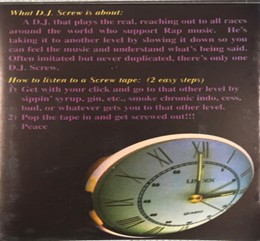
The birthplace of lean can be traced back to Houston, Texas, where it became closely associated with the local hip-hop scene in the 1990s. At the heart of this cultural emergence was the iconic Houston-based hip-hop artist DJ Screw who pioneered a specific hip-hop music genre known as Chopped and Screwed (or Screwed and Chopped) that consisted of remixing hip-hop records by slowing down their tempo (Walker, 2022). Although DJ Screw’s legacy expands far beyond lean as he revolutionised the future of hip-hop music as we know it today, his unique music has often been described as sounding tailor-made for the experience of being high on lean as suggested by DJ Screw himself in one of his tape albums released in 1995 (see Image 1). Just as the music seems designed to be experienced while high on lean, the drug itself feels as though it was made to inspire and create this sound.

The defining characteristic of the Chopped and Screwed sonic aesthetic – blending with the experience of lean – lies in its ability to distort the listener’s perception of time. This temporal disorientation is evoked through slowed-down tempos, stretched-out vocals, and repetitive looping, all of which encapsulate the dissociative, slowed-down, and relaxing sensations associated with being high on lean. Over time, this distinctive sound alongside the use of lean and its (more-than) representations was taken up, reworked, and evolved by a range of music artists into other hip-hop music genres such as trap, drill, and SoundCloud rap (as well as some of their subgenres, such as Rage, Plugg, and so on). This also extended into entirely new music genres beyond hip-hop music such as Vaporwave, emerging in the early 2010s. These sonic elements were further transformed through digital reproduction, incorporating lo-fi techniques, synthesisers, and autotuned vocals that made an even more distorted and imperfect sound. Moreover, as the time of DJ Screw’s cassettes soon passed, these sonic elements were fused with visual aesthetics through music videos consisting of wavy, slow-moving effects and purple[1] hues that not only enhanced this temporal disassociation but also introduced an ambiguous spatiality, inducing a dream-like feeling and atmosphere in which everything seems to float – detached from any concrete sense of place associated with lean.

The symbolic markers of lean as represented in many music videos – including both its main ingredients as the cough syrups and soda bottles, and its paraphernalia as double stacked cups[2] and baby bottles[3] – are often more than represented through these visual effects that appear as surreal and hallucinatory. Therefore, the auratic properties of lean as evoked by the audiovision of such types of music draw viewers into immersive and sensory atmospheres. Many of my interviewees within lean culture recalled their first social encounters with lean through hip-hop music videos not merely as moments of recognition but as affectively charged experiences where the “coolness” attributed to lean exceeds its material properties and resides in its capacity to be represented and more-than represented in multiple aesthetics and meanings that makes it feel endlessly adaptable and culturally resonant. Their initial reaction was often one of surprise and curiosity – “What the fuck is this?” – followed by a sense of encountering something distinctive and unique. They described lean as “a thing no one had ever seen before” and “exclusive, like it was rare”. Here, viewers record of their first attraction to the aesthetic of lean resonate with each other: “wow that looks cool” or “I just thought it looked cool”. These resonances fold back into beliefs and desires to be cool themselves: “when I was little, I thought it was cool to sip lean, it makes you the cool guy”.

The aesthetic of preparing and consuming lean is conveyed through music via sounds, visuals, and lyrics, where the tastes, smells, textures, and colours of lean function as affective channels of transmission. Auditory cues – such as the clinking of ice cubes, the pouring of syrup into a cup, the snap of a soda can opening, or the hiss of escaping gas from a soda bottle – are frequently included within the sonic production and representation of sensory signatures that evoke the ritual of preparing lean. Visually, the brightly coloured mixture of cough syrup and soda creates vivid displays of purples and pinks, used in music videos that draw on the drink’s aesthetic visual appeal. Lyrically, artists explicitly describe lean in terms of excessive sweetness by portraying it as intensely sugary, flavourful, and candy-like in its tasting appeal, while also emphasising the syrup’s thick, viscous, mud-like consistency.

From spectators to spect-actors, listeners and viewers are far from passive consumers; instead, they actively and creatively imitate and readapt artistic performances in which the act of viewing itself is one of action and embodiment (Rancière, 2009). Across all my interviews, the aesthetic of lean was a prominent draw for those belonging to this culture. Respondents reflected on an experience which fully engaged their senses and made the use of lean a multisensorial experience. Among the most prominent sensory features is its intense sweetness, often compared to the taste of candy. While the exact flavour can vary depending on the brand and type of cough syrup – ranging from cherry and strawberry to mint, blackcurrant, or apple – as well as the choice of soda used as a mixer (commonly referred to as “cut”), the overpowering sweet and sugary taste remains a constant. This sweetness is so pronounced that lean is sipped rather than gulped, that is why members of this culture are indeed called sippers. Closely tied to taste is the distinctive smell of lean, which emerges from its sweetness and is highly appreciated by users. Many sippers like the sweet and sugary taste of lean and its smell:

I don’t drink alcohol, I drink lean instead… and my brothers also because it tastes cherry. You mix it with tropical sprite or fanta or whatever you want and man it’s so…if you would like a candy when you were a kid, lean is gonna be a great enemy to you, because it has such a good taste…” (EM from Switzerland, personal communication, 14th January 2025)

That’s the thing too which is crazy that a lot of people don’t know is that like it blows me away that they created lean, like real lean… it tastes good! That’s what blows me away. Like it doesn’t taste like cough syrup… the stuff that you are not supposed to sip like lean that’s the shit that tastes gross, that tastes like medicine, that tastes nasty” (VD from Canada, personal communication, 21st January 2025)

The smell, the colour, and the taste.[…] Oh I love lean. I like the smell… you know wine connoisseurs? When they smell, they drink, they swish it around their mouth, they taste… “yeah that smells good, I like this one”. I’m like that with lean, I consider myself a lean connoisseur.”  (OP from the UK, personal communication, 10th February 2025)

Depending on the type of flavour, the colour of the cough syrup changes accordingly. Cherry-flavoured syrup tends to be red or purple, strawberry is typically pink, mint and apple are green, and blackcurrant is usually purple, among others. Besides the taste, the choice of the type of fizzy soft drink to use is mostly guided by visual aesthetics based on colour compatibility. Only clear or lightly coloured sodas are accepted; for instance, Coca-Cola is never used to make lean, and instead, Sprite – being transparent and relatively neutral in flavour – has become the soda most closely associated with lean. Nonetheless, sippers enjoy experimenting with colour combinations, for instance, pairing purple or red cough syrups with yellow pineapple sodas is a popular choice, as they like the visual contrast of the two colours mixing.

“[I like] the colour that it’s green and or purple and it’s really beautiful to my eyes.” (OS from Mali, personal communication, 07th February 2025)

[About lean, I like] the aesthetic, the bottle, the colours, the drug, the flow, the taste, […], I like to play with the colours, taste some new flavours, all that type of stuff…” (VR from Portugal, personal communication, 13th January 2025) Texture has also frequently been highlighted by respondents as a crucial element in the visual and sensory appeal of preparing lean. In particular, the thickness of the cough syrup plays a fundamental role during the mixture related to the ritualised process of making lean. When syrups with a dense and viscous consistency, like mud, are poured into sodas, the visual effect of the two liquids interacting – especially the slow descent of the syrup dropping into the soda – is considered visually satisfying. Conversely, syrups that are too diluted or watery are strongly disliked by users, as they lack the desired texture and fail to produce the same visually compelling effect.

Benelin [South African codeine-based cough syrup] texture is so thick, it tastes like medicine, it doesn’t taste like sweet even… that, I could drink it straight out the bottle, but with StillPane or others is thinner and is so sweet, so I cannot… I have to mix it…the texture, yeah I love it! It looks good, it looks pleasing!” (TG from South Africa, personal communication, 14th November 2024)

The liquid one is not really good because it’s too liquid… I don’t like it because of the aesthetic but if I need to drink it just to get high I’ll drink it, no problem… but the one that I prefer and looks good it’s the thick syrup.” (MD from Brazil, personal communication, 06th January 2025)

The texture of the cough syrup draws attention to the centrality of tactility in its everyday consumption in relation to the ritualised process of making lean through a series of sensory and textural stages. The first phase, known as pouring up, involves pouring the cough syrup into a bottle of fizzy soft drink (see Image 2). The two bottles are not held at a strict right 90 degrees angle, but rather at a subtle incline so that the syrup gently drops into the soda and goes down the side of the bottle to sediment at the bottom by creating a stratified texture because of the two different liquid densities (see Image 3).

Image 2 Sippers’ preparation ritual: Pouring Up

Source: Screenshots retrieved from Instagram stories

Image 3 Sippers’ preparation ritual: Syrup sedimented at the bottom

The next phase is called flipping, in which, once the pouring up is done, the bottle is closed and inverted by grasping the lid (see Image 4). This upside-down rotation facilitates the slow merging of the two liquids without flattening the drink. Finally, the mixture is transferred into a cup by culminating the ritual (see Image 5) where the process – with its gestures and tactile feel – is just as essential, if not more so, than the consumption itself as highlighted by most of my respondents.

Image 4 Sippers’ preparation ritual: Flipping
                        Image 5 Sippers’ preparation ritual: Pouring the mixture into the cup

Yeah bro, I can’t lie, I love it bro. Me personally, I love the way it drops into the soda and flips. Honestly, me personally, I’m more addicted to the actual pour up, the actual like pouring up the soda, flipping it, watching the lean twirl inside the soda and drop to the bottom, and the colour changing and mix into a nice beautiful pink colour. Like bro I’m in love with that, that is what gets me excited when I pour up.” (VD from Canada, personal communication, 21st January 2025)

I think the addiction is more than just the opioid addiction, the addiction for me is the taste, the smell, the pouring up, the whole activity of drinking lean is what I’m addicted to more so than the actual medicine itself. It’s deep, the status it gives you, the feeling it gives you, the way it makes you feel when you pouring up…” (OC from the UK, personal communication, 10th February 2025)

It’s the ritual, pouring up, flipping a bottle, that ritual… the baby bottle, stuff like that. Mostly because I think my brain associates it with feeling good you know. That’s what I enjoy about it, but also like I hang out with my friends, we just pour up “okay, let’s pour up” you know together… sometimes I do it alone also…” (MD from Brazil, personal communication, 23rd January 2025)

The ritualism surrounding the preparation of lean emerged as one of the most frequently observed daily practices within lean culture during my fieldwork on social media platforms, especially Instagram, where it was predominantly shared through short videos in Instagram stories. These stories not only revealed the tactile and visual aspects of the preparation process during the pouring up and flipping but were also consistently accompanied by hip-hop tracks about lean highlighting, once again, the importance of sound while sipping lean and its multisensorial experience.

The presence of mobile phones to either record or take pictures of the ritual for preparing lean is also an integral part of this process. As much as the cough syrups, fizzy soft drinks, the cups, and baby bottles, therefore, mobile phones are part of the embodied and multisensorial experience that are needed as both a tool for documentation[1] and a medium through which this ritual is performed, shared, and spread worldwide within digital spaces. As such, social media platforms represent newly produced social spaces for drug cultures, to consume, perform, and share drug experiences at the blurred intersections of the online and offline (Manning, 2014). They also exemplify how imitative propagation and affective contagiousness unfold through the aesthetics of lean, rapidly transcending geographical and socio-cultural barriers and evolving into globalising cultural trends.

As criminologists increasingly advocate for an aesthetic and sensory turn in Criminology (McClanahan and South, 2020), significant progress has been made in exploring various criminological issues through these emerging theoretical and methodological lenses (see Herrity et al., 2021; Young, 2023; Holt and Lewis, 2024; etc…). The perspective I have offered on lean culture invites drug scholars to further explore the relevance of aesthetics and sensory experiences in contemporary recreational drug trends among young people worldwide. By doing so, it encourages discussions that could provide fresh insights into evolving patterns of drug consumption and contribute to a broader (sub)cultural analytical perspective that extends beyond the meanings of drugs and their motivations for use.

References

Herrity, K., Schmidt, B., and Warr, J. (2021). Sensory Penalities: Exploring the Senses in Spaces of Punishment and Social Control. London: Emerald.

Holt, A., and Lewis, S. (2024). A Sense of Danger: Gender-Based Violence and the Quest for a Sensory Criminology. Feminist Criminology, 19 (1), 3–24.

Manning, P. (2014). Drugs and popular culture in the age of new media. London: Routledge.

McClanahan, B. and South, N. (2020). All Knowledge Begins with the Senses: Towards a Sensory Criminology. The British Journal of Criminology, 60(1), 3–23.

Rancière, J. (2011). The emancipated spectator. (G. Elliott, Trans.). London, UK: Verso.

Sherratt, Y. (2007). Adorno’s aesthetic concept of aura. Philosophy & Social Criticism. 33(2), 155-177.

Walker, L. S. (2022). DJ Screw: A Life in Slow Revolution. Austin: University of Texas Press.

Young, A. (2023). Listening Criminologically: On the Materiality and Relationality of Sound. Criminological Encounters, 6, 146–56.


[1] Although lean can appear in different colours, it is most commonly associated with the colour purple.

[2] A double stacked cup, or simply double cup, is where one is supposed to sip lean. The reason for the use of double cups is to insulate the drink that needs to be sipped cold and to announce the consumption of lean as part of its visual aesthetic.

[3] Baby bottles are used to dose the cough syrup. One line of syrup, as marked on the baby bottle, would be an ounce and so on.

[4] Documenting the use of lean is important for “real” sippers as proof of their long-lasting relationship with lean that differentiates them from the so-called trend sippers, as those considered within the culture who sip momentarily just because it’s trending.

Categories
Children Corrections custody Emotions food prison Uncategorized

Peanut Butter Jelly Time: Memories of a Former Juvenile Correctional Officer  

Nabil Ouassini

For most people, biting into a peanut butter and jelly sandwich can transport a grown person back into childhood. The creamy texture of peanut butter mixed with the sweet and tangy strawberry or grape jelly on doughy bread is a bite into one of the world’s popular comfort foods. The sandwich reminded me of my Batman lunchbox packed with my mother’s love during my carefree elementary school days. Unfortunately, during my years as a juvenile correctional officer at the Clark County Juvenile Detention Center in Las Vegas, Nevada, this familiar sandwich became a powerful sensory reminder of the complexities and ironies inherent within the American juvenile justice system.  

I worked as a juvenile correctional officer soon after I completed my bachelor’s degree from the University of Nevada, Las Vegas. I was not much older than many young teenagers in the facility. Along with the peanut butter sandwiches, I distinctly remember the process of entering our work shifts and the various smells throughout the units. When entering the facility, a monitored clinical environment, the sounds, and sights become etched into memory. The heavy doors, the echoes, and the constant sense of surveillance set a heavy tone for the atmosphere. I remember walking through these long, narrow hallways in the oldest unit in the detention center. The unit always had problems with flickering lights that made the darkness thick. As our eyes adjust to the dark, the musty walls and rusted iron bars remind us of the countless children and officers who spent time in these halls. The smells in the hallway contrasted between bleach and other industrial cleaners and the faint odor of sweat.

Peanut butter and jelly sandwiches are a staple for children worldwide and a quintessential symbol of childhood in the United States. The simple recipe makes these sandwiches the favorite lunch item for children in school playgrounds and the go-to meal between breaks at work for adults. In many families, affordability is a key factor in the sandwiches’ popularity, a practicality that, in my experience as a juvenile corrections officer, aligns with the cost-cutting measures found in carceral settings. Even in our detention facility, adult inmates from the nearest county jail were transported to prepare the meals for the juveniles. During my years, we would pass out the crustless version of the peanut butter and jelly sandwich made by Smucker’s as an evening snack for juveniles under our care. These sandwiches came in plastic wrappers that released a mixed aroma of artificial fruitiness and nutty peanut butter when ripped open. Biting into it, the white bread and peanut butter clung to the roof of the mouth while the jelly seeped disproportionately. The cafeteria staff would always leave a few extra sandwiches for the staff that we would eat with the youth. The taste of a peanut butter and jelly sandwich in the juvenile detention setting was peculiar, and the symbolism, even then, was never lost on me.  

Peanut butter and jelly sandwiches are emblematic of the care and nurture associated with family. In the juvenile detention setting, a space that represents lost freedoms, systemic failures, over-criminalization, and punitive punishment, the taste of a peanut butter jelly sandwich takes on a profoundly ironic tone. Stripped of its sentimentality, peanut butter and jelly become more than a sandwich when served to children in this environment. Unlike the prevailing narrative, the sandwich now represents the harsh reality of institutionalization and dehumanization of juveniles in the system. The sandwich in juvenile detention highlights the conflicts between the idealized perceptions of youth and the retributory nature of the juvenile justice system. Compared with the affectionate context and familial recipes traditionally reserved to make a tasty sandwich, the peanut butter and jelly sandwiches in detention were mass-produced and served in a cold, regimented, and adverse environment. The contrast represents a paradox of a sandwich symbolizing love and care reduced to a cheap snack to meet the juveniles’ basic nutritional needs.

In the years since, peanut butter and jelly sandwiches continue to remind me of my time working in detention. I remember how some juveniles devoured the sandwiches quickly while others slowly peeled the sandwich apart and took their time to enjoy the jelly first and then the peanut butter and bread. However, for the youth, consuming these sandwiches may inadvertently evoke negative feelings of lost innocence and a reminder of the distressing period of their lives. The symbolism of a food item meant to nourish and be a comfort food snack for children now arouses emotions of regret, anxiety, depression, and bitterness over their time spent in detention.    

Even in the years since, I have become preconditioned to think of the sights, smells, and noises, the memories and conversations I have had in the juvenile detention center when I bite and taste a peanut butter and jelly sandwich. My experiences with the sandwich, a symbol of childhood, oddly reveal the underlying contradictions of American juvenile justice, symbolized by the loss of innocence and systematic failures that contribute to recidivism. In this context, the sandwich goes from America’s beloved snack to a metaphor for the dissonance between childhood ideals and the realities of how society deals with its most vulnerable and detained population.  

* Jelly is the American equivalent of jam in other parts of the world.

Categories
Environment police sensory smell Uncategorized

The Pervasive and Unknown Effects of Sensory Experiences in Policing: An Autoethnographic Response

Marina Carbonell

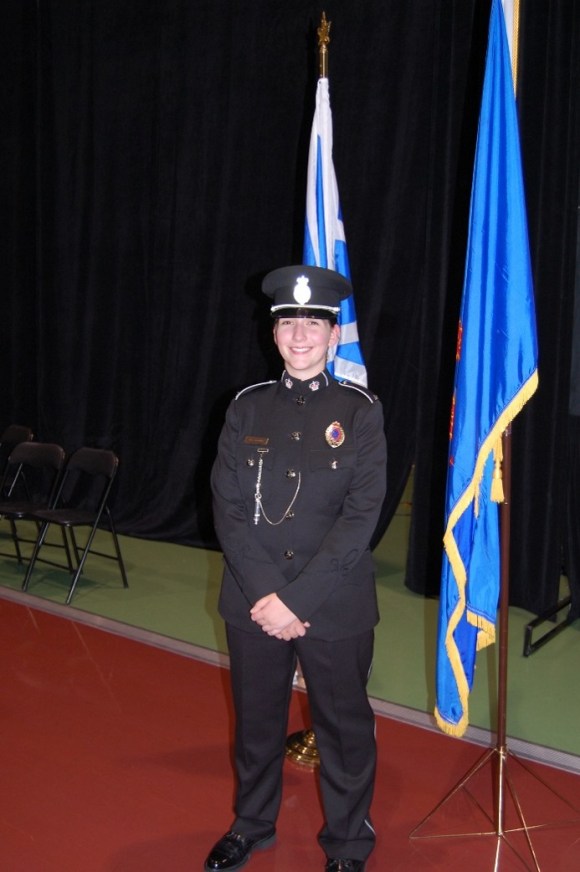
From 2007 to 2018, I served as a police officer with a provincial police service in Canada.  Starting on patrol, I also worked in communications, criminal investigation division, and forensics, I gained experience providing front-line response in a wide variety of emergency contexts. Prior to becoming a police officer, I spent my youth playing sports, specifically hockey and rugby, which resulted over the years in numerous sports-related injuries, including having my nose broken three times.

Figure 1: Graduation Day, 2007

Unbeknownst to me, my broken nose led to a deviated septum – a condition where the middle portion of the nose was twisted, obstructing airflow and preventing proper drainage. I knew my breathing was laboured; a girl in my police recruit class commented on how loud my breathing was, and I couldn’t run with an ‘in through the nose, out through the mouth’ pattern.  Finally, in the Winter of 2017, I saw an ear-nose-and-throat (ENT) doctor. I learned that the obstruction in my nose had created growths within my sinus cavities called polyps.  My nose needed to be reconstructed, and the polyps had to be removed.  The surgery went well; however, I could not have anticipated the results.  On the outside, my nose looked the same. On the inside, however, I quickly realized how poor my sense of smell had been once it had been fully restored.

Working in Forensics is unlike any other job. Calls range from minor incidents involving photographs of property damage and forensics processing of stolen vehicles, to crime scene management and analysis of complicated homicide scenes.  In my province, there is no coroner; every death at home is attended by patrol and forensics to rule out foul play.

Figure 2: Caught by the media while photographing a scene, 2017

The first few weeks after the surgery were tricky.  As my nose was healing on the inside, it would occasionally bleed if I got up too fast or bent over.  Normally, this wouldn’t be cause for concern; however, working in forensics brought the potential of introducing contamination into a crime scene. The last thing anyone wants to do is affect the integrity of a scene or necessitate questions about why your DNA is everywhere! This is commonly discussed in forensics; German police discovered scene contamination introduced by a cotton swab factory worker in Austria after the worker’s DNA was located at multiple scenes (Himmelreich, 2009).

After my nose healed, I quickly became aware of my heightened sense of smell. Before this point, I genuinely thought some people just experienced crime scenes and death differently than others in terms of fortitude, determination or tenacity. To say I was shocked is an understatement. Walking into a heavy smoker’s home, standing next to people with strong odours (good and not so good), and even the smells of diverse cuisines were astonishing compared to the previous complete absence.  The difference was jarring; I could smell the iron in blood, and the chemicals I used for processing, where there had been nothing before. Autopsies were a completely different experience, as was the newfound sensory overload of crime scenes. I was astonished by the difference, finding a huge disparity in my personal perception of my work as a result of regaining my sense of smell. The increased ability to smell made it challenging to leave work behind; my hands continued to smell like nitrile gloves, my skin seemed to exude the cleaning chemicals I used before leaving work, and unfavourable experiences lingered in my hair and on my clothes with apathetic vestige, making it harder to wash off the day. Smell, as a sense, is important, but it can also have lasting effects on well-being. Examining smell, Hur and colleagues found a strong correlation between smell and depression, with the prevalence of depression in individuals reporting negative or challenging smell experiences at nearly 40% (Hur et al., 2018).  Taste and smell problems can be the result of trauma to the head (Schechter & Henkin, 1974). Sense of smell can be influenced by fractures to the face (Drareni et al., 2021) and may be altered by diet (Liu et al, 2020; Stevenson et al., 2020), and salt intake (Henkin, 2014). Vestibular sensory systems may be negatively affected by sleep disruptions, impacting vision and balance (Besnard et al., 2018). Thus, police may be further at risk of sensory changes compared to others, as the profession involves physical altercations, shift work disrupting sleep, and often poor eating habits. These findings are especially timely, given the reported impacts on olfactory experiences by people recovering from COVID-19 (Coelho, 2022).

Souhami (2023) argues that police are affected by their sensory experiences, such as working in the dark, which influences how they work. I agree with Souhami that my perceptions in policing were altered in the dark, and I was aware of this influence. For my entire tenure as a police officer, I refused to watch horror movies for fear it would influence my ability to do my job – you can’t be afraid of fictitious movie characters when you’re running through the woods at night. Police work in an environment where perception is everything. The interpretation of threats helps us determine action, but our interpretation of the world around us is subjective. Fear is an adaptive mechanism intended to keep us safe (Gagnon et al., 2013); however, when afraid, we perceive situations as having more risk (Stefanucci & Proffitt, 2009). For police officers and other first responders, training emphasizes vigilance and safety. The work is stressful and is physically and mentally injurious (Pooley & Turns, 2021). The “anti-police rhetoric” is common (Pooley & Turns, 2021), with perceptions of vulnerability leading to increased hypervigilance as a means to maintain feelings of safety (Pooley & Turns, 2021). Hypervigilance can also be heightened as a symptom of posttraumatic stress, a further consequence of the work, with police experiencing higher rates of PTSD than the public (Carleton et al., 2018).

Souhami (2023) also describes police visual perceptions of their environment as imbued with feeling, calling for increased scholarship into sensile influences. In response, I would argue that there is significance beyond sight in our sensory experiences. It is not solely the vulnerability in the dark or our visual experiences that lead to a change in our perceptions, but the combination of our olfactory, vestibular, proprioceptor, auditory, tactile and oral sensations, known and unknown.

The dark itself is known; we are generally aware of our reduced perception and increased risk. The feeling of vulnerability tells us to pay attention, to be aware, to stay safe. I always preferred night shift, as a ‘night owl’ myself. Working at night felt less restricted with less traffic slowing down around me, fewer calls for service, and fewer car accidents to attend. In the summer months, the cool air was a reprieve from enduring body armour in the hot sun. Weekends were always busy, but weeknights sometimes permitted time to catch up on paperwork, actually eat a lunch on shift, and carried the hope of fewer files for follow during the following week.

Familiarity, however, makes a difference. During one call for service in my early patrol days, I responded to a domestic disturbance call in an area outside my regular district. It was dark, and I was in a part of town that I was unfamiliar with, dispatched there because the unit in the area was assigned to another matter on the busy summer Friday night. The newness of the area increased my attention and intensified my focus. The dark felt darker, and the air hinted at a crispness that should have been absent on a warm summer night. I remember the walk up the long driveway, the gravel crunching under my work boots, while I was trying to figure out which door I should knock at. Before I could knock at the door, a huge German Shepherd appeared on my flank out of nowhere, running forcefully at me, with explosive and thunderous barking. The dog ended up being friendly, but the fear induced by my lack of visual acuity, the sudden sound and intensity of the dog barking, and the abrupt disruption to my vestibular senses and proprioception system during the swift turn was disorienting in an unusual way. I was looking for risk as I was approaching the house, I felt aware, though that sense of awareness was spurious, and the subsequent shock was galvanizing.

The sensory input of the unknown is invisible and profound. We ignore our sense of smell until we have a head cold and lose taste. In policing, smell itself acts like a warning system; approaching a door, I would get a sense of what to expect.  During one call for service where a lady had passed away at home, the patrol officer tried to warn my colleague and I, both in forensics, about the scene inside. We immediately dismissed his comments, thinking patrol officers were always dramatic about death scenes. Entering the front door was like walking into a brick wall. The dozens of cats inside had saturated the air with heavy ammonia, and I felt like I could see the air waving, heavy with dolor. We knew we had to go upstairs, but each step was forced and burdensome like walking through water. The creak of each stair was deafening, the swoosh-swoosh-swoosh of our Tyvek protective suits redounding between our ears. The cats wanted attention, moving in and out between our legs, limiting the space on the cramped stairs. We got halfway up to the second floor when my colleague stopped solid. “We have to get out,” she said with veiled panic. I could feel the sweat coming down my forehead, and I could see it in her hair, too. I remember telling her that if we left, we would have to come back in, we were already halfway there. The following ten or fifteen seconds of eye contact between us felt like it lasted an hour. We would have to come back in.

Prior to surgery, I attributed my ability to withstand the challenges of policing to a personal aptitude or individual competency. Being able to experience the change in perception, while challenging, allowed me insight into how fundamental sensory experience is to functional ability, focus, capability, and coping. Schleiermacher, concerned with language, wrote, “every utterance corresponds to a sequence of thoughts of the utterer, and must therefore be able to be completely understood via the nature of the utterer, his mood, his aim” (Schleiermacher, 1998, p. 229). I would argue this conceptualization of language can be extended to our sensory experience; our perceptions are rooted in our context and standpoint in the moment and over time, which in turn, influences our experience and contextualizes our disposition and abilities. If, as voiced by Wittgenstein, “the limits of my language mean the limits of my world” (1922, p.201), our ability to understand and explain our experiences is vital to processing and conceptual expansion, and potentially, could have long reaching impacts for mental health, job satisfaction, and wellness. For example, understanding sensory needs holistically could influence perceptions and our choices. Something as simple as chewing gum can reduce stress during stimulus experiences (Yu et al, 2013), decrease the levels of cortisol in saliva (Tahara et al, 2007), and increase perception of performance and wellbeing (Smith et al., 2012). Gum chewing may also improve memory (Hirano et al., 2008) and positively influence attention (Hirano et al., 2013). For police, the influences on the visual, olfactory, tactile, vestibular, proprioceptor, gustatory, and auditory systems are complex and variable, and knowingly and unknowingly affect vulnerability and perceptions due to the conditions and environment in which police work. I agree with Souhami, we should not be afraid of the dark. But we must consider how the combination of perception, vulnerability, and all sensory aspects influence us in immeasurable, substantial ways. We still have to do the job, knowing the dog may not be friendly next time, knowing we will have to come back in.

Categories
Emotions Environment Gender nighttime sensory smell space Uncategorized

The Night-Self

Chloe Young

A sea of revellers, young people laughing and dancing in a club.

It all started with shimmering bodies, a sweaty room, and the strobe lights of my favourite club.

The glitter we had meticulously applied in my bedroom, just hours before, had sunk its way down the faces of my friends, the result of our bodies being pressed up against other sweaty strangers. Coming into the club from the street outside, you’d be hit with a nauseating wave of sweat, vodka, and a sickly warmth that’d cling to your hair. Disgusting. And yet… Magical. As I had looked around the room, I’d found myself wondering where else such unfamiliar bodies would collide and become one sweaty blur. Where else would I not only let a stranger’s sweat fall on me but choose to let it in the pursuit of joy, pleasure, and fun. What I didn’t know then, as my body thrashed around in time with the music, was that these questions would set in motion a PhD trying to understand the self we become in the night-time economy.

My passion for nightlife cannot be separated from a youth spent sneaking into pubs and clubs in my small town on the Welsh border. Armed with a fake ID and whatever alcohol I could steal from my mother’s cupboard, I knew even then that there was something unique about the world of nightlife. That it offered me something magical. Something new. Something different.

And, most fascinatingly of all, that I was different.

Even now, I can recall the smell of the first bar I snuck into. With just a whiff of the perfume that I used to wear at that age, something fruity and sweet with a twinge of burnt popcorn, I’m transported back to the sticky aftertaste of spilled booze and sugary beer. See, the club itself that had a certain smell built into its four walls… The synthetic scent of a low budget fog machine and its chemical haze reaching across the room, mingling with the aroma of too many spilled vodka cranberries. No matter how many times the floor must have been cleaned, the sour sugar had etched itself into the floorboards.

Then there were the human smells. Sharp floral undertones fighting against the unescapable stench of sweaty body odour. When you’d first walk in, the smell was a strong and almost unescapable stench. But, over time, the smell would encompass you until it was barely noticeable anymore. You’d become part of the messy throb of bodies until the question of whose sweat was whose was simply impossible to answer. The sweat would bead on brows, soak shirts, and blend into a mix you couldn’t distinguish yourself in. You could smell the heat radiating off our skin as the bodies packed in tighter, the music seemingly louder, and any traces of perfume long gone. Disgusting? Magical? Both.

See, I loved the “Night-Time Economy” (NTE) before I even knew what this term meant. While there is no standard definition for the NTE, this is a label given to a wide range of nightlife sites such as pubs, bars, clubs and their associated services. Despite all the label encompasses, the phrase has most often been used to refer to the economic activity of the night-time city. However, the NTE is so much more than an economy, and I ask whether something is missed when we attempt to bound and define the space through its commercial activity.

Instead, could the sensory elements of nightlife allow us to better understand the NTE and its happenings within? Would we better capture the NTE by understanding it as an affective atmosphere where normal daily life comes to be suspended for a moment of ‘in betweenness’ (Turner, 1967)? Thinking about the NTE in this way, beyond its bounded and regulated zones (Newton, 2015, Philpot et al, 2019) paves the way for an understanding of nightlife as a social arena both made up of and producing embodied experiences evoking shifts in behaviours, identities and relationships with risk. Is nightlife really just made up of disconnections and continuities with our daytime subjectivities?

Nightlife spaces are, to borrow Durkheim’s term, socially and sexually effervescent places. The environment, often loud and electric, offers ‘possibilities of pleasure, excess and gratification” (Measham, 2004, p343). And, most importantly, it primes bodies to behave in certain ways. But how?

This is where affectivity comes in.

Affectivity refers to the realm of the unconscious and of the passions, emotions, and moods that all play a role in shaping our world around us. Conceptualizations of affect allow us to go one step beyond what is merely felt and make sense of the unconscious realm. Vague, and yet often incredibly intense, affect is thus the sensation that a feeling then expresses (McCormack, 2008). McCormack offers us the perfect example of affectivity… we know how a room of dancing bodies feels before we could begin to put the sensation into words or assign it a feeling.

Affects can layer upon each other to create an atmosphere that, “like a haze” (Bohme, 1993) radiates from and through individuals. This haze is contagious and fills a space in a way that spreads and induces moods, relations, and behaviour that align with the atmosphere, rather than any personal morality. As such, the crowd can be brought closer together, both emotionally and in proximity, in the formation of an imagined community (Anderson, 1983). A community built upon the stickiness of sugary mixers and a sticky floor that won’t wash out of your shoes no matter how hard you try. But, also, the stickiness of an affective atmosphere that sticks to, and with, those within it.

‘Getting lost in the crowd’ is a phrase we’ve all heard before and feels apt here. Both for how individuals tune into the affective flows around them in the NTE, but also how a ‘day self’ can be lost in the NTE and replaced with our new ‘night-self’ with a new set of tolerances, desires, and ideas. See, nightlife venues can be vibrant, exciting, and electric – the perfect place to get “lost” in… and this isn’t something that just happens by accident. The deliberate usage of lighting, décor and music contribute to engineering an affective atmosphere (Tan, 2013), which in turn affects rhythmic relationships between bodies and their wider spacings (McCormack, 2008; Tan 2013).

These affective atmospheres don’t exist outside of the bodies experiencing them. Picture walking into an empty club. You’ve timed it wrong. Or maybe you’ve picked the right time but on the wrong night.  The music is still loud, the lights still flash… but it’s not the same. This space needs bodies within to ‘warm it up’ (Duff and Moore, 2015) and create the atmosphere that, ironically, those  very bodies are craving by going to a nightclub.

The way I write about, and photograph myself and my friends in the NTE, suggests it is a magical place of community, excitement, and affirmed identity. Which it can be… but isn’t always. It is no secret that the space is saturated with reports of violence, sexual assault and drug use. It’s then not surprising that the NTE is commonly thought about as a place of victimisation and violence.

There is no denying the dangers, darkness, and risk of the NTE, and any attempt to diminish this would be naïve but could also risk misunderstanding something incremental about nightlife…For, the pressing question is: why do we still go despite the potential risk and danger? Or…is this risk part of the attraction? Does it hold a seduction because we don’t always find this elsewhere? In suggesting risk becomes part of the allure of the NTE, is worth noting here that there is an important distinction to be made between feeling uncomfortable in a space and being unsafe (Nicholls, 2019).

For example, I’d feel extremely uncomfortable on a bungee jump at a great height- but would not actually unsafe (as long as I’m properly harnessed in that is!) So, despite the great waves of adrenaline pulsing through my body as I’d leap off the edge, I wouldn’t be in any danger. This distinction is important. Even the most reckless of adrenaline junkies who seek the thrill of “living on the edge” take actions to minimise the level of danger they put themselves in through a range of risk mitigation strategies. See… you can’t enjoy the thrill if the thrill kills you. Thus, when thinking about thrill seeking in the NTE, it is crucial that such behaviours involve the night-self losing control – in a controlled manner. Or, losing control but only temporarily (Briggs and Turner, 2011).

The controlled loss of control materialises across nightlife. This is not just in the risk-taking behaviours within, but in the way we let our bodies move, interact and leak. Outside of sports events, there are few places where a body may “leak” like they may in a nightclub, revelling in its sweaty form without becoming out of place. Bodies are typically expected to be bounded and any bodily materials that threaten this (tears, sweat, blood, urine) have come to transgress the edges of acceptability. While there is nothing inherently disgusting about these fluids, the sweaty, smelly, unbounded body has been cast as something inappropriate in our social spaces today.  But not necessarily for the night-self…

I always make sure to pack deodorant in my bag when going into the PhD office, scared to get caught out or be “smelly”. Yet, despite much more skin exposed and adrenaline induced sweat, I’d never bother to cram such a thing into my handbag when going clubbing. In the office, deliberate attempts are made to reduce the possibility for sweating through air-conditioning or architectural design (Waitt, 2014), but the NTE offers a unique thermodynamic environment and a very different set of norms about sweat itself. Pennay (2012) suggests that club spaces provide individuals with the chance to be grotesque and ‘occupy an uncivilized body for a night: to grin like a fool; to laugh too loud; to sweat it out on the dance floor; to flirt outrageously; talk well-meaning shite to strangers; feel sexual, carnal and exhilarated” (Jackson, 2004, p. 123 in Pennay, 2012). Crucially, this idea of “sweating it out” and being “sexual” challenges the conditions that people usually face in regulating their bodies to maintain a “professional” image. Perhaps then, people seek out the NTE not in spite of its so-called ‘grossness,’ but because of it; sweaty bodies in the NTE are liberated to leak, sweat, ooze, but most importantly, to interact with other bodies and their fluids outside of gendered bodily structures. So, reflecting on my opening story, maybe that is why I don’t mind other bodies sweating on me as I dance, hair stuck to my face, arms up, and glitter rolling down my cheeks.

Then the lights come on. The air feels heavier, and the smell of danger loiters in the corners of the club as bodies fight their way to pile out onto the street, each on a mission to get a taxi or find a chip shop still open. The music, replaced by a chorus of drunken shouts, rings in your ears as your sweaty clothes cling to you like a second skin you can’t shed.  The air outside is like a slap to the face as your body is hit with reality carrying on outside of your night. Someone’s laughing… Someone’s crying… Someone’s throwing up. Sweat begins to dry down your back as your skin still hums from the vibration of dancing bodies, the smell of quickly stagnating and stale clothes. The sound of bare feet slapping along the pavement rings out as shoes are kicked off for the walk home, wet hair dripping with a concoction of spilled drinks, tears, and sweat. The taste of makeup sliding off your faces, leaking its way down onto white tops that had been carefully chosen and spritzed with perfume just hours before. The leaky, messy, dripping body… Free. For tonight at least.

Nightlife offers us something truly unique, and the chance to be unique. The NTE is magical, scary, and extremely messy… but also special. Trying to understand the NTE through a bounded and overly sober approach would be to neglect what makes nightlife what it is and why it plays such a big role in sociality today. As continue to research the “Night-self” and its affective capacity, allure, subjectivity, tolerance, and vulnerability, I hope to make sense of the NTE in a way that speaks to a truth about the space that has been so often overlooked… That the night-time economy is so different to any other space precisely because we’re different within it.

References

Anderson, B. (1983). Imagined Communities: Reflections on the Origin and Spread of Nationalism. London: Verso.

Bohme, G. (1993) ‘Atmosphere as the fundamental concept of a new aesthetics’ Thesis Eleven 36: 113-126

Briggs, D., & Turner, T. (2011). Risk, transgression and substance use: An ethnography of young British tourists in Ibiza. Studies of Transition States and Societies3(2)

Duff, C., & Moore, D. (2015). Going out, getting about: atmospheres of mobility in Melbourne’s night-time economy. Social & Cultural Geography, 16(3), 299-314.

Jackson, P. (2004). Inside clubbing: Sensual experiments in the art of being human. Oxford: Berg

McCormack, D. P. (2008). Geographies for moving bodies: Thinking, dancing, spaces. Geography Compass, 2(6), 1822-1836.

Measham, F. (2004). Play space: Historical and socio-cultural reflections on drugs, licensed leisure locations, commercialisation and control. International journal of drug policy, 15(5-6), 337-345.

Newton, A. (2015). Crime and the NTE: multi-classification crime (MCC) hot spots in time and space. Crime Science, 4(1), 1-12.

Nicholls, E., & Nicholls, E. (2019). ‘People Don’t See You if You’re a Woman and You’re Not Really Dressed Up’: Visibility and Risk. Negotiating Femininities in the Neoliberal Night-Time Economy: Too Much of a Girl?, 207-252.

Pennay, A. (2012). Carnal pleasures and grotesque bodies: Regulating the body during a “big night out” of alcohol and party drug use. Contemporary Drug Problems, 39(3), 397-428.

Philpot, R., Liebst, L. S., Møller, K. K., Lindegaard, M. R., & Levine, M. (2019). Capturing violence in the night-time economy: A review of established and emerging methodologies. Aggression and violent behavior, 46, 56-65.

Tan, Q. H. (2013). Flirtatious geographies: Clubs as spaces for the performance of affective heterosexualities. Gender, Place & Culture, 20(6), 718-736.

Waitt, G. (2014). Bodies that sweat: the affective responses of young women in Wollongong, New South Wales, Australia. Gender, Place & Culture, 21(6), 666-682.

Categories
Uncategorized

The Sonic and Symbolic Function of the Voice in Far-Right Political Violence.

Liam Gillespie

The choice is ours. The voice is ours. Thank you for allowing me to share in your voice today – George Christensen.

Introduction

While most of us encounter it every day, the voice is perhaps the most uncanny form sound can assume. This is because the voice is fundamentally ambivalent. It is at once sensory (in the sense the voice is, or makes sound), and symbolic (in the sense the voice ‘speaks’, be it for an individual or collective). And yet, despite its ubiquity and ambivalence, what the voice is and does is frequently left unthought. In this article, I hope to think about the relationship of the sensory and symbolic power of the voice. To do this, I will analyse a speech given by a far-right Australian politician, George Christensen, at a rally organised by ‘Reclaim Australia’, a now defunct white nationalist group.

In reference the work of Mladen Dolar, Giorgio Agamben, and Anja Kanngieser, I explore the voice’s potential to function as a modality and vector of (far-right) political violence, arguing the voice carries criminogenic potential not only due to its capacity to be weaponised for direct violence (such as via yelling, or the transmission of racism and misogyny), but so too, through its power to convert those who ‘listen’ into audiences that can function as social and political movements.

Christensen’s Address

On the 18th of July 2015, the Australian politician George Christensen delivered an address to a rally held by the now disbanded white nationalist group, ‘Reclaim Australia’. To massive applause he declared:

My friends. I am proud to be a voice for North Queensland today. We all have a voice: Notwithstanding our choice to use it or not. Notwithstanding the best efforts of those who would render us silent. We have a voice – not a voice of hatred, violence, and extremism – but a voice of warning, defiance, and of hope. Our voice does not go unchallenged but that is the beauty and appeal of the free and open democratic society our voice speaks out to defend. Our voice says: ‘We will not surrender.’ We will not sit idly by and watch the Australian culture and the Australian lifestyle that we love and that is envied around the world be surrendered and handed over to those who hate us for who we are and what we stand for. (2015, n.p.)

After urging nationalists to defend the nation against migration, multiculturalism, and Islam, Christensen concluded his speech with a final exhortation: “The choice is ours. The voice is ours. Thank you for allowing me to share in your voice today” (n.p.).

It is important to consider the function of ‘the voice’ to which Christensen is here appealing. How does his voice relate to the metaphorical collective voice that he invokes? How does the repetition of the idea of the shared voice—and the elisions he makes between his voice, and that voice—work? How is this voice mobilised, and what effects might it have on those gathered to listen?

From Sound to Voice

To explore these probing questions, it is necessary to consider what the voice is. In A Voice and Nothing More (2006), Dolar argues the voice can be differentiated from mere noise insofar as the former “points toward meaning” as “sound which appears to be endowed…with the will to ‘say something’” (14). However as Dolar elaborates, although the voice provides a vehicle through which words and meaning can be conveyed, the voice itself does not provide or contribute to meaning linguistically, but rather, extralinguistically (15). Just as a string can provide a structure that holds beads together, while itself remaining invisible, so too for Dolar, the voice, as an uncanny form of sound, can function as a “string” that holds words together in a “signifying chain” (23). The voice thus occupies a status of ambivalence: it is sensory, but not only sensory; and it is symbolic, even if its meaning cannot be discerned.

Dolar’s understanding articulates with Agamben’s claim that within a discourse, the voice functions as “the pure intention to signify” (1991, 33 [emphasis in original]). There is of course no guarantee that an intended meaning will be received, nor even understood in the slightest. Despite this, the voice is subjectively differentiated from sound through the attribution of the intention:

What would happen if one heard an unfamiliar sign, the sound of a word whose meaning he [sic] does not know…Certainly, the subject will desire to know the meaning. But for this to happen he has to realise that the sound he heard is not an empty voice… mere sound…but meaningful. (33)

For Agamben, it is thus not meaning that turns sound into voice, but rather, the subject’s perception of the Other’s intention to convey meaning. Just as for Dolar the voice enables linguistic meaning despite itself being extralinguistic, so too for Agamben, the voice is ambivalent. It is at once a “no-longer” and a “not-yet”: no longer sound, but not yet meaning (35).

Whether meaning is imagined known or unknown, the perception of the intention to convey meaning creates a relationship between subjects. When one body speaks, those that hear it—whether willingly or unwilling—become an audience. Through their hearing—or perhaps more accurately, their listening—they enter a relation with one another. To this end, the voice creates what it depends upon: a collectivity or community, without which it cannot exist. As Kanngieser explains, the voice is not just sound that happens to transfer information, it also facilitates “affective transmissions that make up our different relations” (2012, 337). As Kanngieser elaborates, “voices, and how we listen to them, reconfigure our relationships to each other and to our shared worlds” (339). The voice is therefore fundamentally intersubjective: it does not belong to the individual subject or body, but rather, to the relations between bodies that the voice itself constitutes. Thus, just as the voice can function as an invisible string that holds words together in a “signifying chain”, so too it can function as an invisible string that holds bodies together. And this is why a sensory analysis of the voice, and its socio-political power, is vital.

From Voice to Violence

The ability of the voice to reconfigure if not inaugurate new forms of relationality can be identified in Christensen’s speech, including both his literal voice, and the metaphorical one he invokes. In his speech, Christensen’s voice works to constitute those who gathered to listen as a collective body—an audience—united via a common political project. Through their listening they share a collective voice.

And yet, although Christensen’s voice constitutes that collective, it does not necessarily precede it. Just as his voice implies a collectivity—that of the listening audience—so too, that collectivity gives his voice its meaning (or perhaps, significance). Indeed, Christensen explicitly acknowledges this when says that the voice with which he is speaking is not really his own voice, but rather, theirs. In positioning himself as a literal mouthpiece, he is not merely claiming to speak for them: instead, he is claiming it is they who speak through him. This can be identified in the elisions he makes between his, and the collective voice. “I am proud to be a voice for North Queensland today”; We have a voice…”; “Our voice does not go unchallenged …our voice speaks out to defend. Our voice says: ‘We will not surrender.’” The idea Christensen is not speaking in a voice that belongs (exclusively) to ‘him’ is conveyed most strongly by his concluding line: “The choice is ours. The voice is ours. Thank you for allowing me to share in your voice today”. In an ironic twist, this final invocation of the collective voice echoes tactics typically associated with the left, in that he calls on those before him to rediscover and reassert their voices, which have supposedly been lost to multiculturalism, Islam, political correctness, and the left.

The above analysis aligns with Slavoj Žižek’s claim that although sound is only converted into voice when the “intention to signify” is perceived (à la Agamben), that nevertheless, the voice that emanates from the subject paradoxically does not belong wholly to the subject who intends to speak. This is because for a subject to speak their ‘internal’ voice, they are reliant upon that which comes from outside of themselves. First, because they must speak in a language that is fundamentally not their own; and second, because they must be heard by a listening Other who bestows recognition. As Žižek elaborates:

An unbridgeable gap separates forever a human body from ‘its’ voice. The voice displays a spectral autonomy, it never quite belongs to the body we see, so that even when we see a living person talking, there is always a minimum of ventriloquism at work: it is as if the speaker’s own voice hollows him [sic] out and in a sense speaks ‘by itself’, through him. (2001, 58)

While this “unbridgeable gap”—the distance between the subject and its voice—can be undermining, in Christensen’s speech, we can detect something altogether different, whereby he strategically distances himself from his ‘own’ voice, and instead explicitly names and exploits the “ventriloquism at work” in his voice to appeal to a higher authority: that of the white nationalist political agency he seeks to invoke. This political agency is embodied in the collective voice he inaugurates: the one that “speaks out to defend”, and says, “‘We will not surrender.’ We will not sit idly by and watch the Australian culture and the Australian lifestyle that we love… be surrendered and handed over”. Through this quick manoeuvre, Christensen’s own voice provides a sensory, symbolic, and affective reification of the white nationalist audience before him and their collective power to act. As he emphasises: “We all have a voice: Notwithstanding our choice to use it or not”. Cohered as an audience, they share political agency and the capacity to choose to mobilise as one to defend the nation against those who he claims “hate us for who we are”.

The above analysis of this brief address provides an example of the sensory, symbolic, and affective power of the voice, highlighting its capacity, as an ambivalent sensory phenomenon, to convert those who ‘listen’ into audiences that can mobilise and indeed, be weaponised towards political ends.

References

Agamben, G. (1991). Language and Death: The Place of Negativity. trans. Karen E. Pinkus with Michael Hardt. Minneapolis: University of Minnesota Press.

Christensen, G. (2015). “Reclaim Australia Address”, July 18. [blog post]. Retrieved from: <http://www.georgechristensen.com.au/reclaim-australia-address/>

Dolar, M. (2006). A Voice and Nothing More (ed. Slavoj Zizek), MIT Press: Cambridge, Massachusetts & London, England.

Kanngieser, A. (2012). “A sonic geography of voice: Towards an affective politics of voice”, Progress in Human Geography, 36(3): 336–353.

Žižek, S. (2001). On Belief. London: Routledge.

Categories
Emotions Environment Pedagogy sensory Teaching Uncategorized Writing

Eating Lemons: Teaching the sensory

Jason Warr

“For the first time in my criminology degree I can actually see the theories and ideas in my own life, outside, in the street.” (Final Year Criminology student, module Feedback (shared with permission.)

Autumn Term. University of Nottingham. 2023. For the first time in the UK I taught a full elective module on Sensory Criminology. Aimed at final year Criminology, Sociology, and Liberal Arts students the idea was to introduce students to the complexities of revisiting the criminological canon through considering the varying ‘sensoria’ that shape our experiential reality and understanding of the world. The basic point being that we, as human beings, are sensory creatures, we smell, we touch, we hear, and we see. These elements of our experience fundamentally shape not just our realities but, necessarily, how we experience and understand issues of crime, victimisation, and criminal justice.

Designing the course was one thing, selling it to students (and other staff members) who had not encountered such ideas before was something quite different. How do you convince students that smell can play a profound role in the experience of victimhood and criminal investigation when they have never really considered the idea of smell in their own lives? What of chronoception and the passing of time in terms of routine activities or sound in relation to green criminology? With developing the module came an explicit awareness that I was going to have to ask students to think about their studies in significantly different ways, and to challenge their learning as they had never considered. I was worried that they would not come with me. I was worried that challenging their pre-existent/nascent ways of criminological and sociological thinking, and asking them to develop a new criminological imagination, was going to go properly Pete Tong.

I need not have worried.

In terms of selling the module it very rapidly became evident that students ‘got’ it. Prior to running the module, I was explaining the basic concepts to a group of students and explored the rather silly, esoteric, and narrative convention of the ‘smell of fear’. I posed the equally silly question, “Does fear have a smell?”. Given this is a common phrase it seemed a useful place to start. Most of the students mentioned ‘acridness’ bitterness’ or sharpness (terms often used to describe this sensory marker of emotion in literature), but one student, a young Black woman from East London, laughed and went “sure, the absence of cocoa butter!”. The other Black students laughed; they immediately got the joke (both about Black skin care and being Black in white spaces), others just looked baffled. However, what it made clear was that students, even those not necessarily engaged or interested in taking the module, could see the links between complex socio-political concepts and the material, corporeal world in which they existed. Simple.

Not so simple …

I designed the module to cover a wide range of quite complex topics, which brought together both classic and novel criminological literature and, to continue the piracy of criminology as a rendezvous subject, coupled it with both novel and challenging sensorial anthropological and sociological developments. At its core, the module focused on the sensory through three distinct issues: 1. The communicative functions and symbolic interactionism of sensory experience; 2. The sensory/emotion/context divide; and, 3. The practices of thick description. There were two assessment points. The first assessment asked students to explore a sensory experience descriptively and analytically. The idea being to explore the complexities of communicating the interiority of sensory experience through written text. The second assessment asked students to sensorially examine a specific ‘space’ of their choosing. The aim was to think through research methodologies, ethics, and forms of analysis that go beyond the subjectively perceptual. Both assessments were designed to allow students to be creative in writing and thinking. By the end of the module students would have an understanding of:

  • The history of sensory social science
  • The development of sensory criminology
  • Sensory criminology and the philosophy of the social sciences
  • Methods of sensory research
  • The ethics of sensory research
  • Differing sensory studies in penality and criminology
  • How sensory criminology can challenge traditional criminological theory
  • Sensory victimology

Perhaps the most interesting but complex element of teaching the module was to get students to think through both the distinctions between the Senses, the relationship between them (intersensoriality) – especially as this relates to interoceptive (internal body states) and exteroceptive (external stimuli) senses and the shared yet often subjectively interpreted experience of sensescapes. Think about hearing a police siren – the intepretation is both singular and communal. This is distinct from the emotions that the sensory can evince and how we often substitute emotive descriptors for sensory ones when talking about the experience of sensoria, and the relationship between these issues and the spatialised/relational contexts in which said senses and emotions are being evoked. This is a core element of sensory criminology – affect and the sensory are distinct and to collapse them into a singular framework is to miss the point (and an entire world of analysis). Yet this is common to written English. To make the point, in the first seminar, I invited students to eat a lemon at the same time (I made sure no one was allergic) and then to write a few sentences describing the experience … but they could not use the words ‘bitter’, ‘sharp’, or ‘sour’ (seriously, try this, it’s not easy). Once those word options were removed, most students fell back on the same emotional signifiers (highlighting the degree to which the experience was shared) to explain the experience yet acknowledged that this did not really capture the reality of the sensation experienced. That was the way in.

One of the core problems of developing a sensory criminology is that many scholars have just not got it. They have either attempted to reduce it to something it is explicitly not (affect studies or embodied phenomenology – these are distinct fields in and of themselves) or, by ignoring the symbolic and material communications inherent to sensory experience have dismissed it as descriptively superficial. It has been interesting to see scholars who pride themselves on being analytically open-minded fail to escape the buttressed borders of their entrenched epistemic and methodological schema. They have clutched these comfort blankets so firmly that they cannot stretch a criminological imagination rendered brittle by repeated, but narrowly focused, use. This was not true of the students on the module. It has been a pleasure to see them open mindedly grapple with, and question, the complexities of trying to disentangle and understand criminological sensoria. This was evident in getting the students to think through the Sensory > Emotion <> Context problem.

The Sensory > Emotion <> Context problem, in many ways, sits at the heart of teaching (and understanding) Sensory Criminology. The problem itself is fairly easy to explain but demands a complex, multi-level, degree of analysis/explanation of any sensory event in order to capture it. So, what is the problem: it is that the sensations we experience communicate information that necessarily evokes emotional and cognitive responses, but both the communicated information and those subsequent emotional and cognitive responses are inherently contingent on context. The same sensation can therefore evoke varying responses dependent on differing settings. Take, for instance, hearing footsteps in the dark (a theme raised across all seminar groups by a wide number of female students) or seeing the blue lights of emergency vehicles. The emotional response to each of these can be utterly contextually contingent. If you are a young woman walking home alone from a club, the timbre of the sound of footsteps can utterly change the response (i.e. rushed heavy tread as opposed to the click clack of high heels), as can directionality (towards or away), or even proximity to a ‘safe’ space. To understand these experiences, at a minimum, we need to consider issues of time, space, geography, locale, gender, power, relations, company, rhythms, activity, sound localisation, temperature, lighting, history, weather, and much, much more. Without much prompting the students got it, and immediately understood how this related to other criminological issues they had been studying (from causal models of crime to victimology to green/environmental issues to state crimes), and what it meant for thinking through a seemingly simple issue. It also allowed them to think through criminological concepts as they related to their own lives and experiences.

It was this ability for students, regardless of lives lived, to ‘see’ the topicality beyond the materiality of the classroom and apply the ideas, which allowed them to grasp and utilise the concepts in quite complex ways in the assessments. As third year students you would expect this to be standard, but even at this level getting students to engage and have the confidence to apply new ideas can be difficult. We over-assess students (and children more broadly) in ways that is, pedagogically (and emotionally), detrimental. This requires a sector wide conversation – not that this will be possible whilst we have an educationally ignorant Government. Anyway, the first step in doing this was in seminars where I would repeatedly ask students to both think through how you communicate a subjective sensory experience and to then analyse it. This led us to Geertz’s ‘thick description’.  The purpose here was, in seminars and in preparation for the first assessment, to describe quite simple (non-criminological) sensory experience in as much, and as rich, detail as possible in order to communicate the sensation, and its context, in such a way as that someone not experiencing it, would be able to (to create a form of verstehen).

This was designed to do three things: first, allow students to develop their writing in creative ways (something the modern university actively and pedagogically discourages) and to explore the interiority of their experience; second, to consider their audience (beyond a marker) and what the communication of that interiority can involve for others; and, third, to begin to consider how the sensory and experience can be turned into data that can be analysed. This was the goal of the first assessment; to describe a sensory experience in five hundred words, and then analyse that piece of writing (1,000 words). Writing in terms of what is known about sensory studies and how that could be related to wider sociological/criminological issues. For instance, one student wrote about their morning coffee and the role of smell and taste in social routines; another spoke about perfume and scents and their link to familial relations and homemaking; others wrote on connections between the sensoria of clubs, the carnivalesque, and deviant leisure. The writing was rich, the detail profoundly communicative, and the skills on display impressive.

The first half of the module and assessment focused on the relationship between the subjective and the communal as it related to understanding and analysing the sensory. The latter half focused on the spatial and the criminological. This gave students the opportunity to apply skills developed in the first half of the module to the criminological analysis of space. I encouraged students to understand those Lefebvrean notions of space and place, and how the sensory may provide new ways to do this if applied to criminological issues or theory. For instance, could we explore sound, rhythmanalysis, and Routine Activity Theory? Does Guardianship (or its absence) have an audible quality? May the acoustic rhythm of a space play a part in the decision making of those who commit crimes in that space? What about Labelling Theory? Does scent and smell play a part in the way we marginalise and label others? If so, how, why, and what communication is being conferred that allows for this? Can this analysis be applied to Racist logics and policing? The possibilities and combinations of this were endless and gave students a way into a canon that had, until that point, seemed abstract.

The results in the final assessment were testament to the students grasp of rich, thick description, criminological theory, concepts of space/place, and application of a sensorial analysis. One student wrote, vividly, on how the sights, smells, sounds, and textures of Las Ramblas in Barcelona create a polyrhythmic environment that in and of itself creates criminal opportunities in ways not applicable to other urban spaces. Another wrote about the front door as a portal and the relationship between arrythmia and household routines as they may relate to crime. Others wrote about traversing the urban night-time economy and the way sounds, and their absence, can contribute to the gendered fear of crime. There was explorations of parks, lanes, alleyways, shops, pubs, kitchens, public toilets, and carparks. Topics of hate, VAWG, violence, theft, drug dealing/taking, policing, car crimes, and racism were covered. Criminological theory as disparate as Environmental Crime Prevention through to Drug Normalisation, and even Zemiology were considered, and unpacked. I know I am biased (and incredibly proud of my students – I told them this) but these were some of the richest and most critical student essays that I have ever marked (even if some did use Wilson and Kelling in rather odd, and unaware ways). The breadth of reading beyond the course material was impressive and extensive. I nearly got altitude sickness from some of the marks I gave (moderated and approved).

So, what did I learn form teaching Sensory Criminology for the first time? I had built quite a rapport with the students (I had 78) and asked them for quite brutal feedback … they took me at face value. Ouch. However, even in their critique it was evident that they had understood the pedagogy inherent to the module design and the aims of the module. They gave me useful advice on where the gaps in their knowledge and skills lay and how my assumptions about these issues had compounded their difficulties. In light of these comments, I will be adjusting some of my seminar tasks. However, beyond that, one of the things I learnt was that lecturer cynicism about students and their learning is really an ‘us’ problem, rather than a ‘them’ problem. It was clear from the start that students were both reading the set list ahead and backwards. They would raise concepts in discussions that we had yet to cover and were linking these to those covered earlier in the module. I have rarely seen that before. The students were taking ownership of their own subjective learning, despite the scaffolding of conceptual learning built into the module. I have not quite unpicked what it is about the teaching of the sensory that a) allowed for that; b) enabled them to interrogate and thus shape their own learning (oddly something similar to the disruption of ordering that is central to cognitive interviewing, a topic that we explored at various points of the module); and, c) to develop their reflexive learning, and pursue lines of interest through the module topics in ways that made sense to them (including the iterative process of revisiting texts when encountering new ones). If I can pin that down …

Categories
Environment food prison smell taste Uncategorized Women

The Aftertaste of Prison

Lucy Campbell

I was a chef for a while when I was younger, I started as a waitress and slowly made my way back into the kitchen, following my nose and my stomach.  I loved cheffing, it fired my enthusiasm, creativity and my appreciation of a chaotic environment. I thrived in the manic, heated frenzy of a working kitchen: the sticky heat, the rich smells of seafood and the warmth of a freshly baked pastry. Food is very important to me and always has been. I am a qualified ‘foodie’.

My time spent in prison then, for me was something of a sensory journey through the realm of taste. In 2004 my partner and I  were arrested for trafficking drugs across an international border and served four years in various Mexican prisons and three in the UK.  The food was worlds apart in each of them. In Mexico, they offered three meals a day served in carts parked at the entrance to each wing. It was essentially three meals of slop. Greasy, watery caldos and rice with beans. Always rice and beans and always with chilli. Chilli in everything! It was tough for a woman who had never eaten chilli before to be immersed in a culture that ate chilli with everything. It took some acclimatising and painful episodes while my body accommodated the new diet. The children had chilli-flavoured lollipops and sweets were chilli flavour. Everything edible had a chilli kick, it was almost a religious sacrament.  To deny the chilli was to deny the Mexican.

Prison life revolved around food, making food, buying food, waiting for food and getting food from family members. I measured the passing of time by the arrival of meals.  Not many women ate the prison food, they didn’t need to. Family is a strong vibe in Mexico and so visit days were busy and smelled delicious. Families brought bags and bags of food in Tupperware, enough to last days. Gorgeous food, real Mexican food. Carnitas, Mole, Sopa de Pollo, fresh tortillas. I didn’t get visitors so  I used to wait in my room and most days when the women came back from their families they would share plates of food with me. Mexicans are generous people, and they were delighted to share food with someone so (eventually) appreciative of their family’s cooking. It took me a while but I grew to love chillis, I grew to love the flavours of Mexico. Chillis, coriander, fresh, tangy salsas.   I wrote recipes of my favourite meals in my diaries and still cook these recipes for my own family today.

We cooked in our cells on small electric pans and the corridors always smelled incredible. It was like walking through a street market with the various aromas drifting out of each cell. This was fine until you were hungry, then the smells were pure torture. Everything was expensive in prison and nothing was free. Even drinking water had to be bought, it was a scrabble most days to survive and get by and it led to an environment where free trade and commerce were normal. Women improvised pop-up food shops which they ran from their cells. Street food done properly; sopes, tacos, carnitas. Flavours and textures that blew my mind, starved as it was for any kind of sensory input. I couldn’t often afford the food but it was a major treat when I could.  I remember walking past a wing where they had had a chilli disaster. The chillis must have been exceptionally strong and then caught in the pan. The whole wing was full of toxic smoke, women were running out with their eyes streaming and coughing. It was like the aftermath of a riot and someone had let off a gas grenade!

When I was finally repatriated to the UK after 4 years in Mexico, I came back pregnant and hungry, four years is a long time to live off other people’s generosity. My partner and I had weekly conjugal visits and birth control wasn’t a high priority in Mexico, it was expensive and difficult to get hold of. My repatriation had finally come through at just the right time, I had been worried about being pregnant in Mexico, and I came back when I was 12 weeks. Holloway Prison was the repatriation centre in England and so it was there I went. Straight from the airport to Holloway’s repatriation centre. I was so worried about Holloway, I had heard all the stories about it on the TV but it was amazing. On arrival, I was offered a meal and then another. It felt like a 4-star hotel after the sparse conditions in Mexico; with soft, fluffy duvets on proper beds, and well-cooked meals with dessert, I could even buy chocolate and snacks if I had the cash! It was sensory overload for the first few weeks with all the bright lights and regimented routine but the food made up for the culture shock. I relished the British classics: Lasagnas, Roast Dinners, and Beef Stews. Then there were the puddings, proper British puddings like treacle pudding and sticky toffee pudding. I ate everything, It was a banquet of food for a starving, pregnant woman and I took full advantage. Holloway was warm and comfortable and yet somehow, I missed Mexico. I used to joke that I had Stockholm syndrome, the condition where you miss your kidnappers or captors.

Can you live in a place and not become a part of it? I grew to love Mexico, I grew to love the food, and I grew to love the language and the people. When I eventually returned to the UK I was dreaming in Spanish and I found it hard to speak English all day long. It seemed so stilted, so lacking in feeling. I missed the open and generous natures of Mexican people, their warmth and their freedom of expression. This is a side of prison that we don’t often think about, happiness and joy in prison. It feels wrong to even write that line! Seven years though, is a long time, it would be impossible to be consistently sad or angry for the entire sentence.  I have some amazing memories of my life in prison in amongst the sadness and the trauma because life goes on in prison. Why wouldn’t it? People are very surprised when I relay stories of ‘fun’ that I had while incarcerated, like the sentence imposed must strip away any life as well as liberty.

Women are women wherever we go, we try to make our lives as close to ‘normal’ as possible. We try to cling to the normality of family and community and shared experiences.  I found that this was done through food, food is a universal connector, and it is hard to have a problem with someone after you have shared a meal with them. It brings people together and allows for a bonding that transcends language and culture. Food began conversations and friendships, it could lift the spirits.  I can cope with most things life throws at me on a full stomach.  I was at my saddest and most depressed when I was hungry.

I suppose now my memories of Mexico are tempered by warm sunshine and hot tacos. Days where although I was at my lowest ebb, I sat in the blazing heat all day long. Tanning myself against the prison walls and looking across the barbed wire fence to watch the avocado trees swaying in the warm winds. Everything feels better with a full belly and with the sun on your face, even imprisonment.

Categories
custody Emotions Environment Neurodiversity probation Uncategorized

The Sensory Experience of Release: Reflections

Jennifer Stickney

Release is often full of hope, expectations of a better life and images of freedom that involve living life to the full[1]. The reality of release can be quite different. Being a prisoner involves significant loss: loss of freedom, loss of choice, loss of communication, loss of possessions, loss of relationships[2] and loss of normal every day sensory experiences that support people in interpreting and navigating the world around them.  It is therefore important that we understand the impact of this loss on the release experience. By doing this we are able to support people as they are released from prison to resettle into the community[3].

In Jays’ poem below he describes his realisation of the loss he has experienced through his offence and being in prison, and the impact this has had on his release.

Free to be Blind

Have you tried seeing the world through eyes that can only see the past?

Have you tried taking steps on the road I walk … consumed in darkness?

What’s freedom if it’s lived within a personal prison?

I’m only willing to accept your future if somehow I am invisible… if my voice made no sound, if my existence was just a memory that you don’t have.

Yes, I am free but don’t be blind to my pain!

I still live with my guilt backed inside my soul,

I can’t see what you see… I can’t see a person.

My reflection has no meaning.

My smile is just a mask.

My laughter only a sound you hear.

What’s freedom if a person isn’t truly free?

What’s a future if it includes me?

Jays’ poem depicts a sensorial numbness. His words suggest an inability to feels sensations, relying on others to use their senses to notice his voice, his smile, in essence notice him as he is unable to notice himself. When he is overwhelmed, Jay’s body is unable to recognise or interpret sensory information around him resulting in him feeling numb. To keep himself feeling safe from the unknown of release Jay has built a personal prison around himself, which limits the sensations he experiences and enables him to avoid the feelings of being overwhelmed and unable to cope. However, by doing this he struggles to see how he can feel free and move forward with his life in the community.

Tony compared his experience of release to one of coming out of segregation.

“I was in seg for 18 moths solid. On my own with no one else around.  When I came out of seg it was mad. Having people around, people talking everywhere. People everywhere.  It was mad.  I couldn’t understand what was going on.  When people spoke to me, they sounded like Pinky and Perky you know…, I couldn’t make sense of what they were saying.  I still don’t like being around lots of people, it makes …too many voices, too many people. When I first came out of jail I went to an AP[4]. I had the same experience as I did coming out of seg.  Everything was different, it looked different, felt different. When people spoke to me their voices all merged, like Pinky and Perky talking together – I couldn’t understand what they were saying or what I needed to do.”

Both James’ and Tony’s words highlight how sensory experiences can impact on emotional regulation. The stress of being released from custody exacerbates people’s arousal states and it is therefore unsurprising that this is a time when an individual needs tools and skills to help them manage unwanted and unhelpful feelings associated with sensory overload.

We know and can understand that people being released from prison following long custodial sentences are likely to need some support with the practical aspects of reintegrating back into society. However, in my experience little thought, or consideration is given to the impact of the sensory shock of release, and the immediate effect this can have on a person’s ability to manage the daily tasks required to navigate the community.

For some people I have worked with, release from custody can feel like an existential shock[5]: a sensory explosion. When their body is not able manage the sensory input it is experiencing, this can trigger the fight, flight or freeze response. The visual sensory experience of the world outside prison is tangible for even those of us who have spent just a few hours at a time visiting them: the space, colours, the shapes and how things move is so different from the generally grey, austere prison buildings. Sounds in the community can be enormously overwhelming, the unfamiliar sound of babies and children, emergency vehicle sirens, the cacophony of noise that is the norm in busy towns or on public transport.  The touch of a person brushing by in the street can be very triggering for someone who has not experienced touch for many years. The smells of petrol, sewers, smoke, flowers and fresh grass can be reminders of the past but unfamiliar in the present, and the pace of life, the speed with which vehicles move nowadays, the rush of people getting to appointments, are so different from the experience inside prison.

Considering our senses separately enables us to look at how they might be impacted by the experience of release:

In recent years there is an increased interest and a growing evidence base regarding the impact of sensory overload on a person’s ability to engage in everyday life and learn new skills. However little attention has been paid to how sensory overload can impact on a person’s experience of being released from prison. Consequently, little consideration has been given to the effect this can have on a person’s occupational performance in everyday tasks, and their feeling that they can cope with life after prison.

In 1969 Scott and Gendreau wrote that a person “cannot adjust to a sudden release into free society because his mental and emotional mechanisms are adjusted to the deprivation circumstances [of prison]. He cannot tolerate the myriad sensory input in normal environments with its pace, noise, confusion, and instant decision making. Anxiety, restlessness, sleeplessness, and irritability become so great in the released ex-inmate that he may seek means to return to prison with its retarded input and routine existence” (p.341).

Little has changed since 1969 regarding supporting people to prepare their sensory systems for release and enable them to manage this existential shock on the sensory system as they walk through the prison gates and start to navigate community living. However, with the growing interest in this area, and the evidence base that highlights the criticality of this support, we need to ensure that we act on this knowledge and evidence to better support people on their journey from prison out into the community.

In the chapter I co-wrote: “180 prisoners and the noise … it hits you, BANG!” Sensory systems, incarceration and resettlement[1] we identified some key strategies that can support people managing their emotions and behaviours particularly in preparation for release and as they transition from custody to the community. These include:

  • Understanding a person’s sensory preferences – it is helpful to know what sort of things calm and agitate a person prior to release to have some idea of how to support emotional regulation during times of high stress.
  • Developing a personalised place of safety – it is important to think about where a person is going to be released to and consider things that can be done to make it feel safe, such as where the bed is placed, the lighting of the room, the sounds they can hear and if they need ear plugs to support sleep etc.
  • Having meaningful structure and routine – this can feel containing and enable people to know what to expect and when, and plan how they can manage their time on release.  Having timetables that identify appointments and activities that will be taking place in the first few days and weeks post release is helpful.
  • Engaging in sensorimotor activities (activities that combine sensory experiences and physical movement e.g., yoga, gym-based activities, swimming and gardening) – can enable people to develop skills and engage in activities that support them to self-regulate when they are feeling overwhelmed.
  • Accessing sensory tool kits – these are personalised kits that are uniquely complied to support a person in managing their emotions and behaviours through sensory strategies and tools at times when they feel dysregulated. 

Getting release right is critical to supporting successful resettlement. Acknowledging the impact of sensory overload on a person’s ability to self-regulate in the first few days following release is essential.  Providing opportunities to enable people to manage their own risks and needs through better understanding of their sensory system can make life feel more tolerable in the first few days, and in the long term will assist people in their resettlement journey. Now is the time to use our knowledge and skills to start offering better support in this area at critical times in a person’s journey through custody and in their resettlement.


[1] Stickney, J., Budd, C. & Mark (2023). “180 prisoners and the noise… it hits you, BANG!”: Sensory systems, incarceration and resettlement. In Shingler, J. and Stickney, J. The Journey from Prison to Community (p. 85-102). Routledge.


[1] Shingler, J., & Stickney, J. (2023). “I can see freedom but I can’t have it”: Supporting people in the immediate aftermath of release. In The Journey from Prison to Community (p. 24-43). Routledge.

[2] Scott, G. D., & Gendreau, P. (1969). Psychiatric implications of sensory deprivation in a maximum security prison.

[3] Stickney, J., Hirons, A., & Jenner, H. (2023). “How could I know what to do?”: Supporting people in building practical skills for resettlement and reintegration. In The Journey from Prison to Community (p. 118-134). Routledge.

[4] AP – Approved Premise, multi-occupancy accommodation managed by the Probation Service.

[5] Canton, R. (2022). After-care, resettlement and social inclusion: The role of probation. Probation Journal, 69(3), 373-390.