Kate Herrity
Music becomes his bridge, a tether between displacement and possibility, a fragile articulation of belonging in a world that refuses to accommodate him. But sound is never neutral. It carries histories of violence, it registers absence, and it disrupts imposed silences (Kyratsou and Murphy, chapter 20).
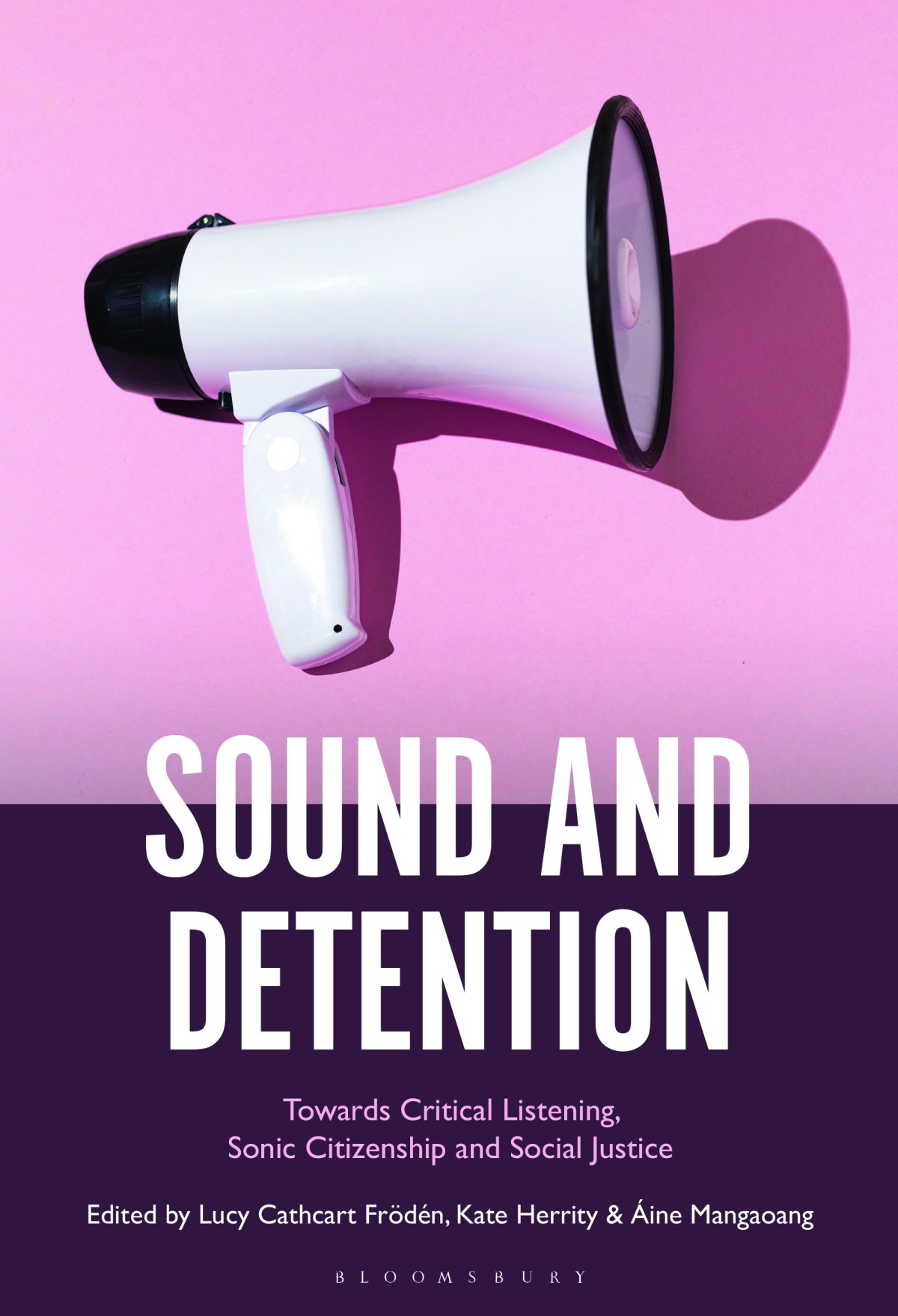
What does it mean to foreground the rhythms of life, songs of loss and longing, crashes and clangs of gates, state agents, violence and disarray in the context of confinement? Over 11.5 million people are in prison around the world, and an estimated 117 million are subject to forced displacement. Both sets of figures are accelerating rapidly (ICPR 2024, Humanitarian action 2026). The edited volume and accompanying audio archive – Sound and Detention: Towards Critical Listening, Sonic Citizenship and Social Justice – uses close attention to soundscapes in places and processes of confinement as a source of sensemaking. Privileging the aurality of incarceration, contributors foreground critical listening as a mode through which to explore sonic citizenship and social justice. In doing so the volume evokes the auditory imagination to reconsider the shifting position of detention at a crucial point of intersection between social, political, economic and cultural life.
Expanding method: ‘Listening nearby’
What does it mean to listen carefully, critically? In the book’s introduction we argue for a “listening nearby”. Following Trinh T. Minh-Ha’s exhortation towards ‘speaking nearby’, we adopt a listening practice that ‘does not objectify, does not point to an object as if it is distant from the speaking subject or absent from the speaking place. A [listening] that reflects on itself and can come very close to a subject without, however, seizing or claiming it (Chen 1992). In Sensory penalities we argue “In our ocularcentric world, foregrounding sonic perceptions and experiences holds potential to disrupt conventional understandings of social life and systemic and structural pressures, and in so doing expands capacity for considering punishment anew (Herrity et al 2020)”.
Working in this way, attending to the aurality of our experience, holds the potential to bring us closer: “listening ‘immerses us in the world’, where seeing ‘removes us from it’…relies on ‘physical contact’, where seeing requires physical distance”. (Chapter 18 Hector McInnes “Pfft Ensemble: Sonic Fiction in a small Highland prison during a global pandemic”). Listening in this way offers the means of developing relational understanding: “Over the next several years, we unravelled the intricate relationship between sound and architecture within 42 carceral spaces. Shifting our focus from music in prisons to soundscapes of the jail, we recognized the potential for a deeper understanding of the carceral experience through sound. We all became students of the soundscape. Learning became relational. (Chapter 1 Benjamin J. Harbert, Joel Castón and Michael Woody “Ear Training for Incarceration: Carceral Acoustemology within the Contemporary Jail”). Listening nearby also, we argue, expands opportunity for enacting agency : “I was just playing birdsong, but sound can be really powerful, it can make a person reflect on their ‘sound being” (Chapter 2 Kate Herrity and Justin Wiggan Emotional Overdubbing: listening passports to sonic agency in the Fens Unit, HMP Whitemoor). Listening nearby shifts proximity, is relational and agentic
Listening Nearby: A found poem from contributed pieces, list below*.
The constant barrage of noise overwhelms life behind bars
Memories about their mother
Everyday bureaucratic rhythms of institutional life
The body granulated into sound, light; selves loosening into others
The institutional melody of people…waiting, waiting
That day saw the end of two different choirs, the formation of one
Singing was an integral part of our lives. There we made the choices
‘We were singing at the top of our voices’
Until they can, simply, choose
Hearing a man’s cries and the sounds of batons hitting flesh
A sonic isolation from the reality, where the mind gets lost
The prison has ears and it is always listening
This ongoing silence
Static…weights and limits on people’s ability to move
Refugees across spaces
Where are you today?
Where did the sounds take us?
Joy in existence
Suspended in bureaucratic inertia
Songs of despair and longing
I hear gunfire in the distance
The book
Sound and Detention is a snapshot of ongoing relationships forged through research, projects and reflections on carceral soundscapes in a variety of times and settings. Using creative as well as academic writing, memoir, sound art, song, these continuing projects place human creativity at the centre of ways of knowing about processes and practices of confinement. Drawing from a range of practitioners, those with lived experience, artists, activists and academics we ask important questions about the role of sound and music in transformative justice and how attention to the sonic can provide impetus to imagine alternatives to the prison and immigration industrial complexes. Accompanying audio resources encourage engagement with the book’s ideas in a multiplicity of ways, as well as showcasing some of the creative, compelling work contributors’ produce.
Through deep engagement with sound, music and listening, we seek to collectively unsettle western, androcentric epistemologies and knowledge hierarchies, specifically with respect to places of detention. Tuning in to the particularities of sound holds the capacity to listen nearby – making space to hold distinct perspectives and positionalities in respectful simultaneity – while also cementing connections to broader questions of social justice and solidarity.
“Prisons of note”
For Aine and Lucy, Sound and Detention was part of the broader Prisons of note project, funded by the Norwegian Research Council. Their work explores uses of music in criminal justice in three locations: Ireland, Norway and Iceland. Amongst the plethora of multi-media outputs thus far, are two powerfully evocative films.
“Pros and Cons” examines the effects of an inside-outside prison choir in Mountjoy prison:
This also forms the subject of chapter 6 in the book, written by the InHouse Harmony Choir and Caroline Jones of SOLAS.
“Real Life, Venja’s Harem” details the support network comprised of women leaving prison making music:
The book is a collaboration as well as part of ongoing conversations between artists, activists, academics, people in prison and those scattered in the diaspora. It is also a project nearly ten years in the making, between a musicologist, a sound artist and a criminologist in Norway, Sweden and England. We launched the book in Oslo this January:
* Full list of contributors:
Lucy Cathcart Frödén, Kate Herrity and Áine Mangaoang (line 1, p1)
Benjamin Harbert, Joel Castón and Michael Woody (line 2, p19)
Kate Herrity and Justin Wiggan (line 3, p37)
Rijul Kataria, Puneeta Roy, and Bhanu Mehta (line 4, p61)
Phil Crockett Thomas (line 5, p67)
Kirstin Anderson (line 6, p73)
InHouse Harmony Choir and Caroline Jones (line 7, p81)
Mary L. Cohen, Naomi Davis, Michael Blackwell, and Anthony Rhodd
Anna Papaeti (line 8, p113)
Lara Quicler Moriarty and Cristina Palomares Toledano (line 9, p131)
Sayati Das (line 10, p146)
Alim Braxton and Mark Katz (line 11, p149)
Christina Hazboun (line 12, p153)
Emilie Amrein and André De Quadros (line 13, p160)
M.J. Grant and James E.K. Parker (line 14, p168)
Tom Western (line 15, p190)
Keith Nyende, Josué Aganze Musoda, Atuhairwe Leocadious and Erin Cory (line 16, p199)
André Dao (line 17, p213)
Hector MacInnes (line 18, p220)
Tesfalem Habte Yemane, Habtat Zerezghi and Hyab Teklehaimanot Yohannes (line 19, p239)
Chrysi Kyratsou and Fiona Murphy (line 20, p258)
Guilnard Moufarrej (line 21, p280)
Ailbhe Kenny (line 22, p290)
References
Chen, N. N. (1992) ‘”Speaking nearby”: a conversation with Trinh T. Minh-Ha’ Visual Anthropology Review, 8(1), 82-91
Herrity, K., Schmidt, B.E., Warr, J. (2021) (Eds) Sensory Penalities: Exploring the Senses in spaces of punishment and social control. Emerald Publishing – Jason and I discussing the book on the emerald podcast: https://www.emeraldgrouppublishing.com/sensory-penalities-decoding-consequences-sensory-punishment
Humanitarian Action (2026) Global Humanitarian Review 2026, “Trends in Crises and Needs: a world at breaking point” [Online] https://humanitarianaction.info/document/global-humanitarian-overview-2026/article/trends-crises-and-needs-world-breaking-point
Institute of Crime and Justice Policy Research (2024) “Prison populations continue to rise in many parts of the world, with 11.5 million held in prisons worldwide” [Online] https://www.icpr.org.uk/news/2024/prison-populations-continue-rise-many-parts-world-115-million-held-prisons-worldwide

