Introducing… Coloniality, Imperialism, and the Senses
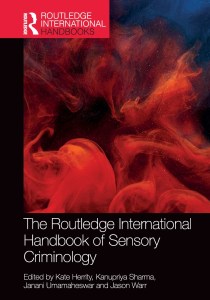
This post marks the third in a series dedicated to discussing each of the organising themes of the Routledge International Handbook of Sensory Criminology, in preparation for its launch. Each piece will leave comments open as an experiment in discussion. Please feel free to post talking points or ask questions – we particularly welcome students. See earlier posts in the series, or the link above, for contents, contributors, reviews and signposting for the next instalment.
The second section opens with an introduction written up from a conversation between Onwubiko Agozino, Rose Boswell, Nontyatyambo Pearl Dastile, Sharon Gabie, Andrew Kettler, Macpherson Uchenna Nnam, Jessica Leigh Thornton and Jason Warr entitled “Recognising Abhorrent Legacies: Lessons for Sensory Criminology”. The discussion reflects on each of the following chapters, foregrounding two interrelated issues: the impact of colonial and imperial legacies on sensory criminological concerns in the present, and the lessons it needs to learn to become part of the broader effort to decolonise criminology as we look toward the future. These themes unfold into a complex consideration of what decolonization looks like: “Within these chapters, we find broader discussions of justice, history, coloniality, criminology, anthropology, ocean cultures, the potential toxicity of legacy, and the lessons that can be drawn from memoir” (p80).
These works disrupt western ways of approaching matters of “justice”. Each of the chapters in this section emphasise the need to consider harm in ways that frequently transcend the visible, the legible. While the focus of these pieces is the abhorrent legacies of colonialism and ways to reconceive justice, there are echoes in these treatments of harm, of the section that precedes it, disrupting how we think about violence and damage beyond immediate materiality and legal classifications. Within Coloniality… “we are invited to…think, rethink, and unthink what justice is, feels like, tastes like, smells like, sounds like, was, and should be in a future free from racism, racialisation, and harms of apartheid” (p81).
The first chapter in the second section – Doing Justice Differently: A Pan‑Africanist Perspective is written by Nontyatyambo Pearl Dastile, Abiodun Omotayo Oladejo, and Macpherson Uchenna Nnam. In it they explore the rich history of Africanist justice and the sensorial tableaus woven in pre-colonial forms of social control. They detail the rich sensoriousness of some of the traditional justice practices which were later suppressed in favour of patriarchal, gendered, racialised violence as well as those perpetuating the violence of apartheid. In considering this history, the authors encourage us to understand, engage and challenge colonial – and other – injustices of the past as a means of imagining a different future. In his chapter I’ll Make You Shit!: Olfactory Othering and the Necropolitics of Colonial Prisons, Andrew Kettler explores colonialist discourses of smell and pollution (and logics of supposed inferiority and threats to the colonial status quo) to consider both how colonialism functions through, and weaponises, the panoptical nature of the prison. The material and the symbolic are combined to sate the colonial need to racialise, sequester, control, exploit, and monitor the bodies of the indigenous, the enslaved, and the oppressed. Kettler foregrounds the discursive weaponisation of olfaction, whereby smell is used to ‘other’ the colonial victim, forcing proximity to shit, death and putrification. ‘Olfactory othering’ is divorced from the actual smell reality, though significant stenches formed part of the everyday in penitentiaries designed for both foreign enemies and colonised locals (p97). Placing the racially oppressed into a noisome space, allowed colonial powers to cast them too as being inherently noisome. This justification then becomes cyclical, justifying and legitimating injustice.
Rosabelle Boswell, Jessica Leigh Thornton, Sharon Gabie, Zanele Hartmann, and Ismail Lagardien follow with their chapter: The Resonance Factor: Personal Experience and the Role of Sensory Ethnography in Countering Violent, Abhorrent Heritage. Both this contribution and the final one of the section again look at the horrors of the colonial past and persistence of neo-colonialism as lenses through which to understand and challenge potential futures for criminology. Boswell et al explore how sensory ethnography can help to reveal the enduring and often overlooked impacts of structural and direct violence in what they term ‘abhorrent heritage’. Focusing on South Africa’s coastal communities, they show how violence is not only historical but deeply embodied. They explore how sensory foci, allow us to access the dimensions of violence that are not always visible or legible, can unsettle dominant heritage discourses as well as expand on criminological theory to include the affective, spatial, and spiritual dimensions of harm, resistance, and social suffering. Onwunbiko Agozino concludes this section with his chapter Decolonizing Sensory Rhetorics and Activism in Africana Prison Memoirs. He considers the important lessons that can, and need to be, learned by sensory criminologists if we are to avoid the essentialist empiricism of criminology’s positivist paradigms and be part of the ongoing work to decolonise our discipline’s future. He makes the point that taking on a sensory ‘lens’ can allow us to explore that which has hitherto been overlooked, or more specifically, in the contexts of the Global South, obfuscated and silenced. He cautions that, given the materiality of sensory methods, we run the risk of once more falling into disciplinary traditions that trap us in conservative and punitive logics that preclude the type of revolutionary, liberatory, and critical criminology that we need to make progress.
These contributions urge the reader to conceive of a broader conception of justice, one which also accounts for our relationship with, and reliance on the land. Agozino urges a greater awareness that “Indigenous ways of knowing and practicing ecological sustainability include embodied and spiritual supra sensory evidence that could be missed if following only Western empiricism” (p120). Failure to acknowledge these bodies and systems of knowing replicate harms and injustice both to one another and to the world we inhabit, alienating us further from the earth that sustains us. As Dastile et al assert, dominant political systems at once diminish the toll of capitalist enterprise on the soil and sea others rely on, resulting in sensorially potent effects of exploitation in the form of, for example pollution, noise, toxic waste. In Boswell et al’s chapter this results in diminished opportunities for keeping livelihoods alive, threatened by the imposition of prohibitive regulatory frameworks. These structures do not recognise the knowledge and experience of those whose forbears have inhabited the land for centuries. Simultaneously, these systems rely on sensorial cues to reinforce cultural, racial and class biases – as Kettler elaborates in his consideration of olfactory othering as a key facet of social control in the colonial prison. A broader conception of justice here, allows us to conceive of the ways in which its practices are interwoven with our connections to both the earth and to one another. Subjects which are revisited later in the book, in section five, albeit in very different ways and places.
Andrew Kettler examines the ways in which the repertoire of olfactory imposition was woven into atmospheres of necropolitical violence; the putridity of colonial regulation (p97). The manufacture of these sensory worlds served both to demarcate space and justify its occupation. The colonial project was bolstered by racist estimations of indigenous sensory difference both as sensory and sensing bodies. The colonial creation of the savage as subordinate was reinforced “due to their supposedly inferior mental functions and perceptual apparatuses, which were believed to be always and falsely attuned to the mystical totems and taboo” (p98). Kettler refers to the sensory studies term for ethical and empathetic numbing, “self-blinding” to the humanity of those subject to violence and torture, percepticide (p100). There is a common strand between percepticide and Agonizo’s caution on the perils of too narrow a conception of the sensory. There is a danger of reiterating what he identifies as the Western tendency to shy away from bigger questions and alternative systems of knowledge.
While Agozino cautions on the perils of too narrow a conception of the sensory, and the danger of reiterating Western tendencies to obfuscate, to shy away from bigger questions and other ways of knowing, Dastile et al and Boswell et al identify mechanisms to move us closer to reconciliation. Their work identifies remedies beyond the imposition of bureaucratic, criminal justice frameworks. Community-led fora for embodied truth-telling and co-created knowledge that more closely honour lived experience, and which can better facilitate healing. Sensory criminology offers the capacity to think, feel, listen, see differently, and in so doing reimagine future conceptions of justice in ways that offer the possibility of mitigating rather than engendering harm, and of fostering inclusivity rather than facilitating social exclusion and marginalisation. Dastile et al argue for a reconfiguring of systems of justice which privilege Africanist human security and communitarianism (p92). Their chapter demonstrates how the sensorial aspects of reintegrative justice allow for a greater distinction between the affective response to the act, and the corporeal dignity of the actor – dividing feeling from feelings. Boswell et al urge us to adopt a sensorially-astute sensitivity both to embodied remembrances of violence, and those which intrude upon the interior into the dream world of spiritual life. The sensory constitutes a potential mechanism for disrupting Western percepticide.
It is important, too, to note that a significant number of scholars reject the conceptual framing of decolonising criminology all together. Juan Tauri takes issue with what he identifies as a frequently tokenistic, superficial and ultimately harmful effort to assimilate and neutralize indigenous voices. Rather than representing progress, these contributions mimic and reproduce the structural violence of the systems they emerge from. He argues of criminology’s decolonising efforts that “until it confronts its deep entanglement with colonisation, any reconciliation with Indigenous scholars will remain rhetorical rather than real” (2025). These vital criticisms raise the fundamental question of whether the master’s tools can ever dismantle the master’s house (to misquote Audre Lorde 1979). In the field of academic discourse this can arguably become a murkier issue. In this context what and who constitutes the master’s tools is itself an open question – contributors, discourse, theoretical frame, methods, formats of dissemination?
The contributors of this section have emphasised the need for reckoning, a heightened sensitivity to the violence of historical and persistent processes and forged potential pathways for us all to consider possibilities for doing justice differently. Where sound dominated treatments of violence in the last section, in section two smell provides a mechanism for charting the textures of the everyday violence of racism. Our proximity to one another, central to social interaction, is close, personal, as are, frequently, those processes of distancing and othering. As Classen et al emphasise; smell is a social phenomenon (Classen et al 1994). Though this is not to detract from the potency of Boswell et al’s identification of weaponised noise as a form of cultural violence (p114). If, as Boswell et al assert, developing a sensorial attunement to the harms of racist and colonial violence is a necessary step to more constructive iterations of justice, we must endeavour to do justice differently. In our failure to consider colonial legacies, we bequeath a most abhorrent heritage.
Some questions
What possibilities are opened up by considering the sensory in these contexts?
What might it mean to address “abhorrent heritage”?
Is the concept of “percepticide” useful more broadly to account for cultural blindness?
What might a decolonial criminology look/sound/smell like?
References
Classen, C., Howes, D., Synnott, D. (1994) Aroma: the cultural history of smell. London: Routledge https://api.pageplace.de/preview/DT0400.9781134822409_A25032735/preview-9781134822409_A25032735.pdf
Lorde, A. (1979/2018) The master’s tools will never dismantle the master’s house. London: Penguin (in Sister Outsider: Essays and Speeches. Ed. Berkeley, CA: Crossing Press. 110-114) [online] https://theanarchistlibrary.org/library/audre-lorde-the-master-s-tools-will-never-dismantle-the-master-s-house https://monoskop.org/images/2/2b/Lorde_Audre_1983_The_Masters_Tools_Will_Never_Dismantle_the_Masters_House.pdf
Tauri, J. (2025). Decolonising Criminology? We’re Not Interested: Indigenous Refusal and the Limits of the Discipline. Journal of Global Indigeneity, 9(4). https://doi.org/10.54760/001c.151793 [online] https://www.journalofglobalindigeneity.com/article/151793-decolonising-criminology-we-re-not-interested-indigenous-refusal-and-the-limits-of-the-discipline
 Sensory Criminology