Categories
Environment food prison smell taste Uncategorized Women

The Aftertaste of Prison

Lucy Campbell

I was a chef for a while when I was younger, I started as a waitress and slowly made my way back into the kitchen, following my nose and my stomach.  I loved cheffing, it fired my enthusiasm, creativity and my appreciation of a chaotic environment. I thrived in the manic, heated frenzy of a working kitchen: the sticky heat, the rich smells of seafood and the warmth of a freshly baked pastry. Food is very important to me and always has been. I am a qualified ‘foodie’.

My time spent in prison then, for me was something of a sensory journey through the realm of taste. In 2004 my partner and I  were arrested for trafficking drugs across an international border and served four years in various Mexican prisons and three in the UK.  The food was worlds apart in each of them. In Mexico, they offered three meals a day served in carts parked at the entrance to each wing. It was essentially three meals of slop. Greasy, watery caldos and rice with beans. Always rice and beans and always with chilli. Chilli in everything! It was tough for a woman who had never eaten chilli before to be immersed in a culture that ate chilli with everything. It took some acclimatising and painful episodes while my body accommodated the new diet. The children had chilli-flavoured lollipops and sweets were chilli flavour. Everything edible had a chilli kick, it was almost a religious sacrament.  To deny the chilli was to deny the Mexican.

Prison life revolved around food, making food, buying food, waiting for food and getting food from family members. I measured the passing of time by the arrival of meals.  Not many women ate the prison food, they didn’t need to. Family is a strong vibe in Mexico and so visit days were busy and smelled delicious. Families brought bags and bags of food in Tupperware, enough to last days. Gorgeous food, real Mexican food. Carnitas, Mole, Sopa de Pollo, fresh tortillas. I didn’t get visitors so  I used to wait in my room and most days when the women came back from their families they would share plates of food with me. Mexicans are generous people, and they were delighted to share food with someone so (eventually) appreciative of their family’s cooking. It took me a while but I grew to love chillis, I grew to love the flavours of Mexico. Chillis, coriander, fresh, tangy salsas.   I wrote recipes of my favourite meals in my diaries and still cook these recipes for my own family today.

We cooked in our cells on small electric pans and the corridors always smelled incredible. It was like walking through a street market with the various aromas drifting out of each cell. This was fine until you were hungry, then the smells were pure torture. Everything was expensive in prison and nothing was free. Even drinking water had to be bought, it was a scrabble most days to survive and get by and it led to an environment where free trade and commerce were normal. Women improvised pop-up food shops which they ran from their cells. Street food done properly; sopes, tacos, carnitas. Flavours and textures that blew my mind, starved as it was for any kind of sensory input. I couldn’t often afford the food but it was a major treat when I could.  I remember walking past a wing where they had had a chilli disaster. The chillis must have been exceptionally strong and then caught in the pan. The whole wing was full of toxic smoke, women were running out with their eyes streaming and coughing. It was like the aftermath of a riot and someone had let off a gas grenade!

When I was finally repatriated to the UK after 4 years in Mexico, I came back pregnant and hungry, four years is a long time to live off other people’s generosity. My partner and I had weekly conjugal visits and birth control wasn’t a high priority in Mexico, it was expensive and difficult to get hold of. My repatriation had finally come through at just the right time, I had been worried about being pregnant in Mexico, and I came back when I was 12 weeks. Holloway Prison was the repatriation centre in England and so it was there I went. Straight from the airport to Holloway’s repatriation centre. I was so worried about Holloway, I had heard all the stories about it on the TV but it was amazing. On arrival, I was offered a meal and then another. It felt like a 4-star hotel after the sparse conditions in Mexico; with soft, fluffy duvets on proper beds, and well-cooked meals with dessert, I could even buy chocolate and snacks if I had the cash! It was sensory overload for the first few weeks with all the bright lights and regimented routine but the food made up for the culture shock. I relished the British classics: Lasagnas, Roast Dinners, and Beef Stews. Then there were the puddings, proper British puddings like treacle pudding and sticky toffee pudding. I ate everything, It was a banquet of food for a starving, pregnant woman and I took full advantage. Holloway was warm and comfortable and yet somehow, I missed Mexico. I used to joke that I had Stockholm syndrome, the condition where you miss your kidnappers or captors.

Can you live in a place and not become a part of it? I grew to love Mexico, I grew to love the food, and I grew to love the language and the people. When I eventually returned to the UK I was dreaming in Spanish and I found it hard to speak English all day long. It seemed so stilted, so lacking in feeling. I missed the open and generous natures of Mexican people, their warmth and their freedom of expression. This is a side of prison that we don’t often think about, happiness and joy in prison. It feels wrong to even write that line! Seven years though, is a long time, it would be impossible to be consistently sad or angry for the entire sentence.  I have some amazing memories of my life in prison in amongst the sadness and the trauma because life goes on in prison. Why wouldn’t it? People are very surprised when I relay stories of ‘fun’ that I had while incarcerated, like the sentence imposed must strip away any life as well as liberty.

Women are women wherever we go, we try to make our lives as close to ‘normal’ as possible. We try to cling to the normality of family and community and shared experiences.  I found that this was done through food, food is a universal connector, and it is hard to have a problem with someone after you have shared a meal with them. It brings people together and allows for a bonding that transcends language and culture. Food began conversations and friendships, it could lift the spirits.  I can cope with most things life throws at me on a full stomach.  I was at my saddest and most depressed when I was hungry.

I suppose now my memories of Mexico are tempered by warm sunshine and hot tacos. Days where although I was at my lowest ebb, I sat in the blazing heat all day long. Tanning myself against the prison walls and looking across the barbed wire fence to watch the avocado trees swaying in the warm winds. Everything feels better with a full belly and with the sun on your face, even imprisonment.

Categories
power taste Women

A proper brew: sensory recollections of my time in prison

Danica J.M. Darley

My memory is crap. It’s a standing joke with my sister. I have no recollection of holidays we took as kids, favourite toys, friend’s birthday parties or family pets. Years of ingesting too much alcohol and fatty foods probably hasn’t helped the matter and many a counsellor has told me that it’s my brain’s way of suppressing childhood trauma. So, imagine my surprise when at work last year a taste transported me back to a situation I would much rather have forgotten. A cost cutting exercise at the day centre for young people with learning disabilities – where I worked throughout my undergraduate degree – had led them to downgrade the usual Yorkshire ‘proper brew’ tea bags to a much cheaper version. On that sunny morning in June I was sent back (thankfully only figuratively) to prison.

In July 2014 I started an 11 month prison sentence in Scotland’s only prison for women, the infamous Cornton Vale.  I had never been in prison, never even really been in trouble with the Police, and here I was wrenched away from my home in England, my husband and my 16 month old daughter for an offence I had committed 7 years previously.  My brain has done its usual trick of hiding many of the events that unfolded in the next 5 months, spent in that run down 1970’s building. However, what it chooses to whisper often comes back as recollections triggered by my senses.

Taste has always been one of the biggest triggers for my memory, helping me to recall the emotions, practicalities and surroundings of some of the most important and mundane situations of my life.  Many mothers will tell you about how good (or awful) the first thing they eat after giving birth to their children is.  For me, that was a soggy cheese sandwich on plain white bread with some sort of value, low fat spread.  I’ve never had a better cheese sandwich in my life! Bound up inextricably with that waxy cheese slice is the memory of becoming a mum for the first time, and all that goes with that, the feelings of love, exhaustion, pain, fear and overwhelming joy.

The taste of that cheap teabag whisked me back to the cramped ‘staff’ room at the side of the card workshop where I spent much of my days in ‘The Vale’. The tea was made from the cheapest possible tea bag that the Scottish Prison Service could lay their hands on. The taste was more akin to the mud soup you would whip up as a kid than any sort of tea I had tasted before, strangely chemically tasting and earthy all at the same time.  However, as is so often the case with food and drink, tea was part of a ritual. Breaks from the job were an important part of the rhythm of the day in prison, they gave us an opportunity to chat, vent, seek advice, size each other up and decide if we wanted to invest time in a friendship with our fellow prisoners. So I endured, I made tea, gratefully took tea made by others, screwed up my nose and swallowed down cup after cup of bargain basement, lukewarm, only slightly brown prison tea. 

However, I was one of the lucky ones. I had a job in the prison that meant I made a few pounds every week and I had a supportive family on the outside who could afford to send in money for me to buy the things I needed whilst in prison.  I didn’t smoke and kept my head down, choosing to spend much of it in the gym, in education or reading in my cell.  All of this meant that I was able to afford the luxury of a pack of Tetley tea bags every other week off of my shop sheet!  It’s funny the things that suddenly become important to you when you have little else to focus your mind or attention on.  Shop day was the best day of the week, ask anyone who’s been in prison and they’ll tell you that, and the best thing I got from the shop was my delicious, longed for ‘proper’ tea bags.

Having time, space (and the privilege) to now reflect on my experience in prison I realise that this sensorial taste experience can really help us to unlock important insights into how we view imprisonment, prisoners and the physical spaces in which people are locked up.  For me, it throws up questions about how society views people who are sent to prison. Is the fact that the prison service provides prisoners with the cheapest of everything representative of the way that prisoners are viewed by the wider population?  Could we not stand the ensuing moral panic created if prisoners were to be given Tetley? If, like many a liberal prison officer will tell you, the punishment is not in fact the prison experience but the deprivation of liberty itself, should the dehumanizing conditions in prison be something that people have to endure? There are also questions around the self-worth of prisoners. So many of the women that I met in prison came from awful situations which forced them to often unquestioningly accept the hand that they were dealt. They coped with life by just putting up with all the crap that was thrown at them and I wonder if the acceptance of the most foul tasting tea could be seen as indicative of their life experiences? A life that had so often ground them down that they didn’t see the point of sticking their head over the parapet and demanding better. 

All of this from a cup of fetid, brown liquid?

For me, the biggest thing that this sensorial recollection has brought was gratitude. That sounds ridiculous, but in some ways I am grateful for the experience of being in prison. Don’t get me wrong, there is so much work that needs to be done to reform all our systems so that they deliver much fairer, less harmful and just (in the truest sense of the word) outcomes for everyone whose lives they touch. However, the ability to recall in brilliant technicolor my prison experience opened my eyes, not only to how lucky I was, but to how I was wasting the opportunities that life had given me. It helped me see the world of opportunity that was before me, and set me on a path that will hopefully lead to me getting my PhD and helping to affect some really positive changes for people who come into conflict with the law. Three years of undergraduate study has given me the opportunity to retrospectively apply my sociological lens to my time in prison, and it’s interesting to do this from a sensory perspective. The senses allow us to get up close and personal with not only a person’s individual experience but with the emotions, sensations, thoughts and all the messiness that comes with that.  It allows us to more deeply interrogate and hopefully understand the situation from all angles, and perhaps come up with more creative and innovative solutions as a result. 

Categories
Comparative Penology Drug Use Emotions research Sensory Penalities Women

A taste of …Down by the river

Amy B. Smoyer

Amy’s chapter in “Sensory Penalities” revisits fieldnotes from extensive research experience in correctional settings, to ponder what value lies for our understanding in revisiting the “The Everything Else”. She prompts us to consider “what is the price of sharing these visceral details? What is the
price of keeping them hidden?” and argues that “Sensory perceptions” allow us to “move forward with an intention to build a more authentic representation of our shared humanity”. These impressions, usually excluded after the data has been stripped and “consumed”, comprise not the “scraps” and left behinds as we commonly regard them, but are “the thickest cut that bleeds when you chew it, gets stuck in your throat, turns over in your stomach, and gives you a taste of what is actually being served” (Smoyer 2021: 202, full citation at the end of the piece).


As social scientists, academics, and activists dedicated to understanding, improving, and undoing correctional systems, we regularly travel through prison spaces. Our upcoming book, Sensory Penalties, describes some of these experiences touching, smelling, breathing, and hearing punishment. These observations of the inside become even more pressing and relevant today, as the COVID epidemic has pushed many of us to the outside, rendering correctional spaces invisible. And yet our work is deemed non-essential. Today, the inquiry persists outside, as we move through and with community, noticing the traces of prison all around us.

Research has found that the six months following release from prison are the most deadly, especially for women who live with opioid addiction (Binswanger et al., 2013). Was the woman who died in the park by the river several years ago on this pathway home? The news does not share this detail, but knowing that it is easier for a person who uses drugs in the US to go to prison than treatment, the scenario is possible.

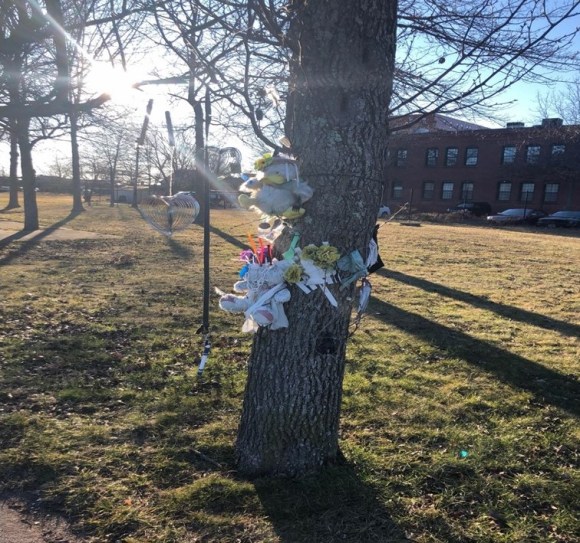
Since the COVID lockdown began in March 2020, I have walked by her memorial countless times. Every once in a while, I will stop to see it. The memorial, which has been meticulously maintained through all the seasons over months and months, exudes a powerful love that shimmers with grief. Rainbow-colored mobiles capture the wind, mirrors and glass reflect light, knickknacks suggest an inside joke, candles build warmth. I have never seen anyone tend to the memorial and imagine a brigade of fairies building the project by moonlight.

Last week, I could barely make out the latest additions to the monument because the sun shone directly into my eyes and I was hesitant to stand too close. We see what and when we want to. The river was still, the park was quiet, and the cold air smelled like distant snow. I imagine her as a newborn baby, covered in goo; a child raising her hand in class, heart pounding; a young person in love, sweating; a desperate person causing harm, surviving; a grown woman waiting in the prison med line, impatient. I imagine her sitting next to the tree, mind focused on one destination, distant from fairies who would tend to her spirit when she departed.

Binswanger, I. A., Blatchford, P. J., Mueller, S. R., & Stern, M. F. (2013). Mortality after prison release: Opioid overdose and other causes of death, risk factors, and time trends from 1999 to 2009. Annals of Internal Medicine159(9), 592-600.

Smoyer, A.B., (2021) “The Everything Else” in Herrity, K., Schmidt, B., Warr, J.J. (eds) Sensory Penalities: Exploring the Senses in Spaces of Punishment and Social Control, 195–202. Sensory Penalities is now available here: https://books.emeraldinsight.com/page/detail/Sensory-Penalities/?K=9781839097270.