Categories
Environment police sensory smell Uncategorized

The Pervasive and Unknown Effects of Sensory Experiences in Policing: An Autoethnographic Response

Marina Carbonell

From 2007 to 2018, I served as a police officer with a provincial police service in Canada.  Starting on patrol, I also worked in communications, criminal investigation division, and forensics, I gained experience providing front-line response in a wide variety of emergency contexts. Prior to becoming a police officer, I spent my youth playing sports, specifically hockey and rugby, which resulted over the years in numerous sports-related injuries, including having my nose broken three times.
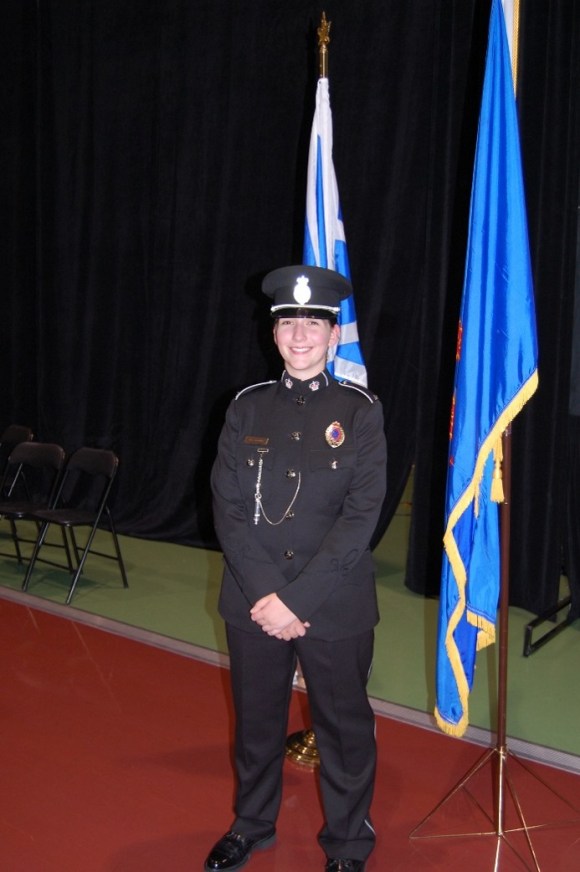
Figure 1: Graduation Day, 2007

Unbeknownst to me, my broken nose led to a deviated septum – a condition where the middle portion of the nose was twisted, obstructing airflow and preventing proper drainage. I knew my breathing was laboured; a girl in my police recruit class commented on how loud my breathing was, and I couldn’t run with an ‘in through the nose, out through the mouth’ pattern.  Finally, in the Winter of 2017, I saw an ear-nose-and-throat (ENT) doctor. I learned that the obstruction in my nose had created growths within my sinus cavities called polyps.  My nose needed to be reconstructed, and the polyps had to be removed.  The surgery went well; however, I could not have anticipated the results.  On the outside, my nose looked the same. On the inside, however, I quickly realized how poor my sense of smell had been once it had been fully restored.

Working in Forensics is unlike any other job. Calls range from minor incidents involving photographs of property damage and forensics processing of stolen vehicles, to crime scene management and analysis of complicated homicide scenes.  In my province, there is no coroner; every death at home is attended by patrol and forensics to rule out foul play.

Figure 2: Caught by the media while photographing a scene, 2017

The first few weeks after the surgery were tricky.  As my nose was healing on the inside, it would occasionally bleed if I got up too fast or bent over.  Normally, this wouldn’t be cause for concern; however, working in forensics brought the potential of introducing contamination into a crime scene. The last thing anyone wants to do is affect the integrity of a scene or necessitate questions about why your DNA is everywhere! This is commonly discussed in forensics; German police discovered scene contamination introduced by a cotton swab factory worker in Austria after the worker’s DNA was located at multiple scenes (Himmelreich, 2009).

After my nose healed, I quickly became aware of my heightened sense of smell. Before this point, I genuinely thought some people just experienced crime scenes and death differently than others in terms of fortitude, determination or tenacity. To say I was shocked is an understatement. Walking into a heavy smoker’s home, standing next to people with strong odours (good and not so good), and even the smells of diverse cuisines were astonishing compared to the previous complete absence.  The difference was jarring; I could smell the iron in blood, and the chemicals I used for processing, where there had been nothing before. Autopsies were a completely different experience, as was the newfound sensory overload of crime scenes. I was astonished by the difference, finding a huge disparity in my personal perception of my work as a result of regaining my sense of smell. The increased ability to smell made it challenging to leave work behind; my hands continued to smell like nitrile gloves, my skin seemed to exude the cleaning chemicals I used before leaving work, and unfavourable experiences lingered in my hair and on my clothes with apathetic vestige, making it harder to wash off the day. Smell, as a sense, is important, but it can also have lasting effects on well-being. Examining smell, Hur and colleagues found a strong correlation between smell and depression, with the prevalence of depression in individuals reporting negative or challenging smell experiences at nearly 40% (Hur et al., 2018).  Taste and smell problems can be the result of trauma to the head (Schechter & Henkin, 1974). Sense of smell can be influenced by fractures to the face (Drareni et al., 2021) and may be altered by diet (Liu et al, 2020; Stevenson et al., 2020), and salt intake (Henkin, 2014). Vestibular sensory systems may be negatively affected by sleep disruptions, impacting vision and balance (Besnard et al., 2018). Thus, police may be further at risk of sensory changes compared to others, as the profession involves physical altercations, shift work disrupting sleep, and often poor eating habits. These findings are especially timely, given the reported impacts on olfactory experiences by people recovering from COVID-19 (Coelho, 2022).

Souhami (2023) argues that police are affected by their sensory experiences, such as working in the dark, which influences how they work. I agree with Souhami that my perceptions in policing were altered in the dark, and I was aware of this influence. For my entire tenure as a police officer, I refused to watch horror movies for fear it would influence my ability to do my job – you can’t be afraid of fictitious movie characters when you’re running through the woods at night. Police work in an environment where perception is everything. The interpretation of threats helps us determine action, but our interpretation of the world around us is subjective. Fear is an adaptive mechanism intended to keep us safe (Gagnon et al., 2013); however, when afraid, we perceive situations as having more risk (Stefanucci & Proffitt, 2009). For police officers and other first responders, training emphasizes vigilance and safety. The work is stressful and is physically and mentally injurious (Pooley & Turns, 2021). The “anti-police rhetoric” is common (Pooley & Turns, 2021), with perceptions of vulnerability leading to increased hypervigilance as a means to maintain feelings of safety (Pooley & Turns, 2021). Hypervigilance can also be heightened as a symptom of posttraumatic stress, a further consequence of the work, with police experiencing higher rates of PTSD than the public (Carleton et al., 2018).

Souhami (2023) also describes police visual perceptions of their environment as imbued with feeling, calling for increased scholarship into sensile influences. In response, I would argue that there is significance beyond sight in our sensory experiences. It is not solely the vulnerability in the dark or our visual experiences that lead to a change in our perceptions, but the combination of our olfactory, vestibular, proprioceptor, auditory, tactile and oral sensations, known and unknown.

The dark itself is known; we are generally aware of our reduced perception and increased risk. The feeling of vulnerability tells us to pay attention, to be aware, to stay safe. I always preferred night shift, as a ‘night owl’ myself. Working at night felt less restricted with less traffic slowing down around me, fewer calls for service, and fewer car accidents to attend. In the summer months, the cool air was a reprieve from enduring body armour in the hot sun. Weekends were always busy, but weeknights sometimes permitted time to catch up on paperwork, actually eat a lunch on shift, and carried the hope of fewer files for follow during the following week.

Familiarity, however, makes a difference. During one call for service in my early patrol days, I responded to a domestic disturbance call in an area outside my regular district. It was dark, and I was in a part of town that I was unfamiliar with, dispatched there because the unit in the area was assigned to another matter on the busy summer Friday night. The newness of the area increased my attention and intensified my focus. The dark felt darker, and the air hinted at a crispness that should have been absent on a warm summer night. I remember the walk up the long driveway, the gravel crunching under my work boots, while I was trying to figure out which door I should knock at. Before I could knock at the door, a huge German Shepherd appeared on my flank out of nowhere, running forcefully at me, with explosive and thunderous barking. The dog ended up being friendly, but the fear induced by my lack of visual acuity, the sudden sound and intensity of the dog barking, and the abrupt disruption to my vestibular senses and proprioception system during the swift turn was disorienting in an unusual way. I was looking for risk as I was approaching the house, I felt aware, though that sense of awareness was spurious, and the subsequent shock was galvanizing.

The sensory input of the unknown is invisible and profound. We ignore our sense of smell until we have a head cold and lose taste. In policing, smell itself acts like a warning system; approaching a door, I would get a sense of what to expect.  During one call for service where a lady had passed away at home, the patrol officer tried to warn my colleague and I, both in forensics, about the scene inside. We immediately dismissed his comments, thinking patrol officers were always dramatic about death scenes. Entering the front door was like walking into a brick wall. The dozens of cats inside had saturated the air with heavy ammonia, and I felt like I could see the air waving, heavy with dolor. We knew we had to go upstairs, but each step was forced and burdensome like walking through water. The creak of each stair was deafening, the swoosh-swoosh-swoosh of our Tyvek protective suits redounding between our ears. The cats wanted attention, moving in and out between our legs, limiting the space on the cramped stairs. We got halfway up to the second floor when my colleague stopped solid. “We have to get out,” she said with veiled panic. I could feel the sweat coming down my forehead, and I could see it in her hair, too. I remember telling her that if we left, we would have to come back in, we were already halfway there. The following ten or fifteen seconds of eye contact between us felt like it lasted an hour. We would have to come back in.

Prior to surgery, I attributed my ability to withstand the challenges of policing to a personal aptitude or individual competency. Being able to experience the change in perception, while challenging, allowed me insight into how fundamental sensory experience is to functional ability, focus, capability, and coping. Schleiermacher, concerned with language, wrote, “every utterance corresponds to a sequence of thoughts of the utterer, and must therefore be able to be completely understood via the nature of the utterer, his mood, his aim” (Schleiermacher, 1998, p. 229). I would argue this conceptualization of language can be extended to our sensory experience; our perceptions are rooted in our context and standpoint in the moment and over time, which in turn, influences our experience and contextualizes our disposition and abilities. If, as voiced by Wittgenstein, “the limits of my language mean the limits of my world” (1922, p.201), our ability to understand and explain our experiences is vital to processing and conceptual expansion, and potentially, could have long reaching impacts for mental health, job satisfaction, and wellness. For example, understanding sensory needs holistically could influence perceptions and our choices. Something as simple as chewing gum can reduce stress during stimulus experiences (Yu et al, 2013), decrease the levels of cortisol in saliva (Tahara et al, 2007), and increase perception of performance and wellbeing (Smith et al., 2012). Gum chewing may also improve memory (Hirano et al., 2008) and positively influence attention (Hirano et al., 2013). For police, the influences on the visual, olfactory, tactile, vestibular, proprioceptor, gustatory, and auditory systems are complex and variable, and knowingly and unknowingly affect vulnerability and perceptions due to the conditions and environment in which police work. I agree with Souhami, we should not be afraid of the dark. But we must consider how the combination of perception, vulnerability, and all sensory aspects influence us in immeasurable, substantial ways. We still have to do the job, knowing the dog may not be friendly next time, knowing we will have to come back in.

Categories
Emotions Environment Gender nighttime sensory smell space Uncategorized

The Night-Self

Chloe Young

A sea of revellers, young people laughing and dancing in a club.

It all started with shimmering bodies, a sweaty room, and the strobe lights of my favourite club.

The glitter we had meticulously applied in my bedroom, just hours before, had sunk its way down the faces of my friends, the result of our bodies being pressed up against other sweaty strangers. Coming into the club from the street outside, you’d be hit with a nauseating wave of sweat, vodka, and a sickly warmth that’d cling to your hair. Disgusting. And yet… Magical. As I had looked around the room, I’d found myself wondering where else such unfamiliar bodies would collide and become one sweaty blur. Where else would I not only let a stranger’s sweat fall on me but choose to let it in the pursuit of joy, pleasure, and fun. What I didn’t know then, as my body thrashed around in time with the music, was that these questions would set in motion a PhD trying to understand the self we become in the night-time economy.

My passion for nightlife cannot be separated from a youth spent sneaking into pubs and clubs in my small town on the Welsh border. Armed with a fake ID and whatever alcohol I could steal from my mother’s cupboard, I knew even then that there was something unique about the world of nightlife. That it offered me something magical. Something new. Something different.

And, most fascinatingly of all, that I was different.

Even now, I can recall the smell of the first bar I snuck into. With just a whiff of the perfume that I used to wear at that age, something fruity and sweet with a twinge of burnt popcorn, I’m transported back to the sticky aftertaste of spilled booze and sugary beer. See, the club itself that had a certain smell built into its four walls… The synthetic scent of a low budget fog machine and its chemical haze reaching across the room, mingling with the aroma of too many spilled vodka cranberries. No matter how many times the floor must have been cleaned, the sour sugar had etched itself into the floorboards.

Then there were the human smells. Sharp floral undertones fighting against the unescapable stench of sweaty body odour. When you’d first walk in, the smell was a strong and almost unescapable stench. But, over time, the smell would encompass you until it was barely noticeable anymore. You’d become part of the messy throb of bodies until the question of whose sweat was whose was simply impossible to answer. The sweat would bead on brows, soak shirts, and blend into a mix you couldn’t distinguish yourself in. You could smell the heat radiating off our skin as the bodies packed in tighter, the music seemingly louder, and any traces of perfume long gone. Disgusting? Magical? Both.

See, I loved the “Night-Time Economy” (NTE) before I even knew what this term meant. While there is no standard definition for the NTE, this is a label given to a wide range of nightlife sites such as pubs, bars, clubs and their associated services. Despite all the label encompasses, the phrase has most often been used to refer to the economic activity of the night-time city. However, the NTE is so much more than an economy, and I ask whether something is missed when we attempt to bound and define the space through its commercial activity.

Instead, could the sensory elements of nightlife allow us to better understand the NTE and its happenings within? Would we better capture the NTE by understanding it as an affective atmosphere where normal daily life comes to be suspended for a moment of ‘in betweenness’ (Turner, 1967)? Thinking about the NTE in this way, beyond its bounded and regulated zones (Newton, 2015, Philpot et al, 2019) paves the way for an understanding of nightlife as a social arena both made up of and producing embodied experiences evoking shifts in behaviours, identities and relationships with risk. Is nightlife really just made up of disconnections and continuities with our daytime subjectivities?

Nightlife spaces are, to borrow Durkheim’s term, socially and sexually effervescent places. The environment, often loud and electric, offers ‘possibilities of pleasure, excess and gratification” (Measham, 2004, p343). And, most importantly, it primes bodies to behave in certain ways. But how?

This is where affectivity comes in.

Affectivity refers to the realm of the unconscious and of the passions, emotions, and moods that all play a role in shaping our world around us. Conceptualizations of affect allow us to go one step beyond what is merely felt and make sense of the unconscious realm. Vague, and yet often incredibly intense, affect is thus the sensation that a feeling then expresses (McCormack, 2008). McCormack offers us the perfect example of affectivity… we know how a room of dancing bodies feels before we could begin to put the sensation into words or assign it a feeling.

Affects can layer upon each other to create an atmosphere that, “like a haze” (Bohme, 1993) radiates from and through individuals. This haze is contagious and fills a space in a way that spreads and induces moods, relations, and behaviour that align with the atmosphere, rather than any personal morality. As such, the crowd can be brought closer together, both emotionally and in proximity, in the formation of an imagined community (Anderson, 1983). A community built upon the stickiness of sugary mixers and a sticky floor that won’t wash out of your shoes no matter how hard you try. But, also, the stickiness of an affective atmosphere that sticks to, and with, those within it.

‘Getting lost in the crowd’ is a phrase we’ve all heard before and feels apt here. Both for how individuals tune into the affective flows around them in the NTE, but also how a ‘day self’ can be lost in the NTE and replaced with our new ‘night-self’ with a new set of tolerances, desires, and ideas. See, nightlife venues can be vibrant, exciting, and electric – the perfect place to get “lost” in… and this isn’t something that just happens by accident. The deliberate usage of lighting, décor and music contribute to engineering an affective atmosphere (Tan, 2013), which in turn affects rhythmic relationships between bodies and their wider spacings (McCormack, 2008; Tan 2013).

These affective atmospheres don’t exist outside of the bodies experiencing them. Picture walking into an empty club. You’ve timed it wrong. Or maybe you’ve picked the right time but on the wrong night.  The music is still loud, the lights still flash… but it’s not the same. This space needs bodies within to ‘warm it up’ (Duff and Moore, 2015) and create the atmosphere that, ironically, those  very bodies are craving by going to a nightclub.

The way I write about, and photograph myself and my friends in the NTE, suggests it is a magical place of community, excitement, and affirmed identity. Which it can be… but isn’t always. It is no secret that the space is saturated with reports of violence, sexual assault and drug use. It’s then not surprising that the NTE is commonly thought about as a place of victimisation and violence.

There is no denying the dangers, darkness, and risk of the NTE, and any attempt to diminish this would be naïve but could also risk misunderstanding something incremental about nightlife…For, the pressing question is: why do we still go despite the potential risk and danger? Or…is this risk part of the attraction? Does it hold a seduction because we don’t always find this elsewhere? In suggesting risk becomes part of the allure of the NTE, is worth noting here that there is an important distinction to be made between feeling uncomfortable in a space and being unsafe (Nicholls, 2019).

For example, I’d feel extremely uncomfortable on a bungee jump at a great height- but would not actually unsafe (as long as I’m properly harnessed in that is!) So, despite the great waves of adrenaline pulsing through my body as I’d leap off the edge, I wouldn’t be in any danger. This distinction is important. Even the most reckless of adrenaline junkies who seek the thrill of “living on the edge” take actions to minimise the level of danger they put themselves in through a range of risk mitigation strategies. See… you can’t enjoy the thrill if the thrill kills you. Thus, when thinking about thrill seeking in the NTE, it is crucial that such behaviours involve the night-self losing control – in a controlled manner. Or, losing control but only temporarily (Briggs and Turner, 2011).

The controlled loss of control materialises across nightlife. This is not just in the risk-taking behaviours within, but in the way we let our bodies move, interact and leak. Outside of sports events, there are few places where a body may “leak” like they may in a nightclub, revelling in its sweaty form without becoming out of place. Bodies are typically expected to be bounded and any bodily materials that threaten this (tears, sweat, blood, urine) have come to transgress the edges of acceptability. While there is nothing inherently disgusting about these fluids, the sweaty, smelly, unbounded body has been cast as something inappropriate in our social spaces today.  But not necessarily for the night-self…

I always make sure to pack deodorant in my bag when going into the PhD office, scared to get caught out or be “smelly”. Yet, despite much more skin exposed and adrenaline induced sweat, I’d never bother to cram such a thing into my handbag when going clubbing. In the office, deliberate attempts are made to reduce the possibility for sweating through air-conditioning or architectural design (Waitt, 2014), but the NTE offers a unique thermodynamic environment and a very different set of norms about sweat itself. Pennay (2012) suggests that club spaces provide individuals with the chance to be grotesque and ‘occupy an uncivilized body for a night: to grin like a fool; to laugh too loud; to sweat it out on the dance floor; to flirt outrageously; talk well-meaning shite to strangers; feel sexual, carnal and exhilarated” (Jackson, 2004, p. 123 in Pennay, 2012). Crucially, this idea of “sweating it out” and being “sexual” challenges the conditions that people usually face in regulating their bodies to maintain a “professional” image. Perhaps then, people seek out the NTE not in spite of its so-called ‘grossness,’ but because of it; sweaty bodies in the NTE are liberated to leak, sweat, ooze, but most importantly, to interact with other bodies and their fluids outside of gendered bodily structures. So, reflecting on my opening story, maybe that is why I don’t mind other bodies sweating on me as I dance, hair stuck to my face, arms up, and glitter rolling down my cheeks.

Then the lights come on. The air feels heavier, and the smell of danger loiters in the corners of the club as bodies fight their way to pile out onto the street, each on a mission to get a taxi or find a chip shop still open. The music, replaced by a chorus of drunken shouts, rings in your ears as your sweaty clothes cling to you like a second skin you can’t shed.  The air outside is like a slap to the face as your body is hit with reality carrying on outside of your night. Someone’s laughing… Someone’s crying… Someone’s throwing up. Sweat begins to dry down your back as your skin still hums from the vibration of dancing bodies, the smell of quickly stagnating and stale clothes. The sound of bare feet slapping along the pavement rings out as shoes are kicked off for the walk home, wet hair dripping with a concoction of spilled drinks, tears, and sweat. The taste of makeup sliding off your faces, leaking its way down onto white tops that had been carefully chosen and spritzed with perfume just hours before. The leaky, messy, dripping body… Free. For tonight at least.

Nightlife offers us something truly unique, and the chance to be unique. The NTE is magical, scary, and extremely messy… but also special. Trying to understand the NTE through a bounded and overly sober approach would be to neglect what makes nightlife what it is and why it plays such a big role in sociality today. As continue to research the “Night-self” and its affective capacity, allure, subjectivity, tolerance, and vulnerability, I hope to make sense of the NTE in a way that speaks to a truth about the space that has been so often overlooked… That the night-time economy is so different to any other space precisely because we’re different within it.

References

Anderson, B. (1983). Imagined Communities: Reflections on the Origin and Spread of Nationalism. London: Verso.

Bohme, G. (1993) ‘Atmosphere as the fundamental concept of a new aesthetics’ Thesis Eleven 36: 113-126

Briggs, D., & Turner, T. (2011). Risk, transgression and substance use: An ethnography of young British tourists in Ibiza. Studies of Transition States and Societies3(2)

Duff, C., & Moore, D. (2015). Going out, getting about: atmospheres of mobility in Melbourne’s night-time economy. Social & Cultural Geography, 16(3), 299-314.

Jackson, P. (2004). Inside clubbing: Sensual experiments in the art of being human. Oxford: Berg

McCormack, D. P. (2008). Geographies for moving bodies: Thinking, dancing, spaces. Geography Compass, 2(6), 1822-1836.

Measham, F. (2004). Play space: Historical and socio-cultural reflections on drugs, licensed leisure locations, commercialisation and control. International journal of drug policy, 15(5-6), 337-345.

Newton, A. (2015). Crime and the NTE: multi-classification crime (MCC) hot spots in time and space. Crime Science, 4(1), 1-12.

Nicholls, E., & Nicholls, E. (2019). ‘People Don’t See You if You’re a Woman and You’re Not Really Dressed Up’: Visibility and Risk. Negotiating Femininities in the Neoliberal Night-Time Economy: Too Much of a Girl?, 207-252.

Pennay, A. (2012). Carnal pleasures and grotesque bodies: Regulating the body during a “big night out” of alcohol and party drug use. Contemporary Drug Problems, 39(3), 397-428.

Philpot, R., Liebst, L. S., Møller, K. K., Lindegaard, M. R., & Levine, M. (2019). Capturing violence in the night-time economy: A review of established and emerging methodologies. Aggression and violent behavior, 46, 56-65.

Tan, Q. H. (2013). Flirtatious geographies: Clubs as spaces for the performance of affective heterosexualities. Gender, Place & Culture, 20(6), 718-736.

Waitt, G. (2014). Bodies that sweat: the affective responses of young women in Wollongong, New South Wales, Australia. Gender, Place & Culture, 21(6), 666-682.

Categories
Environment food prison smell taste Uncategorized Women

The Aftertaste of Prison

Lucy Campbell

I was a chef for a while when I was younger, I started as a waitress and slowly made my way back into the kitchen, following my nose and my stomach.  I loved cheffing, it fired my enthusiasm, creativity and my appreciation of a chaotic environment. I thrived in the manic, heated frenzy of a working kitchen: the sticky heat, the rich smells of seafood and the warmth of a freshly baked pastry. Food is very important to me and always has been. I am a qualified ‘foodie’.

My time spent in prison then, for me was something of a sensory journey through the realm of taste. In 2004 my partner and I  were arrested for trafficking drugs across an international border and served four years in various Mexican prisons and three in the UK.  The food was worlds apart in each of them. In Mexico, they offered three meals a day served in carts parked at the entrance to each wing. It was essentially three meals of slop. Greasy, watery caldos and rice with beans. Always rice and beans and always with chilli. Chilli in everything! It was tough for a woman who had never eaten chilli before to be immersed in a culture that ate chilli with everything. It took some acclimatising and painful episodes while my body accommodated the new diet. The children had chilli-flavoured lollipops and sweets were chilli flavour. Everything edible had a chilli kick, it was almost a religious sacrament.  To deny the chilli was to deny the Mexican.

Prison life revolved around food, making food, buying food, waiting for food and getting food from family members. I measured the passing of time by the arrival of meals.  Not many women ate the prison food, they didn’t need to. Family is a strong vibe in Mexico and so visit days were busy and smelled delicious. Families brought bags and bags of food in Tupperware, enough to last days. Gorgeous food, real Mexican food. Carnitas, Mole, Sopa de Pollo, fresh tortillas. I didn’t get visitors so  I used to wait in my room and most days when the women came back from their families they would share plates of food with me. Mexicans are generous people, and they were delighted to share food with someone so (eventually) appreciative of their family’s cooking. It took me a while but I grew to love chillis, I grew to love the flavours of Mexico. Chillis, coriander, fresh, tangy salsas.   I wrote recipes of my favourite meals in my diaries and still cook these recipes for my own family today.

We cooked in our cells on small electric pans and the corridors always smelled incredible. It was like walking through a street market with the various aromas drifting out of each cell. This was fine until you were hungry, then the smells were pure torture. Everything was expensive in prison and nothing was free. Even drinking water had to be bought, it was a scrabble most days to survive and get by and it led to an environment where free trade and commerce were normal. Women improvised pop-up food shops which they ran from their cells. Street food done properly; sopes, tacos, carnitas. Flavours and textures that blew my mind, starved as it was for any kind of sensory input. I couldn’t often afford the food but it was a major treat when I could.  I remember walking past a wing where they had had a chilli disaster. The chillis must have been exceptionally strong and then caught in the pan. The whole wing was full of toxic smoke, women were running out with their eyes streaming and coughing. It was like the aftermath of a riot and someone had let off a gas grenade!

When I was finally repatriated to the UK after 4 years in Mexico, I came back pregnant and hungry, four years is a long time to live off other people’s generosity. My partner and I had weekly conjugal visits and birth control wasn’t a high priority in Mexico, it was expensive and difficult to get hold of. My repatriation had finally come through at just the right time, I had been worried about being pregnant in Mexico, and I came back when I was 12 weeks. Holloway Prison was the repatriation centre in England and so it was there I went. Straight from the airport to Holloway’s repatriation centre. I was so worried about Holloway, I had heard all the stories about it on the TV but it was amazing. On arrival, I was offered a meal and then another. It felt like a 4-star hotel after the sparse conditions in Mexico; with soft, fluffy duvets on proper beds, and well-cooked meals with dessert, I could even buy chocolate and snacks if I had the cash! It was sensory overload for the first few weeks with all the bright lights and regimented routine but the food made up for the culture shock. I relished the British classics: Lasagnas, Roast Dinners, and Beef Stews. Then there were the puddings, proper British puddings like treacle pudding and sticky toffee pudding. I ate everything, It was a banquet of food for a starving, pregnant woman and I took full advantage. Holloway was warm and comfortable and yet somehow, I missed Mexico. I used to joke that I had Stockholm syndrome, the condition where you miss your kidnappers or captors.

Can you live in a place and not become a part of it? I grew to love Mexico, I grew to love the food, and I grew to love the language and the people. When I eventually returned to the UK I was dreaming in Spanish and I found it hard to speak English all day long. It seemed so stilted, so lacking in feeling. I missed the open and generous natures of Mexican people, their warmth and their freedom of expression. This is a side of prison that we don’t often think about, happiness and joy in prison. It feels wrong to even write that line! Seven years though, is a long time, it would be impossible to be consistently sad or angry for the entire sentence.  I have some amazing memories of my life in prison in amongst the sadness and the trauma because life goes on in prison. Why wouldn’t it? People are very surprised when I relay stories of ‘fun’ that I had while incarcerated, like the sentence imposed must strip away any life as well as liberty.

Women are women wherever we go, we try to make our lives as close to ‘normal’ as possible. We try to cling to the normality of family and community and shared experiences.  I found that this was done through food, food is a universal connector, and it is hard to have a problem with someone after you have shared a meal with them. It brings people together and allows for a bonding that transcends language and culture. Food began conversations and friendships, it could lift the spirits.  I can cope with most things life throws at me on a full stomach.  I was at my saddest and most depressed when I was hungry.

I suppose now my memories of Mexico are tempered by warm sunshine and hot tacos. Days where although I was at my lowest ebb, I sat in the blazing heat all day long. Tanning myself against the prison walls and looking across the barbed wire fence to watch the avocado trees swaying in the warm winds. Everything feels better with a full belly and with the sun on your face, even imprisonment.

Categories
power prison sensory smell Teaching

The Prison Mug: Perceptions of permission

Ross Little

I recently found a blue plastic prison issue mug in a brown cardboard box at home, sitting on top of a collection of classroom notes from a class I taught in prison. I was in the process of writing an article (Little and Warr, 2022) and thought I’d try to recall something of the sensory feel of that space. Instead, I was reminded that my handwriting is not always as clear as I had assumed it was. The ink had faded a little and the paper curled inwards at the edges, but otherwise was in good condition. However, it was the discovery of the mug that really transported me back to this former pedagogical space, one in which I co-facilitated an eight-week educational course. The course included students from De Montfort University and men serving long sentences at ‘HMP Lifer’. The mug might seem like an unlikely vehicle for such an evocative transportation, and yet to me it screams its institutional association.

To me, the mug is unmistakeably a prison mug. Its insipid light blue colour is distinctive. It might well be the sort of mug used in other institutional settings, but this is symbolically imbued with the essence of punishment. Its colour matches closely the faded light blue prison issue t-shirts worn by many of the men on the wings. It has a very plastic feel to it and is surprisingly lightweight, without substance, in contrast with the depth and weight of the sentences hanging over the prison learners in the classroom. It smells of plastic too, infused with a slight whiff of instant coffee, perhaps because it hasn’t had a very good wash yet, even after several years. Its authenticity has been preserved, like a relic from a bygone era found intact. The tasting notes of the coffee it contained promise that it “…makes a solid morning cup. It’s rich, bold, and robust…”. Just like me, I chortle inaccurately to myself.

I feel the need to clarify fairly early on that the mug was taken from one of our weekly sessions, hastily gathered up as we sought to depart the prison on time. The mug was taken accidentally, packed up in a box containing papers and stickers, photocopied readings and feedback sheets. This defence may not hold up in a court of law, but I know you trust my account.

The prison is not that far away, geographically speaking, from where I’m writing this now, at home. In other ways, however, it’s another world: where I am now there is the freedom to descend to the kitchen, fill up on coffee or snack on toast. I can choose something fresh and zesty or something warm and comforting, a new combination or something familiar. These are items that I’ve chosen, that create some sense of familiarity, curated for the moment. If the space has a smell, it is one that has been cultivated over time by its inhabitants, my family. It does not have that distinctive institutional smell of disinfectant mixed with blood, sweat and fear that a prison has. Or at least visitors have been too polite to mention it.

At the time of writing, I haven’t been back into the prison for a while, a period elongated by the experience of the Covid-19 pandemic and associated lockdowns. It feels like a long time since I was in the prison, and I miss the classroom space. It wasn’t an easy experience, because planning and organizing it from beyond the prison boundary can be stressful and tiring. As can the facilitation itself. Going through notes and interviews with participants helped transport me back to moments and sensations experienced in the prison classroom. The classroom itself generally felt like a convivial space, a chatty place where people engaged in conversation easily despite the constrained circumstances. This was a zone where people were able to express something of their real selves, exhibit different thoughts and feelings to the ones they typically felt able to show openly in their institution they ‘belonged’ to. It felt like an honest space, a space rendered sufficiently trustworthy for the people there to engage in conversation despite their deeply contrasting experiences of day-to-day life.

University students spoke about seeing the men as humans, as individuals they could relate to; with perspectives and experiences they could learn from. I remember clearly a university student explaining to me about how this experience had also helped to humanize myself and my colleague, university lecturers. Compared with a lecture theatre environment, she was more able to see us as individual people with real thoughts, views, emotions, a sense of humour and a life beyond university. I was slightly surprised, but it made sense, and I was pleased she felt able to say this. Some months later, I was lecturing during the pandemic lockdown and I was confronted with the realization that the experience of prattling away to my laptop alone in a room at home was likely further reducing my pedagogical humanity in the eyes of students.

Back in the prison classroom, and some of the thoughts, feelings and life experiences expressed weighed heavily on me and I took some of this away with me, without even realizing it at first. Finding the mug took me back to the session it came from, and then a previous session when we were taking a break.

At break-time, everyone mingled as a group. The second week was the first time during the course we were able to take in refreshments for the group. The prison had agreed to this and to provide the hot water in flasks, but nothing more. This contrasts with the experience of the very first course, in 2016, when we were eventually able to have lunch together from the restaurant. The food had been provided by the on-site restaurant and one of the prison students proudly showed off his baking skills. Now, the prison would not, or could not, provide refreshments because the restaurant had long since ‘temporarily’ closed, and has been ever since.  We were now allowed to take certain – limited – items in. We took in some biscuits, fruit, juice, teas and coffee. I was pleased with this, as I recognized from a previous course that break time is important in setting some sort of tone, in communicating something of the course essence. Commensality tends to be more limited in our society these days, especially in prisoner society. It can helpfully echo the social nature of learning and helps humanize the space. It helps put people more at ease and communicates something of the pedagogical equity we’re aiming for during the sessions. Of course, there were considerable differences between the living circumstances of the people in the room. However, for these moments, social interaction was enabled and normalized, and subsequent conversations suggested it was a very welcome part of the overall setting. Just being able to converse with ‘normal’ people from beyond the prison boundary, who had no power or interest in impeding their paths to official rehabilitation, was experienced as worthwhile and valuable. Paired with new, fresh, products from the outside world, the effect was a sensory delight.

So, for me the mug is associated with a break, and yet a continuation of the values in the space, with informal dialogue privileged to facilitate interaction and the exchange of information, ideas and stories. The mug provided people with a vehicle for activity, or inactivity: something to do (make a drink), a catalyst for conversation, or a way to remove oneself from interaction for a short while. But the mug was never the main event, nor could it be, especially when drinks would have tasted so much better from something designed with a little more sensory pleasure in mind.  The main event for me was the biscuits and these are good for generating abstract conversation (Little and Warr, 2022). There were some plainer classics (your ‘Nice’ biscuits – how do you pronounce that word?), some popular favourites (Jaffa Cakes are not cakes), through to some more luxurious chocolate coated options. These offerings were popular amongst some but the group was careful not to demolish them too quickly. There was no stashing of the goodies in socks, trackies and sleeves I had witnessed when running a similar (shorter) course in a local ‘resettlement’ prison. The most noteworthy observation, in fact, was a palpable initial reticence amongst the prison students to touch or consume the biscuits. ‘Are you sure we’re allowed these?’ I was asked by more than one prison learner. It took what felt like quite a while for one of the students to take a biscuit, despite there being some interest. It’s unusual for a group to resist the allure of such sugary treats. It’s also impossible to eat only one; fact. Based on my autoethnographic research replicated over many years.

Being genuinely asked by a grown man if they could eat a biscuit that had clearly been brought in partly for their benefit came as something of a shock to me. The reason became clear shortly afterwards when one of the prisoners explained that they had recently been explicitly told they should not eat the biscuits. It may even have been included in the prison’s pre-course information briefing session. They were led to believe from prior experience that indulging in biscuits could lead to a ‘nicking’ and they did not want to risk unnecessary aggro for the sake of a custard cream. Whatever the precise reason, it was clearly a shared understanding amongst the group and it took a surprisingly long time to encourage them that it would be ok, and without disciplinary consequence. It was in this moment I belatedly realized that at least some people in the room sensed that I had some power in proceedings, or responsibility, or both. I had been relatively oblivious to this until that point, and now it was being made explicit. Whilst this was ‘only’ about biscuits, the biscuits had become symbolic of these other currents related to power and permission. By the end of the session we were informed clearly not to bring in any shit biscuits again. By which was meant, none from a ‘basics’ range or that might be confused with something that might be easily available institutionally.

Whilst the biscuits, and the responses to them, were significant, they were not quite as big a hit as expected. They were definitely appreciated, but there were quite a few left. By the end of the break, this seemed less about perceptions of permission, and more about personal choice. For even more popular than the biscuits was the fruit that had been brought in; there were grapes and kiwis. I recall thinking that our inclusion of kiwis was a bit of a random touch. This was not the view of one of the prisoners. The unfamiliar fresh citrussy smells cut through the heavy, warm air like nothing else. The bright, natural fruity colours hypnotised their consumers for a few moments: ‘Woah, a kiwi; I haven’t had one of them in eight years’. Cue a conversation about the last time he had a kiwi and how the quality and quantity of fruit generally available in the prison was so limited, and poor. Likewise, the (decent, not from concentrate) fruit juice went down a storm. It reminded me of how important fresh fruit and vegetables are, especially in (island) communities when access is so restricted. It also reminded me that perceptions of what is valuable, are also highly contingent upon personal circumstances. 

So, the tea, biscuits and fruit were popular, appreciated and came to symbolise break time. They were a good way of bringing people together for a chat, enhancing the comfort in the classroom space and helped people feel more at ease with each other. A sign that break times were ‘working’ well further occurred when men ‘doing time’ brought in their own tea to share with the group. This human desire to engage in exchange provided a nice touch and validated our sense that this had become a convivial space in which to teach and to learn. We had several more breaktimes like this over the following weeks. And then they changed.

During a later session, perhaps the fifth, the biscuits were stopped. Whilst exiting the prison the previous week we were told not to bring in any more fruit or biscuits for the sessions. This was disappointing but we complied with the request, which was made by a member of the education department staff. Curious to know the reason, the only explanation we received was a concern about ‘conditioning’. Conditioning seemed to be a new buzzword that was being lobbed around by certain staff to explain or justify any new restriction or cutback that further impoverished the regime. This is not to deny the existence of manipulation between people in prison and people employed to hold them there. Indeed, in recent years, there has been an increase in instances of drugs, mobile phones and sim cards being found in prisons. In the year prior to our course, it was reported in the national press that a lack of experienced prison officers had been blamed, in part, for these challenges (The Guardian, 2018). This played a part in the sensitivity towards some items being brought into the prison, such as grapes, kiwis and custard creams. Meanwhile, a prison mug escaped undetected.

References

Little, R., & Warr, J. (2022). Abstraction, belonging and comfort in the prison classroom. Incarceration3(3). https://doi.org/10.1177/26326663221142759

The Guardian (2018) More than 2,500 prison officers disciplined in five years, MoJ figures show [accessed November 2022]

Categories
Children custody prison smell

Revealing Sensory Scars

Gemma

I came across sensory criminology fairly recently whilst browsing social media, completely distracted from what I should have been reading. I found it fascinating, not least because it helped me to identify and make sense of some of my experiences whilst conducting prison research. However, what I was not expecting was the power this perspective has given me to really consider and understand my own position – transporting me back to pain, revealing scars I didn’t realise existed and considering what this taught me about the prison.

To give some context then, between the ages of 12 and 15 I was in and out of police custody. I was never sent to secure[1] (although almost ‘for my own protection’) but I regularly spent periods of confinement in cells, often for full weekends when they had nowhere else to send me. This was during the mid to late 90s so pre-YOT[2] and the YJB[3] and, as a female, the police would often tell me I was better off in a cell than on the streets anyway.

My life has changed significantly since then and in both work and voluntary roles I have revisited criminal justice sites and institutions with relative emotional ease. However, this was challenged during my time conducting research in a prison and it is these challenges that shall be the focus of my writing. In particular, I found there were three experiences that acutely activated and revealed what I feel are sensory scars – that is sites of old wounds revisited via: the smell, the cell, and leaving the prison.

The Smell

I was, and still am, surprised that the smell of the cleaning fluid activated emotion. That chemical disinfectant, that I’m assuming must be standard for communal areas in cold, soulless institutions with hard blue and green floors. It took me straight back. This smell is only around at certain points in the day so conducting research, rather than visiting, meant more opportunities to connect with it. That cheap, sterile, cold smell – it reminded me so much of being escorted down the corridor often by men twice my size, just a body, chucked in a cell and kept until another place or person knew what to do with you. I suppose that was the message, the ‘we don’t know what to do with you’ smell – you’re an inconvenience to society, it doesn’t know what to do with you so we’ll contain you for a bit in this building, disinfecting human traces.

The Cell

I was given a small office to work from during my research. It was an old cell, small with cream walls and no natural light. It was similar to the cells I had been held in when I was a child, but without the window made from thick square panes of glass and set with concrete. I didn’t hold keys during my research and I couldn’t leave this office unlocked. This meant that I had to, or felt like I had to, wait for a prison officer to relieve me. I was very appreciative of the space I’d been given and didn’t want to add to the workload of prison staff and so sometimes I could be waiting a while – it was this that revealed the second sensory scar. The sounds while waiting…footsteps walking down the corridor, keys jangling and that feeling of relief that someone is coming. You think it’s time for you to go…only for the sounds to tail off at someone else’s door. It’s not your turn so there’s that sinking feeling. Then, waiting longer, and again, the same process repeated. You’re enclosed and powerless with nothing to do, convinced you’ve been forgotten about. Life is buzzing onwards and you’re left, no one is coming and you don’t matter. You’re forgotten.

Leaving

The act of leaving the prison each day reminded me of how it felt every time I left police custody. Switching from the dull, still, confined space, with stale air and limited natural light to a heightened awareness of the outside world and that feeling of being free. The crisp, clean fresh air hitting your face after feeling nothing but stillness, demanding some consciousness. Having to wait a few seconds while your eyes adjust to the brightness, waking you up from the dull artificial gloom. The sounds of cars, birds and people walking past on the pavement. It made me feel so grateful that I could leave behind the emptiness of confinement and this time, step towards life.

Reflecting upon these sensorial experiences has provided me with a source of insight and understanding around some of the experiences of prison and social control. This is particularly with regard to the dehumanising nature of these institutions and the act of confinement. Perhaps the most pertinent aspect of this is reflected in my reaction, when discussing this blog, to someone using the word child. That really hit me… the idea that I was a child. I’d never thought of myself as a child. I certainly didn’t feel like a child at the time and over 20 years on, I still needed to be reminded that I was one. That is probably a testament to the long term damage dehumanising spaces have on our bodies and sense of self and it is the etching sensory scars that lay dormant ready to be raised to remind you of that.


[1] “Secure” here refers to secure children’s homes (SCH’s) which offer full time residential care for children aged 10-17 (14 if referred for custody). 43% of placements were those commissioned by the Ministry of Justice in 2020 (80 children): https://explore-education-statistics.service.gov.uk/find-statistics/children-accommodated-in-secure-childrens-homes For more information see Howard League for Penal reform, (2016) Future insecure: secure children’s homes in England and Wales. Available here: https://howardleague.org/wp-content/uploads/2016/05/Future-Insecure.pdf

There are three types of custody for children in England and Wales (who mysteriously become “young people” when criminalised): Secure children’s homes (SCH’s) – run by local councils for children 10-14, Secure Training Centres (STC’s) – for children up to 17, run privately by for-profit organisations, and Young Offender Institutions (YOIs) – for children and young people 15-21 (termed “people” on the government website), run by the prison service and private companies https://www.gov.uk/young-people-in-custody/what-custody-is-like-for-young-people).

England and Wales has the lowest age of criminal responsibility (10 years old) and the highest rates of child incarceration in Western Europe. Most children in custody are held in prison, (YOI’s). For some comparison, in December 20/21 60 were held in SCH’s, 94 in STC’s and 454 in YOI’s (figures taken from gov.uk: https://www.gov.uk/government/statistics/youth-custody-data).

[2] YOT refers to “Youth Offending Team”. Set up following the 1998 Crime and Disorder Act, with an emphasis on “protecting the public” (and reducing reoffending as their principle aim) See HMIP (2017) “The work of youth offending teams to protect the public”: https://www.justiceinspectorates.gov.uk/hmiprobation/wp-content/uploads/sites/5/2017/10/The-Work-of-Youth-Offending-Teams-to-Protect-the-Public_reportfinal.pdf

[3] YJB refers to the “Youth Justice Board”, also established in the wake of the 1998 Crime and Disorder Act, to monitor and promote good practice. In 2000 they assumed responsibility for commissioning custodial places (taken from www.beyondyouthcustody.net)

Categories
History overcrowding prison smell

eau de Durham

Michael Spurr

From my room on the third floor of St Chad’s College I would look out across the river and watch the prisoners in Durham Gaol take their daily exercise. Walking round and round in circles. Always in circles. I walked past the gaol myself, most days, en route to the Economic History Department ( or sometimes en route to the Dun Cow ) but like most students (and most people) I really didn’t give the prison much thought. Then a Careers Adviser asked if I’d ever considered the Prison Service as a career. I hadn’t, but the conversation sparked an interest and shortly afterwards I found myself outside the Victorian gate waiting to enter a prison for the first time. ‘Why are you thinking of joining the Prison Service’ asked the Governor, apparently bemused that a Durham University student wanted to visit his prison. But he had organised an Assistant Governor, Jim Phillips, to take me round and that visit set the direction for my working life.


There are two things I remember most vividly from that afternoon. The first was my shock at finding remand prisoners, unconvicted and therefore innocent in the eyes of the law, in the worst living conditions. Three to a cell designed for one with only a bucket for a toilet and locked up for most of the day with nothing to do. The second was the smell – or as one Officer put it the ‘eau de Durham’. It was pungent, an institutional odour but particular and unique to prison. A combination of cleaning fluid and carbolic soap masking the stench of bodily fluids, slop buckets, and tobacco (cannabis and other drugs were not quite so prevalent then). It was an unmistakeable prison smell or to be more precise an unmistakeable local prison smell – for it was local prisons which suffered gross overcrowding, where unconvicted prisoners were held three to a cell with nothing to do and where slopping out was the daily routine. It was a smell I came to know intimately when I became a Prison Officer at HMP Leeds.


And it was at Leeds that I learned, to my surprise, that many unconvicted prisoners did their best to prolong their time on remand. You see it counted towards any subsequent sentence and, whilst living conditions were grim, you were held locally, could have a visit for 15 minutes every day, and you could receive food and drink from your visitors! Two pints of beer or a bottle of wine a day were permitted -though being Yorkshire in 1983 there wasn’t much call for wine. Oh the joy of the visits search detail which meant not only searching prisoners but also decanting beer into jugs; delving into pies; straining stews; and exploring curries for contraband before taking them up to the landings for the men. All these smells added further depth to the distinct prison odour requiring even more cleaning fluid and carbolic soap the next day.


Then there was the original ‘barmy army’ – the cleaning party whose job it was to pick up the ‘shit’ parcels thrown out of cell windows along with the discarded food – a feast for the pigeons and the rats. The men did it with stoic good humour but it wasn’t a job for the faint hearted! A trip to the Bathhouse on C Wing for a shower was a daily reward for the ‘barmies’ but for most prisoners that luxury was at best a weekly event – and only then if you were lucky. Holding around 1300 prisoners in a prison built for 550 created its own challenges. Staff were simply relieved to complete the ‘daily miracle’ and get through the day. Prisoners acquiesced and largely did what was required because that was how it was and stepping out of line risked unofficial physical punishment and an overcrowding draft to Durham or further afield. It was a world invisible and ignored by those outside; ignored that is until it all boiled over at Strangeways in 1990 and riots followed across the country.

The resulting Woolf Report proposed radical changes to the Prison system. An end to overcrowding and provision of proper sanitation in cells were two of its main recommendations. Thirty years on, to our shame, overcrowding is still with us ( around 20 000 prisoners are housed in cells designed for fewer people) but slopping out officially ended on 12 April 1996 and the environment in local prisons was dramatically changed as a result. Unconvicted prisoners had, by then already lost their right to have food and drink brought into prison; showers were increased and moved onto individual living units; and then eventually tobacco was banned (though illicit substances are still smoked in most prisons). These reforms -particularly the ending of slopping out -have permanently changed the environment for prisoners and staff – and definitely for the better!


Prisons today continue to provide a unique and immersive sensory experience. Living conditions for many prisoners, particularly in Victorian gaols -starved of investment, remain very poor (far from what should be acceptable in the twenty first century) but the dreadful unsanitary conditions found in local prisons in the 1980’s have thankfully been consigned to history. Still I will never forget that smell – it has permeated my senses forever!