Categories
Environment Green Criminology History power sensory Uncategorized

International Handbook of Sensory Criminology Series: 3

Introducing… Coloniality, Imperialism, and the Senses
This post marks the third in a series dedicated to discussing each of the organising themes of the Routledge International Handbook of Sensory Criminology, in preparation for its launch. Each piece will leave comments open as an experiment in discussion. Please feel free to post talking points or ask questions – we particularly welcome students. See earlier posts in the series, or the link above, for contents, contributors, reviews and signposting for the next instalment.

The second section opens with an introduction written up from a conversation between Onwubiko Agozino, Rose Boswell, Nontyatyambo Pearl Dastile, Sharon Gabie, Andrew Kettler, Macpherson Uchenna Nnam, Jessica Leigh Thornton and Jason Warr entitled “Recognising Abhorrent Legacies: Lessons for Sensory Criminology”. The discussion reflects on each of the following chapters, foregrounding two interrelated issues: the impact of colonial and imperial legacies on sensory criminological concerns in the present, and the lessons it needs to learn to become part of the broader effort to decolonise criminology as we look toward the future. These themes unfold into a complex consideration of what decolonization looks like: “Within these chapters, we find broader discussions of justice, history, coloniality, criminology, anthropology, ocean cultures, the potential toxicity of legacy, and the lessons that can be drawn from memoir” (p80).

These works disrupt western ways of approaching matters of “justice”. Each of the chapters in this section emphasise the need to consider harm in ways that frequently transcend the visible, the legible. While the focus of these pieces is the abhorrent legacies of colonialism and ways to reconceive justice, there are echoes in these treatments of harm, of the section that precedes it, disrupting how we think about violence and damage beyond immediate materiality and legal classifications. Within Coloniality… “we are invited to…think, rethink, and unthink what justice is, feels like, tastes like, smells like, sounds like, was, and should be in a future free from racism, racialisation, and harms of apartheid” (p81).

The first chapter in the second section – Doing Justice Differently: A Pan‑Africanist Perspective is written by Nontyatyambo Pearl Dastile, Abiodun Omotayo Oladejo, and Macpherson Uchenna Nnam. In it they explore the rich history of Africanist justice and the sensorial tableaus woven in pre-colonial forms of social control. They detail the rich sensoriousness of some of the traditional justice practices which were later suppressed in favour of patriarchal, gendered, racialised violence as well as those perpetuating the violence of apartheid. In considering this history, the authors encourage us to understand, engage and challenge colonial – and other – injustices of the past as a means of imagining a different future. In his chapter I’ll Make You Shit!: Olfactory Othering and the Necropolitics of Colonial Prisons, Andrew Kettler explores colonialist discourses of smell and pollution (and logics of supposed inferiority and threats to the colonial status quo) to consider both how colonialism functions through, and weaponises, the panoptical nature of the prison. The material and the symbolic are combined to sate the colonial need to racialise, sequester, control, exploit, and monitor the bodies of the indigenous, the enslaved, and the oppressed. Kettler foregrounds the discursive weaponisation of olfaction, whereby smell is used to ‘other’ the colonial victim, forcing proximity to shit, death and putrification. ‘Olfactory othering’ is divorced from the actual smell reality, though significant stenches formed part of the everyday in penitentiaries designed for both foreign enemies and colonised locals (p97). Placing the racially oppressed into a noisome space, allowed colonial powers to cast them too as being inherently noisome. This justification then becomes cyclical, justifying and legitimating injustice.

Rosabelle Boswell, Jessica Leigh Thornton, Sharon Gabie, Zanele Hartmann, and Ismail Lagardien follow with their chapter: The Resonance Factor: Personal Experience and the Role of Sensory Ethnography in Countering Violent, Abhorrent Heritage. Both this contribution and the final one of the section again look at the horrors of the colonial past and persistence of neo-colonialism as lenses through which to understand and challenge potential futures for criminology. Boswell et al explore how sensory ethnography can help to reveal the enduring and often overlooked impacts of structural and direct violence in what they term ‘abhorrent heritage’. Focusing on South Africa’s coastal communities, they show how violence is not only historical but deeply embodied. They explore how sensory foci, allow us to access the dimensions of violence that are not always visible or legible, can unsettle dominant heritage discourses as well as expand on criminological theory to include the affective, spatial, and spiritual dimensions of harm, resistance, and social suffering. Onwunbiko Agozino concludes this section with his chapter Decolonizing Sensory Rhetorics and Activism in Africana Prison Memoirs. He considers the important lessons that can, and need to be, learned by sensory criminologists if we are to avoid the essentialist empiricism of criminology’s positivist paradigms and be part of the ongoing work to decolonise our discipline’s future. He makes the point that taking on a sensory ‘lens’ can allow us to explore that which has hitherto been overlooked, or more specifically, in the contexts of the Global South, obfuscated and silenced. He cautions that, given the materiality of sensory methods, we run the risk of once more falling into disciplinary traditions that trap us in conservative and punitive logics that preclude the type of revolutionary, liberatory, and critical criminology that we need to make progress.

These contributions urge the reader to conceive of a broader conception of justice, one which also accounts for our relationship with, and reliance on the land. Agozino urges a greater awareness that “Indigenous ways of knowing and practicing ecological sustainability include embodied and spiritual supra sensory evidence that could be missed if following only Western empiricism” (p120). Failure to acknowledge these bodies and systems of knowing replicate harms and injustice both to one another and to the world we inhabit, alienating us further from the earth that sustains us. As Dastile et al assert, dominant political systems at once diminish the toll of capitalist enterprise on the soil and sea others rely on, resulting in sensorially potent effects of exploitation in the form of, for example pollution, noise, toxic waste. In Boswell et al’s chapter this results in diminished opportunities for keeping livelihoods alive, threatened by the imposition of prohibitive regulatory frameworks. These structures do not recognise the knowledge and experience of those whose forbears have inhabited the land for centuries. Simultaneously, these systems rely on sensorial cues to reinforce cultural, racial and class biases – as Kettler elaborates in his consideration of olfactory othering as a key facet of social control in the colonial prison. A broader conception of justice here, allows us to conceive of the ways in which its practices are interwoven with our connections to both the earth and to one another. Subjects which are revisited later in the book, in section five, albeit in very different ways and places.

Andrew Kettler examines the ways in which the repertoire of olfactory imposition was woven into atmospheres of necropolitical violence; the putridity of colonial regulation (p97). The manufacture of these sensory worlds served both to demarcate space and justify its occupation. The colonial project was bolstered by racist estimations of indigenous sensory difference both as sensory and sensing bodies. The colonial creation of the savage as subordinate was reinforced “due to their supposedly inferior mental functions and perceptual apparatuses, which were believed to be always and falsely attuned to the mystical totems and taboo” (p98). Kettler refers to the sensory studies term for ethical and empathetic numbing, “self-blinding” to the humanity of those subject to violence and torture, percepticide (p100). There is a common strand between percepticide and Agonizo’s caution on the perils of too narrow a conception of the sensory. There is a danger of reiterating what he identifies as the Western tendency to shy away from bigger questions and alternative systems of knowledge.

While Agozino cautions on the perils of too narrow a conception of the sensory, and the danger of reiterating Western tendencies to obfuscate, to shy away from bigger questions and other ways of knowing, Dastile et al and Boswell et al identify mechanisms to move us closer to reconciliation. Their work identifies remedies beyond the imposition of bureaucratic, criminal justice frameworks. Community-led fora for embodied truth-telling and co-created knowledge that more closely honour lived experience, and which can better facilitate healing. Sensory criminology offers the capacity to think, feel, listen, see differently, and in so doing reimagine future conceptions of justice in ways that offer the possibility of mitigating rather than engendering harm, and of fostering inclusivity rather than facilitating social exclusion and marginalisation. Dastile et al argue for a reconfiguring of systems of justice which privilege Africanist human security and communitarianism (p92). Their chapter demonstrates how the sensorial aspects of reintegrative justice allow for a greater distinction between the affective response to the act, and the corporeal dignity of the actor – dividing feeling from feelings. Boswell et al urge us to adopt a sensorially-astute sensitivity both to embodied remembrances of violence, and those which intrude upon the interior into the dream world of spiritual life. The sensory constitutes a potential mechanism for disrupting Western percepticide.

It is important, too, to note that a significant number of scholars reject the conceptual framing of decolonising criminology all together. Juan Tauri takes issue with what he identifies as a frequently tokenistic, superficial and ultimately harmful effort to assimilate and neutralize indigenous voices. Rather than representing progress, these contributions mimic and reproduce the structural violence of the systems they emerge from. He argues of criminology’s decolonising efforts that “until it confronts its deep entanglement with colonisation, any reconciliation with Indigenous scholars will remain rhetorical rather than real” (2025). These vital criticisms raise the fundamental question of whether the master’s tools can ever dismantle the master’s house (to misquote Audre Lorde 1979). In the field of academic discourse this can arguably become a murkier issue. In this context what and who constitutes the master’s tools is itself an open question – contributors, discourse, theoretical frame, methods, formats of dissemination?

The contributors of this section have emphasised the need for reckoning, a heightened sensitivity to the violence of historical and persistent processes and forged potential pathways for us all to consider possibilities for doing justice differently. Where sound dominated treatments of violence in the last section, in section two smell provides a mechanism for charting the textures of the everyday violence of racism. Our proximity to one another, central to social interaction, is close, personal, as are, frequently, those processes of distancing and othering. As Classen et al emphasise; smell is a social phenomenon (Classen et al 1994). Though this is not to detract from the potency of Boswell et al’s identification of weaponised noise as a form of cultural violence (p114). If, as Boswell et al assert, developing a sensorial attunement to the harms of racist and colonial violence is a necessary step to more constructive iterations of justice, we must endeavour to do justice differently. In our failure to consider colonial legacies, we bequeath a most abhorrent heritage.

Some questions

What possibilities are opened up by considering the sensory in these contexts?

What might it mean to address “abhorrent heritage”?

Is the concept of “percepticide” useful more broadly to account for cultural blindness?

What might a decolonial criminology look/sound/smell like?

References

Classen, C., Howes, D., Synnott, D. (1994) Aroma: the cultural history of smell. London: Routledge https://api.pageplace.de/preview/DT0400.9781134822409_A25032735/preview-9781134822409_A25032735.pdf

Lorde, A. (1979/2018) The master’s tools will never dismantle the master’s house. London: Penguin (in Sister Outsider: Essays and Speeches. Ed. Berkeley, CA: Crossing Press. 110-114) [online] https://theanarchistlibrary.org/library/audre-lorde-the-master-s-tools-will-never-dismantle-the-master-s-house https://monoskop.org/images/2/2b/Lorde_Audre_1983_The_Masters_Tools_Will_Never_Dismantle_the_Masters_House.pdf

Tauri, J. (2025). Decolonising Criminology? We’re Not Interested: Indigenous Refusal and the Limits of the Discipline. Journal of Global Indigeneity9(4). https:/​/​doi.org/​10.54760/​001c.151793 [online] https://www.journalofglobalindigeneity.com/article/151793-decolonising-criminology-we-re-not-interested-indigenous-refusal-and-the-limits-of-the-discipline

Categories
History prison research

TALKING ABOUT NOT TALKING: THE SENSES AND THE VICTORIAN PRISON

Richard W. Ireland

I write this as the COVID-19 pandemic still dominates everyday life and where in Wales, from which I write, restrictions on movement and association are still much stricter than in other parts of the UK. The changes that lockdown has made have often been remarked upon in terms of sensory experience; roads are quieter, birdsong more noticeable, air purer etc. The observation that sensory experience is both (inter alia) historically and geographically variable is banal, and will come as no surprise to those interested in this site. But it is the experience of sudden change which I want to pursue here and I will do that in relation to the impact of imprisonment in the nineteenth century. The examples which I will cite here come, unless I indicate otherwise, from my  researches into the daily workings of a particular County Gaol, that of Carmarthen in South-West Wales, between c.1840 and c.1877, but many will find echoes down the corridors of other Victorian prisons.

For those who may be unacquainted with the momentous changes in the criminal justice system in the nineteenth century a few words of introduction may help. In the hundred years between Howard’s State of the Prisons in 1777 and the nationalisation of the prison system in 1877 massive changes took place within state punishment. The punishments of the stocks, pillory and transportation had been abolished and whipping and capital punishment had both been much restricted in their use and brought inside the walls of the prison. Imprisonment had become the focus of the response to crime. Elements of the carceral experience which we now consider axiomatic, such as the cell and the uniform, become generally employed only at this time. The regime to be used in prison, and the aims to be pursued, became a matter of vigorous debate and experimentation.in the period covered by this piece.  The “Separate System”, which had seen its highpoint in the opening of Pentonville in 1842, promoted religious reform through isolation of prisoners in solitary confinement, while the rival “Silent System” allowed association, but forbad any talking between inmates. Both, it can be seen, were defined by limitations of sensory experience. We will have cause to consider both in due course, but I will use consideration of different senses as the framework of my discussion, although it will be clear that there is considerable and unavoidable overlap at times.

Sight

I want to begin here, not with the walls and the cell, but with the transformation of the prisoner within the Victorian gaol. Such immediate marks of individuality as might be conveyed by the visual indicators of clothing and hair were removed, this latter only in the case of male prisoners. The haircut was a source of some controversy, particularly as the end of a sentence approached, for it could serve as a badge of criminality even after discharge. In Carmarthen in 1846-7 there were significant disputes, including the invocation by the prisoners of the authority of the Home Secretary, led by inmates James Hunt and James Hargrave and which centred on the haircut. Institutions where the separate system was rigidly enforced even the face itself was concealed: males wore “Pentonville peaks”, caps the peaks of which were pulled over the face, leaving only holes for vision. Even so, if prisoners met outside the cell whilst being moved one had to turn to the wall as another passed. Women prisoners wore a thick black veil, through which their features were indistinguishable. What was visible under such a regime was not a person, but a symbol of controlled criminality.

Prisoners who were in any way visually impaired could provide particular problems for the prison routine. John Wilson, a tea dealer “blind in both eyes” was sentenced to twelve months with hard labour in 1846 was unable to be employed within the prison and his conduct during his sentence was described as “very bad”. Twenty-five years earlier a 74-year-old debtor, James Davies, whose eyesight was so bad that he collided with the prison walls, won a bet that he could run 420 yards before another debtor could eat two muffins. Others could be subjected to abuse, David Jones was punished by Governor Westlake in 1845, whose spelling is here typically erratic,  “for neglecting to work on the wheel in is turn and calling George Gilbert a blind eye has he had lost a eye”.

There was another visual problem, of immense theoretical importance, inherent in the penological transition of the nineteenth century. If prison was intended to deter (an aim which ebbed and flowed reciprocally with reformation during the century) then how could suffering be conveyed to those outside the walls? The crowds who witnessed the pains and shame of physical punishment, the public whippings and executions, had the moral drama played out in full sight. Prison had to employ a different strategy, the architecture of the building supplanting the body of the criminal as the site, and the sight, of deterrence. Architecture tended towards the massy and powerful, prisons often in highly visible positions within towns and cities. Carmarthen’s gaol, on the site of the old castle, dominated the townscape. It was built by the celebrated John Nash, the carved chains on the gatehouse recalling Newgate. It also had, at one point, a unique (as far as I know) yet symbolically perfect substitute for the suffering body hidden within. When the treadwheel was in operation a painted, life-size pewter model of a prisoner revolved on a pole above the walls. It may have been this, or perhaps the sails and regulators which were visible indicators of the wheel in other prisons, which was pointed out to the “thimble gentry” arrested at a fair in the town in 1833.

Touch

One of the most important rituals of the experienced criminal starting a sentence in some cellular Victorian prisons was entirely tactile. He or she would run their fingers along the ledge beneath the ventilator over the door of the cell. I do the same whenever I enter a preserved gaol now. They were feeling for a nail which might have been left there by the previous occupant. Nails could be a great help in picking the daily allocation of oakum, one of the tasks assigned as hard labour. Oakum was old ships’ rope which had to be pulled apart into its constituent fibres; a dirty and unpleasant task. That it could damage the fingers to the extent of hindering completion of the task seems evident from the records. It need hardly be added that the susceptibility to injury would to an extent depend on the variable sensitivity of the hands into which the uniform lump of rope was delivered: the miner and the clerk would not necessarily experience the punishment in the same way. Other hard labour tasks could also result in painful injury. One of the many prisoners’ names for the treadwheel  was the “shinscraper”, the desire to use bodyweight as well as muscle power to drive the revolving treads prompting, I think, a desire to move further forward on the step, risking contact with the one above as it descended.

If such tactile encounters were unwelcome, one benefit of incarceration may have been that prisoners may have scratched themselves rather less than they had been used to. A large number of those admitted to Carmarthen Gaol (in one quarterly report from 1870 more than one third of them) were suffering from scabies, which meant that they would begin their remand or sentence by entering a liminal space with an undeniably sensory title: the “Itch Ward”.

I have read many accounts of the transition from the open “wards” of the pre-reform prison to the cellular Victorian version, made compulsory after 1865, which stress the intention of preventing “contamination” both moral and physical between prisoners, and the disruption of the inmate subculture, but few which actually consider how strange it would have seemed to those subjected to it. To sleep in a room without anyone else in it, even in the bed itself, would have been unprecedented for many adult offenders, and not only those with spouses and children, but also to those who slept in overcrowded lodging houses, servants’ quarters or miners’ barracks. It is unclear whether that nocturnal solitude, without the warmth and opportunity for conversation which a shared bed brought, would have been welcomed, but the supposition is certainly not unreasonable. In the year 1856-7 there were five beds for women prisoners in Carmarthen gaol and at one point they were occupied by no fewer than thirteen adults and two children at the same time. When the womens’ prison was rebuilt thereafter to allow greater segregation it was still condemned by the Prison Inspector, the separationist J.G. Perry as not entirely excluding association.

Hearing

As has been indicated earlier, the prison regime of the nineteenth century was predicated on silence, whether it depended on solitary confinement or association. Yet this was easier to propose than to enforce, particularly in local gaols which had not been built to a particular pattern, as had, for example, Pentonville. In that “penitentiary” the Separate System was enforced to such an extent that prison officers wore felt slippers to muffle the sound of their perambulations. But the construction of individual cells in older local gaols, financed by ratepayers, was expensive in terms of construction, whilst the alternative Silent System needed an increase in staff to be effectively enforced. In fact the 1835 Select Committee heard that within Wales only Cardiganshire claimed to enforce silence, a prisoner on the Discovery hulk stating that the cursing swearing and obscene stories he had been exposed to in Carmarthen were “enough to ruin any young man”. Even after the system had been officially improved within the gaol the Governor admitted, in an unguarded comment in his Journal, that it could not be fully enforced.

To the reasons for such failure to control communication we will return shortly. Suffice it to say that even in prisons where it was strictly enforced the ban on communication might simply promote a change of sensory register: the sign language used within the silent system (tapping the nose for tobacco, hence “snout” in prison slang”), or the banging on pipes connecting separate cells. I want to pause here though to consider the language which was used within prisons when the opportunity did arise. The county which Carmarthen Gaol served was a predominantly Welsh speaking one, and our best estimate suggests that around one third of the population spoke no English, whilst the proficiency of others in English may have been limited. Yet the official language of the prison was English as was the language of the courtroom, in which offenders were tried, even on capital charges, in a language they did not understand. But it is not this question of understanding that I want to address here, but simply the sound of the language of official penality, quite different from that to which the Welsh speakers (and indeed Irish speakers who were also confined there) were accustomed. We have seen that visual signs of the transition to an alien environment (the uniform, the haircut) marked the significant fracture from previous experience. Here was an aural one.

As Katy Roscoe’s blog at this site has admirably demonstrated, despite the theoretical insistence on, and optimistic reporting of, the regime of silence, such a rule could not, as we have mentioned earlier, be fully enforced. Nor was such noise as there was always contained within the walls. One Sunday in August 1846 Mary Ann Awberry, a frequent prisoner who often showed contempt for the rule of silence, was confined to the punishment cell where she continued to sing loud enough to be heard in the two main streets around the gaol.

I want to pause here however to consider an element of Victorian imprisonment which inevitably compromised the supposed requirement of silence, namely the presence of babies and toddlers in the prison. This was not by any means an isolated occurrence. Women gave birth in prison or brought in young children who would otherwise have nowhere to go, and cries and talk would have been unavoidable. In Beaumaris Gaol (Ynys Môn/Anglesey) an attempt to distance mothers from children in separate rooms involved an extension of the tactile, as a rope passed through a hole in the workroom ceiling to rock the cradle positioned in the room above.

Taste

Much has been written, and more should be, on the Victorian prison diet, but the discussion has largely been confined to the nature and the adequacy of the meals provided, rather than their taste. Yet this is not quite as inaccessible to the modern commentator: I have myself on many occasions made, eaten and served to others (sometimes large numbers in lectures) food prepared in accordance with approved prison dietaries. Such experiments can actually reveal more than might be expected. Asked to make a short film on prison food a while ago for Archives Awareness Week (available at https://www.youtube.com/watch?v=rs2uexvfKc8 ) I learned something interesting about that staple of prison food, gruel. I had to drive for a couple of hours from my home to Ruthin Gaol for an early start to filming, so made the gruel the night before. What was usually a warm thin liquid porridge had congealed when cold into a viscous lump, as it might have done in a large cold prison. Of course I do not know exactly what it would have tasted like to a Victorian prisoner, but I suspect that it would, like so many aspects of life which we have considered above, have been at the very least very alien. Whilst local prisons could, whilst under local control, permit local taste to be catered for (Ruthin at one time served “lobscouse”) other ingredients such as “Indian meal” (i.e. maize) were not, as far as I know, to be found regularly in the kitchens of West Wales.

We know that there were complaints from prisoners, not only about the quantity of food but also its quality. Indeed, as one of their few recognised entitlements food became a frequent battle between staff and inmates. Soup and bread were often tasted, if complained of, by officers of the gaol, particularly the surgeon or by a magistrate, who would inevitably, in Carmarthen at any rate, rule against the prisoner. It was perhaps disingenuous of a local JP to declare in a case from 1849 that the bread (made with “seconds” flour and deliberately not served fresh to prevent prisoners pulping it into dough to claim it was uncooked and thereby gain more) was “nearly as good as that eaten in his own family”.

Such local issues pale into insignificance when set aside the experience of some elsewhere, who would eat such things as candle ends and used poultices to assuage their hunger. Prison candles were given a “highly offensive smell” to prevent them being eaten. An account of the stomach-turning material consumed by some inmates may be found in Philip Priestley’s excellent Victorian Prison Lives. The question of their taste would seem to have been as irrelevant to the desperate prisoner as they are unthinkable to the researcher.

Smell

After a recent minor relaxation of lockdown regulations, a friend was able to travel from her home in a small seaside town to the nearby uplands. “I’ve missed the difference in the air inland” she said, before pausing, “I think I mean the smell of sheep piss!”. It is, indeed, the unmistakeable aroma of parts of the countryside, particularly in summer. I mention this to make a point which is insufficiently appreciated by academics, most of whom live and work in towns or cities. Until 1851, according to figures recorded in the census, more people in Britain lived in rural than in urban environments, and many areas such as in Wales remained largely rural thereafter. Yet prisons, like universities, are and were largely to be found in towns. The ambient smell of the urban is not the same as that of the rural: not only the animals but the differences such as plant life or the smell of wood fires rather than coal ones. I am not being romantic here: it is simply true. (The same point could of course have been made in relation to ambient sound,  and not simply along the axis of volume, for a visiting city friend confessed that he had been unable to sleep due to the impressive levels of sound produced by a field full of ewes with lambs at foot.) The farm worker from hill country, moved to prison in even a small town like Carmarthen, which was a busy port at the time, would have smelled different things from outside the walls. Inside the smell of people confined and labouring hard would have been notable too. True, things were not as bad as when Howard had toured the unreformed gaols with his vinegared handkerchief to his nose. The miasma theory of disease had led to a concentration on the ventilation of new or rebuilt prisons which was, on occasion, elevated to remarkable levels. The most visible part of Ruthin gaol is a tower, built not as part of the chapel or for observation but to draw air through the building’s ventilation system. Control of contamination had been raised to the status of a public landmark.

Sense as privilege

I want to say a few words about prison punishment, in which deprivation of sensory experience featured strongly, as if it were a luxury to be forfeited for bad behaviour. Meals could be withdrawn and use made of “refractory”, “solitary”, “underground” or “dark” cells (these are not always synonyms in Carmarthen, which could have more than one differently-described punishment room at the same time; the exact relationship still eludes me). In 1851 the two “dark cells” were described by the Inspector as “dangerous to health, perhaps even to life”. Punishment cells were unheated and, I suspect unventilated. Certainly, the sensations experienced by prisoners might not be uniform. In that particular gaol a prisoner was “forgiven” by the Governor after a night in the cell in 1846, the weather being “so cold and freezing”, whilst later in the same year he complained that prisoners preferred to be sent to the refractory cell rather than to labour during a particularly hot spell.

I have tried here to give a glimpse (or echo or feel or taste or sniff: see how easily the sensory permeates even the written document?) of life in the Victorian prison. I have concentrated on the institutions within Wales not only because I know them best but also because the experience of the rural offender in general, and the Welsh one in particular, has been so frequently overlooked. Nonetheless much of what has been considered here is applicable, mutandis mutatis, to other environments. I hope that I have demonstrated that for the Victorian prisoner, and in particular the prison novice, what was lost was not simply liberty, but familiarity. That familiarity is built up by sensory experience and its loss is not an insignificant one.

Categories
History overcrowding prison smell

eau de Durham

Michael Spurr

From my room on the third floor of St Chad’s College I would look out across the river and watch the prisoners in Durham Gaol take their daily exercise. Walking round and round in circles. Always in circles. I walked past the gaol myself, most days, en route to the Economic History Department ( or sometimes en route to the Dun Cow ) but like most students (and most people) I really didn’t give the prison much thought. Then a Careers Adviser asked if I’d ever considered the Prison Service as a career. I hadn’t, but the conversation sparked an interest and shortly afterwards I found myself outside the Victorian gate waiting to enter a prison for the first time. ‘Why are you thinking of joining the Prison Service’ asked the Governor, apparently bemused that a Durham University student wanted to visit his prison. But he had organised an Assistant Governor, Jim Phillips, to take me round and that visit set the direction for my working life.


There are two things I remember most vividly from that afternoon. The first was my shock at finding remand prisoners, unconvicted and therefore innocent in the eyes of the law, in the worst living conditions. Three to a cell designed for one with only a bucket for a toilet and locked up for most of the day with nothing to do. The second was the smell – or as one Officer put it the ‘eau de Durham’. It was pungent, an institutional odour but particular and unique to prison. A combination of cleaning fluid and carbolic soap masking the stench of bodily fluids, slop buckets, and tobacco (cannabis and other drugs were not quite so prevalent then). It was an unmistakeable prison smell or to be more precise an unmistakeable local prison smell – for it was local prisons which suffered gross overcrowding, where unconvicted prisoners were held three to a cell with nothing to do and where slopping out was the daily routine. It was a smell I came to know intimately when I became a Prison Officer at HMP Leeds.


And it was at Leeds that I learned, to my surprise, that many unconvicted prisoners did their best to prolong their time on remand. You see it counted towards any subsequent sentence and, whilst living conditions were grim, you were held locally, could have a visit for 15 minutes every day, and you could receive food and drink from your visitors! Two pints of beer or a bottle of wine a day were permitted -though being Yorkshire in 1983 there wasn’t much call for wine. Oh the joy of the visits search detail which meant not only searching prisoners but also decanting beer into jugs; delving into pies; straining stews; and exploring curries for contraband before taking them up to the landings for the men. All these smells added further depth to the distinct prison odour requiring even more cleaning fluid and carbolic soap the next day.


Then there was the original ‘barmy army’ – the cleaning party whose job it was to pick up the ‘shit’ parcels thrown out of cell windows along with the discarded food – a feast for the pigeons and the rats. The men did it with stoic good humour but it wasn’t a job for the faint hearted! A trip to the Bathhouse on C Wing for a shower was a daily reward for the ‘barmies’ but for most prisoners that luxury was at best a weekly event – and only then if you were lucky. Holding around 1300 prisoners in a prison built for 550 created its own challenges. Staff were simply relieved to complete the ‘daily miracle’ and get through the day. Prisoners acquiesced and largely did what was required because that was how it was and stepping out of line risked unofficial physical punishment and an overcrowding draft to Durham or further afield. It was a world invisible and ignored by those outside; ignored that is until it all boiled over at Strangeways in 1990 and riots followed across the country.

The resulting Woolf Report proposed radical changes to the Prison system. An end to overcrowding and provision of proper sanitation in cells were two of its main recommendations. Thirty years on, to our shame, overcrowding is still with us ( around 20 000 prisoners are housed in cells designed for fewer people) but slopping out officially ended on 12 April 1996 and the environment in local prisons was dramatically changed as a result. Unconvicted prisoners had, by then already lost their right to have food and drink brought into prison; showers were increased and moved onto individual living units; and then eventually tobacco was banned (though illicit substances are still smoked in most prisons). These reforms -particularly the ending of slopping out -have permanently changed the environment for prisoners and staff – and definitely for the better!


Prisons today continue to provide a unique and immersive sensory experience. Living conditions for many prisoners, particularly in Victorian gaols -starved of investment, remain very poor (far from what should be acceptable in the twenty first century) but the dreadful unsanitary conditions found in local prisons in the 1980’s have thankfully been consigned to history. Still I will never forget that smell – it has permeated my senses forever!

Categories
Comparative Penology Emotions History homophobia prison

Singing, Sex and Silence on a Victorian prison island

Katy Roscoe

Mrs Macpherson, ‘Cockatoo Island, Sydney’ (1856-7), courtesy of State Library of NSW.

CW: homophobia, sexual abuse.

In 1857, Reverend Charles Roberts, writing under a pseudonym, wrote into a local newspaper, The Empire, complaining that the shouting and singing of inmates from Cockatoo Island Prison was drifting over the harbour to the Sydney suburbs. Worse, it was interrupting his families’ prayers on the Sabbath,

He wrote:

Disorder on Cockatoo Island

“On Sunday last myself and my family were at a distance of nearly a quarter of a mile, we were disturbed by a frightful yelling and hallooing”

He went on to complain that “on calm evenings, I hear most distinctly singing and chorusses until a late hour”. (Empire, 26 Sept. 1857)

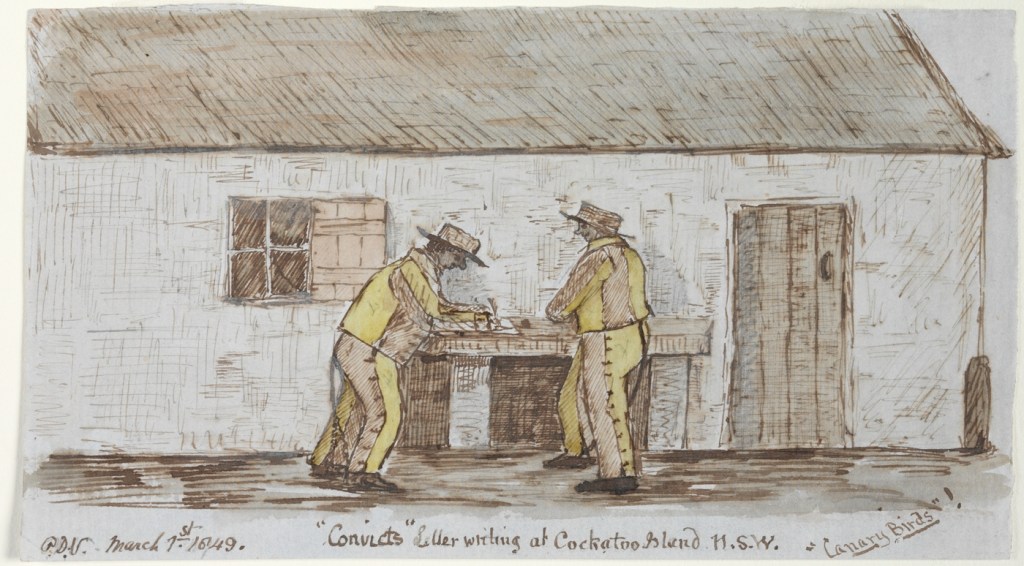
Philip Doyne Vigors, ‘Convicts Letter writing at Cockatoo Island: Canary Birds! NSW’ (1849), courtesy of the State Library of NSW.

By this time in the nineteenth century, silence had become foundational to ‘proper’ prison discipline. In 1820s New York ‘the silent system’ was introduced at Auburn prison, enforcing complete silence 24 hours a day. Prisoners were only allowed to listen to the gospel in weekly-services or during visits from the Chaplain. This was supposed to protect them from ‘moral contamination’ by fraternising with other criminals.

Cockatoo Island was far from a silent prison. The inmates’ days were marked by the clanging of pickaxes on sandstone, the blasts of explosives felling cliffs, and the sloshing of water against their legs as they finished building a dry dock for repairing ships (which opened in September 1857).

However, it was the noise of prisoners in their barracks at night that most worried the Victorian public. Another witness “G.W.H” wrote directly to the Empire’s editor Henry Parkes, complaining that the young lads were mixing with hardened ‘old lags’ and that ‘touch, pitch and defilement’ (Ecclesiastes 13:1) was bound to follow.

G.W.H. described a fictional 18-year old prisoner being sent to Cockatoo Island:

‘[He is] compelled to co-mingle with villains… compelled to the disgusting recital of their deeds of darkness… and sleep is banished from his sorrowful eyes by the wild chorus of vulgar, ribald and licentious songs’. (Board of Inquiry into the Management of Cockatoo Island, 1858)

Here, again, noisy singing drifts across space, crossing boundaries between prisoners’ bunks and between the prison island and the city. For Victorians, unwilling to name directly the ‘unspeakable’ crime of homosexuality, bawdy songs become a metaphor for illicit, sexual acts that took place in darkened barracks. Yet, the censure of male-on-male sex full stop renders the question of consent – was he “compelled”? – unknowable.

This speaking without saying persisted in an Select Committee into Cockatoo Island prison in 1861, which was chaired by Henry Parkes (the newspaper editor who had kicked off these inquiries). Prisoners testified that homosexual acts took place, but insisted that they had heard rumours, rather than having witnessed them directly. They described the prison slang for effeminate boys (‘sailor boys’ ‘sprigs of fashion’, or pejoratively ‘bleeding nuns’). But they displaced themselves from the room, by having heard rather than seen or touched anyone. Their testimony is silenced by the enforced morality of the board of inquiry.

As a historian, it can be frustrating to be confronted with all this “silence” at the heart of all this noise. What songs were sung, stories told and tender words shared by these Victorian prisoners is sadly lost to time.